Priority Marine Feature - Flame shell beds
Improving the protection given to Priority Marine Features
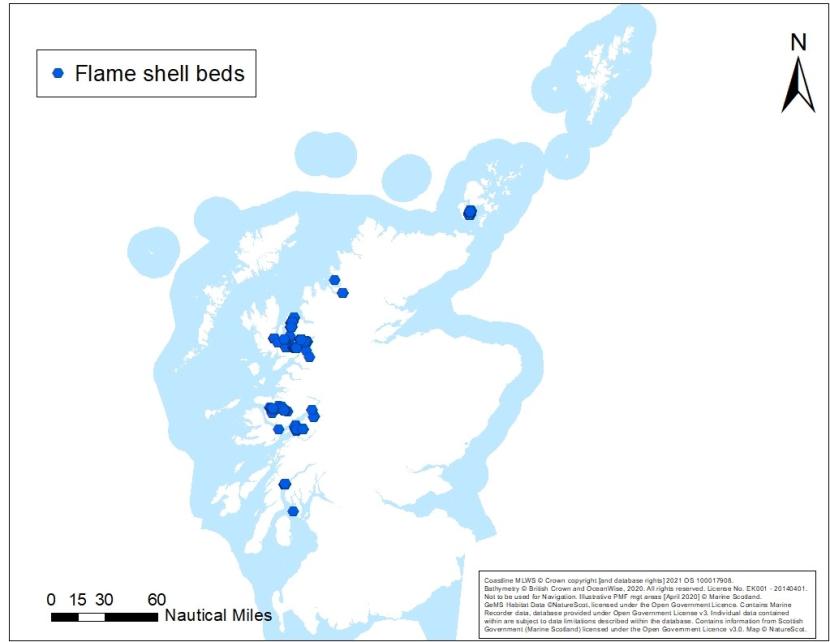
An overview of flame shell bed records off Scotland's coast.
Description
Characteristics
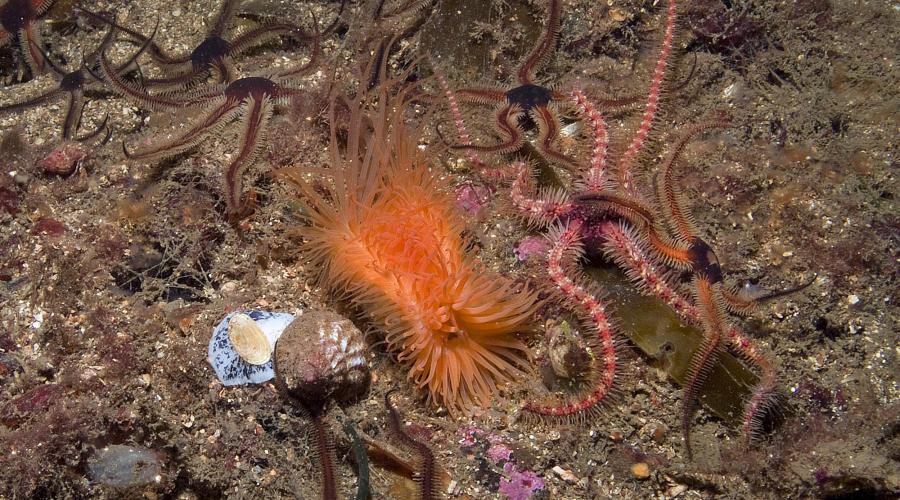
The flame shell (Limaria hians) creates nests by weaving together tough threads (byssus) with surrounding material such as seaweed, maerl and shells. Adjoining nests coalesce to form larger structures which, in some locations, carpet the seabed for several hectares. Flame shell beds stabilise the sediment and provide an attachment surface for many organisms including hydroids, bryozoans, ascidians and seaweeds. These structural species increase habitat complexity, providing shelter for more mobile species such as brittle stars, crabs, queen scallops and saithe (Tyler-Walters & Perry, 2016). A rich diversity of fauna is also found within and below the flame shell bed. Deterioration of flame shell bed habitat can have a significant impact on local biodiversity.
Definition
A minimum cover of 10% byssal turf material over an area of at least 5 m x 5 m has been used to define a flame shell bed. At certain locations (for example the low-density bed in the Sruth Lagaidh Narrows in Loch Broom), a continuous blanket of byssal material is not present; instead, flame shells occur amongst stone and shell material which they may bind together, but do not form a layer overtopping the substrate. The concept of a byssal turf can be less clear in such circumstances and a better practical definition of a bed here would be a mixed substrate supporting a flame shell density of at least 1 per 0.1 m2 (Moore et al., 2013; Moore & Harries, 2017). This equates to Common or Abundant on the SACFOR species abundance scale used by scientific divers (Hiscock, 1996).
Environmental preferences
Flame shells occur on mixed, muddy sand and gravel bottoms at depths of 5-100 m in sheltered areas with moderately strong currents (~1 to 3 knots or 0.5 to 1.5 m/sec.). Flame shell beds are commonly associated with tide-swept narrows including the entrances or sills of sea lochs, primarily between depths of 5-25 m but occasionally >40 m (52 m within Loch Alsh; Moore, 2017) in variable to full salinity (18 to 35 ppt) (Trigg, 2009).
Distribution
Scottish distribution
Flame shell beds have been recorded at 11 locations within Scottish waters, primarily on the west coast, with the most extensive beds occurring in Scapa Flow, Loch Carron, Loch Alsh and Loch Sunart.
Estimated known Scottish extent
Beds vary considerably in size and in the proportion of dense nest / turf cover present. One of the smallest mapped beds, at the western entrance to the Creagan Narrows in the Loch Creran MPA covers ~0.5 ha, is fragmented (comprising three discrete patches of habitat) and dense nest cover (>50% of the seabed) is confined to an area of ~0.1 ha (Moore et al., 2013). In contrast, the bed in the Loch Carron MPA extends to ~194 ha with cover averaging 30-70% across the bed and extensive areas supporting 100% (Moore et al., 2018). The bed in Scapa Flow is conservatively estimated to cover 508 ha with a total extent across Orkney waters estimated as 1,799 ha (Porter et al., 2020). Known beds in Scottish waters are currently estimated to cover an area of ~2,251 ha.
Wider distribution
Flame shell beds have a globally restricted distribution. Outside Scottish waters, the only records of this habitat are from the Moross Channel area in Mulroy Bay SAC on the north-west coast of Ireland. Survey work there in 2008 (MERC Consultants, 2008) recorded only small numbers of flame shells and not the extensive carpets of dense aggregations previously described in Minchin (1995). Other available records worldwide / within European waters relate to the presence of individual flame shells rather than flame shell beds. Flame shell species distribution is patchy; extending from the Mediterranean to the Canary Islands and northwards to the Lofoten Islands in Norway.
Status
Scottish beds are of international importance. The habitat is considered to be severely declined and threatened in Scottish waters (Howson et al., 2012b). Evidence of declines in the beds in the Wester Ross MPA and the Upper Loch Fyne and Loch Goil MPA led to a ‘recover’ conservation objective being set for the feature in these sites. Declines have also been observed in beds outside the Scottish MPA network e.g. at Port Appin (Moore et al., 2012; Scott, 2016; Moore, 2018). Management measures put in place after damage occurred in the Loch Carron flame shell bed have ensured no further damage and allowed significant recovery (The Scottish Government, 2024).
Drivers for improving protection
Flame shell beds are included on the PMF list which means that National Marine Plan General Policy 9(b) (avoiding significant impact on national status) applies. The Scottish Biodiversity Strategy to 2045, the Scottish Biodiversity Duty and UK Marine Strategy Good Environmental Status provide further drivers to ensure biological diversity is restored, and ecosystems are safeguarded.
Sensitivity (including recovery)
[Key sources: FeAST, Fisheries Management Guidance]
Flame shell beds are highly sensitive to physical damage, contamination and changes in siltation, smothering, water flow and wave action (Hall-Spencer & Moore, 2000a; Tyler-Walters & Perry, 2016; Mazik et al., 2015). Activities such as bottom-contacting fishing (including creels), aquaculture and anchoring / moorings can all impact flame shell beds. Towed bottom-contacting fishing gear can affect flame shell beds in two main ways. Firstly, direct mortality from damage to the shells and secondly, through disruption or removal of the structure of flame shell nests, resulting in the loss of associated species (Hall-Spencer & Moore, 2000a&b; Hall-Spencer et al., 2003; Trigg & Moore, 2009). Where complete defaunation does not occur, sensitivity to changes in current speed and sediment mobility are likely to increase following disturbance due to reduced nest integrity and fragmentation.
Habitat recovery following impact is dependent on removal of the pressure, the continued presence of suitable substrates and a source of adult colonists or larval recruits. For a dredged area 7.5 m wide, a study estimated a recovery time of 117 years, (Trigg & Moore, 2009). However, in Loch Carron recovery of a damaged area occurred within 5 years (The Scottish Government, 2024). This is thought to be due to the small area of damage and the fact that the damaged area was surrounded by extensive areas of intact flame shell beds. In addition, whilst nest material was considerably disrupted, it was not entirely removed. Recovery may be quicker where a dense, actively recruiting flame shell population remains post-impact.
The predicted impacts of climate change may also threaten flame shell beds which may be sensitive to changes in salinity and to ocean acidification which has been shown to impact on the fertilization, cleavage, larval settlement and reproductive stages of marine bivalves (Kurihara, 2008).
Connectivity
Between flame shell beds
The mechanism by which a flame shell can propel itself through the water is likely to be energetically expensive and dispersal over large distances through swimming activity is not expected. Therefore, establishment and maintenance of flame shell populations is likely to be limited to areas of suitable habitat within proximity to a source of colonists (through expansion of existing beds and / or larval settlement to form new beds). Flame shell larvae are believed to spend at least a few weeks in the plankton (Tyler-Walters & Perry, 2016). Preliminary hydrodynamic modelling outputs concluded some connectivity across the known beds in Scottish waters up the west coast to Orkney (e.g. Gallego et al., 2013). A study by Millar et al. (2019) found that flame shell beds self-recruit and are weakly connected to at least one other flame shell bed area. However, the nearshore and semi-enclosed sea loch environments that support most of the extant beds are less dispersive than open water models predict and larval supply is likely to be restricted. Due to a lack of self-recruitment, small beds may have a greater reliance on adjacent larger beds as a source of larval recruits (see Moore et al., 2012 regarding the loss of a bed at Shuna Island) and some beds may be isolated and incapable of recovery if damaged. There are large spatial gaps between the Clyde and Argyll beds and along the north-west and north coasts. Additional management could help provide connectivity between beds, including those within the MPA network.
With other PMFs
Nests of the flame shell are often found in conjunction with the maerl beds PMF (Hall-Spencer et al., 2003; Moore et al., 2018). Flame shells bind maerl together with their byssal threads, helping to stabilise the maerl bed (Birkett et al., 1998). In Loch Linnhe, Loch Alsh and Loch Carron there are records of flame shell beds adjacent to or intermixed with the horse mussel beds PMF (Moore et al., 2012; 2013; 2018). Flame shell beds are also often found in combination with tide-swept algal communities PMF; the nests providing a stable substratum for the attachment of seaweeds in an otherwise unsuitable location (Lancaster et al., 2014).
Ecosystem services
Flame shell beds play an important role in habitat creation. The habitat provided by flame shell beds supports a number of other species and contributes to the protection of biodiversity. Flame shell beds also have an important role in nutrient cycling and sediment stabilisation as well as waste breakdown and detoxification of water and sediments.
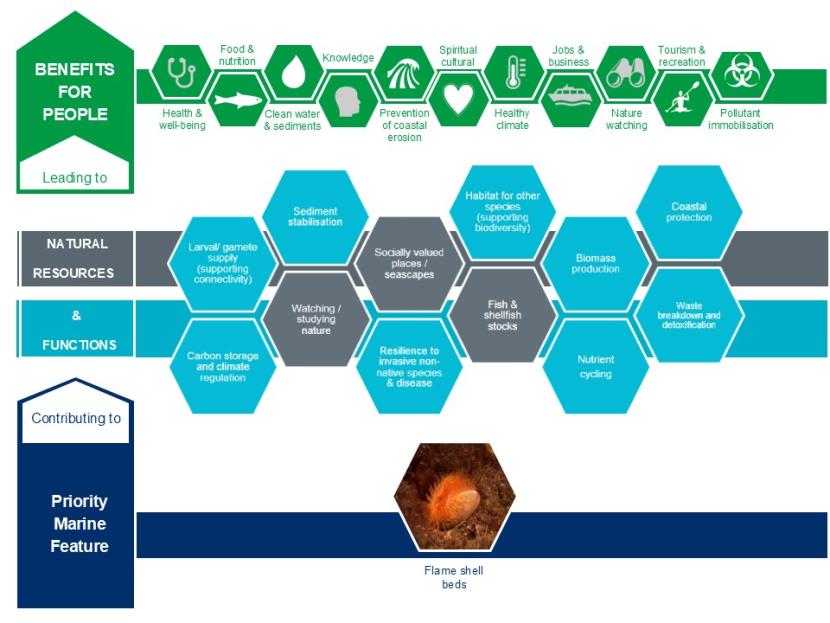
The contribution flame shell beds make to natural resources and functions and the benefits for people that these lead to.
Click for a full description
- Priority Marine Feature: flame shell beds contributing to
- Natural resources (NR) and functions (F)
- Laval/gamete supply (supporting connectivity (F)
- Carbon storage & climate mitigation
- Waste breakdown and detoxification
- Sediment stabilisation (F)
- Socially valued places/seascapes (NR)
- Nutrient cycling (F)
- Watching/studying nature (NR)
- Resilience to invasive non-native species & disease (F)
- Habitat for other species (supporting biodiversity) (F)
- Fish and shellfish stocks
- Biomass production
- Coastal protection
- Which leads to benefits for people
- Health & wellbeing
- Spiritual/cultural
- Clean water & sediments
- Pollutant immobilisation
- Knowledge
- Food and nutrition
- Prevention of coastal erosion
- Healthy climate
- Jobs and business
- Nature watching
- Tourism and recreation
Existing Marine Protected Areas
Flame shell beds are a protected feature of 6 MPAs: Upper Loch Fyne & Loch Goil; Loch Creran; Loch Sunart; Lochs Duich, Long and Alsh; Wester Ross; and Loch Carron.
Existing and proposed fishing measures providing PMF protection
Flame shell beds are protected by the following existing fishing measures:
- The Inshore Fishing (Scotland) Order 2015 (Upper Loch Fyne & Loch Goil; Loch Creran; Loch Sunart; and Lochs Duich, Long and Alsh (through the combined Southern Inner Sound measures CA150)).
- The Wester Ross Marine Conservation Order 2016.
- The Loch Carron Marine Conservation Order 2019.
- The Red Rocks and Longay Marine Conservation Order.
- The Loch Sunart to the Sound of Jura Marine Conservation Order. However, following survey work in 2011 there is some uncertainty regarding the continued presence of flame shell habitat in this location (Moore et al., 2012).
- The BUTEC Outer Sea Area (British Underwater Test and Evaluation Centre).
Approach to assessing improvements in management needed to protect flame shell beds from impacts related to towed bottom-contacting fishing gear
The assessment presented in this document relates to fishing using towed bottom-contacting gear only. It is consistent with the approach taken for assessing proposed developments.
When considering biodiversity evidence more weight has been given to clusters of flame shell records and records which show the extent of flame shell beds (i.e. polygon data) where available, in preference to isolated observations. There has been particular consideration of larger beds in comparison to smaller ones (where extent is known), except where smaller or fragmented beds are the only remaining examples in a geographic area and require protection to support recovery of the PMF.
Consideration of key locations for flame shell beds has included ensuring the areas/locations are distributed to cover the full range of environmental conditions in which flame shell beds occur (type of wider environment e.g. sea loch vs. coastal, depth, geographic range, substrate, etc.), and the connectivity of beds.
A greater biological diversity of associated faunal and floral communities and greater bed extents are factors which increase the conservation importance of a bed. Information on these characteristics does not exist for all records in Scottish waters precluding their detailed application in this assessment. However, such information should be sought and used in development licensing and consenting processes.
Any towed bottom-contacting fishing activity that leads to the loss of entire beds or damage to beds, such that function or provision of ecosystem services cannot be maintained, should be considered to have a significant impact on national status and as a result not meet General Policy 9(b) in the National Marine Plan. Existing licensing and consenting processes will continue to consider the potential for significant impacts on flame shell beds.
Key locations for the protection of flame shell beds outside designated sites and existing towed bottom-contacting fisheries restrictions
Summary
We recommend that the development of spatial fisheries measures to protect flame shell beds from pressures associated with towed bottom-contacting gears should cover records of the feature within the following key locations (outside of MPAs that protect this feature and areas with existing fisheries measures). These are shown in Map 2: Orkney, several areas in the Inner Sound, Port Appin, Loch Leven and Upper Loch Linnhe.
The recommendations for flame shell beds need to be considered alongside the recommendations for the other 10 PMFs considered as part of the development of PMF management areas. These recommendations are based on biodiversity evidence taking into consideration the information above and have been provided to help inform the development of fishing measures, led by Marine Directorate.
If fisheries management measures were established to protect records in all these key locations it would achieve substantial protection for flame shell beds, complementing the protection already in place for some MPAs and proposed for other MPAs (see map 2).
Details of locations
The beds at Gutter Sound in Orkney are the most northerly examples of the habitat in Scottish waters. The beds are adjacent to a number of horse mussel bed records at Scapa Flow and in a mosiac with maerl bed records around Fara, Rysa Little and Cava.
In the Inner Sound some records are already afforded protection by the Red Rocks and Longay MPA though several other records still require protection alongside other PMFs being considered for PMF management, including areas off the south west coast of Skye, around Pabay and with maerl along the coastline of the Inner Sound (Moore et al., 2011; Moore & Atkinson, 2012; Moore, 2019) potentially extending from north of the Crowlin Islands up to Rubha Chuaig.
Measures to support recovery of the declining beds at Port Appin in lower Loch Linnhe should include static gear. Due to the proximity of adjacent extant habitat, the proposed area includes Shuna Island, where former flame shell bed records were not validated in 2011 (Moore et al., 2012). Although even early records indicate some patchiness in coverage, it now appears to be absent from most of its previous range (Moore et al., 2012; Scott, 2016; Moore, 2018). Previously considered one of the larger Scottish beds (~40ha; Moore et al., 2011); current evidence suggests that it is now one of the smallest. There are two recent records of flame shell beds in Loch Leven and records in Upper Loch Linnhe all near to horse mussel bed records.
Data confidence
We have recent records from 2021. Surveys vary in their original aims from Seasearch (carried out by volunteer divers) to MPA-related nature conservation assessments (e.g. Ullapool approaches survey in 2010 or SNH/MSS Loch Carron surveys in 2017). Records primarily come from diving but also infaunal grab samples and remote video surveys. New records of this feature were made in Loch Carron and the Inner Sound in 2017 (Moore et al., 2018) and more recently in 2021. Given the cryptic nature of this habitat (i.e. the beds can be difficult to distinguish from the surrounding seabed) it is possible that this feature is under-recorded. There are additional flame shell species records in NBN Atlas.
Knowledge gaps and other recommended work
We recommend continuing efforts to explore opportunities for collaborative monitoring, survey and research to improve our understanding of this habitat, for example:
- This feature may be under-recorded. There are numerous additional observations of flame shells as a species; additional flame shell beds may be identified in Scottish waters.
- The flame shell beds in the northern Inner Sound were said to have been significantly larger, with unconfirmed records potentially extending beyond the limits of the measures associated with the BUTEC range to Red Point on the outer, northern coast of Loch Torridon. Scallop dredging is currently exempted from the prohibitions imposed under the Loch Torridon and the Northern Inner Sound (CA56) measures.
- There are additional records of possible flame shell beds which need further investigation from Inchmarnock in the Firth of Clyde (Allen et al., 2013). There are historic records of flame shells around the south of Bute and the Cumbrae Islands in the Clyde. Nearshore habitats here including flame shell and maerl beds have been heavily fished over the last 60 years so recovery potential is likely to be low. Other records exist from the Clyde Sea Sill, waters around Sanda Island, the Sound of Canna and the Sound of Mull.
- There are potentially flame shell beds present in Shetland within the Fetlar to Haroldwick MPA. If these records were to be confirmed this would extend the known northernly distribution of flame shell beds within Scottish waters.
Key locations for the protection of flame shell beds
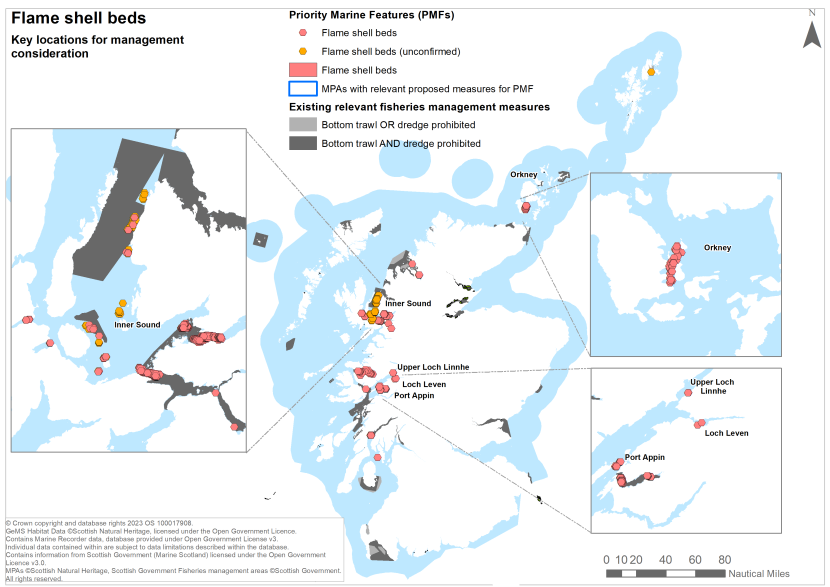
Key locations for the protection of flame shell beds outside of MPAs with management measures and existing towed bottom-contacting fisheries restrictions.
Click for a full description
For further details about the locations marked in this map see above, section Key locations for the protection of flame shell beds outside designated sites and existing towed bottom-contacting fisheries restrictions
References
Allen, C., Axelsson, M., Dewey, S. & Clark, L. 2013. Marine biological survey to establish the distribution of Priority Marine Features within the Clyde Sea area. Scottish Natural Heritage Commissioned Report No. 437.
Birkett, D.A., Maggs, C.A. & Dring, M.J. 1998. Maerl (volume V). An overview of dynamic and sensitivity characteristics for conservation management of marine SACs. Scottish Association for Marine Science (UK Marine SACs Project), 117 pages.
Gallego, A., Gibb, F.M., Tulett, D. & Wright, P.J. 2013. Connectivity of Benthic Priority Marine Species within the Scottish MPA Network. Scottish Marine and Freshwater Science, 4(2):1-51.
Hall-Spencer, J.M., Grall, J., Moore, P.G. & Atkinson, R.J.A. 2003. Bivalve fishing and maerl-bed conservation in France and the UK - retrospect and prospect. Aquatic Conservation, 13(S1): S33-S41.
Hall-Spencer, J.M. & Moore, P.G. 2000a. Scallop dredging has profound, long-term impacts on maerl habitats. ICES Journal of Marine Science, 57(5): 1407-1415.
Hall-Spencer, J.M. & Moore, P.G. 2000b. Limaria hians (Mollusca: Limacea): a neglected reef-forming keystone species. Aquatic Conservation: Marine and Freshwater Ecosystems, 10(4): 267-277.
Hiscock, K. 1996. Marine Nature Conservation Review: rationale and methods. Peterborough: Joint Nature Conservation Committee. Coasts and seas of the United Kingdom. MNCR series.
Hiscock, K., Southward, A., Tittley, I., Jory, A. & Hawkins, S. 2001. The impact of climate change on subtidal and intertidal benthic species in Scotland. Scottish Natural Heritage Research, Survey and Monitoring Report No. 182.
Hood, H. 2016. An assessment of Limariahians contribution to the blue carbon resource in Scottish waters. A dissertation submitted in the partial fulfilment of the requirements for the degree of Master of Science (MSc.) in Marine Resource Management (MRM). ICIT, Heriot-Watt University.
Howson, C.M., Steel, L., Carruthers, M. & Gillham, K. 2012b. Identification of Priority Marine Features in Scottish territorial waters. Scottish Natural Heritage Commissioned Report No. 388.
Kurihara, H. 2008. Effects of CO2-driven ocean acidification on the early developmental stages of invertebrates. Marine Ecology Progress Series 373: 275-284.
Lancaster, J. (Ed.), McCallum, S., Lowe, A.C., Taylor, E., Chapman, A. & Pomfret, J. 2014. Development of detailed ecological guidance to support the application of the Scottish MPA selection guidelines in Scotland’s seas. Scottish Natural Heritage Commissioned Report No. 491. Flame shell beds - supplementary document.
Lebour, M.V. 1937. Larval and post-larval Lima from Plymouth. Journal of the Marine Biological Association of the United Kingdom, 21(2): 705-710.
Mair, J.M., Moore, C.G., Kingston, P.F. & Harries, D.B. 2000. A review of the status, ecology and conservation of horse mussel Modiolus modiolus beds in Scotland. Scottish Natural Heritage Commissioned Report No. F99PA08.
Mazik, K., Strong, J., Little, S., Bhatia, N., Mander, L., Barnard, S. & Elliott, M. 2015. A review of the recovery potential and influencing factors of relevance to the management of habitats and species within Marine Protected Areas around Scotland. Scottish Natural Heritage Commissioned Report No. 771.
MERC Consultants. 2008. Surveys of sensitive sublittoral benthic communities in Mullet/Blacksod Bay Complex SAC; Rutland Island and Sound SAC; and, Mulroy Bay SAC. A report to the National Parks and Wildlife Service, Galway.
Millar, H., O’Hara Murray, R., Gallego, A., Gormley, K. & Kent, F. 2019. Connectivity of selected Priority Marine Features within and outwith the Scottish MPA network. Scottish Natural Heritage Research Report No. 1048.
Minchin, D. 1995. Recovery of a population of the flame shell, Lima hians, in an Irish Bay previously contaminated with TBT. Environmental Pollution, 90(2): 259-262.
Moore, C.G. 2017. Biological analyses of underwater video from ongoing monitoring and research cruises in Lochs Sunart, Etive and Alsh, sea lochs off South Skye, the Sounds of Barra and Arisaig and around the Southern Trench. Scottish Natural Heritage Commissioned Report No. 959.
Moore, C.G. 2018. Contraction of Port Appin Narrows flame shell bed (1989 - 2018) - note to SNH. Heriot-Watt University.
Moore, C.G. & Harries, D.B. 2017. Diving survey of specified Priority Marine Features in Loch Carron and the surrounding area - Survey plan. Unpublished report to Scottish Natural Heritage.
Moore, C.G., Harries, D.B., Cook, R.L., Hirst, N.E., Saunders, G.R., Kent, F.E.A., Trigg, C. & Lyndon, A.R. 2013. The distribution and condition of selected MPA search features within Lochs Alsh, Duich, Creran and Fyne. Scottish Natural Heritage Commissioned Report No. 566.
Moore, C.G., Harries, D.B., James, B., Cook, R.L., Saunders, G.R, Tulbure, K.W., Harbour, R.P. & Kamphausen, L. 2018. The distribution and condition of flame shell beds and other Priority Marine Features in Loch Carron Marine Protected Area and adjacent waters. Scottish Natural Heritage Research Report No. 1038.
Moore, C.G., Harries, D.B., Trigg, C., Porter, J.S. & Lyndon, A.R. 2011. The distribution of Priority Marine Features and MPA search features within the Ullapool Approaches: a broadscale validation survey. Scottish Natural Heritage Commissioned Report No. 422.
Moore, C.G., Harries, D.B. & Trigg, C. 2012. The distribution of selected MPA search features within Lochs Linnhe, Etive, Leven and Eil: a broadscale validation survey (Part B). Scottish Natural Heritage Commissioned Report No. 502.
NatureScot. 2024. Geodatabase of Marine features adjacent to Scotland (GeMS). GeMS V10 (i26).
Scott, C.J. 2016. The disappearance of the File shell (Limaria hians) and the investigations into reef-builder bivalve molluscs of Port Appin. Honours BSc dissertation. Heriot-Watt University, Edinburgh.
The Scottish Government. 2024. Marine Protected Area Network. 2024 Report to the Scottish Parliament. ISBN: 978-1-83601-718-9.
Tillin, H.M., Hull, S.C. & Tyler-Walters, H. 2010. Development of a Sensitivity Matrix (pressures-MCZ/MPA features). Report to the Department of Environment Food and Rural Affairs from ABPmer, Southampton and the Marine Life Information Network (MarLIN) Plymouth: Marine Biological Association of the UK. Defra contact No. MB102 Task 3A, Report No. 22.
Trigg, C. 2009. Ecological studies on the bivalve Limaria hians (Gmelin). A thesis submitted for the degree of Doctor of Philosophy, Heriot-Watt University.
Trigg, C. & Moore, C.G. 2009. Recovery of the biogenic nest habitat of Limaria hians (Mollusca: Limacea) following anthropogenic disturbance. Estuarine, Coastal and Shelf Science, 82(2): 251-356.
Tyler-Walters, H. & Perry, F. 2016. Limaria hians beds in tide-swept sublittoral muddy mixed sediment. In: Tyler-Walters, H. & Hiscock, K, eds. Marine Life Information Network: Biology and Sensitivity Key Information Reviews, [on-line]. Plymouth: Marine Biological Association of the United Kingdom.