Priority Marine Feature - Fan mussel aggregations
Improving the protection given to Priority Marine Features
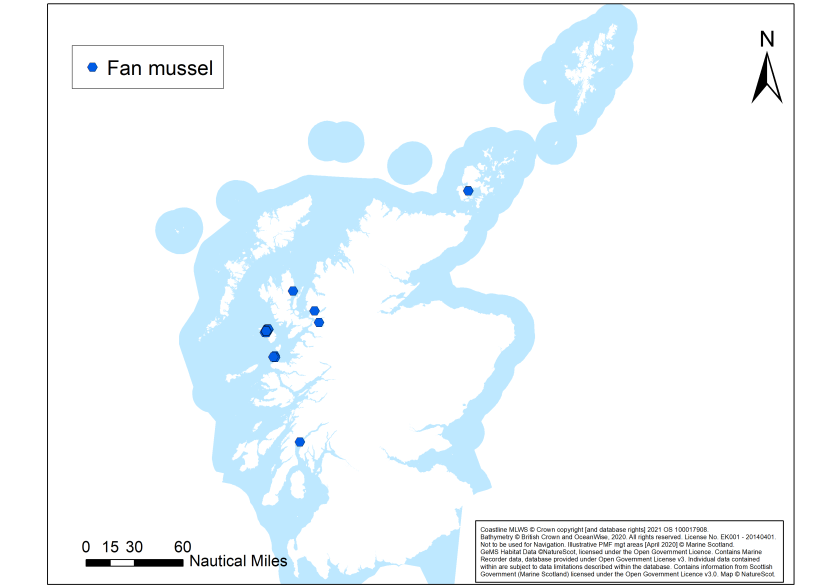
An overview of fan mussel records off Scotland's coast.
Description
Characteristics
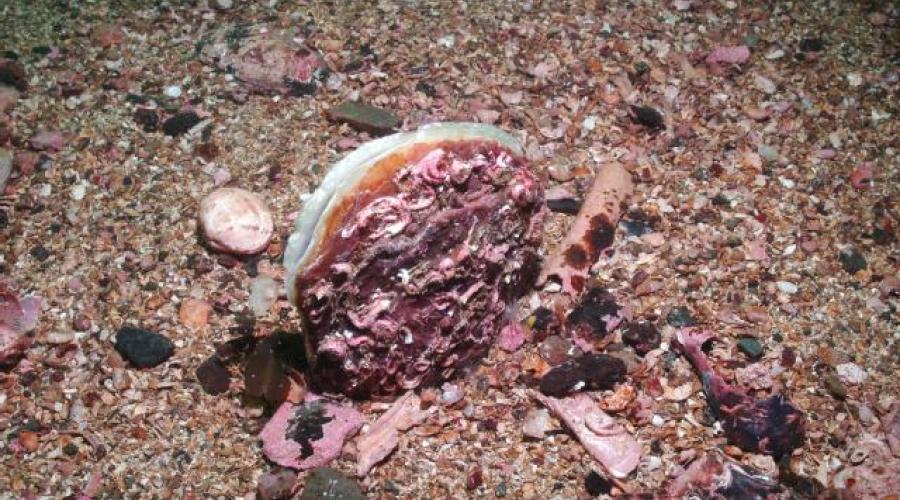
The fan mussel (Atrina fragilis) is one of Britain’s largest molluscs, growing to 30-48 cm in length. The fragile shell is light yellow-brown to dark brown in colour, brittle and tapers to a point. Fan mussels live with their pointed end embedded in sediment, attached by many fine byssal threads. The posterior (broad) end protrudes from the surface of the sediment and may support growths of sea anemones, keel worms, hydroids, soft corals and sponges. They feed on plankton and suspended organic particles. Fan mussels are often solitary but also occur in clusters or aggregations. Assumed to be long-lived due to its large size, the fan mussel is believed to have a lifespan of between 7 and 32 years (Papoutsi & Galinou-Mitsoudi, 2010). Fan mussel records have only been considered from 2000 onwards due to the sparse nature and confidence in the data.
Definition
Fan mussel density in the Sound of Canna (the largest known aggregation in Scottish waters) varies from an estimated 1-4 per m2 to widely scattered individuals. An aggregation is currently considered to exist where more than two fan mussels are present in a single survey sample (e.g. a single drop-down video camera run) or across multiple surveys / samples in a broad geographic area (1-2 km2). This is to accommodate variation in mussel density and ensure that potential aggregations are not overlooked. Additional sampling would be required to validate records where mussel numbers are low. This working definition may be revised subject to further analyses of new Scottish / UK records.
Environmental preferences
Fan mussels have been found embedded in lower intertidal and subtidal muds, sandy muds or gravels, at sites sheltered from water movement down to 400 m depth. The aggregation off Canna occurs between 100-275 m (Howson et al., 2012).
Distribution
Scottish distribution
Most recent records from Scotland are in deep water on the west coast (average 161 m; Stirling et al., 2016b). Fan mussels havealso been found off Shetland (believed to be the northerly limit for the species) and around Orkney, with scattered records from the north-east coast (beyond 6 nm). The Sound of Canna in the Small Isles supports the densest known aggregation in UK waters. Recorded originally in 2009, follow-up survey work in 2010 and 2011 established the full extent of the fan mussels in this area (Moore & Roberts, 2011; Howson et al., 2012; Moore, 2012; 2013).
Estimated known Scottish extent
The fan mussel aggregation in the Sound of Canna covers an area of ~3.9 km2.
Wider distribution
Recorded off the north and west coasts of Ireland, the Irish Sea (Dublin Bay, Liverpool Bay and the Bristol Channel), the Scilly Isles, Channel Isles and along the south coast of England. Atrina fragilis distribution extends around the Iberian Peninsula down as far as the north-western African coast at Mauritania and throughout the Mediterranean (EOL, 2018; GBIF, 2018). The species has also been recorded around the Caribbean Islands and off Madeira (Nobre 1938-1940 cited in Šimunović et al., 2001) with a record from the Pakistan coast in 2013 (Sultana & Jamil, 2013).
Status
Historical accounts describe the species as being ‘sparingly and locally distributed’ on all British coasts but 'gregarious', from low-water mark down to a depth of 150 m (Jeffreys, 1862). Individuals and sometimes aggregations were commonly caught in the nets of scallop and demersal fish trawlers and expedition ships in the 19th century (Solandt, 2003). However, almost every reported record in the 20th century is based on sightings of individuals and these records are deemed newsworthy (e.g. MCS, 2011). The species is now considered one of the most endangered molluscs in Britain. The causes for the decline of the fan mussel in UK waters are reviewed by Solandt (2003) who presents a convincing case for the decline being linked to the industrialisation of benthic fishing over the last century. These observations are supported by the work of Hall-Spencer et al. (1999), Fryganiotis et al. (2013) and Stirling et al. (2016b).
Scottish fan mussels are therefore of national importance and are protected under Schedule 5 of the Wildlife and Countryside Act 1981 (killing & injuring; possession; & sale).
In the south-west of England, it is thought that the fan mussel has largely disappeared from inlets where it was once common. The main surviving UK populations appear to be from Cornwall and Devon with those in the Salcombe Estuary particularly well documented (Goodwin et al., 2011). A cluster of ~20 fan mussels found by divers in comparatively shallow nearshore waters in Plymouth Sound in 2004 (BBC, 2004) has not been re-recorded in recent years.
Fisheries research cruises in the UK in the 1990s regularly observed fan mussels as bycatch (Solandt, 2003).
Drivers for improving protection
Fan mussels reefs are included on the PMF list which means that National Marine Plan General Policy 9(b) (avoiding significant impact on national status) applies. The Scottish Biodiversity Strategy to 2045, the Scottish Biodiversity Duty and UK Marine Strategy Good Environmental Status provide further drivers to ensure biological diversity is restored, and ecosystems are safeguarded.
Sensitivity (including recovery)
[Key sources: FeAST, Fisheries Management Guidance]
Fan mussels are vulnerable to over-exploitation due to their long life, slow growth, limited reproductive output and sporadic recruitment (Butler et al., 1993). They are highly sensitive to physical changes at the seabed (i.e. a change in substratum type, physical removal of substratum and abrasion), changes in siltation rates and removal of non-target species. They are also sensitive to smothering and changes in water flow and wave action (Mazik et al., 2015; Tyler-Walters & Wilding, 2017).
These pressures arise from fishing (dredging and trawling) and activities including infrastructure development and extraction of sand and gravel. The presence of aggregations of fan mussels in the Sound of Canna (an area considered unfavourable for trawling due to the complex topography and presence of a spoil site) and also in Plymouth Sound (recorded near areas of heavy shipping traffic) suggest that these locations serve as possible refuges for fan mussels (Stirling, 2016).
Fan mussels may also be vulnerable to future climate impacts, with changes in seawater chemistry (ocean acidification) potentially affecting growth and shell production in juvenile and adult molluscs. Changes in circulation may affect the early life stages of fan mussels (Stirling et al., 2018). Sudden changes in temperature may have an impact on spawning and decreased salinity may also have an effect.
Recovery of fan mussel populations is likely to be slow and sporadic (Fryganiotis et al., 2013; Mazik et al., 2015) and is dependent on removal of relevant pressures, the continued presence of suitable substrates and a source of larval recruits. Individuals can’t rebury (Yonge, 1953) and growth rates of damaged shells have been reported as 1 cm yr-1 (Yonge & Thomson, 1976). Fertilisation is dependent on proximity to other individuals and environmental factors influencing larval dispersal and survival. When populations become very sparse, as is the case in the UK, fertilization failure is likely to be significant (Butler et al., 1993).
Connectivity
Between fan mussels
Fan mussel larvae are believed to have a pelagic larval duration (PLD) of up to 4 months (Gallego et al., 2013; Stirling et al., 2016a). Spawning peaks over the summer and winter with trickle spawning continuing throughout the year. Stirling (2016) modelled fan mussel larval transport on the west coast of Scotland, taking into account key aspects of the life-history, habitat suitability and fine scale hydrodynamics. The model outputs suggest that fan mussel larvae from the aggregation in the Sound of Canna have the potential to be transported over a wide geographical scale; as far north as Shetland during winter months and across to St Kilda in the west during the summer. The study concluded that with sufficient habitat protection in place, the Small Isles fan mussel population could re-colonise large areas of its former range in Scottish waters north of 57oN. However, due to the prevailing circulation patterns on the west coast (general larval transport from south to north), this source population could not, in isolation, underpin colonisation of all areas of suitable habitat. The results from Stirling (2016) are in agreement with Gallego et al., (2013), who also found Canna to be an important larvae source and aggregations within the Clyde to be relativity isolated with a greater degree of self-recruitment.
Areas of potentially suitable habitat are identified in Stirling et al. (2016b). Additional management to the south of the Sound of Canna could provide support to the population within the MPA network. Likewise, additional management of areas of suitable habitat to the north could support recolonisation from the population within the MPA.
With other PMFs
Fan mussels have been recorded within and adjacent to horse mussel beds PMF within Scapa Flow (Marine Conservation Society, 2011) and off Copinsay in Orkney; and on the west coast, in the Sound of Canna (Moore & Roberts, 2011; Howson et al., 2012). Fan mussels also have a known association with seagrass beds PMF; formerly recorded from the Scilly Isles in SW England, they have not been recorded there since the seagrass beds were lost (Turk 1982; Turk & Seaward, 1997). This association can still be observed in the shallow subtidal and lower shore in the Salcombe Estuary. Fan mussels have also been recorded from sublittoral sediments adjacent to bedrock, boulder and cobble habitats supporting the northern sea fan and sponge communities PMF. This relationship almost certainly only reflects the natural refuge function afforded to pockets of sediments within rough ground favoured by sea fans.
Ecosystem services
Fan mussel aggregations are now rare but these may be important larval sources and for sediment stabilisation. In shallow or semi-enclosed waters aggregations may be important for nutrient cycling and for waste breakdown and detoxification of water and sediment.
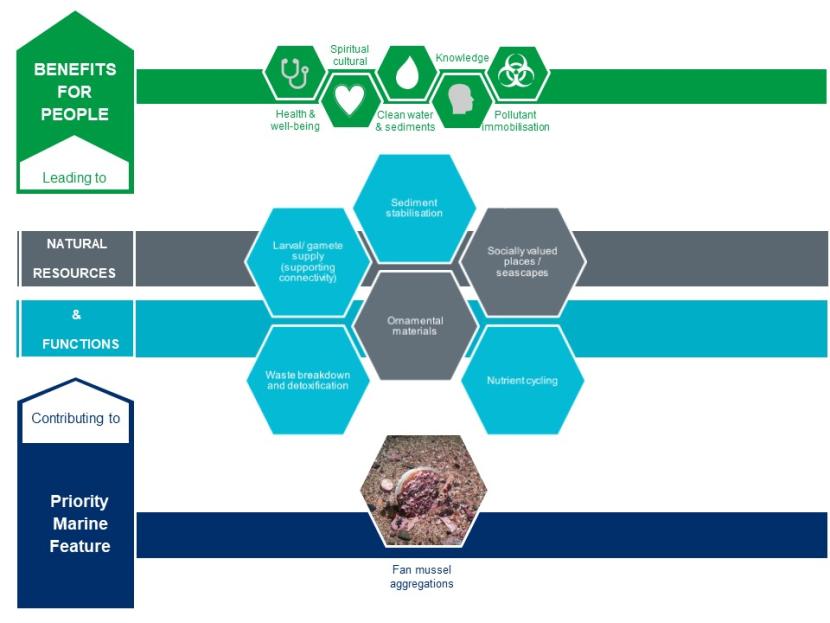
The contribution fan mussel aggregations make to natural resources and functions and the benefits for people that these lead to.
Click for a full description
- Priority Marine Feature: fan mussel aggregations contributing to
- Natural resources (NR) and functions (F)
- Laval/gamete supply (supporting connectivity (F)
- Waste breakdown and detoxification
- Sediment stabilisation (F)
- Ornamental materials (NR)
- Socially valued places/seascapes (NR)
- Nutrient cycling (F)
- Which leads to benefits for people
- Health & wellbeing
- Spiritual/cultural
- Clean water & sediments
- Pollutant immobilisation
- Knowledge
Existing Marine Protected Areas
Fan mussel aggregations are a protected feature of the Small Isles MPA.
Existing and proposed fishing measures providing PMF protection
Fan mussel aggregations are protected by the following existing fishing measures:
- The Inshore Fishing (Scotland) Order 2015 (Upper Loch Fyne and Loch Goil; and, Lochs Duich, Long and Alsh (through the combined Southern Inner Sound measures CA150)).
- The Loch Carron Marine Conservation Order 2019.
The following new fishing measures are proposed which will protect fan mussel aggregations in MPAs:
- Small Isles.
Approach to assessing improvements in management needed to protect fan mussel aggregations from impacts related to towed bottom-contacting fishing gear
The assessment presented in this document relates to fishing using towed bottom-contacting gear only. It is consistent with the approach taken for assessing proposed developments.
When considering biodiversity evidence more weight has been given to clusters of fan mussel records and records which show the extent of fan mussel aggregations (i.e. polygon data) where available, in preference to isolated observations. There has been particular consideration of larger aggregations in comparison to smaller ones (where extent is known), except where smaller or fragmented beds are the only remaining examples in a geographic area and require protection to support recovery of the PMF.
Consideration of key locations for fan mussel aggregations has included ensuring the areas/locations are distributed to cover the full range of environmental conditions in which fan mussel aggregations occur (type of wider environment e.g. sea loch vs. coastal, depth, geographic range, substrate, etc.), and the connectivity of aggregations.
A greater biological diversity of associated faunal and floral communities and greater aggregation extents are factors which increase the conservation importance of an aggregation. Information on these characteristics does not exist for all records in Scottish waters precluding their detailed application in this assessment. However, such information should be sought and used in development licensing and consenting processes.
Any towed bottom-contacting fishing activity that leads to the loss of habitat or damage to habitat, such that function or provision of ecosystem services cannot be maintained should be considered to have a significant impact on national status and as a result not meet General Policy 9(b) in the National Marine Plan. Existing licensing and consenting processes will continue to consider the potential for significant impacts on fan mussel aggregations.
Key locations for the protection of fan mussel aggregations outside designated sites and existing towed bottom-contacting fisheries restrictions
Summary
In a fisheries context, there are currently two areas where there is sufficient information to recommend additional measures to protect an aggregation of fan mussels from pressures associated with towed bottom-contacting gears (outside of MPAs that protect this feature and areas with existing fisheries measures). These are shown in Map 2: south of Muck and Bring Deeps, Orkney.
The recommendation for fan mussel aggregations needs to be considered alongside the recommendations for the other 10 PMFs considered as part of the development of PMF management areas. These recommendations are based on biodiversity evidence taking into consideration the information above and have been provided to help inform the development of fishing measures, led by Marine Directorate.
If fisheries management measures were established to protect records in these key locations it would supplement the protection proposed for the Small Isles MPA and provide a measure of replication in PMF management (see map 2).
Details of locations
A total of 44 fan mussels (and three observations of empty / broken shells) was recorded from five video transects completed to the south of Muck by Marine Directorate in 2014 (Stirling, 2016). The 2014 survey was undertaken to verify the conclusions of species distribution modelling presented in Stirling (2016b). The area of likely suitable habitat identified by that study in this area covers ~29 km2. Further survey work is required to determine the distribution and density of fan mussels across the wider area but there are a considerable number of records of northern sea fan and sponge communities, a PMF also being considered in this review, amongst and extending further than the known distribution of the fan mussel aggregations.
Records of fan mussels in Bring Deeps to the north-west of Cava in Orkney have been recorded by seasearch divers in 2011-2013. Further survey work is required to determine the distribution and density of fan mussels across the wider area and revalidation of pre-1980s records throughout Orkney, including Scapa Flow and Copinsay
Other records
Individual fan mussels have been recorded since 2000 to the east of Skye with older clusters of records to the north of Skye, to the north and south-east of Coll and the Sound of Mull. The 2014 fan mussel record at the Sound of Raasay is on rugged ground so potentially protected by the geography of the area. All other records are from pre-1980s and have not been considered due to their age.
Data confidence
We have recent records from 2016. The earliest records of fan mussels in Scottish waters were collated and presented in Woodward (1985), with records from 1764-1973. The clusters of records to the north of Skye, around the top of Coll and in the Sound of Mull are from fisheries research surveys undertaken in the 1990s. There are a small number of diver records including from Loch Duich and recent Seasearch observations in Bring Deeps. The fan mussel aggregation in the Sound of Canna was discovered in 2009 (identified on video footage collected as part of routine dredge disposal monitoring) and has been the subject of a number of follow-up studies. In 2014 further records of fan mussels, including the aggregation at the south of Muck, were found in a survey undertaken to verify the conclusions of species distribution modelling presented in Stirling (2016b).
Knowledge gaps and other recommended work
We recommend continuing efforts to explore opportunities for collaborative monitoring, survey and research to improve our understanding of this habitat, for example:
- Eight knowledge gap areas have been identified primarily on the basis of modelled habitat (i.e. records of fan mussels may not exist in these areas - except Bring Deeps): north-west Tiree; south of Islay; off Clyde Sea Sill; south of Rum; east of Barra; southern Inner Sound; Small Isles; and, Scapa Flow & Copinsay.
- If areas occupied by fan mussels can be identified and protected in south-west Scotland they would serve as a source of larvae for areas of suitable habitat south of the Sound of Canna aggregation. To that end, the first three knowledge gap areas (north-west Tiree, south of Islay and off Clyde Sea Sill) mirror areas of suitable habitat identified by Stirling (2016b). Consideration should be given to implementing appropriate management measures should future survey work confirm the presence of fan mussel aggregations in any of these areas.
- Fan mussels have been recorded in the waters surrounding Rathlin Island and elsewhere on the north-coast of Northern Ireland (Godwin et al., 2011) and as such, this is considered a particularly promising area in which to conduct future collaborative surveys.
Key locations for the protection of fan mussel aggregations
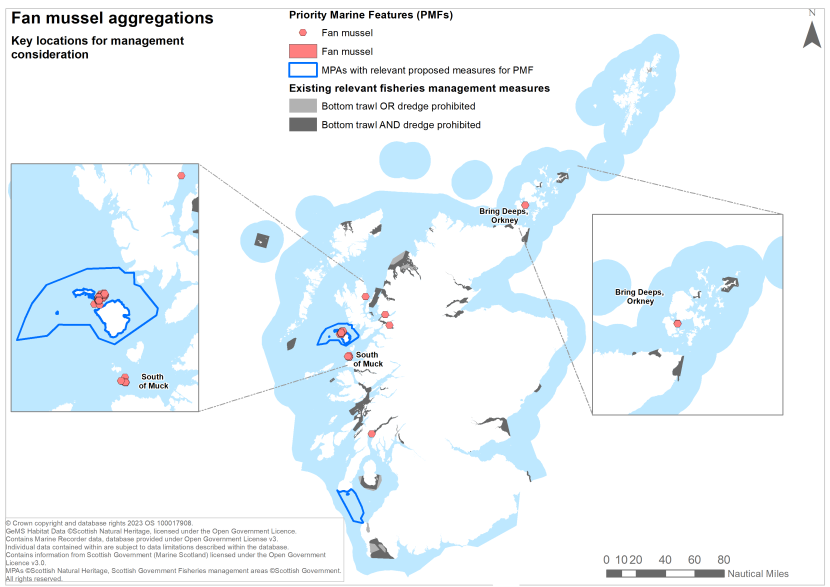
Key locations for the protection of fan mussel aggregations off Scotland's coast.
Click for a full description
For further details about the locations shown in this map see above, section Key locations for the protection of fan mussel aggregations outside designated sites and existing towed bottom-contacting fisheries restrictions.
References
BBC. 2004. Rare giant shells found in Plymouth.
Butler, A.J., Vicente, N. & de Gaulejac, B. 1993. Ecology of the pteroid bivalves Pinna bicolor Gmelin and Pinna nobilis Linnaeus. Marine Life, 3: 37-45.
EOL: Encyclopaedia of Life. 2018. Atrina fragilis.
Fryganiotis, K., Antoniadou, C. & Chintiroglou, C. 2013. Comparative distribution of the fan mussel Atrina fragilis (Bivalvia, Pinnidae) in protected and trawled areas of the north Aegean Sea (Thermaikos Gulf). Mediterranean Marine Science, 14(1): 119-124.
Gallego, A., Gibb, F.M., Tulett, D. & Wright, P.J. 2013. Connectivity of benthic priority marine species within the Scottish MPA network. Scottish Marine and Freshwater Science, 4 (2): 55 pages.
GBIF: Global Biodiversity Information Facility. 2018. Atrina fragilis (Pennant 1777).
Goodwin, C., Picton, B., Breen, J., Edwards, H. & Nunn, J. 2011. Sublittoral Survey Northern Ireland (2006 - 2008). Northern Ireland Environment Agency Research and Development Series No. 11/01. DOI: 10.13140/RG.2.1.1169.3043.
Hall-Spencer, J.M., Froglia, C., Atkinson, R.J.A. & Moore, P.G. 1999. The impact of Rapido trawling for scallops, Pecten jacobaeus (L.), on the benthos of the Gulf of Venice. ICES Journal of Marine Science, 56(1): 111-124.
Howson, C.M., Clark, L., Mercer, T.S. & James, B. 2012. Marine biological survey to establish the distribution and status of fan mussels, Atrina fragilis, and other Marine Protected Area (MPA) search features within the Sound of Canna, Inner Hebrides. Scottish Natural Heritage Commissioned Report No. 438.
Jeffreys, J.G. 1862. An Account of the Mollusca which now Inhabit the British Isles and the Surrounding Seas. British Conchology, 2(5): 465.
MCS: Marine Conservation Society. 2011. Seasearch divers discover giant rarity in the Orkney Isles. News release.
Mazik, K., Strong, J., Little, S., Bhatia, N., Mander, L., Barnard, S. & Elliott, M. 2015. A review of the recovery potential and influencing factors of relevance to the management of habitats and species within Marine Protected Areas around Scotland. Scottish Natural Heritage Commissioned Report No. 771.
Moore, C.G. 2012. An assessment of the conservation importance of benthic epifaunal species and habitats identified during a series of research cruises around NW Scotland and Shetland in 2011. Scottish Natural Heritage Commissioned Report No. 507.
Moore, C.G. 2013. Biological analyses of underwater video from research cruises in Lochs Kishorn and Sunart, off the Mull of Kintyre and islands of Rum, Tiree and Islay, and in the Firth of Lorn and Sound of Mull approaches. Scottish Natural Heritage Commissioned Report No. 574.
Moore, C.G. & Atkinson, R.J.A. 2012. Biological analyses of underwater video from research cruises in the Clyde Sea, Loch Torridon and the Inner Sound, the North Minch, Loch Eriboll and off Orkney. Scottish Natural Heritage Commissioned Report No. 536.
Moore, C.G., Harries, D.B., James, B., Cook, R.L., Saunders, G.R, Tulbure, K.W., Harbour, R.P. & Kamphausen, L. 2018. The distribution and condition of flame shell beds and other Priority Marine Features in Loch Carron Marine Protected Area and adjacent waters. Scottish Natural Heritage Research Report No. 1038.
Moore, C.G. & Roberts, J.M. 2011. An assessment of the conservation importance of species and habitats identified during a series of recent research cruises around Scotland. Scottish Natural Heritage Commissioned Report No. 446.
NatureScot. 2024. Geodatabase of Marine features adjacent to Scotland (GeMS). GeMS V10 (i26).
Nobre, A. 1938-1940. Fauna Malacológica de Portugal: Moluscos marinhos e das Águas Salobras, volume 1. Porto, Portugal: Companhia Editora do Minho, 806 pages.
Papoutsi, O. & Galinou-Mitsoudi, S. 2010. Preliminary results of population dynamics, age and growth of Atrina pectinata (Linnaeus, 1767) in Thermaikos gulf (Greece). 14th Panellenic Congress of Ichthyologists: Fisheries - Aquaculture, a multidimensional approach. Proceedings Panellenic Ichthyological Association, Athens (Greece), Piraeus, 6-9 May 2010, 131-134.
Šimunović, A., Piccinetti, C., Bartulović, M. & Grubelić, I. 2001. Distribution of Atrina fragilis (Pennant, 1777) (Pinnidae, Mollusca, Bivalvia) in the Adriatic Sea. Acta Adriatica, 42: 61-70.
Stirling, D. A. 2016. Assessing the conservation benefit of Marine Protected Areas to vulnerable benthic species as illustrated by the fan-mussel, Atrina fragilis. PhD Thesis. University of Aberdeen.
Stirling, D. A., Boulcott, P., Bidault, M., Gharbi, K., Scott, B. E. & Wright, P. J. 2018. Identifying the larva of the fan mussel, Atrina fragilis (Pennant, 1777) (Pinnidae). Journal of Molluscan Studies, 84(3): 247-258.
Stirling, D.A., Boulcott, P., Scott, B.E. & Wright, P.J. 2016b. Using verified species distribution models to inform the conservation of a rare marine species. Diversity and Distributions, 22(7): 808-822.
Solandt, J-L. 2003. The fan shell Atrina fragilis - A species of conservation concern. British Wildlife, 14(6): 423-427.
Sultana, R. & Jamil, K. 2013. New record of Pinna fragilis from Pakistan coast. Marine Biodiversity Records, 6: e48.
Turk, S.M. 1982. The silkworm of the sea, spinner of cloth of gold. Conchologists Newsletter,83: 39-42.
Turk, S.M. & Seaward, D.R. 1997. The marine fauna and flora of the Isles of Scilly - Mollusca. Journal of Natural History, 31(4): 555-633.
Tyler-Walters, H. & Wilding, C.M. 2017. Atrina fragilis Fan mussel. In Tyler-Walters, H. & Hiscock, K, eds. Marine Life Information Network: Biology and Sensitivity Key Information Reviews, [on-line]. Plymouth: Marine Biological Association of the United Kingdom.
Woodward, F.R. 1985. The Fan-mussel, Pinna fragilis Pennant, in Scotland. Glasgow Naturalist, 21: 63-69.
Yonge, C.M. 1953. Form and Habit in Pinna carnea Gmelin. Philosophical Transactions of the Royal Society of London. Series B, Biological Sciences, 237(648): 335-374.
Yonge, C.M. & Thomson, T.E. 1976. Living Marine Molluscs. London: William Collins: 288 pages.