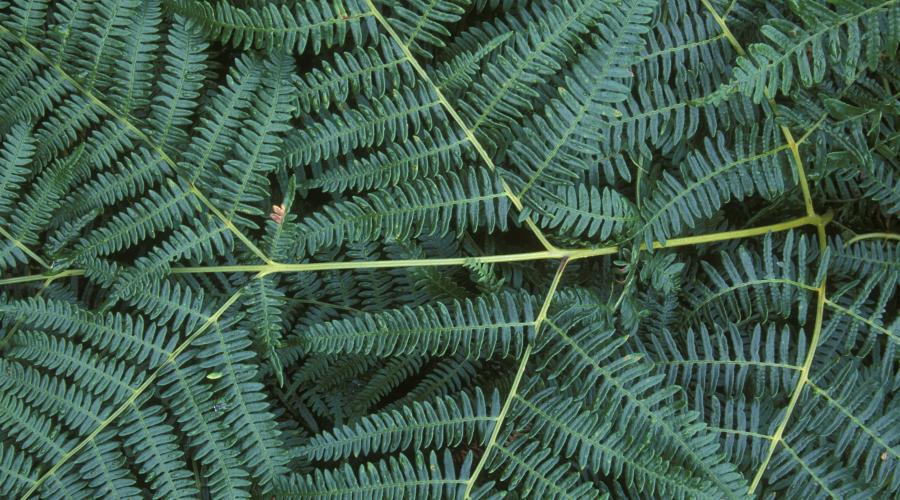
Bracken
Bracken is our most widespread large fern species, covering large areas of Scotland’s moors and uplands.
Update on Asulox
Asulox was a selective herbicide, previously used for aerial spraying and ground-based treatment of bracken. The registration allowing Asulox to be used across the EU was withdrawn in 2012, due to concerns that the active ingredients were an endocrine disruptor, risking animal and human health.
Until 2023, an annual Emergency Authorisation (EA) to permit Asulox use was submitted to the Chemicals Regulation Division of the Health & Safety executive (HSE) by the Bracken Control Group. UPL, the manufacturers of Asulox, were required to undertake research to prove that Asulox was safe and effective for bracken treatment to support full regulatory approval in the UK.
In 2023, the HSE’s advice for the UK was not to authorise Asulox due to the risks it posed to human, animal, and environmental health. Scotland, Wales, and Northern Ireland refused to issue the EA in 2023, based on the HSE advice.
UPL made the decision in October 2023 to cease further research to support full regulatory approval, therefore Asulox is permanently withdrawn from the UK and EU.
UK Preliminary Best Practice Bracken Management Guidance
With Asulox no longer available to treat bracken, there was a need to update the best practice guidance on bracken management, which was previously heavily weighted towards chemical treatment.
The UK nature conservation bodies, (Natural England, NatureScot, Department of Agriculture, Environment and Rural Affairs (DAERA, Northern Ireland), Natural Resources Wales) and the UK national historic advisors, (Historic England, Historic Environment Scotland, Communities Northern Ireland and Cadw) commissioned revised guidance on bracken management.
We have an interest in appropriate management of bracken to protect biodiversity, landscape and the historic environment, in line with our statutory purposes. The revised guidance has been produced to promote best practice in bracken management across the UK and will be updated as further information emerges.
UK Preliminary Best Practice Guidance Bracken Management
Bracken Management Plan Template
To assist with bracken management planning, we have produced a Bracken Management Plan template, to allow land managers to plan bracken treatment over a five-year period and monitor and record regrowth and the condition/diversity of replacement vegetation.
Case Studies
Information on case studies using non-chemical bracken management approaches is available as follows:
Hodge Hill Farm - Non-chemical Bracken Management
Winter Cattle/Combination
My name is Fiona Daley, and together with my husband David, I farm 150 acres at Hodge Hill in the southern Lakeland low fells. We are part of the Innovative Farmers Bracken Field Labs, exploring how bracken can be managed without chemicals using a low input grazing system based around our herd of Belted Galloway cattle and a small number of sheep.
We bought the land in the early 2000s, but its history stretches back through many generations of the previous farmer’s family, who have given us valuable insight into how it was managed. Bracken was once an important resource here: it was cut by hand every three to five years and used as winter bedding, a practice that effectively kept it under control. This stopped around 70 years ago following post war labour shortages, the availability of cheaper transported straw, and the increasing use of herbicides, at one point even applied by helicopter.
These changes reflected a wider shift in post war agriculture toward efficiency and higher production. While successful in many respects, they also allowed bracken to dominate. When we arrived, much of the farm had reverted to dense stands. Our previous conventional system of Swaledale sheep, a few Limousin cattle, fertilisers, wormers and higher stocking rates did little to change that, prompting our move toward a different, low input approach.
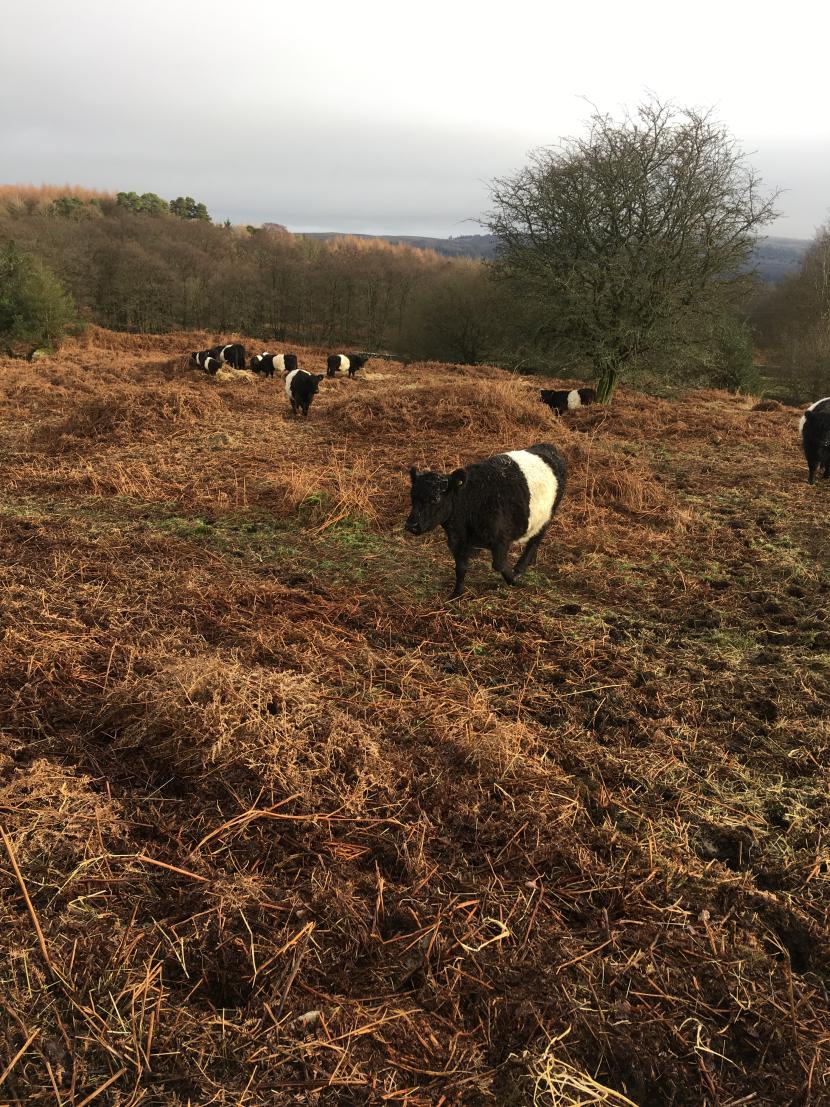
Belted galloways on bracken beds. copyright Soil Association.
Methodology
Management approach
Since 2017 we have implemented an integrated, low‑input system designed to control bracken without chemicals and to restore a more productive, biodiverse sward.
Livestock & forage: A herd of Belted Galloway cattle (hardy, out‑wintered) and a few sheep. Cattle are 100% pasture‑based: grass and natural browse (including tree leaves). In winter they receive hay we grow ourselves (single cut). No chemical fertilisers, no supplementary feed, and no routine chemical treatments are used.
Behavioural grazing management: In dense bracken, we broadcast leaves of hay to tempt cattle into new areas. We place salt/mineral licks strategically to encourage exploration. As cattle move, their feet create “plug holes” (divots) that trap seed and moisture, providing germination niches for grass and other plants.
Out‑wintering on bracken beds: Bracken litter warms beds by up to ~10°C (observational), providing shelter and encouraging use of bracken zones.
Mechanical support (site‑specific): On one experimental site we pasture‑top bracken once to twice per year, generally mid–late August, reducing regrowth vigour ahead of dormancy and limiting nutrient return to rhizomes.
Virtual fencing: A control area is stock‑excluded using virtual fence collars, allowing clear comparison of management impacts.
Field Lab design (3 sites)
To assess non‑chemical bracken management, we participate in the Innovative Farmers Bracken Field Lab with three site types:
Control; No farming on this area; livestock excluded by virtual fencing.
Cattle only; Broadcast feeding and licks to draw cattle into bracken; no machinery.
Cattle + mechanical; This where we broadcast feed and we also pasture top at least once per year, sometimes twice. Generally mid to late August so the brackens don’t have the time to recover before the growing season finishes or to put nutrients back into the ground.
This structure allows us to compare the relative and combined effects of cattle behaviour and mechanical topping.
| Parameter | Method | Timing |
|---|---|---|
| Bracken height | Measure average height of bracken, at ten 1 m x 1 mquadrats across the site | Annually in July/August |
| Bracken density | Count total number of fronds within the same ten 1 m x 1 m quadrats | Annually in July/August |
| Soil VESS | Visual Evaluation of Soil Structure at surface and 30cm depth. Worm count | July/August year 1 and 3 |
| Soil Samples | Ten 30 cm cores analysed for Bulk Density, Organic Matter, Total Carbon, Soil Organic Carbon, Soil Inorganic Carbon, Total Nitrogen, C:N, stone content | July/August year 1 and 3 |
| Biodiversity | Plants: Record all species, including mosses, with their % cover values. Five roughly spaced quadrats (avoid edges) per plot. Record all species and cover and log GPS location. Butterflies & Bees: Walk the same path between quadrats, recording all individuals within 2.5 m either side, noting unknowns and weather. | Annually |
| Photographic record | Fixed‑point photo series to capture visible change (bracken mosaic, glades, tracks). | Annually in July/August Plus before and after management. |
Farm Insights
Through the Field Lab we are adding to the evidence base to understand the options for managing brackens without chemicals. The farms in the trials are all taking broadly similar but different approaches. This is because our land, our farming practices, our sizes and scale and our range and breeds of livestock etc are all different. At Hodge Hill we want to understand the effect of what we are doing on biodiversity, carbon sequestration and food production capacity
Bracken height and density initial results
Our observations show that the greatest progress in terms of reduction in bracken density and height occurs where cattle grazing is combined with mechanical control as shown in the data. In these areas, bracken fronds are noticeably shorter, and the increased light reaching the soil, along with the divots created by Belted Galloways, has helped grasses, forbs and self-set trees reestablish.
| Change 2024-25 | Both cattle and mechanical | Cattle only | Control |
|---|---|---|---|
| Average height (cm) | -37.22 | -34.76 | -28.25 |
| Average density (fronds/m) | -12.8 | -4.3 | +1.8 |
The control and cattle only sites, suggesting that cattle alone will take longer to reverse around 70 years of bracken dominance. In 2025, bracken height was lower across all three sites compared with the previous year, despite measurements being taken 12 months apart, indicating that a hot, dry spring and summer may also influence bracken growth. The Field Labs are still in the early stages of gathering evidence, and we do not yet know how reducing bracken density affects biodiversity.
Case Studies funded by Nature Scot on behalf of the Soil Association's Innovative Farmers programme.
Hudson Place Farm - Non-chemical Bracken Management
Summer Cattle / Pathway Formation Approach
My name is Katharine Pinfold. I previously worked as a Chartered Accountant and, with my husband Martin, ran a food‑flavourings manufacturing business before selling it in 2020 and moving into farming full‑time. We first farmed on a small scale in Staffordshire, later purchasing Hudson Place fell farm at Loweswater, in the northwest Lake District, along with additional upland land. Today we manage around 1,200 acres, mainly upland grazing, with Belted Galloway cattle and Herdwick sheep, all grass‑fed and out‑wintered. We sell our meat direct to customers. Bracken remains a significant challenge, reducing available grazing and continually spreading.
Our 125‑acre fell is grazed each summer by around 20 younger cattle, who have free access across the whole area. As they move naturally across the fell, they create regular routes, some of which run directly through bracken. Over time these routes form visible green pathways, especially noticeable in winter when the surrounding dead bracken has turned brown. Areas the cattle use most frequently now show shorter, sparser regrowth, and after three summers these patterns are increasingly clear.
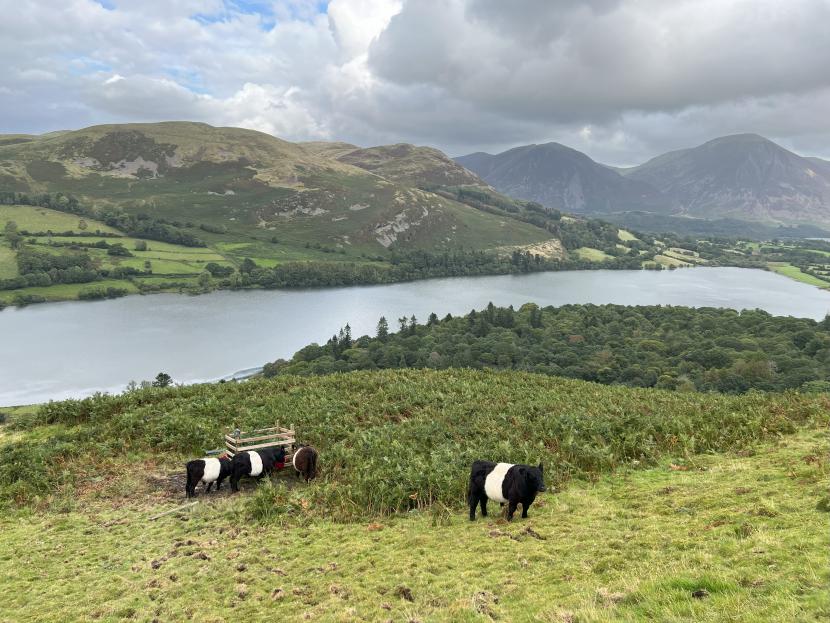
Belted Galloways on bracken. copyright Soil Association.
Methodology
Management approach
For the Field Lab we designated a specific trial zone on our 125 acres fell for these 20 cattle and used Himalayan salt blocks to draw cattle into that area for longer periods. Their repeated activity: walking, lying down, and disturbing the ground while licking the salt intensified the pressure on bracken. By the end of year two, bracken in this targeted zone had largely disappeared.
Across the wider fell, the cattle reduce bracken simply through physical impact. Although they do not eat bracken, their movement breaks and crushes the fronds and weakens regrowth. Their natural behaviour: wandering, resting, and establishing habitual routes, continues to thin bracken cover and encourage other vegetation to return.
Purpose and aims
Our aim is to reduce bracken vigour, weaken annual regrowth, and open up space for other vegetation to compete successfully. By encouraging cattle to move repeatedly through bracken stands, we reduce canopy height and density and promote the establishment of grasses and other plant species
Field Lab design (2 sites):
To assess non‑chemical bracken management, we participate in the Innovative Farmers Bracken Field Lab with:
Control; No farming on this area; livestock excluded.
Cattle only; 20 cattle grazed between April and October.
This allows us to compare the effects of cattle grazing on the bracken against the control with no grazing.
| Parameter | Method | Timing |
|---|---|---|
| Bracken height | Measure average height of bracken, at ten 1 m x 1 mquadrats across the site | Annually in July/August |
| Bracken density | Count total number of fronds within the same ten 1 m x 1m quadrats | Annually in July/August |
| Soil VESS | Visual Evaluation of Soil Structure at surface and 30cm depth. Worm count. | July/August year 1 and 3 |
| Soil Samples | Ten 30 cm cores analysed for Bulk Density, Organic Matter, Total Carbon, Soil Organic Carbon, Soil Inorganic Carbon, Total Nitrogen, C:N, stone content | July/August year 1 and 3 |
| Biodiversity | Plants: Record all species (including mosses) and their % cover in five spaced quadrats; log GPS locations. Birds: Count all individuals seen in a 10‑minute period. Butterflies & Bees: Walk the set route between quadrats, recording all individuals within 2.5 m either side, noting unknowns and weather. | Annually |
| Photographic record | Fixed‑point photo series to capture visible change (bracken mosaic, glades, tracks). | Annually in July/August Plus before and after management. |
Farm Insights
Through the Field Lab we are adding to the evidence base to understand the options for managing brackens without chemicals. The farms in the trials are all taking different approaches. This is because our land, our farming practices, our sizes and scale and our range and breeds of livestock etc are all different. At Hodge Hill we want to understand the effect of what we are doing on biodiversity, carbon sequestration and food production capacity .
| Change 2024-25 | Cattle only | Control |
|---|---|---|
| Average height (cm) | -19 | -4 |
| Average density (fronds/m) | -14 | -1 |
Monitoring from 2024–25 shows that the cattle‑grazed site reduced bracken considerably more than the ungrazed control. Bracken height in the cattle area fell by 19 cm, compared with only 4 cm in the control, and bracken density decreased by 14 fronds/m², while the control showed a reduction of just 1 frond/m². These results indicate that regular summer cattle movement measurably weakens bracken structure and density over a single season, whereas areas without grazing show only limited natural decline.
Case Studies funded by Nature Scot on behalf of the Soil Association's Innovative Farmers programme.
JS Baird Sons - Non-chemical Bracken Management using a Crimper Roller
Background
Diarmid Baird, of Scotston Farm, which has been organic since 1988 carried out the mechanical bracken management trial. The farm covers 480ha, 180ha of which is moorland, and is farmed by three Baird brothers, Diarmid, Dougal and Euan.
Following the withdrawal of Asulox in October 2023 for bracken control, we are exploring non- non‑chemical alternatives. This field lab expands the ongoing “Bracken Management with Livestock” work by testing an innovative mechanical method: a purpose‑built crimper roller designed and engineered by Diarmid Baird (JS Baird and Sons).
Bracken occupies an estimated 263.000 ha across the UK equivalent to a 1.1% of land, limiting grazing potential, reducing biodiversity, suppressing tree establishment and increasing habitat suitability for ticks which are becoming more prevalent with climate change, winters in Scotland no longer 'containing' their spread. With chemical control no longer available, mechanical options may offer an economically viable and environmentally beneficial alternative.
Crimping is a technique used in regenerative arable systems; adapting it for bracken presents a novel opportunity. When applied after maximum frond unfurling, crimping is expected to inflict significant vascular damage at a point when rhizome reserves are at their lowest, maximising impact and potentially reducing plant competitiveness over time.
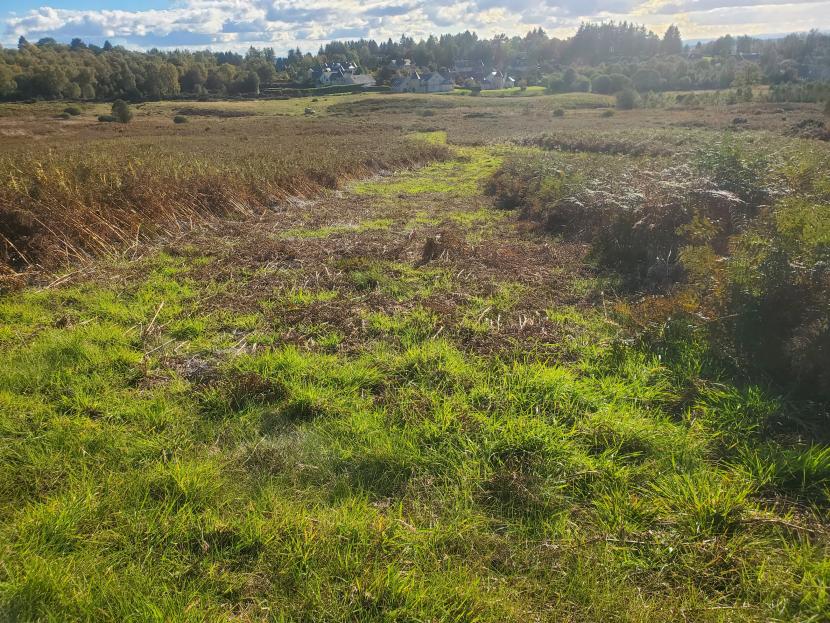
Crimped area of trials. copyright Soil Association.
This project builds on industry interest from the Bracken Control Group, Forestry Scotland and other stakeholders who have supported early-stage development of the prototype machinery.
The removal of this would increase biodiversity, allow grazing for animals and prepare ground that was otherwise unusable for planting trees. Several machines would need to be constructed by local fabricators and operated by contractors all increasing economic development in Scotland to tackle this area.
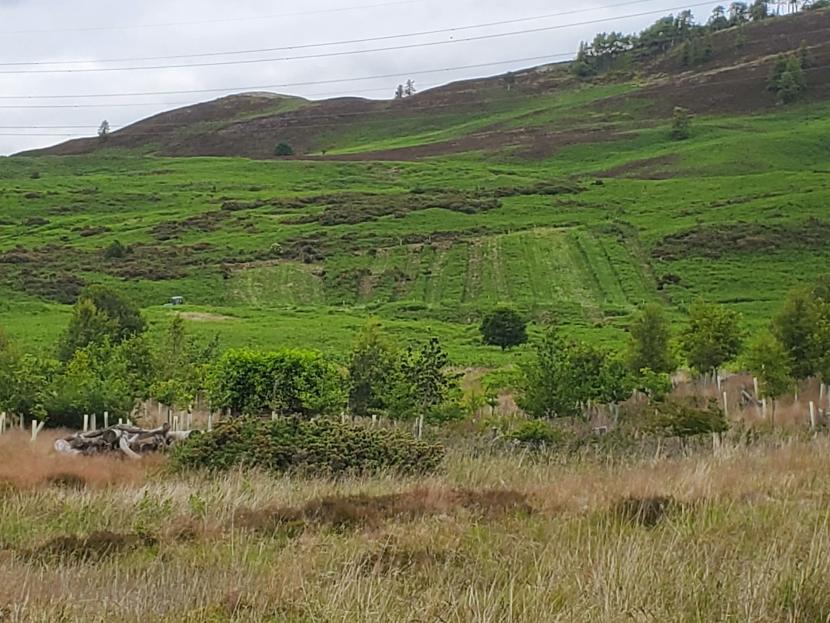
Trial areas from distance. copyright Soil Association.
Methodology
Mechanical Management
The prototype roller uses a series of blunt blades to compress bracken fronds along their length, rupturing vascular tissues while leaving the stem attached. We think this prevents replenishment of the rhizome reserves without removing the apical dominance that prevents regrowth from below ground buds.
The method is intended for steep, uneven or environmentally sensitive terrain where other mechanical approaches are impractical. A blunt metal blade along the length of the stem of the plant without cutting it. This damages the vascular system of the plant essentially 'bleeding' and slowly dehydrating it.
Following the same survey protocol as the current Bracken Field Lab, environmental outcomes of this management method will be analysed compared to a control site. Providing additional data/comparisons for the ongoing field lab as well as providing insight into the impact and effectiveness of this innovative management technique.
Diarmid Baird (JS Baird and Sons) has purpose built a prototype crimper roller for the control of bracken, therefore he will be the only farm directly involved in this Field Lab. However, due to the close alignment with the ongoing Bracken management with Livestock Field Lab, discussion and knowledge exchange will be done collaboratively with that group.
Purpose and Aims
This field lab will evaluate the effectiveness of a purpose built mechanical crimper roller for nonchemical bracken control while assessing its wider ecological impacts, including changes in plant communities, invertebrates and bird activity. Alongside bracken suppression, the project investigates how mechanical treatment influences soil structure, organic matter and carbon, generating robust evidence to support future investment in alternative equipment. A further aim is to strengthen knowledge exchange between farmers, contractors, conservation groups and the existing Bracken Management with Livestock cohort, ensuring shared learning across both projects.
Field Lab Design
The trial will take place at JS Baird & Sons, the only participating farm due to the availability of the prototype machinery, with ongoing collaboration and knowledge exchange coordinated alongside the Livestock Bracken Field Lab group. The design consists of two plots;
1) Mechanical treatment and 2) Control; with baseline (Year 1) and final (Year 2) measurements collected through a combination of farm staff, contractors and trained volunteers.
Engagement includes at least one public demonstration day to showcase the crimper roller in operation, open to the livestock bracken group and the wider farming community.
| Parameter | Method | Timing |
|---|---|---|
| Soil VESS | Visual Evaluation of Soil Structure at surface and 30cm depth. Worm count | July/August year 1 and 3 |
| Soil Samples | Ten 30 cm cores analysed for Bulk Density, Organic Matter, Total Carbon ,Soil Organic Carbon, Soil Inorganic Carbon, Total Nitrogen, C:N, stone content | July/August year 1 and 3 |
| Biodiversity | Plants: Record all species, including mosses, with their % cover values. Five roughly spaced quadrats (avoid edges) per plot. Record all species and cover and log GPS location. Butterflies & Bees: Walk the same path between quadrats, recording all individuals within 2.5 m either side, noting unknowns and weather. | Annually |
| Photographic record | Fixed‑point photo series to capture visible change (bracken mosaic, glades, tracks). | Annually in July/August Plus before and after management. |
Farm Insights
Farmer feedback will be gathered through a structured cost–benefit survey capturing operational time, fuel and machinery requirements, perceived effectiveness of bracken control, and any practical challenges or opportunities identified during the trial. Findings will contribute to a clear understanding of the mechanical feasibility of bracken suppression on steep, uneven and environmentally sensitive sites, alongside an environmental impact assessment covering vegetation, soil health and faunal responses. The project will also generate operational and economic guidance for land managers considering mechanical alternatives to herbicides, supported by evidence based recommendations for scaling up crimper roller manufacture through local fabricators. Collectively, these insights will help strengthen relationships between farmers, engineers, researchers and bracken management organisations.
Case Studies funded by Nature Scot on behalf of the Soil Association's Innovative Farmers programme.
Last updated: