Wildflower meadow creation
Advice for creating and sowing a wildflower patch
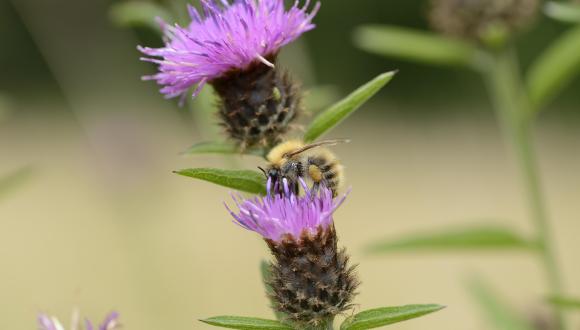
Insects such as bees and hoverflies are a familiar sight in our gardens, parks and countryside. They play an important role in our lives by contributing to our enjoyment of the outdoors, our health and wellbeing, and to our food and farming industries.
The perennial and biennial Scottish wildflower seeds in this pack help attract pollinators. Find out more at our webpage Helping Scotland's Pollinators.
| Species | Common name | Origin |
|---|---|---|
| 100 | % wildflowers | - |
| Daucus carota | wild carrot | Angus |
| Dipsacus fullonum | teasel | Fife |
| Achillea millefolium | yarrow | Fife |
| Centaurea nigra | common knapweed | Fife |
| Knautia arvensis | field scabious | Fife |
| Hypericum perforatum | St John's wort | Fife |
| Leucanthemum vulgare | ox-eye daisy | Fife |
| Prunella vulgaris | selfheal | Fife |
| Ranunculus acris | meadow buttercup | Fife |
| Silene dioica | red campion | Fife |
| Succisa pratensis | devil's-bit scabious | Fife |
| Thymus polytrichus | wild thyme | Fife |
| Trifolium pratense | red clover | Orkney |
| Trifolium repens | white clover | Inverness-shire |
| Vicia cracca | tufted vetch | Fife |
Growing and managing your wildflower mix
Preparation
Remove existing vegetation by ploughing, digging it in (cutting it short first may help)
Prepare a fine seed bed - a smooth surface with the soil broken down as much as possible. For small areas breaking soil down with a fork or rake will do. For larger areas, rotovate with a garden rotovator. For large areas, rotovate or power harrow.
Soils with low fertility can be very good sites for wildflowers. In large projects where soil is being moved and there is a choice of subsoil and topsoil available, a mixture of topsoil and subsoil (about 50:50) to a depth of approx. 30 cm over subsoil is ideal (make sure the topsoil is clean of dominant less desirable seeds). Subsoil alone can be used but if the structure is poor and fertility low, wildflowers will grow very slowly and may be outcompeted by plants such as clovers which do not need soil nitrogen for their growth. Don’t worry if you have soil with high fertility. It is not true that wildflowers do not grow in highly fertile soil but they compete better in sites that are low in nutrients. Plants such as docks may outcompete them on soils with high fertility.
If there have been lots of dominant plants such as docks on your site, even if you have removed the plants, their seeds might still be there and so a ‘stale seed bed’ technique can be used before sowing to reduce the number of undesirable seedlings. Cultivate the soil for sowing but allow the undesirable seeds to germinate. Then remove the seedlings by rotovating or digging repeating the process once or twice more.
Places where grass has been growing often have a relatively low number of undesirable seeds present in the soil and can be good once the grass has been removed.
Sowing
Sow at 2g/m2; this low sowing rate allows plants space to grow – it is not advisable to increase the sowing rate.
You can sow in spring and early summer (Early March to June), as soon as it is possible to work the soil and the soil starts to warm up (later in wet soils). Late sowing after April is possible up to the end of June but there is a risk in some areas of the country after May that seedlings will appear in very warm weather and the young plants may dry out and die. In other areas, the risk is quite small and, depending on weather conditions, sowing can be done throughout the summer. You can also sow in autumn (mid-August to September). The advantage of an autumn sowing is that plants get an early start in the following spring. The disadvantage is that the site will look bare over winter with the possibility of soil erosion on some sites and any seedlings that unexpectedly appear may later be killed by frost.
How to sow
Seed can be sown by hand or by using a mechanical method. You can use some dry sand or sawdust to bulk up the seed so that it is easier to handle and to see where it has been spread. Mix seed very well before and during sowing as some seeds are very small and dense and will separate from larger and less dense seeds. Seed should be sown on or very close to the soil surface.
Sowing by hand - choose a calm day as seed can be blown away easily. Divide the site up into at least four equal areas. Divide seed into the same number of equal sized amounts. Use the first lot of seed on the first area to get used to sowing at the correct sowing rate. Seed can be spread from a box or bag using a wide swinging action (to cover up to 2m width). Walk up and down in a regular pattern, remembering that it can be difficult to see the seed on the ground so you may have to look at your footprints or use a marker to see where you have already sown. If you can, use half of the seed for each area sowing in one direction and then use the other half sowing at rights angles. This helps to avoid leaving any empty patches.
Sowing mechanically - broadcast by seed or fertilizer spreader. Cut the rate down to a very low level to start with and sow twice as above. A seed drill can be used but it must be set to allow the seed to be sown on or very close to the surface.
After sowing, roll the ground. For small areas without a roller, seed can be trampled in by foot - as long as the seed is pressed into the soil surface so that it makes good contact with the soil and so will absorb water from it more effectively. A very light raking or harrowing before rolling can help to settle the seed into the soil, especially for sowings late in the spring or if dry conditions are expected, but the seed should not be buried.
Managing wildflower-only areas after establishment
Biennial species will usually grow and then flower in the second year. They will often self-seed very happily and reoccur. Perennial wildflowers are longer lived species which will grow and begin to flower in the second and third seasons and will continue for many years after that. They can be cut back after flowering or you can leave seed heads and dried stems over winter to look attractive as well as providing food and shelter for wildlife. New growth will come through in the spring. It is likely that over time the less desirable species will start to appear depending on what they are you have the option to leave them and allow the area to evolve into a grassland and start managing it as a meadow.
Wildlife management signs explaining that the site is not forgotten it is being left for wildflowers, can be downloaded.
You can also use this mix to add wildflowers to existing grass to make a meadow
Adding wildflowers to an existing grassy area to create a wildflower meadow is often less successful than sowing a full meadow seed mix into a bare seed bed because the competition with existing grass may be too much for wildflowers to establish, seed may not make good contact with the soil and fail to germinate or, if the seed germinates, seedlings can be smothered by the more vigorous grass. Steps can be taken however to maximize chances of successful establishment of wildflowers into existing grassland, by disturbing grass that has become a dense sward.
Preparation
Long-term preparation before sowing can increase successful wildflower establishment and persistence in grassland. Establishing Yellow Rattle (Rhinanthus minor), ideally over several seasons, is the most effective way although it can be sown at the same time as the other wildflowers if necessary. ‘Rattle’ is a hemi-parasite which parasitizes the roots of some plants, especially grasses. As it steals nutrients from grasses, they grow slower and weaker and the balance of competition is changed in favour of other wildflower species. ‘Rattle’ builds up in patches and then begins to thin out as its hosts become fewer. These patches are then open for further colonization by wildflowers.
Yellow Rattle should only be sown in late autumn as it needs a prolonged period of cold required for its germination. It is most successful where grass is cut back and then harrowed, rotovated or harshly raked before sowing, as healthy grass can resist the attempted parasitisation by Yellow Rattle. Sow ‘Rattle’ seed into the harrowed or raked areas and then tread or roll in - all it really needs is good contact with the soil. Germination occurs early in spring and the annual plant grows and sets seed which then spreads through the meadow area.
As Yellow Rattle does not readily spread into healthy vigorous grassland, neighbouring areas managed for hay, silage or lawns are unlikely to be affected. Cutting ‘Rattle’ when flowering and before setting seed is an effective way to control it if it is no longer wanted.
An alternative to using Yellow Rattle is to weaken the grass by cutting it as often and as short as possible and remove the cuttings in the season preceding sowing wildflowers – this can also help Yellow Rattle establishment if you do want to use it.
Sowing
Sow at a rate of 1-2g/m2. The grassy area to be sown should be harrowed or rotovated (or at least very harshly raked) to increase open soil and damage the grass. Seed should be hand sown across the surface area and rolled, or trodden in. You should then begin to manage your site as a meadow.
We would love to see and share your progress – it is particularly effective if you take before and after photos from the same location showing the change. Please tag us in any images online using #NatureScot
Last updated: