Sharks and Skates of Scotland Report: Tope (Galeorhinus galeus)
An extract from the Sharks and Skates of Scotland Report..
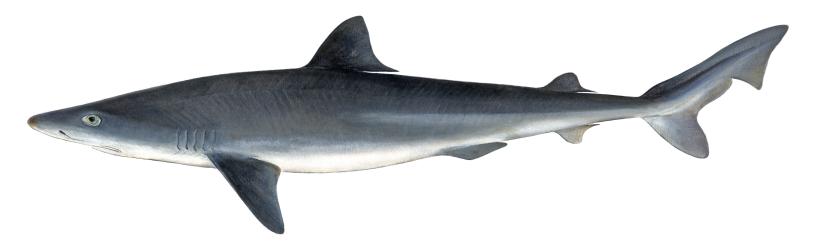
Tope - Galeorhinus galeus (Linnaeus, 1758)
Occurrence in Scotland: Shelf species occasionally occurring on the upper continental slope and in Oceanic waters. Regular summer visitor to coastal waters off southwest Scotland, with increasing records from the northwest/northern coasts and northern North Sea.
Synonym(s): Squalus galeus; Order: Carcharhiniformes; Family: Triakidae
Common name: Tope, school shark, snapper shark, soupfin
AlphaID: 105820 TSN Code: 160181
Population status
Scotland and Northeast Atlantic: Decreasing. (Dureuil, 2015). Landings have remained relatively stable since 2010, but have exceeded precautionary advice (ICES, 2024). In Europe, an estimated 38% decline over the three-generation period (90 years) was observed across its distribution (McCully-Phillips et al., 2015).
Global: Decreasing (Walker et al., 2020)
Note on data quality: Long-term historical catch data for the Northeast Atlantic are not available because many nations historically reported tope with other species in aggregated “dogfish and hounds” categories; species-specific landings have only been consistently available since 2005 and may still be subject to misreporting/misidentification (ICES, 2024).
Conservation listings
- IUCN Red List Europe: Vulnerable
- UCN Red List Mediterranean: Vulnerable
- IUCN Red List Global: Critically Endangered
- CITES: Listed on Appendix II
- CMS: Listed on Appendix II of the Convention on the Conservation of Migratory Species
- Memorandum of Understanding on the Conservation of Migratory Sharks: Listed on Annex 1
- OSPAR: Not listed
- Scottish Biodiversity List
- Species of Principal Importance in England and Wales (SPIe, SPIw)
- Feature of Conservation Importance in England and Wales (FOCI)
- The Tope (Prohibition of Fishing) Order 2008
- Listed on The Sharks, Skates and Rays (Prohibition of Fishing, Trans-shipment and Landing) (Scotland) Order 2012
- Listed on the UK’s ‘Prohibited Species’ list as documented in the ‘Written Record of fisheries consultations between the United Kingdom and the European Union for 2025’ for ICES Division 2a and Subareas 4-8
- Prohibited for retention in EU longline fisheries under Council Regulation EU 2025/202
- Qualifying species of Luce Bay and Inner Hebrides ISRAs
Range and distribution
Tope are a wide-ranging temperate species found worldwide except in the western North Atlantic and western North Pacific (Ebert & Stehmann, 2013). In European waters, they range from southern Norway and Scotland south to Northwest Africa and throughout the Mediterranean.
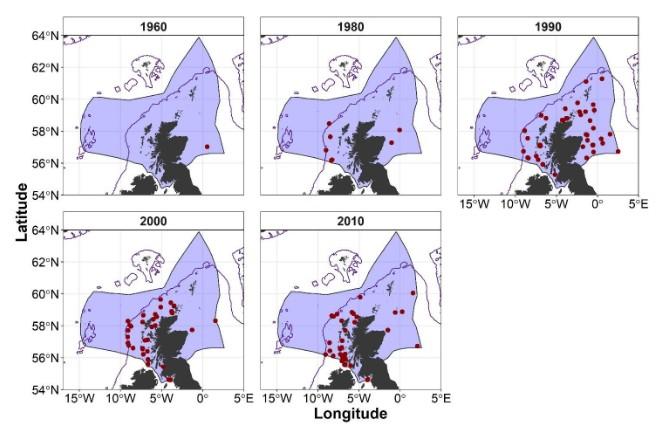
ICES DATRAS records for Tope (Galeorhinus galeus), 1960 - 2019.
Click for a full description
Map of the economic exclusion zone (EEZ) of Scotland showing the ICES (International Council for the Exploration of the Sea) DATRAS (database of trawl surveys hosted by ICES) records for the Tope (Galeorhinus galeus) from the bottom trawl fish surveys conducted between 1960 and 2019. Red point locations represent trawl shoot positions in which Tope (G. galeus) were captured. From 1960 to 1969, Tope were only recorded in one trawl in the North Sea. No tope were recorded between 1970 and 1979. From 1980 to 1989, Tope were captured in 4 trawls evenly distributed around the continental shelf to the west of Scotland and in 2 trawls in the North Sea. From 1990 to 1999 Tope were captured in 36 trawls distributed fairly evenly across the continental shelf around Scotland. From 2000 to 2009, Tope were captured in 32 trawls, primarily on the continental shelf west of Scotland, with only two trawls in the North Sea. Records for 2010 to 2019 were similar to 2000 to 2009, with Tope captured in a few more trawls in the North Sea during this period. A change in the number or distribution of records over time does not reflect a change in occurrence or abundance since data have not been corrected for effort.
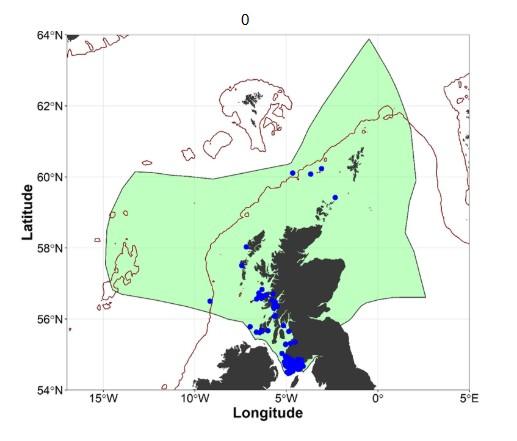
Tag / recapture data for Tope (Galeorhinus galeus) from the Scottish Shark Tagging Programme, the Glasgow Museums tagging programme and the UK Shark Tagging Programme from 1970 to 2025.
Click for a full description
Map of the economic exclusion zone of Scotland showing records for Tope (Galeorhinus galeus) from the Scottish Shark Tagging Programme, Glasgow Museums tagging programme and the UK Shark Tagging Programme from 1970 to 2025. Data are presented as blue dots for each Tope tagged or recaptured. Data is predominantly clustered around the south-west and west coasts of Scotland, with a few records from the inner and Outer Hebrides. There is one record north of Orkney and three west of Shetland, these illustrate recaptures of tagged Tope reported from commercial fishing vessels. These tag – recapture records provided by anglers and occasionally supplemented by reports of tagged animals subsequently captured in commercial fisheries show tight clusters in places where angling and tagging have occurred, for example Luce Bay and around the Mull of Galloway in the southwest of Scotland.
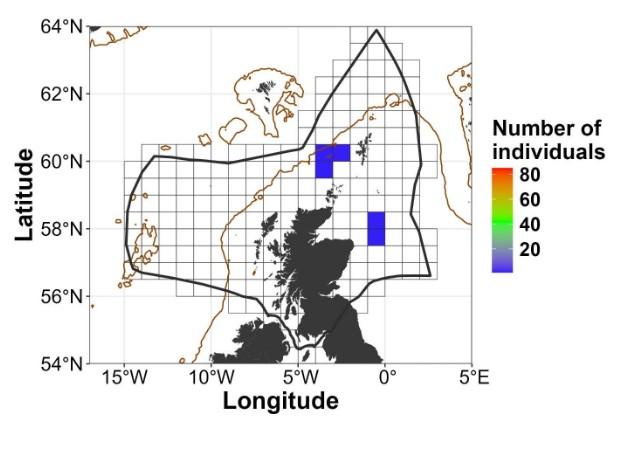
Landings data from commercial fishing vessels in ICES rectangles for Tope (Galeorhinus galeus) 2011-2019.
Click for a full description
Map of the economic exclusion zone (EEZ) of Scotland showing landings data per ICES (International Council for the Exploration of the Sea) rectangle for Tope (Galeorhinus galeus) recorded by commercial fishing vessels from 2011 to 2019. Values are presented as the number of individuals landed per trip. Data is illustrated in a heat map, colouring each ICES rectangle from 0 (white) to 81 (red). Small numbers of landings illustrated by blue rectangles representing 0 to 20 individuals were reported west of Shetland and east of the Moray Firth.
Habitat
Tope occur in temperate waters from shallow inshore bays to offshore slopes (0–826 m, most common 0–200 m), usually in schools segregated by size and sex (Walker et al., 2008; Weigmann, 2016; Thorburn et al., 2019; Walker et al., 2020). While mature individuals make long offshore migrations into mesopelagic layers, they have not been shown to cross ocean basins (Walker, 1999; Colloca et al., 2019; Schaber et al., 2022). The species depends on shallow, sheltered bays and estuaries as pupping and nursery grounds, where juveniles may remain up to two years before dispersing (Olsen, 1954; Stevens & West, 1997; McAllister et al., 2015; Bovcon et al., 2018; McMillan et al., 2018, 2021).
Biology and Ecology
Males mature at ~117–158 cm TL, and females at ~140–190 cm TL. Age at 50% maturity is ~12 years (males) and ~21 years (females) (Capapé & Mellinger, 1998; Capapé et al., 2005), with a generation time estimated at ~26 years. The species’ reported maximum ages range from 40 to 60 years (Olsen, 1954; Capapé et al., 2005; Dureuil, 2015). Tope are viviparous, with embryos developing in retained eggs until birth (aplacental viviparity). Gestation lasts approximately 12 months, and most evidence suggests a triennial reproductive cycle, though biennial reproductive cycles have been reported in European waters (Peres & Vooren, 1991; Lucifora et al., 2004; Walker, 2005; Capapé et al.,2005). Tope are philopatric, with reproductively distinct populations returning to specific nursery sites in shallow, sheltered bays (Thomson et al., 2020; Nosal et al., 2021). Tope are born at ~24–32 cm TL, often with black fin tips and white pectoral trailing edges, and litter sizes range from 8–55 (Compagno, 1984; Capapé & Mellinger, 1998; Capapé et al., 2005). Tope nursery areas in the Northeast Atlantic are thought to be in the Dutch Delta, the Wadden Sea, the English Channel, Channel Islands, the Irish Sea, and the Azores and small pups (<45 cm LT) are recorded in the southern North Sea and the northern Bristol Channel, and small juveniles occur in the Severn Estuary, Cardigan Bay and Liverpool Bay (Ellis et al., 2012; Thorburn et al., 2019; ICES, 2024). Individuals <50 cm TL typically remain at depths <45 m (Thorburn et al., 2019). Tope are wide-ranging, undertaking seasonal migrations between coastal feeding and breeding grounds, with some individuals wintering offshore and diving to depths >800 m (Thorburn et al., 2019). Tagging and telemetry have documented long-distance movements linking the British Isles with the Azores, Canary Islands, and Mediterranean (Thorburn et al., 2019; Colloca et al., 2019; ICES, 2024). Adults are active predators of demersal and pelagic fishes and cephalopods (Ellis et al., 1996; Morato et al., 2003; Domi et al., 2005).
Human interactions
Tope are assessed as a single stock for the Northeast Atlantic by ICES. There are currently no targeted commercial fisheries for Tope in the Northeast Atlantic, but the species is regularly taken as bycatch in mixed trawl, gillnet, and longline fisheries (ICES, 2024); however, if taken by longline in EU waters, it must be discarded. Discard survival in Triakidae is variable: at-vessel mortality (AVM) ranges from 57–93% in Australian gillnet fisheries, with generally lower AVM on longlines. Post-release survival of Tope in Australian automatic demersal longlines was high when handling was careful (Braccini et al., 2012; Frick et al., 2010; Coelho et al., 2012; Rogers et al., 2017; ICES, 2024). Species-specific catch data remain poor, as many nations report landings under aggregated categories (“dogfish and hounds”), discard rates are uncertain, and survival is variable but generally low to moderate. Reported landings from 2005–2023 have been relatively stable (~340–715 t annually since 2012), but remain above ICES precautionary advice, which limits landings to ≤241 t for 2024–2027. Historically, landings declined sharply from >1000 t in the 1980s to a few hundred tonnes by the 1990s. Survey trends are confounded by misidentification with smoothhounds (Mustelus spp.), making stock assessment uncertain. Unmanaged targeted fisheries in other regions (e.g. California, South America) have resulted in collapses, underlining the need for precautionary management in the Northeast Atlantic. Tope also supports a valuable recreational fishery and is frequently caught and released by sea anglers, charter skippers, and angling clubs (ICES, 2024).
References
Bonfil, R. (1994). Overview of world elasmobranch fisheries. FAO Fisheries Technical Paper. Food & Agriculture Organization.
Bovcon, N. D., Cochia, P. D., Navoa, X., Ledesma, P., Caille, G. M., & Baigun, C. R. M. (2018). First report on a pupping area of the tope shark Galeorhinus galeus (Carcharhiniformes, Triakidae) in the south-west Atlantic. Journal of Fish Biology, 93(6), 1229–1232.
Braccini, J. M., Van Rijn, J., & Frick, L. (2012). High post-capture survival for sharks, rays and chimaeras discarded in the main shark fishery of Australia? PLoS ONE, 7(2), e32547.
Capapé, C., & Mellinger, J. (1998). Reproductive biology of the tope shark Galeorhinus galeus (Linnaeus, 1758) (Chondrichthyes: Triakidae) in the Gulf of Gabès (southern Tunisia, central Mediterranean). Cybium, 22(3), 209–223.
Capapé, C., Ben Souissi, J., Méjri, H., Guélorget, O., & Hemida, F. (2005). The reproductive biology of the school shark, Galeorhinus galeus Linnaeus 1758 (Chondrichthyes: Triakidae), from the Maghreb shore (southern Mediterranean). Acta Adriatica, 46(2), 109–214.
Coelho, R., Infante, P., & Erzini, K. (2012). Catch, by-catch and discards of the semi-pelagic longline fishery off Madeira and the Azores. Fisheries Research, 107(1–3), 122–132.
Colloca, F., Scannella, D., Geraci, M. L., Falsone, F., Batista, G., Vitale, S., … Fiorentino, F. (2019). British sharks in Sicily: Records of long-distance migration of tope shark (Galeorhinus galeus) from the north-eastern Atlantic to the Mediterranean Sea. Mediterranean Marine Science, 20(2), 309–313.
Compagno, L. J. V. (1984). Sharks of the world: An annotated and illustrated catalogue of shark species known to date. FAO Species Catalogue, Vol. 4, Parts 1 and 2. FAO Fisheries Synopsis No. 125. Rome: Food and Agriculture Organization.
Domi, N., Bouquegneau, J. M., & Das, K. (2005). Feeding ecology of five commercial shark species of the Celtic Sea through stable isotope and trace metal analysis. Marine Environmental Research, 60(5), 551–569.
Dureuil, M., & Worm, B. (2015). Estimating growth from tagging data: An application to north-east Atlantic tope shark Galeorhinus galeus. Journal of Fish Biology, 87(6), 1389–1410.
Ebert, D. A., & Stehmann, M. F. W. (2013). Sharks, batoids and chimaeras of the North Atlantic. FAO Species Catalogue for Fishery Purposes No. 7. Rome: Food and Agriculture Organization of the United Nations.
Ellis, J. R., Pawson, M. G., & Shackley, S. E. (1996). The comparative feeding ecology of six species of shark and four species of ray (Elasmobranchii) in the north-east Atlantic. Journal of the Marine Biological Association of the United Kingdom, 76(1), 89–106.
ICES. (2024). Report of the Working Group on Elasmobranch Fishes (WGEF). ICES Scientific Reports, 6:75.
Lucifora, L. O., Menni, R. C., & Escalante, A. H. (2004). Reproductive biology of the school shark, Galeorhinus galeus, off Argentina: Support for a single southwestern Atlantic population with synchronized migratory movements. Environmental Biology of Fishes, 71(2), 199–209.
McAllister, J. D., Barnett, A., Lyle, J. M., Stehfest, K. M., & Semmens, J. M. (2015). Examining trends in abundance of an overexploited elasmobranch within a nursery area closure. Marine and Freshwater Research, 66(9), 832–839.
McMillan, M. N., Huveneers, C., Semmens, J. M., & Gillanders, B. M. (2018). Partial female migration and cool-water migration pathways in an overfished shark. ICES Journal of Marine Science, 75(4), 1473–1483.
McMillan, M. N., Semmens, J. M., Huveneers, C., Sims, D. W., Stehfest, K. M., & Gillanders, B. M. (2021). Grow or go? Energetic constraints on shark pup dispersal from pupping areas. Conservation Physiology, 9(1), coab017.
Morato, T., Solà, E., Grós, M. P., & Menezes, G. (2003). Diets of thornback ray (Raja clavata) and tope shark (Galeorhinus galeus) in the bottom longline fishery of the Azores, north-eastern Atlantic. Fishery Bulletin, 101(3), 590–602.
Nosal, A. P., Cartamil, D. P., Ammann, A. J., Bellquist, L. F., Ben-Aderet, N. J., Blincow, K. M., … Hastings, P. A. (2021). Triennial migration and philopatry in the critically endangered soupfin shark Galeorhinus galeus. Journal of Applied Ecology, 58(8), 1570–1582.
Olsen, A. M. (1954). The biology, migration, and growth rate of the school shark, Galeorhinus australis (Macleay), in south-eastern Australian waters. Marine and Freshwater Research, 5(3), 353–410.
Peres, M. B., & Vooren, C. M. (1991). Sexual development, reproductive cycle and fecundity of the school shark Galeorhinus galeus of south Brazil. Fishery Bulletin, 89(4), 655–667.
Rogers, P. J., Knuckey, I., Hudson, R. J., Lowther, A. D., & Guida, L. (2017). Post-release survival, movement, and habitat use of school shark Galeorhinus galeus in the Great Australian Bight, southern Australia. Fisheries Research, 187, 188–198.
Schaber, M., Gastauer, S., Cisewski, B., Hielscher, N., Janke, M., Peña, M., … Klevjer, T. (2022). Extensive oceanic mesopelagic habitat use of a migratory continental shark species. Scientific Reports, 12(1), 2047.
Stevens, J. D., & West, G. J. (1997). Investigation of school and gummy shark nursery areas in south-eastern Australia. Hobart: CSIRO Marine Research.
Thorburn, J., Neat, F., Burrett, I., Henry, L.-A., Bailey, D. M., Jones, C. S., Noble, L.R. (2019). Ontogenetic variation in movements and depth use, and evidence of partial migration in a benthopelagic elasmobranch. Frontiers in Ecology and Evolution, 7, 353.
Thomson, R., Bravington, M., Feutry, P., Gunasekera, R., & Grewe, P. (2020). Close-kin mark recapture for school shark in the SESSF. FRDC Project 2014/024 Final Report.
Walker, T. I. (1999). Galeorhinus galeus fisheries of the world. FAO Fisheries Technical Paper 378. Rome: Food and Agriculture Organization.
Walker, T. I. (2005). General biology of chondrichthyan fishes. In W. C. Hamlett (Ed.), Reproductive biology and phylogeny of Chondrichthyes: Sharks, batoids, and chimaeras (pp. 1–60). Enfield, NH: Science Publishers.
Walker, T. I., Rigby, C. L., Pacoureau, N., Ellis, J. R., Kulka, D. W., Chiaramonte, G. E., & Herman, K. (2020). Galeorhinus galeus. The IUCN Red List of Threatened Species 2020.
Weigmann, S. (2016). Annotated checklist of the living sharks, batoids and chimaeras (Chondrichthyes) of the world, with a focus on biogeographical diversity. Journal of Fish Biology, 88(3), 837–1037.