Sharks and Skates of Scotland Report: Small spotted catshark (Scyliorhinus canicula)
An extract from the Sharks and Skates of Scotland Report.
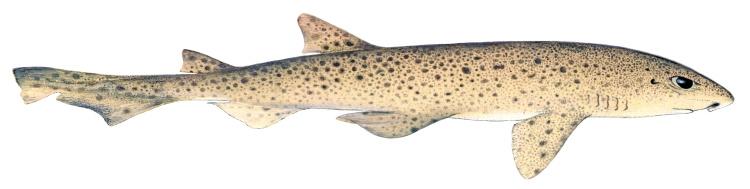
Small spotted catshark - Scyliorhinus canicula (Linnaeus, 1758)
Occurrence in Scotland: Shelf. Resident. Found commonly throughout shelf waters. Very high number of records.
Synonym(s): Squalus canicula, Squalus catulus, Catulus duhamelii, Squalus elegans; Order: Carcharhiniformes; Family: Scyliorhinidae “Catsharks”
Common name: Small spotted catshark, lesser-spotted dogfish
AlphaID: 105814 and 322612 TSN Code: 160065
Note on data quality: Landings of ‘catsharks’ were traditionally reported in category groups (e.g. dogfishes and hounds), though since 2005, more species-specific landings have become available (ICES, 2019a). Misidentification between S. canicula and S. stellaris is also problematic in fisheries data, especially in areas where both species occur, such as the Celtic Sea (ICES, 2018). The lack of historical landings data and the uncertainty associated with recent species-specific information suggest fisheries-dependent data should be viewed with caution. However, scientific groundfish surveys provide valuable information on the abundance and distribution of this species (ICES, 2018).
Population status
Scotland and Northeast Atlantic: Increasing biomass in the North Sea Ecoregion between 2004 and 2022 (ICES, 2024). Increasing biomass in the Celtic Seas Ecoregion between 2008 and 2018, and stable to increasing between 2018 and 2022 (ICES, 2024). Increasing in the rest of the Northeast Atlantic (Finucci et al., 2021, Serena et al., 2015).
Global: Stable (Finucci et al., 2021)
Conservation listings
- IUCN Red List Europe: Least Concern (assessment 17 September 2014)
- IUCN Red List Global: Least Concern (assessment 31 August 2020)
- CITES: Not listed
- CMS: Not listed
- OSPAR: Not listed
Range and distribution
Small spotted catshark (Scyliorhinus canicula) is one of the most abundant and wide-ranging elasmobranch species in the Northeast Atlantic and the Mediterranean (Serena et al., 2015) and can also be found in the central Atlantic. In the Northeast Atlantic its range extends from waters around Shetland and Norway in the north, all the way southwards to the waters off West Africa (Serena et al., 2015). It is relatively abundant throughout Scottish waters (Baxter et al., 2011), and around much of the British Isles (Ellis et al., 2005). Small spotted catshark are thought to have localised movement patterns with limited migration, and ICES assumes that “immigration and emigration from adjacent populations are either insignificant or on a par” (ICES, 2018). ICES currently consider 4 stock units for this species: (i) North Sea ecoregion (Subarea 4 and Divisions 3.a and 7.d), (ii) Celtic Seas and west of Scotland (Subarea 6 and Divisions 7.a–c and 7.e–j), (iii) northern Bay of Biscay (Divisions 8.a–b and 8.d), and (iv) Atlantic Iberian waters (Divisions 8.c and 9.a) (ICES, 2018).
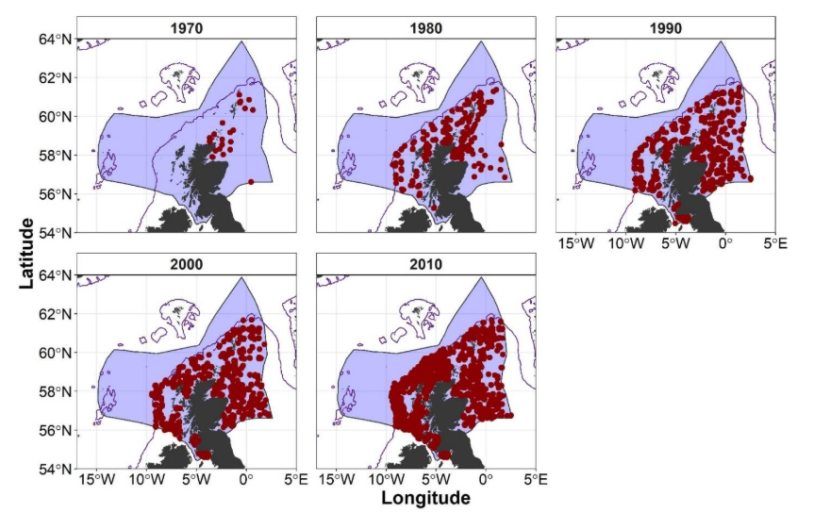
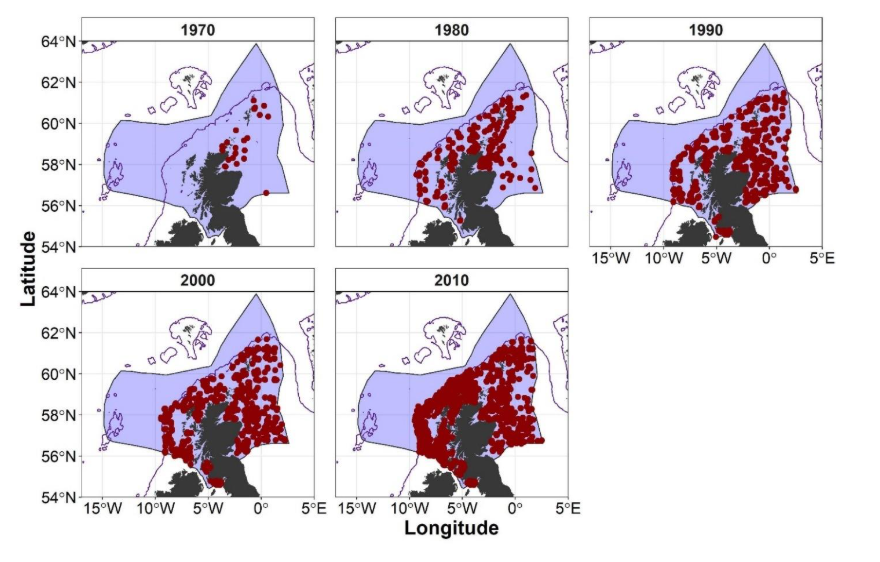
ICES DATRAS records for the Small spotted catshark (Scyliorhinus canicular), 1970: 1970-1979; 1980:1980-1989; 1990: 1990-1999; 2000: 2000-2009; 2010:2010-2019.
Click for a full description
View a larger version of this image.
Map of the economic exclusion zone (EEZ) of Scotland showing the ICES (International Council for the Exploration of the Sea) DATRAS (database of trawl surveys hosted by ICES) records for the Small spotted catshark (Scyliorhinus canicula) from bottom trawl surveys. There are five maps presenting the data for trawl surveys conducted between 1970 and 1979, 1980 and 1989, 1990 and 1999, 2000 and 2009 and 2010 and 2019 respectively. Red points represent trawl shoot positions in which Small spotted catshark (S. canicula) were captured. For 1970 to 1979 Small spotted catsharks (S. canicula) were captured in the Moray Firth, around the Orkney Islands and the Shetland Isles with one record in the North Sea at the southern boundary of Scotland’s EEZ. For 1980 to 1989 there are more records covering the continental shelf throughout the EEZ of Scotland but records are sparser in the North sea and absent from the north North Sea. For 1990 to 1999 records cover the whole of the continental shelf within the EEZ of Scotland apart from a notable absence to the immediate west of the Outer Hebrides. For 2000 to 2009 records are denser still throughout the whole of the continental shelf within the EEZ of Scotland, records are sparser in the northern North Sea and again absent from an area immediately west of the Outer Hebrides. For 2010 to 2019, records were denser still across the whole of the continental shelf around Scotland, except for sparse records for the northern North Sea and the area immediately west of the Outer Hebrides. A change in the number or distribution of records over time does not reflect a change in occurrence or abundance since data have not been corrected for effort.
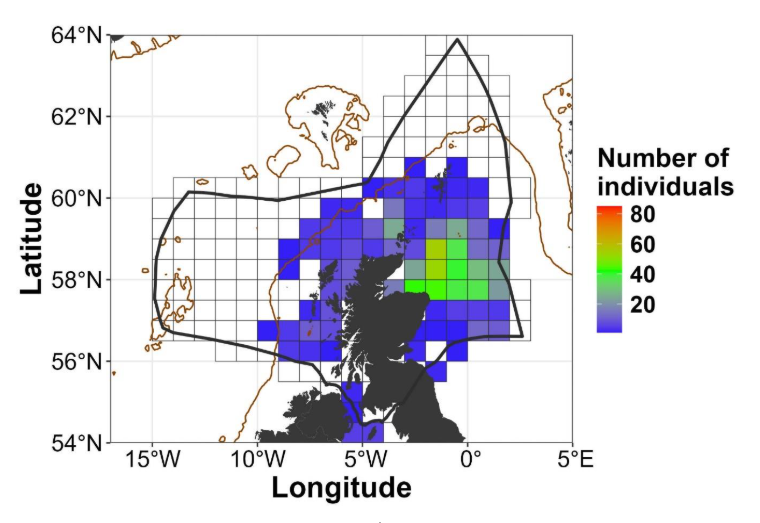
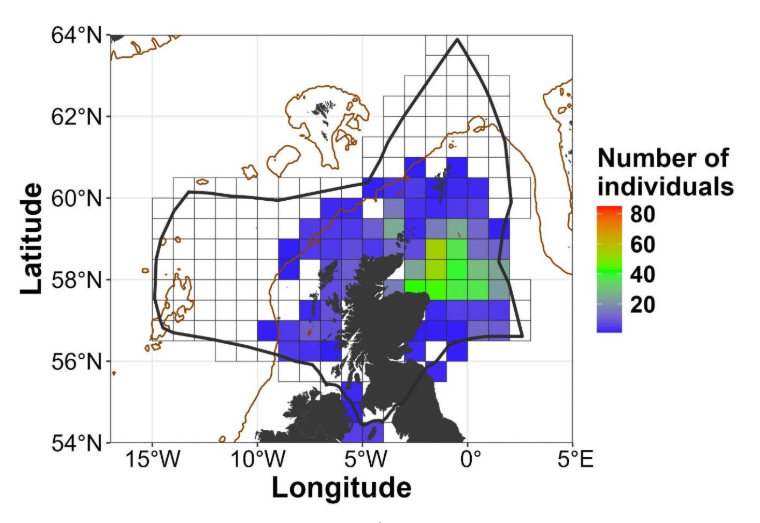
Landings records per ICES rectangle for Small spotted catshark (Scyliorhinus canicula) from 2011 – 2019. Data is filtered to exclude information in rectangles where three vessels or less operate.
Click for a full description
View a larger version of this image.
Map of the economic exclusion zone (EEZ) of Scotland showing landings data for Small spotted catshark (Scyliorhinus canicula) recorded on commercial fishing vessels from 2011 to 2019. The EEZ of Scotland is covered by a grid dividing it into the International Council for the Exploration of the Sea (ICES) rectangles. Data is filtered to exclude information in rectangles where three vessels or less operate. Values are presented as individuals per trip and represented as a heat map, colouring each ICES rectangle from 1 (blue) to 81 (red). Small numbers of small spotted catshark represented by blue rectangles (less than 10 individuals) were reported throughout Scottish waters. Higher numbers represented by green rectangles (approximately 40 individuals) were reported in the North Sea east of Peterhead north to the east of the Orkney Isles.
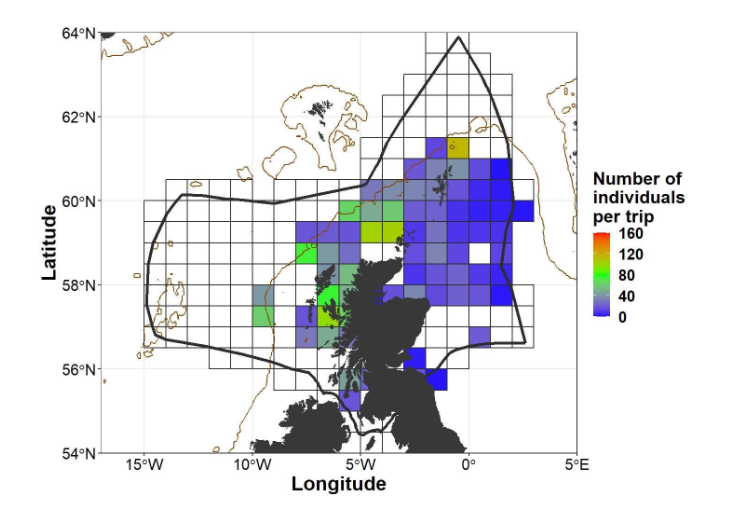
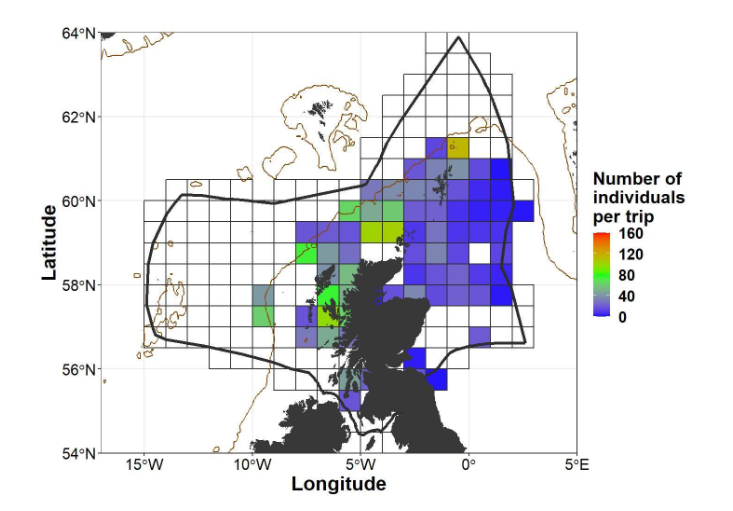
Discard data from commercial fishing vessels in ICES rectangles for Small spotted catshark (Scyliorhinus canicula) 2014-2018. Data is filtered to exclude information in rectangles where 3 vessels or fewer fish.
Click for a full description
View a larger version of this image.
Discard data from commercial fishing vessels in ICES (International Council for the Exploration of the Sea) rectangles for Small spotted catshark (Scyliorhinus canicula) 2014-2018. Data is filtered to exclude information in rectangles where 3 vessels or fewer fish. Values are presented as individuals per trip. Data is illustrated via a heat map colouring each of the ICES rectangles (a grid dividing the EEZ of Scotland into rectangles) from 1 individual per trip (blue) to 160 individuals per trip (red). Small numbers of discards were recorded, represented by blue rectangles (0 to 40 individuals), throughout the North Sea except for rectangles to the south east of Scotland’s EEZ where there are no records. Records are also absent from the ICES rectangles around the Isle of Islay, south west of the Isle of Mull and close to the edge of the continental shelf on the west coast of Scotland, on the north coast of Scotland between the mainland and the Orkney Isles and the ICES rectangles at the northern most point of the continental shelf within Scotland’s EEZ. Landings were higher in the Minch around the Isle of Skye where rectangles are coloured light green (40 individuals per trip) mid green (60 individuals per trip) and bright green (80 individuals per trip), off the most northerly tip of the west coast of Scotland where the rectangle is coloured light green (60 individuals per trip), to the north west of the Orkney Isles where the rectangles are coloured green to yellow (100 individuals per trip) and on the edge of the continental shelf on the west and north west of Scotland where the rectangles are coloured light green (60 individuals per trip) and bright green (80 individuals per trip). There is a single ICES rectangle coloured yellow to orange (120 individuals per trip) on the northwestern edge of the continental shelf north of Shetland, which represents the highest number of discards recorded during this period.
Habitat
This species inhabits inshore waters from the shallow coast out to the edge of the continental shelf, at depths ranging from about 6 – 300 m (Ellis et al., 2005), although it is most common in water <110 m deep (Ebert and Stehmann, 2013). Small spotted catsharks are a bottom-dwelling species that can be found over a variety of substrates, including sand, coralline algal, gravel and mud (Ebert and Stehmann, 2013). Juveniles and hatchlings are often found in shallower water than the adults (Ebert and Stehmann, 2013).
Biology and Ecology
Small spotted catshark are a medium sized elasmobranch that can grow to a maximum length of about 80 - 85 cm around the British Isles and in the North Sea. In the Northeast Atlantic males mature at 49 – 55 cm, and females mature at 52 – 65 cm (Ellis and Shackley, 1997). Females are oviparous (egg laying), and eggs are deposited on macroalgae or sessile invertebrates (e.g. hydroids, sponges, bryozoans) and take 5 – 11 months to hatch (Ellis and Shackley, 1997; Ebert and Stehmann, 2013). Females lay eggs year-round; however most are deposited between November and July (Ellis and Shackley, 1997; Ebert and Stehmann, 2013). Fecundity of females is proportional to their length, and they produce around 29 - 62 eggs per year in the Northeast Atlantic, with size at birth ranging from 7-11 cm TL (Ellis and Shackley, 1997). Small spotted catsharks are known to aggregate according to sex and size, with females tending to return to or remain in a particular area, while males are more wide-ranging (Sims, 2003). Studies suggest they generally exhibit site fidelity (Labourgade et al., 2024) and have a small home range, which was estimated at 0.2 – 38.5 km in the Balearic islands (Ferragut-Perello et al., 2024). Small spotted catsharks feed on a variety of bottom-dwelling invertebrates, such as hermit, swimming and various other crab species, shrimps, whelks and other gastropods, small cephalopods and polychaetes (Martinho et al., 2012; Ebert and Stehmann, 2013). They may also prey on teleost fish, and both adults and juveniles consume relatively more fish in the spring and summer than in other seasons (Martinho et al., 2012).
Human interactions
Small spotted catshark are a bycatch of demersal trawl, gillnet and longline fisheries over much of their range in Northeast Atlantic waters. They are usually of low commercial value and, except for some seasonal, small-scale fisheries in some coastal areas, are not subject to target fisheries, discarding can be high (ICES, 2024). Some Small spotted catshark may occasionally be landed as bait by creel and pot fishers in the UK, specifically by whelk and brown crab fisheries. They are also commonly caught by recreational anglers around the UK.
Scyliorhinids are considered to be a relatively productive species in comparison to other demersal elasmobranchs (ICES, 2024), so may be resilient to fishing pressures. In addition, the survival rates of discarded Small spotted catsharks are estimated to be high (Barragán-Méndez et al., 2019). For example, in the Western English Channel beam trawl fishery, discard survival was estimated that more than 90% in a 48-hour aquarium trial (Revill et al., 2005), and similar high survival rates were observed for this species in otter trawl fisheries (Serena et al., 2015).
ICES has provided species-specific advice on landings since 2012. ICES advice on landings for 2024 and 2025 (using the maximum sustainable yield approach) were 2680 tonnes for the North Sea ecoregion (Subarea 4 and in divisions 3.a and 7.d; ICES 2023a) and 3984 tonnes for the Celtic Seas and west of Scotland (Subarea 6 and divisions 7.a–c and 7.e–j) (ICES 2023b).
References
Barragán-Méndez, C., Ruiz-Jarabo, I., Fuentes, J., Mancera, J. M., & Sobrino, I. (2019). Survival rates and physiological recovery responses in the lesser-spotted catshark (Scyliorhinus canicula) after bottom-trawling. Comparative Biochemistry and Physiology Part A: Molecular & Integrative Physiology, 233, 1-9.
Baxter, J.M. et al., (2011) Sharks and Rays, In: Scotland’s MariNortheast Atlas, Scotland’s MariNortheast Atlas: Information for The National Marine Plan. (Accessed: 13 January 2020).
Ebert, D.A. and Stehmann, M. F. W. (2013) Sharks, batoids, and chimaeras of the North Atlantic. FAO Species Catalogue for Fishery Purposes. No. 7. Rome: Food and Agricultural Organization of the United Nations (FAO).
Ellis, J.R. et al., (2005) ‘The Distribution of Chondrichthyan Fishes Around the British Isles and Implications for Conservation’, Journal of Northwest Atlantic Fisheries Science, 35, pp. 195–213.
Ellis, J.R. and Shackley, S.E. (1997) ‘The reproductive biology of Scyliorhinus canicula in the Bristol Channel, U.K.’, Journal of Fish Biology. Wiley, 51(2), pp. 361–372. doi: 10.1111/j.1095-8649.1997.tb01672.x.
Ferragut-Perello, F., Sánchez-Zulueta, P., Ramírez-Amaro, S., Farriols, M. T., Pasini, N., Guijarro, B., ... & Ordines, F. (2024). Elasmobranch Mark–Recapture Experiment off the Balearic Islands: Insight into Scyliorhinus canicula Growth, Mobility, and Population Size. Fishes, 9(8), 315.
Finucci, B., Derrick, D., Neat, F.C., Pacoureau, N., Serena, F. & VanderWright, W.J. 2021. Scyliorhinus canicula. The IUCN Red List of Threatened Species 2021: e.T161307554A124478351. Accessed on 14 February 2025.
Labourgade, P., Couturier, L. I., Bourjea, J., Woillez, M., Feunteun, E., Reubens, J. T., & Trancart, T. (2024). Acoustic telemetry suggests the lesser spotted dogfish Scyliorhinus canicula stays and uses habitats within a French offshore wind farm. Marine Environmental Research, 202, 106802.
Martinho, F. et al., (2012) ‘Comparative feeding ecology of two elasmobranch species, Squalus blainville and Scyliorhinus canicula, off the coast of Portugal.’, Fishery Bulletin, 110(1), pp. 71–84.
Revill, A.S. et al., (2005) ‘The survival of discarded lesser-spotted dogfish (Scyliorhinus canicula) in the Western English Channel beam trawl fishery’, Fisheries Research. Elsevier, 71(1), pp. 121–124. doi: 10.1016/j.fishres.2004.07.006.
Serena, F. et al., (2015) Small Spotted Catshark, Scyliorhinus canicula, The IUCN Red List of Threatened Species 2015. (Accessed: 2 March 2020).
Sims, D.W. (2003) ‘Tractable models for testing theories about natural strategies: Foraging behaviour and habitat selection of free-ranging sharks’, in Journal of Fish Biology. John Wiley & Sons, Ltd, pp. 53–73. doi: 10.1111/j.1095-8649.2003.00207.x.