Sharks and Skates of Scotland Report: Porbeagle (Lamna nasus)
An extract from the Sharks and Skates of Scotland Report.
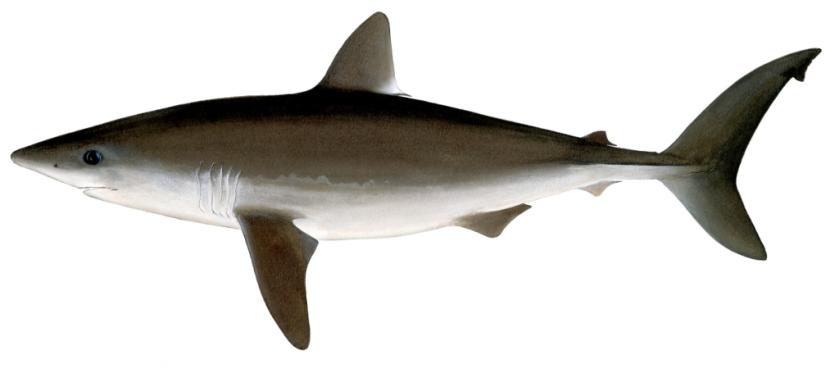
Porbeagle - Lamna nasus (Bonnaterre, 1788)
Occurrence in Scotland: Coastal and Oceanic. Resident. Patchy distribution throughout Scottish waters. Local over-winter abundance in coastal waters on the North coast of Scotland. Low number of records in Scotland.
Synonym(s): Squalus nasus; Order: Lamniformes; Family: Lamnidae
Common name: Porbeagle
AlphaID: 105841 TSN Code: 159911
Population status
Scotland and Northeast Atlantic: Decreasing. Over 90% decline estimated in the Northeast Atlantic (Ellis et al., 2015, ICES, 2024a).
Global: Decreasing (Rigby et al., 2019).
Conservation listings
- IUCN Red List Europe: Critically Endangered (assessment 5 February 2015)
- IUCN Red List Global: Vulnerable (assessment 6 November 2018)
- CITES: Listed in Appendix II since 2014
- CMS: Listed on Appendix II of the Convention on the Conservation of Migratory Species
- OSPAR: Threatened and/or Declining Species
- Listed as a Priority Marine Feature in Scotland
- Scottish Biodiversity List
- Listed on The Sharks, Skates and Rays (Prohibition of Fishing, Trans-shipment and Landing) (Scotland) Order 2012.
- Listed on the UK’s ‘Prohibited Species’ list as documented in the ‘Written Record of fisheries consultations between the United Kingdom and the European Union for 2025’ for all UK waters.
- Prohibited under EU Regulation 2025/202
- Included in the NEAFC measures prohibiting directed fishing for porbeagle
- Qualifying species of North East Atlantic Corridor ISRA and Dunnet Head candidate ISRA
Range and distribution
Porbeagle are found in the North and South Atlantic, Mediterranean Sea, South Pacific, and South Indian Ocean. In the Northeast Atlantic, they are found in the waters of Greenland, Iceland, Norway, the British Isles, Sweden, Germany, France, and south to Spain, Portugal (including the Azores) and Morocco (Ebert and Stehmann, 2013). The species prefers colder waters and does not occur in equatorial seas. They are widely distributed across Scotland, although they are generally considered rare in Scottish waters (Baxter et al., 2011) although the species can be seasonally abundant in northern Scottish waters over winter (pers. comm. Thorburn).
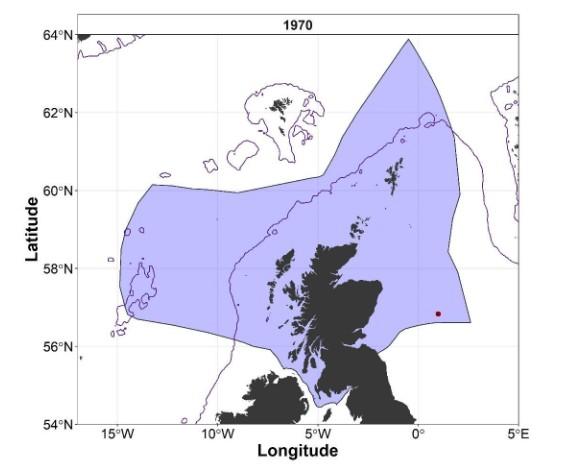
ICES DATRAS records for Porbeagle (Lamna Nasus) in Scotland, 1970-1979. This is the only ICES DATRAS record for Porbeagle in Scottish waters.
Click for a full description
Map of the economic exclusion zone (EEZ) of Scotland showing ICES (International Council for the Exploration of the Sea) DATRAS (database of trawl surveys hosted by ICES) records for Porbeagle (Lamna Nasus) from bottom trawl surveys conducted between 1970 and 1979. Locations of trawls where Porbeagle were captured are illustrated by red dots. A single Porbeagle was captured in a single trawl located in the North Sea to the west of Dundee, close to the southern boundary of the EEZ.
Habitat
This high-latitude shark species generally prefers water temperatures between 5 and 10 °C, although it has been found in temperatures ranging from -1 °C to 23 °C (Ebert and Stehmann, 2013; Bortoluzzi et al., 2024). Porbeagle can be found in coastal and oceanic waters at depths of 0–1867 m (Ebert and Stehmann, 2013; Ellis et al., 2015; Bortoluzzi et al., 2024). Tagging studies have found that the species can undergo large migrations of over 2400 km from polar to subtropical waters (Biais et al., 2017; Bortoluzzi et al., 2024). During these migrations, the sharks will dive to great depths to undertake ‘subtropical submergence’ (a specific migratory and diving behaviour where mature females travel long distances from their typical cold, temperate habitats to deep, cooler waters beneath the warm Gulf Stream in the Sargasso Sea to give birth) (Ebert and Stehmann, 2013). A study tracked the movement of Porbeagle in the Northeast Atlantic using pop-up satellite archival tags (PSATs) and found that sharks tagged around the British Isles and along the Bay of Biscay shelf edge can cross the North Atlantic to at least the Mid-Atlantic Ridge in autumn-winter and return to the European spring-summer feeding areas, providing evidence of site fidelity (Biais et al., 2017). A female Porbeagle tagged in western Irish waters was captured in Canadian waters after 10 years, marking the first record of a trans-Atlantic migration. This finding supports genetic evidence of pan-oceanic stock mixing (Cameron et al., 2018). However, such trans-Atlantic migrations are considered rare (Haugen et al., 2022). Kohler and Turner (2018) also found that tagged porbeagles were recaptured an average of 228.8 nm from their original tagging location with a maximum distance of 1,216 nm although no timeframe was reported for the movements.
Biology and Ecology
Porbeagle are a long-lived and late maturing species, which can reach a maximum age of at least 26 years and possibly as much as 46 years (Ebert and Stehmann, 2013), and maximum sizes of 253 – 302 cm fork length (FL) (Francis et al., 2008). Data on biology are scarce for the Northeast Atlantic population, but males are estimated to reach sexual maturity at 7–8 years, and females at approximately 20 years (Hennache and Jung, 2010). This corresponds to a size at maturity of 170 cm for males and 200 cm for females (FL). The generation length of this species is estimated at approximately 25 years (Ellis et al., 2015). It is estimated that the gestation period in the North Atlantic is approximately 8-9 months, and the reproductive cycle is biennial, with a resting year between parturition and mating (Aasen, 1963; Francis et al., 2008; Ebert and Stehmann, 2013; Natanson et al., 2019). In the eastern North Atlantic, mating is reported to occur from December-January, with parturition possibly occurring in the Spring or late summer (Aasen, 1963; Gauld, 1989). Porbeagle are aplacental viviparous, giving birth to live young that measure 68 – 78 cm at birth, and litters ranging from 1 to 5, averaging four pups (Ebert and Stehmann, 2013). Parturition and nursery sites for the species are not well understood; however, in the Western Atlantic, there are indications that the Gulf of Maine may be a pupping ground, whereas in the Northeast Atlantic, the Bay of Biscay may be a nursery ground (Haugen et al., 2022). They are endothermic and can maintain their body temperature several degrees above surrounding water temperatures, which is a trait common to other ‘mackerel sharks’ (Ebert and Stehmann, 2013). Porbeagle segregate by size (age) and sex, and in some areas off the coast of Scotland, females outnumber males four to three. In contrast, males outnumber females in coastal Spanish (CMS, 2019) and off the north coast of Scotland (Thorburn unpubl. data). The species mainly feeds on teleost fish, with cephalopods also being consumed. There is seasonal variation in the proportions of pelagic and demersal prey species (Joyce et al., 2002).
Human interactions
Porbeagle were historically exploited in the Northeast Atlantic, primarily by four countries (Norway, Denmark, the Faroes, and France) using longline fisheries from 1926 until 2010. Altogether, these four countries accounted for 98% of total landings from 1926 to 2009 (ICES, 2024b). The species is highly vulnerable to overexploitation due to its slow growth rates, late maturity, and low fecundity (Clarke et al., 2016). In 2010, the total allowable catch (TAC) for Porbeagle was reduced to zero for animals caught in international waters, and from 2015 in all EU and UK waters (ICES, 2019). ICES recognise that discarding occurs and is likely to have increased since 2015, but has not been fully quantified, and discard survival has not been estimated; it is expected to be low for netters and trawlers (ICES, 2019). Recreational fishers may take the species, with post-release survival from angling shown to be high under best-practice conditions (Garzon et al., 2025).
References
Aasen, O. (1963) ‘Length and growth of the porbeagle (Lamna nasus, Bonaterre) in the North West Atlantic.’, FiskDir. Skr. Serie Havundersokelser, 13(6), pp. 20–37.
Baxter, J.M. et al., (2011) Sharks and Rays, In: Scotland’s Marine Atlas, Scotland’s Marine Atlas: Information for The National Marine Plan. (Accessed: 13 January 2020).
Belleggia, M., Colonello, J., Cortés, F., & Figueroa, D. E. (2021). Eating catch of the day: the diet of porbeagle shark Lamna nasus (Bonnaterre 1788) based on stomach content analysis, and the interaction with trawl fisheries in the south‐western Atlantic (52° S–56° S). Journal of Fish Biology, 99(5), 1591-1601.
Biais, G. et al., (2017) ‘Return migration patterns of porbeagle shark (Lamna nasus) in the Northeast Atlantic: implications for stock range and structure’, ICES Journal of Marine Science. Oxford Academic, 74(5), pp. 1268–1276. doi: 10.1093/icesjms/fsw233.
Bortoluzzi, J.R. et al., (2024) Transboundary movements of porbeagle sharks support need for continued cooperative research and management approaches. Fisheries Research, 275, 107007.
Cameron, L.W.J. et al., (2018) ‘Transatlantic movement in porbeagle sharks, Lamna nasus’, Fisheries Research. Elsevier B.V., 207, pp. 25–27. doi: 10.1016/j.fishres.2018.05.014.
Clarke, M. et al., (2016) Ireland Red List No. 11: Cartilaginous fish [sharks, skates, rays and chimaeras]. Dublin, Ireland
CMS (2019) Lamna nasus, Convention on the Conservation of Migratory Species of Wild Animals. (Accessed: 30 March 2020).
Ebert, D.A. and Stehmann, M.F.W. (2013) Sharks, batoids, and chimaeras of the North Atlantic. FAO Species Catalogue for Fishery Purposes. No. 7. Rome: Food and Agricultural Organization of the United Nations (FAO).
Ellis, J. et al., (2015) Porbeagle Lamna nasus, The IUCN Red List of Threatened Species 2015: e.T11200A48916453. (Accessed: 30 March 2020).
Francis, M.P. et al., (2008) ‘The Biology and ecology of the Porbeagle shark (Lamna nasus).’, in Pikitch, E. K. and Camhi, M. (eds) Sharks of the open ocean. Blackwell Scientific Publications., pp. 105–113.
Gauld, J. A. (1989) Records of porbeagles landed in Scotland, with observations on the biology, distribution and exploitation of the species (No. 45). Department of Agriculture and Fisheries for Scotland.
Haugen, J.B., et al., 2022. Interdisciplinary stock identification of North Atlantic porbeagle (Lamna nasus). J. Northw. Atl. Fish. Sci., 53: 1–18.
Hennache, C. and Jung, A. (2010) Etude de la pêcherie palangrière de requin taupe de l’île d’Yeu. doi: 10.13140/RG.2.1.3192.7924.
ICCAT (2020) Compendium, management recommendations and resolutions adopted by ICCAT for the conservation of Atlantic tunas and tuna‐like species.
ICES (2018) Report of the Working Group on Elasmobranch Fishes (WGEF), 19-28. Lisbon, Portugal.
ICES (2019) Porbeagle (Lamna nasus) in subareas 1–10, 12, and 14 (the Northeast Atlantic and adjacent waters), ICES Advice on fishing opportunities, catch, and effort Northeast Atlantic ecoregion. (Accessed: 30 March 2020).
ICES (2024b) Report of the Working Group on Elasmobranch Fishes (WGEF). ICES Scientific Reports. 06:75. 994 pp.
Joyce, W. N., Campana, S. E., Natanson, L. J., Kohler, N. E., Pratt Jr, H. L., & Jensen, C. F. (2002). Analysis of stomach contents of the porbeagle shark (Lamna nasus Bonnaterre) in the northwest Atlantic. ICES Journal of Marine Science, 59(6), 1263-1269.
Kohler, N. E., & Turner, P. A. (2018). Distributions and movements of Atlantic shark species: A 52-year retrospective atlas of mark and recapture data. Marine Fisheries Review, 81(2), 1–93.