Sharks and Skates of Scotland Report: Deep-water skate (Rajella bathyphila)
An extract from the Sharks and Skates of Scotland Report.
Deep-water skate - Rajella bathyphila (Holt and Byrne, 1908)
Occurrence in Scotland: Deep-water. Occasional. Found on the continental slope of the Rockall Trough and around Rockall.
Synonym(s): Raja bathyphila; Order: Rajiformes; Family: Rajidae
Common name: Deep-water skate
AlphaID: 105892 TSN Code: 564125
Note: This species is rarely observed in deep-water scientific surveys and occasionally recorded in deep-water fisheries. As such, there is limited data available on population size and trends (Dulvy and Walls, 2015). For example, only 10 individuals were caught in total in Scottish deep-water surveys in the Northeast Atlantic between 1998-2013 (ICES, 2018b). May be difficult to distinguish from the Bigelow’s skate (Rajella bigelowi), and the two species may be sympatric. There is also identification confusion with Rajella fyllae (Dulvy and Walls, 2015).
Population status
Scotland and Northeast Atlantic: Stable. This species is mainly known from sporadic records from local deepwater fisheries and is rarely encountered by deepwater research trawl surveys (Ebert and Stehmann 2013; Dulvy and Walls, 2015).
Global: Increasing. An overall annual rate of increase of 8.7% is consistent with an estimated median increase of 835% over three generation lengths (40.5 years) for Newfoundland and Labrador Shelf survey of mature individuals over the period 1996–2018. Due to this index of abundance and the level of fisheries this skate is exposed across the rest of its range, the population is expected to be increasing (Dulvy et al., 2020).
Conservation listings
- IUCN Red List Global: Least Concern (assessment 20 June 2019)
- IUCN Red List Europe: Least Concern (assessment 17 October 2014)
- CITES: Not listed
- CMS: Not listed
- OSPAR: Not listed
Range and distribution
Deep-water skate is found in the North Atlantic from the northeastern USA and Scotian shelf, Canada north to the Davis Strait, Greenland, Iceland and the Mid-Atlantic Ridge, Faroe Islands, and Rockall Trough (Gordon and Duncan, 1989; Ebert and Stehmann 2013, Dulvy and Walls, 2015; Last et al. 2016; Dulvy et al., 2020).
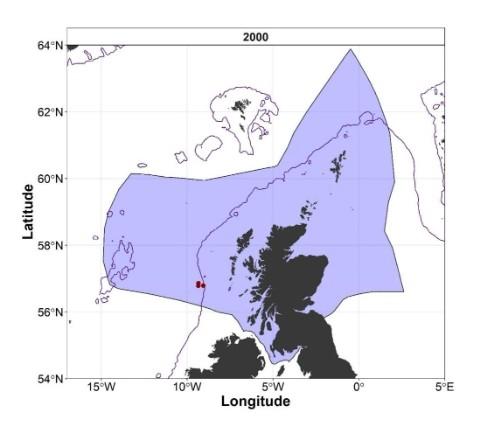
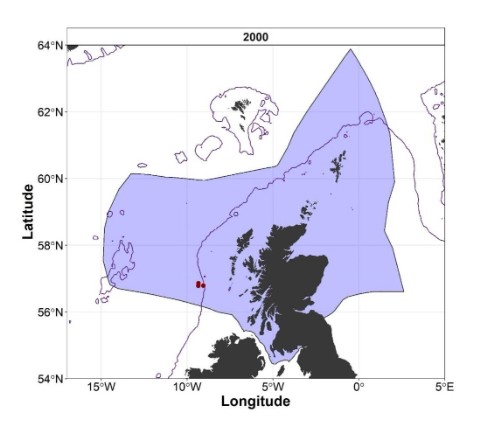
ICES DATRAS records for Deep-water skate (Rajella bathyphila), 2000: 2000-2009.
Click for a full description
View a larger version of this image.
Map of the EEZ of Scotland showing the ICES (International Council for the Exploration of the Sea) DATRAS (database of trawl surveys hosted by ICES) records for Deep-water skate (Rajella bathyphila) from bottom trawl surveys conducted between 2000 and 2009. Red points represent trawl shoot positions in which Deep-water skate (R. bathyphila) were captured. Records are exclusively clustered just off the continental shelf to the west of the Isle of Barra.
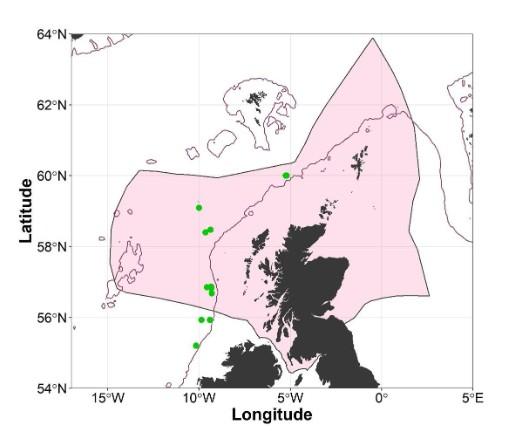
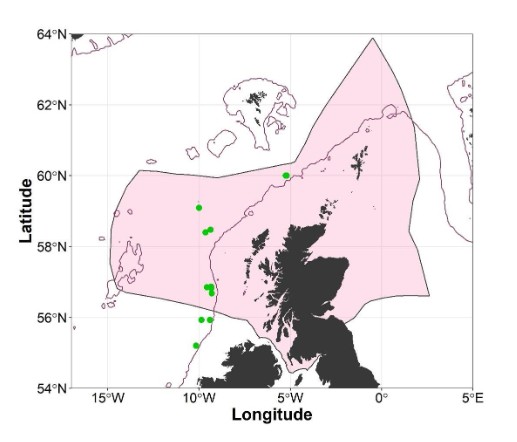
Records for Deep-water skate (Rajella bathyphila) from SIAMISS and deep-water fisheries surveys undertaken by the Marine Directorate 1996 – 2019.
Click for a full description
View a larger version of this image.
Map of the economic exclusion zone (EEZ) of Scotland showing records for Deep-water skate (Rajella bathyphila) from the Scottish-Irish anglerfish and megrim industry-science survey (SIAMISS) and deep-water fisheries surveys undertaken by Marine Directorate from 1996 to 2019. Records are illustrated as green points and are exclusively located off the west coast of Scotland and Northern Ireland off the edge of the continental shelf. Most records are just off the edge of the continental shelf but there are a few north west of the Outer Hebrides further from the continental shelf edge in deeper water.
Habitat
Deep-water skate are found on deeper continental slopes and abyssal plains over both hard and soft substrate, at depths ranging from 600 – 2300 m, but mostly occur in water deeper than 1400 m with a temperature range of 2.5 – 4.0oC (Stehmann and Bürkel 1984, Ebert and Stehmann 2013; Dulvy and Walls, 2015).
Biology and Ecology
Relatively little is known about the biology of Deep-water skate. They reach a maximum size of 95 cm total length (TL); males mature at 65–75 cm TL and female size-at-maturity is unknown (Ebert and Stehmann 2013, Last et al. 2016). Reproduction is oviparous (Ebert and Stehmann 2013, Last et al. 2016). Females lay approximately 40 eggs per year, and the young hatch after several months at 12 cm TL (Ebert and Stehmann 2013, Last et al. 2016) (Dulvy and Walls, 2015; Dulvy et al., 2020). The length of time taken to hatch is likely to vary with water temperature; for example, slower embryonic development is expected in colder water.
Human interactions
Historically, Deep-water skate were occasionally taken as bycatch in local deep-water trawl fisheries, for example, those that operate in the Rockall Trough. Today, bycatch and discards are unlikely due to the introduction of general measures to protect deep-water elasmobranchs (i.e. ban of certain net fisheries below 600 m, and trawls below 800 m) (ICES 2024).
References
Dulvy, N.K., Kulka, D.W., Anderson, B., Pacoureau, N. & Derrick, D. 2020. Rajella bathyphila. The IUCN Red List of Threatened Species 2020: e.T161345A124469469.
Dulvy, N. & Walls, R. 2015. Rajella bathyphila (Europe assessment). The IUCN Red List of Threatened Species 2015: e.T161345A48953965.
Ebert, D.A. and Stehmann, M.F.W. 2013. Sharks, batoids, and chimaeras of the North Atlantic. FAO Species Catalogue for Fishery Purposes No. 7. Food and Agricultural Organization of the United Nations (FAO). FAO, Rome.
Gordon, J.D.M. and Duncan, J.A.R. (1989) ‘A note on the distribution and diet of deep-water rays (rajidae) in an area of the rockall Trough’, Journal of the Marine Biological Association of the United Kingdom. Cambridge University Press, 69(3), pp. 655–658. doi: 10.1017/S0025315400031040.
ICES (2024). Report of the Working Group on Elasmobranch Fishes (WGEF). ICES Scientific Reports. 06:75. 994 pp.
Last, P., White, W., de Carvalho, M., Séret, B., Stehmann, M. and Naylor, G. 2016. Rays of the World. CSIRO Publishing, Clayton.
Stehmann, M. and Bürkel, D.L. 1984. Rajidae. In: P.J.P. Whitehead, M.-L. Bauchot, J.-C. Hureau, J. Nielsen and E. Tortonese (eds), Fishes of the North-eastern Atlantic and Mediterranean, pp. 163–196. UNESCO, Paris.