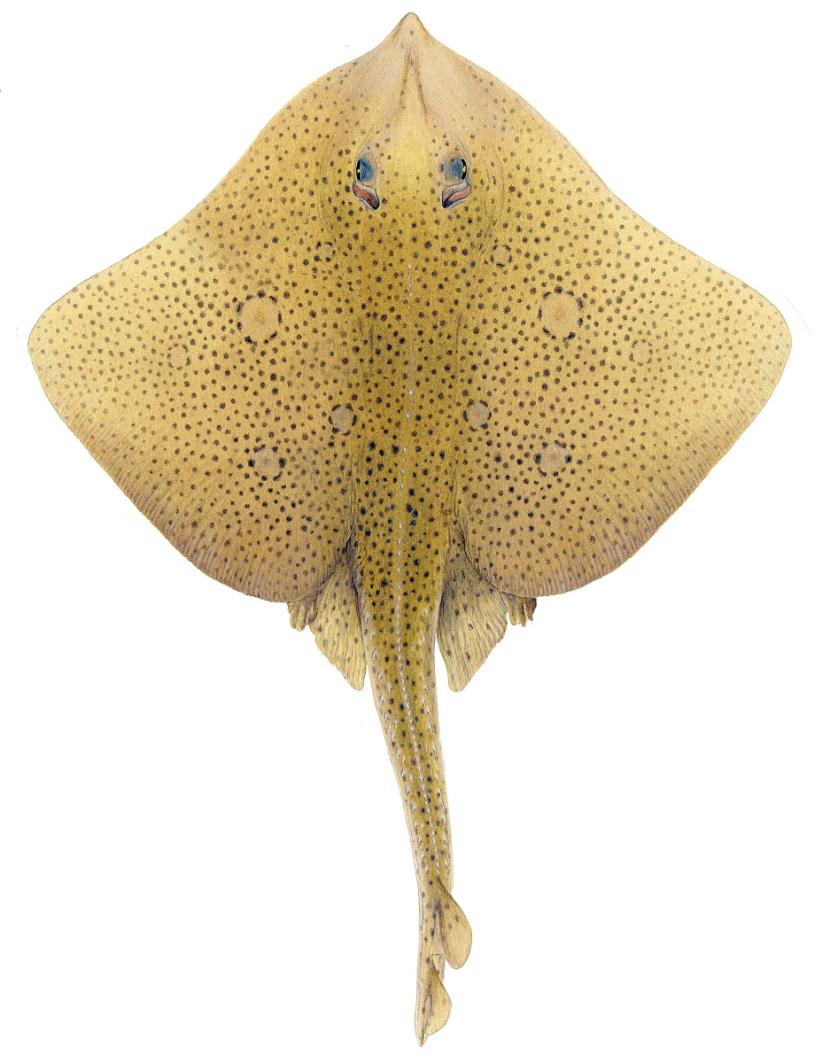
Sharks and Skates of Scotland Report: Blonde skate (Raja brachyura)
An extract from the Sharks and Skates of Scotland Report.
Blonde skate - Raja brachyura (Lafont, 1873)
Occurrence in Scotland: Shelf. Resident. Widespread but patchily distributed in western and NW waters. More occasional records in the North Sea.
Synonym(s): Raia brachyura; Order: Rajiformes; Family: Rajidae
Common name: Blonde skate; Blonde ray
AlphaID: 105882 and 367297 TSN Code: 160880
Population status
Scotland and Northeast Atlantic: Stable. Trend analysis of the North Atlantic modelled biomass for 1950–2021 (71 years) revealed annual rates of increase of 1.23%, with the highest probability of no major reductions in population over the past three generation lengths (29 years) (Finucci et al., 2024).
Global: Decreasing. Due to increasing trends in parts of its range and inferred declines in others, and high levels of exploitation, a population reduction of 20–29% over the past three generations (29 years) was estimated (Finucci et al., 2024).
Conservation listings
- IUCN Red List Global: Near Threatened (assessment 15 April 2023)
- IUCN Red List Europe: Near Threatened (assessment 13 May 2014)
- IUCN Red List Mediterranean: Near Threatened (assessment 25 March 2016)
- CITES: Not listed
- CMS: Not listed
- OSPAR: Not listed
Range and distribution
Blonde skate are a wide-ranging species that are found across much of the central and north-eastern Atlantic, from the waters of Morocco and Madeira in the south up to Shetland in the North. They are found in varying abundances around the British Isles (McCully-Phillips et al., 2015). The skate tends to be locally abundant in areas associated with their preferred habitat (sand banks), such as within the English Channel and Irish Sea, Bristol Channel and St George’s Channel in SE Ireland. They are less abundant in areas of the North Sea (at the edge of their geographical range) and their distribution is patchy in the Celtic Seas (Ellis et al., 2005). The species also occurs in the Mediterranean but is relatively rare when compared to the Northeast Atlantic.
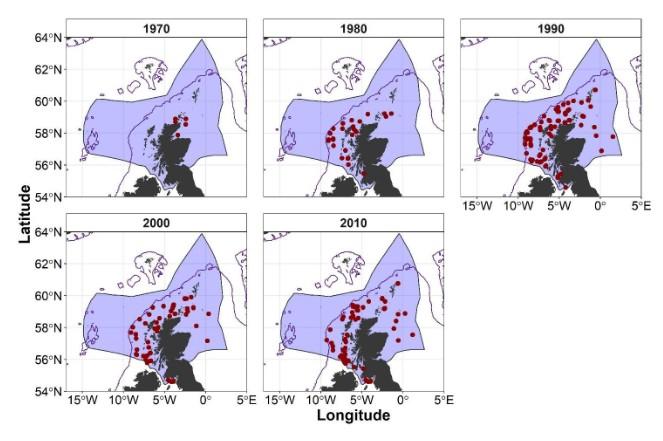
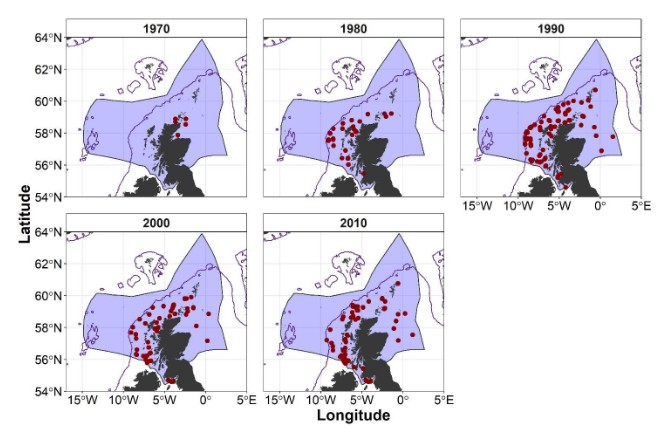
CES DATRAS records for Blonde skate (Raja brachyura) for 1970 - 2019.
Click for a full description
View a larger version of this image.
Five maps of the economic exclusion zone (EEZ) of Scotland showing locations of trawls where Blonde skate (Raja brachyura) were captured from 1970 to 1979, 1980 to 1989, 1990 to 1999, 2000 to 2009, and 2010 to 2019. Red points represent trawl shoot locations in which Blonde skate (R. brachyura) were recorded. Between 1970 and 1979 there were a small number of records, one in the Moray Firth and 4 clustered around the Orkney Isles. From 1980 to 1989 records were distributed all along the west coast of Scotland inshore and offshore beyond the Outer Hebrides (but not off the continental shelf), a small number of Blonde skate were also recorded on the north coast of Scotland to the west and east of the Orkney Isles. From 1990 to 1999 records were more numerous on the west coast and a few records occurred in the North Sea and in the Solway Firth and the Clyde. From 2000 to 2019 records were similar to those from 1990 to 1999. A change in the number or distribution of records over time does not reflect a change in occurrence or abundance since data have not been corrected for effort.
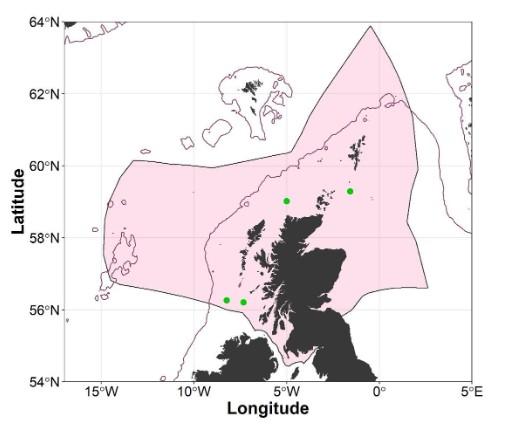
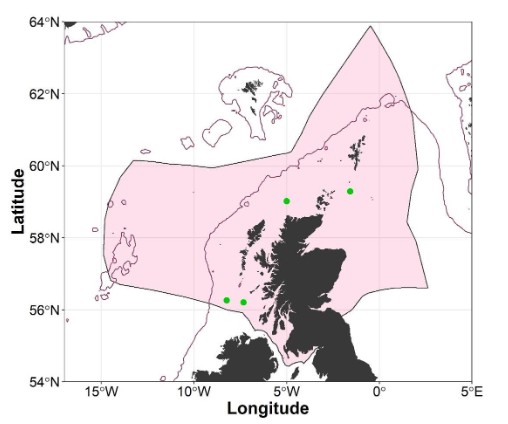
Records for Blonde skate (Raja brachyura) from SIAMISS and deep-water fisheries surveys undertaken by the Marine Directorate 1996 – 2019.
Click for a full description
View a larger version of this image.
Map of the economic exclusion zone (EEZ) of Scotland showing records for Blonde skate (Raja brachyura) from the Scottish-Irish anglerfish and megrim industry-science survey (SIAMISS) and deep-water fisheries surveys undertaken by Marine Directorate from 1996 to 2019. Green points represent the locations of surveys in which Blonde skate (R. brachyura) were recorded. There are only a few records spread out around Scotland, two are on the north coast one either side of the Orkney Isles and 2 are located north of Northern Ireland and west of the Isle of Mull.
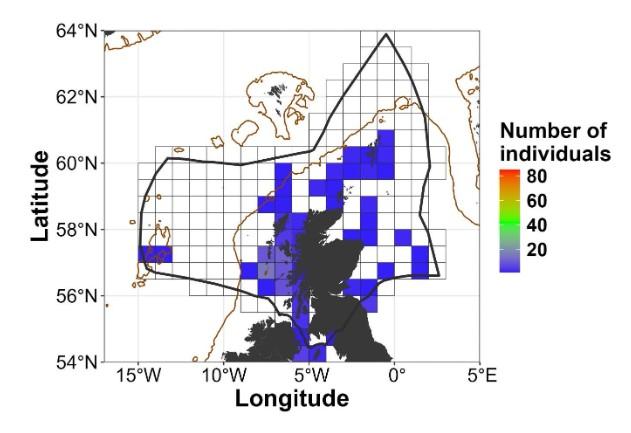
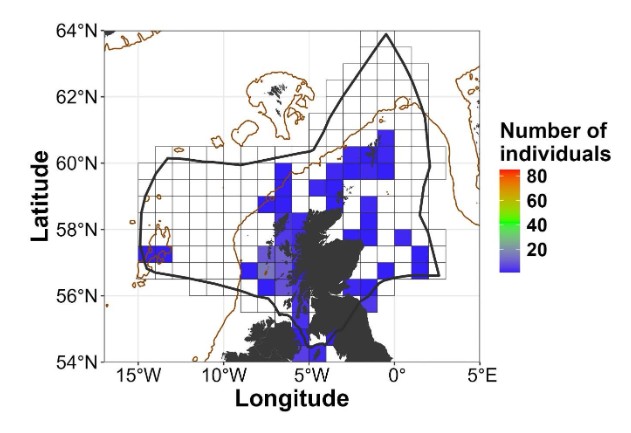
Landings data from commercial fishing vessels in ICES rectangles for Blonde skate (Raja brachyura) 2011 - 2019. Data is filtered to exclude information in rectangles where three vessels or less operate.
Click for a full description
View a larger version of this image.
Map of the economic exclusion zone (EEZ) of Scotland showing landings data for Blonde skate (Raja brachyura) recorded on commercial fishing vessels from 2011 to 2019. The EEZ of Scotland is covered by a grid that divides it into International Council for the Exploration of the Sea (ICES) rectangles. Data is filtered to exclude information in rectangles where three vessels or less operate. Values are presented as number of individuals landed per trip and represented as a heat map, colouring each ICES rectangle from 1 (blue) to 81 (red). Small numbers of individuals (blue rectangles) are reported from most of the coastal waters off the west coast of Scotland up to the shelf edge north of the Outer Hebrides, around the Rockall Plateau, in the rectangles around Orkney and Shetland, and occasional rectangles in the North Sea.
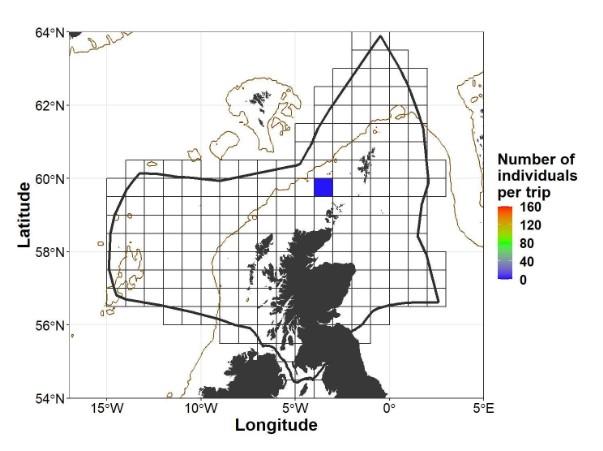
Discard data from commercial fishing vessels in ICES rectangles for Blonde skate (Raja brachyura) 2014 - 2018.
Click for a full description
View a larger version of this image.
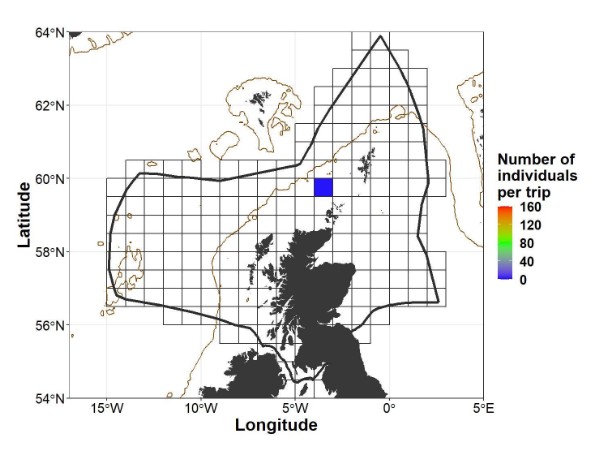
Map of the economic exclusion zone (EEZ) of Scotland showing discard data for Blonde skate (Raja brachyura) recorded on commercial fishing vessels from 2011 to 2019. The EEZ of Scotland is covered by a grid dividing it into the International Council for the Exploration of the Sea (ICES) rectangles. Data is filtered to exclude information in rectangles where three vessels or less operate. Data is illustrated in a heat map, colouring each ICES rectangle from 1 (blue) to 160 (red) individuals recorded per trip. A small number of Blonde skate were discarded to the northeast of Orkney represented by a single blue rectangle, illustrating 0 to 40 individuals recorded per trip.
Habitat
Blonde skate occur on the continental shelf at depths from nearshore to 150 m, and occasionally to 900m (Ellis et al. 2015, Last et al. 2016, Ebert and Dando 2021). They prefer sandbanks and usually occur in inshore waters at depths of 14–146 m in the Northeast Atlantic (Ellis et al., 2005). Shallower waters in this depth range may be used as nursery areas by juveniles (Ellis et al., 2005). The population across the Northeast Atlantic is suspected to be fragmented due to the species preference for sandbanks. Recapture studies have shown that blonde rays exhibit site fidelity (Simpson, 2018; Ellis et al., 2011).
Biology and Ecology
Blonde skate have relatively large body size, reaching a maximum total length (TL) of ~120 cm. Male and female maturity occurs at 78 and 86 cm TL, respectively (McCully et al. 2012), and size-at-hatching occurs at 16–18 cm TL (Last et al. 2016). Reproduction is oviparous. Accurate fecundity estimates are lacking, but it is thought to be in the range of 37–90 eggs per year (Holden et al. 1971, Porcu et al. 2015), with a gestation period of up to 7 months (Stehmann and Bürkel, 1984; Ebert and Stehmann, 2013). Female age-at-maturity is 6 years and maximum age is 10–16 years (Fahy 1989, Gallagher et al. 2005, Porcu et al. 2015), resulting in a generation length of 9.5 years. Immature individuals remain in shallower depths before migrating to deeper habitats as adults (Simpson, 2018; Ellis et al., 2005).
Human interactions
Blonde skate are an important commercial species and are taken as targeted catch and retained from bycatch in demersal trawl and set net (gillnet and trammel) fisheries targeting flatfish and gadoids, and in demersal longline fisheries (ICES, 2023a). Given their large size and slow rates of reproduction, Blonde skate are considered vulnerable to overexploitation (Clarke et al., 2016). The species is also important to recreational fisheries in some areas.
ICES advises that when the precautionary approach is applied, landings should be no more than 7 tonnes in each of the years 2024–2027 for North Sea and West of Scotland (ICES, 2023b) and should be no more than 573 tonnes in each of the years 2025–2028 for Irish Sea, Bristol Channel, Celtic Sea North (ICES, 2024). ICES advises that when the maximum sustainable yield (MSY) approach is applied, catches in 2026 and 2027 should be no more than 1627 tonnes and 1546 tonnes, respectively. If discard rates do not change from the average of the last three years (2022–2024), this implies landings in 2026 and 2027 of no more than 1447 and 1375 tonnes, respectively, for the central and southern North Sea and eastern English Channel (ICES, 2025).
References
Clarke, M. et al., (2016) Ireland Red List No. 11: Cartilaginous fish [sharks, skates, rays and chimaeras]. Dublin, Ireland.
Ebert, D.A. and Dando, M. 2021. Field guide to sharks, rays & chimaeras of Europe and the Mediterranean. Princeton University Press, Plymouth, U.K.
Ebert, D.A., and Stehmann, M.F.W., 2013. Sharks, batoids, and chimaeras of the North Atlantic FAO Species Catalogue for Fishery Purposes. No. 7. Rome, FAO. 523 pp.
Ellis, J. R. et al., (2005) ‘The Distribution of Chondrichthyan Fishes Around the British Isles and Implications for Conservation’, Journal of Northwest Atlantic Fisheries Science, 35, pp. 195–213.
Ellis, J.R., Heessen, H.J.L. and McCully Phillips, S.R. 2015. Skates (Rajidae). In: Heessen, H.J.L., Daan, N. and Ellis, J.R. (eds), Fish atlas of the Celtic Sea, North Sea, and Baltic Sea, pp. 96–124. Wageningen Academic Publishers / KNNV Publishing, Wageningen, Netherlands.
Finucci, B., McCully-Phillips, S.R., Ellis, J.R., Serena, F., Soldo, A., Pacoureau, N. & Charles, R. 2024. Raja brachyura. The IUCN Red List of Threatened Species 2024: e.T161691A183779320. Accessed on 15 September 2025.
ICES. 2023a. Working Group on Elasmobranch Fishes (WGEF). ICES Scientific Reports. 05:92. 837 pp.
ICES. 2023b. Blonde ray (Raja brachyura) in Subarea 6 and Division 4.a (North Sea and West of Scotland). In Report of the ICES Advisory Committee, 2023. ICES Advice 2023, rjh.27.4a6.
ICES. 2024. Blonde ray (Raja brachyura) in divisions 7.a and 7.f-g (Irish Sea, Bristol Channel, Celtic Sea North). In Report of the ICES Advisory Committee, 2024. ICES Advice 2024, rjh.27.7afg.
ICES. 2025. Blonde ray (Raja brachyura) in divisions 4.b, 4.c and 7.d (southern North Sea and eastern English Channel). In Report of the ICES Advisory Committee, 2025. ICES Advice 2025, rjh.27.4bc7d.
Last, P., White, W., de Carvalho, M., Séret, B., Stehmann, M. and Naylor, G. 2016. Rays of the World. CSIRO Publishing, Clayton.
McCully, S., Serena, F., Walls, R.H.L., Morey, G & Ellis, J.R. 2015. Raja brachyura (Europe assessment). The IUCN Red List of Threatened Species 2015: e.T161691A48907330.
McCully, S., Serena, F., Morey, G & Ellis, J.R. 2016. Raja brachyura (Mediterranean assessment). The IUCN Red List of Threatened Species 2016: e.T161691A16527725.
McCully, S. et al., (2012) ‘Lengths at maturity and conversion factors for skates (Rajidae) around the British Isles, with an analysis of data in the literature’, ICES Journal of Marine Science. Narnia, 69(10), pp. 1812–1822. doi: 10.1093/icesjms/fss150.
Simpson, S.J., 2018. Spatial ecology and fisheries interactions of Rajidae in the UK. PhD Thesis, University of Southampton, Southampton.
Stehmann, M. and Bürkel, D. L. (1984) ‘Rajidae’, in Whitehead, P. J. P. et al., (eds) Fishes of the north-eastern Atlantic and Mediterranean. Vol 1. Paris: UNESCO.