Sharks and Skates of Scotland Report: Blackmouth catshark (Galeus melastomus)
An extract from the Sharks and Skates of Scotland Report.
Blackmouth catshark - Galeus melastomus (Rafinesque, 1810)
Occurrence in Scotland: Occurrence in Scotland: Deep-sea and shelf. Resident. Found in deeper water throughout shelf seas, including deep fjordic systems in coastal waters on the west coast of Scotland. Also found on the upper slopes, both sides of the Rockall Trough. Very high number of data records.
Synonym(s): None; Order: Carcharhiniformes; Family: Pentanchidae
Common name: Blackmouth catshark/dogfish
AlphaID: 105812 & 322611; TSN Code: 160034 & 160038
Note: Fisheries landings, catch and discards data are considered unreliable for this species, and the best indicators of population trends can be derived from long-term scientific survey data (ICES, 2024).
Populations status
Scotland and Northeast Atlantic: Highly erratic / Fluctuating abundance over the last decade, possibly increasing, in subareas 6 and 7 (ICES, 2024); increasing stock in ICES subareas 8 & 9 (ICES, 2024).
Global: Stable (Finucci et al., 2021).
Conservation listings
- IUCN Red List Europe: Least Concern (assessment 14 October 2014)
- IUCN Red List Global: Least Concern (assessment 31 August 2020)
- CITES: Not listed
- CMS: Not listed
- OSPAR: Not listed
- Zero TAC under EU Regulation 2018/2025 and EU Regulation 2023/194
- Prohibited under EU Regulation 2025/202
- Listed on The Sharks, Skates and Rays (Prohibition of Fishing, Trans-shipment and Landing) (Scotland) Order 2012
- Inshore Fishing (Prohibition of Fishing and Fishing Methods) (Scotland) Order 2015 prohibits certain types of fishing in the East Mingulay MPA providing protection to an egg-laying site for the species
- Included in the NEAFC measures prohibiting directed fishing for deep-sea sharks
Range and distribution
Blackmouth catsharks are native to the eastern-central and north-eastern Atlantic, as well as the Mediterranean and Black Sea. In the Northeast Atlantic, they are found on upper continental slopes from northern Norway and the Faroe Islands down to Senegal. They are reportedly abundant on the upper slopes of the Rockall Trough, between depths of 300 and 1000 m, with a peak abundance at around 500 m (Neat et al., 2015). They may also be found along the outer continental shelf and shelf edge of the Celtic Sea and the northern North Sea (Ellis et al., 2005; Clarke et al., 2016).
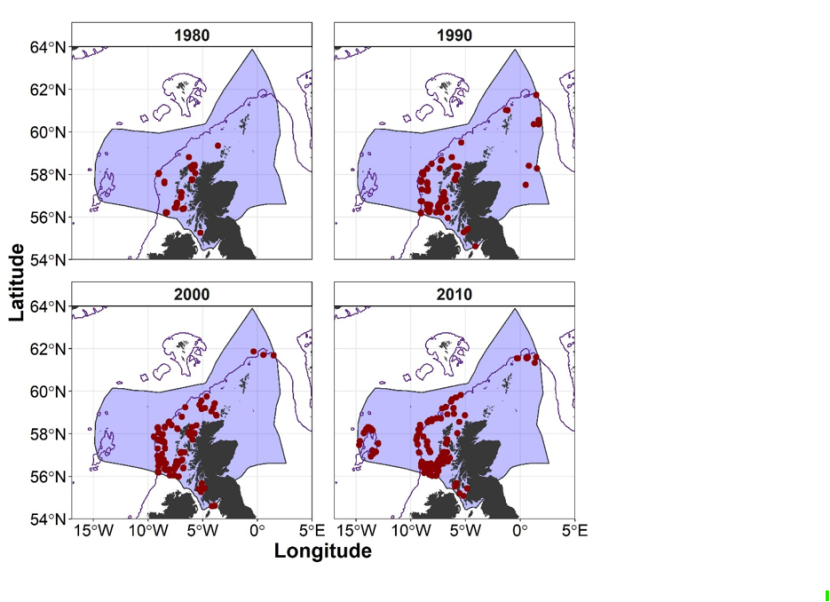
ICES DATRAS records for the Blackmouth dogfish (Galeus melastomus), 1980-2019.
Click for a full description
Four maps of the EEZ of Scotland showing the ICES (International Council for the Exploration of the Sea) DATRAS (database of trawl surveys hosted by ICES) records for the Blackmouth catshark (Galeus melastomus) from bottom trawl surveys conducted between 1980 and 1989; 1990 and1999; 2000 and 2009 and 2010 and 2019. Red points represent trawl shoot positions in which Blackmouth dogfish (G. melastomus) were captured. From 1980 to 1989, data points were exclusively clustered on the west coast of Scotland on the continental shelf, with the northernmost records on the west coast of Orkney. From 1990 to 1999, records on the west coast increased, and a few records were reported in the north of the North Sea. From 2000 to 2009, there were more records on the west coast of Scotland and a few north of Shetland at the edge of the continental shelf; there were no records in the North Sea for this period. Finally, from 2010 to 2019, records on the west coast were very dense, and for the first time, there were records off the continental shelf around the Rockall Plateau. There were a few records North of Shetland at the edge of the continental shelf; there were no records from the North Sea.
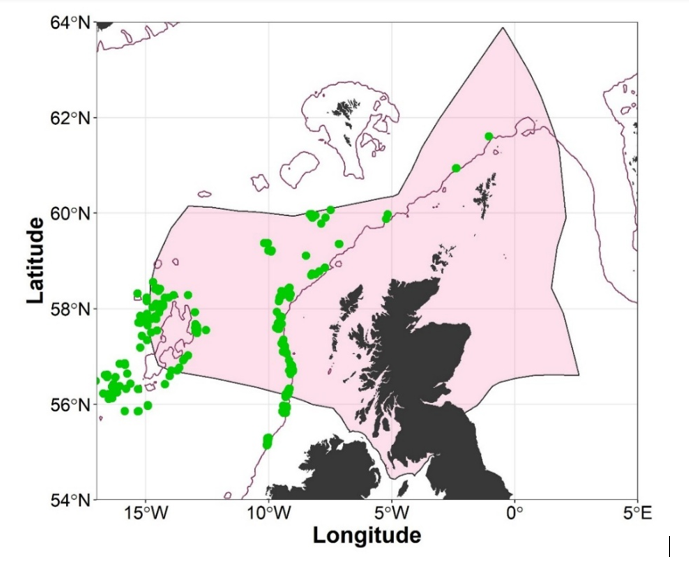
Records for Blackmouth catshark (Galeus melastomus) from SIAMISS and deep-water surveys undertaken by The Marine Directorate 1996 – 2019.
Click for a full description
Map of the economic exclusion zone (EEZ) of Scotland showing records for the Blackmouth catshark (Galeus melastomus) from Scottish-Irish anglerfish and megrim industry and science survey (SIAMISS) and deep-water fisheries surveys undertaken by Marine Directorate 1996-2019. Records are illustrated as green points and are exclusively located on the west coast of Scotland and Northern Ireland as far north as the Shetland Isles, just off the continental shelf and around the Rockall Plateau.
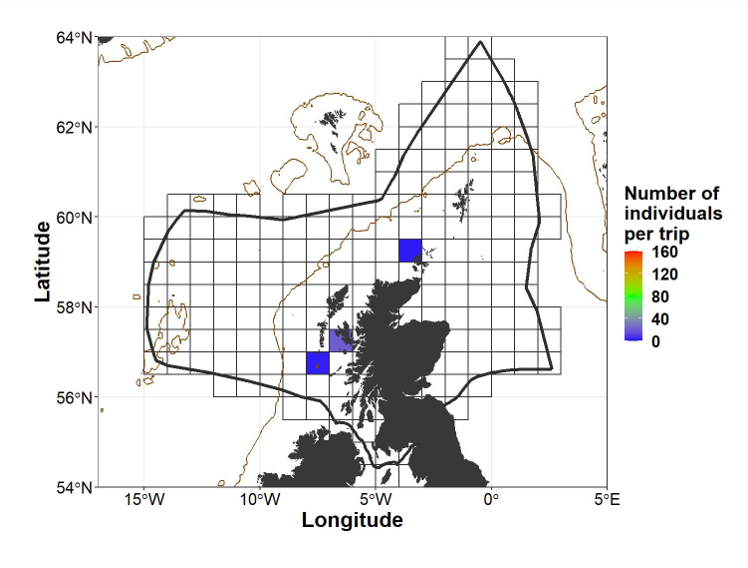
Discard data from commercial fishing vessels in ICES rectangles for Blackmouth catshark (Galeus melastomus) 2014-2018. Data is filtered to exclude information in rectangles where three vessels or less operate.
Click for a full description
Map of the economic exclusion zone (EEZ) of Scotland showing discard data for Blackmouth catshark (Galeus melastomus) recorded on commercial fishing vessels. The EEZ of Scotland is covered by a grid dividing it into the International Council for the Exploration of the Sea (ICES) rectangles. Data is filtered to exclude information in rectangles where three vessels or less operate. Values are presented as individuals per trip and represented as a heat map (blue is zero and red is 160) for each rectangle in the grid. Small numbers of discards were recorded resulting in blue rectangles in the Sea of the Hebrides, in the Minch to the southwest of the Isle of Skye and to the northwest of the Orkney Isles.
Habitat
Around the coast of the UK, Black mouth catsharks (G. Melastomus) have been recorded along continental shelves and slopes at depths of ~100 m – 1000 m (Ellis et al., 2005; Neat et al., 2015), however they have also been found in shallower waters (55 m) and as deep as 2000 m elsewhere (Abella et al., 2015., Clarke et al., 2016). The species occurs in relatively high numbers in the fjordic systems of west Scotland. Black mouth catshark were found to use the cold-water coral reef habitat to the East of Mingulay, in the Outer Hebrides, as a spawning ground. The abundance of Black mouth catshark was found to be six times higher next to the Mingulay Reef Complex compared to sites further away, and eggs were repeatedly found nested in live corals at a narrow depth range of 165 – 172 m (Henry et al., 2013). ‘Spawning sites’ in the Mingulay Reef were found to face N to ~ NW on the leeward side of prevailing SSW to NNE currents, which likely reduced the risk of eggs drifting away (Henry et al., 2013). This site now forms part of the East Mingulay Protected Area, where demersal trawling, dredging and seine netting are prohibited according to the Inshore Fishing (Prohibition of Fishing and Fishing Methods) (Scotland) Order 2015.
Biology and Ecology
Black mouth catshark are a small species, with a maximum total length of 90 cm, and are relatively fast-growing and early-maturing (Neat et al., 2015). In the Rockall Trough, the size at first maturity was estimated to be 55.6 cm (TL) for males and 59.7 cm (TL) for females. Black mouth catsharks are estimated to live for up to 10 years (Moore et al., 2013; Neat et al., 2015). The sex ratio of males to females caught in the Rockall rough was 1:1 (Moore et al., 2013; Neat et al., 2015). Studies in the Mediterranean found that females can hold 1-12 egg capsules in their oviducts, with sizes varying from 38 × 14 mm to 55 × 20 mm (Metochis et al., 2018). As is typical for catsharks (family: Scyliorhinidae), the right ovary is functional while the left is vestigial; however, both uteri are functional (Metochis et al., 2018). Off the coast of Portugal, mating and egg deposition occur year-round, with two reproductive peaks in winter and summer (Costa et al., 2005). The results of several studies indicate that Black mouth catsharks in the Atlantic attain a larger total length and a larger size at first maturity than those caught in the Mediterranean. In addition, egg cases from female Atlantic Black mouth catsharks are typically larger than those from Mediterranean females. This may be due to differences in food availability between the Mediterranean and the Northeast Atlantic (Metochis et al., 2018). Black mouth catsharks are generalist predators that feed on decapod crustaceans, cephalopods, euphausiids and mesopelagic fish. Dietary studies indicate that as they mature, the diet shifts from predominantly cephalopods and euphausiids, to decapod crustaceans and finally to a more generalist diet (Fanelli et al., 2009, RodríguezGarcía et al., 2024). Additionally, population-genetic analysis suggests differences between Scottish Black mouth catsharks and those found in the Mediterranean Sea and in Atlantic waters off Portugal (Crescenzo et al., 2022). A northward shift in species distribution from the Celtic-Biscay shelf is suggested by data collected between 1997 and 2020, which may indicate a response to changes in ocean temperatures or alterations in population numbers (Le Luherne et al., 2024).
Human interactions
Black mouth catsharks are often caught as bycatch of demersal trawl, gillnet and longline fisheries over much of their range, and larger individuals may have been landed for human consumption (generally further south, although see prohibitions from 2025). Rates of discarding can be high, but variable, and there are no data for the survival rates of Black mouth catsharks caught in fisheries (ICES, 2024). In some areas, they may also have been landed by creel/pot fishers and used as bait, especially in whelk and brown crab fisheries (ICES, 2018). The species may be of importance to recreational fisheries in some areas, including off the west coast of Scotland (Henry et al., 2013). This species is currently assessed over two management units by ICES (i) Celtic Seas and west of Scotland (Subarea 6 and Divisions 7.a–c and 7.e–j), and (ii) Bay of Biscay and Atlantic Iberian waters (Subarea 8 and Division 9.a). Advice is provided by ICES every 2 years. The last assessments of catsharks were published in 2023, covering the years 2024 and 2025, and were based on the MSY (maximum sustainable yield) approach. In 2023, ICES advised that for ICES subareas 6 and 7 “catches in each of the years 2024 and 2025 should be decreased by no less than 30% compared to the average catches in 2020-2022” (ICES 2024).
References
Clarke, M. et al., (2016) Ireland Red List No. 11: Cartilaginous fish [sharks, skates, rays and chimaeras]. Dublin, Ireland
Costa, M.E. et al., (2005) ‘Reproductive biology of the blackmouth catshark, Galeus melastomus (Chondrichthyes: Scyliorhinidae) off the south coast of Portugal’, Journal of the Marine Biological Association of the United Kingdom, 85(5), pp. 1173–1183. doi: 10.1017/S0025315405012270.
Di Crescenzo, S., Ferrari, A., Barría, C., Cannas, R., Cariani, A., Drewery, J., ... & Tinti, F. (2022). First evidence of population genetic structure of the deep-water blackmouth catshark Galeus melastomus Rafinesque, 1810. Frontiers in Marine Science, 9, 953895.
Ellis, J.R. et al., (2005) ‘The Distribution of Chondrichthyan Fishes Around the British Isles and Implications for Conservation’, Journal of Northwest Atlantic Fisheries Science, 35, pp. 195–213.
Ebert, D. A. ., & Stehmann, Matthias. (2013). Sharks, batoids and chimaeras of the North Atlantic. Food and Agriculture Organization of the United Nations.
Fanelli, E. et al., (2009) ‘Feeding habits of blackmouth catshark Galeus melastomus Rafinesque, 1810 and velvet belly lantern shark Etmopterus spinax (Linnaeus, 1758) in the western Mediterranean’, in Journal of Applied Ichthyology. John Wiley & Sons, Ltd, pp. 83–93. doi: 10.1111/j.1439-0426.2008.01112.x.
Finucci, B., Derrick, D., Neat, F.C., Pacoureau, N., Serena, F. & VanderWright, W.J. 2021. Galeus melastomus. The IUCN Red List of Threatened Species 2021: e.T161398A124477972. https://dx.doi.org/10.2305/IUCN.UK.2021-2.RLTS.T161398A124477972.en. Accessed on 10 February 2025.
Henry, L.A. et al., (2013) ‘Cold-water coral reef habitats benefit recreationally valuable sharks’, Biological Conservation. Elsevier, 161, pp. 67–70. doi: 10.1016/j.biocon.2013.03.002.
ICES (2018) Report of the Working Group on Elasmobranch Fishes (WGEF), 19-28. Lisbon, Portugal.
ICES (2024). Report of the Working Group on Elasmobranch Fishes (WGEF). ICES Scientific Reports. Report. https://doi.org/10.17895/ices.pub.26935504.v1
Le Luherne, E., Pawlowski, L., & Robert, M. (2024). Northeast Atlantic species distribution shifts over the last two decades. Global Change Biology, 30(6), e17383.
Metochis, C. P. et al., (2018) ‘Population structure and aspects of the reproductive biology of the blackmouth catshark, Galeus melastomus Rafinesque, 1810 (Chondrichthyes: Scyliorhinidae) caught accidentally off the Greek coasts’, Journal of the Marine Biological Association of the United Kingdom. Cambridge University Press, 98(4), pp. 909–925. doi: 10.1017/S0025315416001764.
Moore, D. et al., (2013) ‘Population biology and ageing of the deep water sharks Galeus melastomus, Centroselachus crepidater and Apristurus aphyodes from the Rockall Trough, north-east Atlantic’, Journal of the Marine Biological Association of the United Kingdom. Cambridge University Press, 93(7), pp. 1941–1950. doi: 10.1017/S0025315413000374.
Neat, F.C. et al., (2015) ‘The diversity, distribution and status of deep-water elasmobranchs in the Rockall Trough, north-east Atlantic Ocean’, Journal of Fish Biology. Blackwell Publishing Ltd, 87(6), pp. 1469–1488. doi: 10.1111/jfb.12822.
Rodríguez-García, C., Gonçalves Neto, J. B., García-Romero, C., Domínguez-Bustos, Á. R., & Cabrera-Castro, R. (2024). Feeding habits of two shark species: velvet belly, Etmopterus spinax (Linnaeus, 1758) and blackmouth catshark, Galeus melastomus (Rafinesque, 1810), present in fishing discards in the Gulf of Cádiz. Environmental Biology of Fishes, 107(2), 159-172.