Sharks and Skates of Scotland Report: Black dogfish (Centroscyllium fabricii)
An extract from the Sharks and Skates of Scotland Report.
Black dogfish - Centroscyllium fabricii (Reinhardt, 1825)
Occurrence in Scotland: Deep-water. Resident. Found on the slopes both sides of the Rockall Trough, to the west of Rockall, Rosemary Bank, the southern slopes of the Wyville Thomson ridge and the continental shelf off NW Scotland.
Synonym(s): Spinax fabricii; Order: Squaliformes; Family: Etmopteridae
Common name: Black dogfish
AlphaID: 105906; TSN Code: 160703
Population status
Scotland and Northeast Atlantic: Stable. No trend in abundance between 1998 and 2015 in Scottish waters (Neat et al., 2015; ICES, 2018). Considered stable in the Northeast Atlantic (Kulka et al., 2020).
Global: Stable (Kulka et al., 2020).
Conservation listings
- IUCN Red List Europe: Least Concern (assessment 14 August 2014)
- IUCN Red List Global: Least Concern (assessment 18 June 2019)
- CITES: Not listed
- CMS: Not listed
- OSPAR: Not listed
- Listed on the UK’s ‘Prohibited Species’ list as documented in the ‘Written Record of fisheries consultations between the United Kingdom and the European Union for 2025’ for UK waters of ICES Subareas 5-10
- Zero TAC under EU Regulation 2018/2025 & Regulation 2023/194
- Prohibited under EU Regulation 2025/202
- Listed on The Sharks, Skates and Rays (Prohibition of Fishing, Trans-shipment and Landing) (Scotland) Order 2012
- Included in the NEAFC measures prohibiting directed fishing for deep-sea sharks
Range and distribution
Black dogfish are a deepwater species with a wide range in the Atlantic. In the Northeast Atlantic the species can be found from Morocco up to the Porcupine Seabight, Rockall Trough, southern Norway, and across to the Faroes and along the Iceland-Faroe Ridge (Ebert & Stehmann, 2013; Blasdale et al., 2015). In the central and southeastern Atlantic, they inhabit waters along the west coast of Africa from Morocco down to South Africa, and in the western Atlantic, they can be found from south Greenland to Canada, down to the USA and in the North Gulf of Mexico (Ebert & Stehmann, 2013).
Landings data from commercial fishing vessels in ICES rectangles for Longnosed skate (Dipturus oxyrinchus) 2011-2019.
Click for a full description
Map of the economic exclusion zone (EEZ) of Scotland showing landings data per ICES (International Council for the Exploration of the Sea) rectangle for Longnosed skate (Dipturus oxyrinchus) recorded by commercial fishing vessels from 2011 to 2019. Values are presented as the number of individuals landed per trip. Data is illustrated in a heat map, colouring each ICES rectangle from 0 (white) to 81 (red). Small numbers of landings illustrated by blue rectangles representing 0 to 20 individuals were reported across the north of Scotland, up to and on the shelf edge including the waters around the Orkney and Shetland Isles, on the shelf edge to the west of Scotland, on and around the Rockall Plateau and off the east coast of Scotland between Peterhead and Aberdeen.
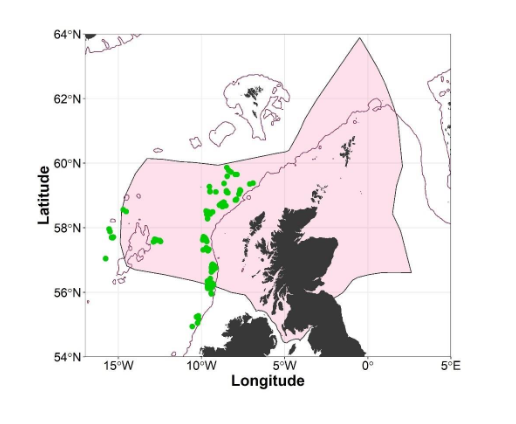
Records for the Black dogfish (Centroscyllium fabricii) from SIAMISS and deep-water fisheries surveys undertaken by the Marine Directorate 1996 – 2019.
Click for a full description
Map of the economic exclusion zone (EEZ) of Scotland showing records for the Black dogfish (Centroscyllium fabricii) from the Scottish-Irish anglerfish and megrim industry-science survey (SIAMISS) and deep-water fisheries surveys undertaken by Marine Directorate 1996-2019. Records are illustrated as green points representing survey postions where Black dogfish (C. fabricii) were recorded and are exclusively located off the west coast of Scotland and Northern Ireland off the edge of the continental shelf. Most records are to the east of the Rockall Trough (on the slope of the continental shelf) with some records in the Rockall Trough to the west and northwest of the Outer Hebrides and some records on the slopes around the Rockall Plateau.
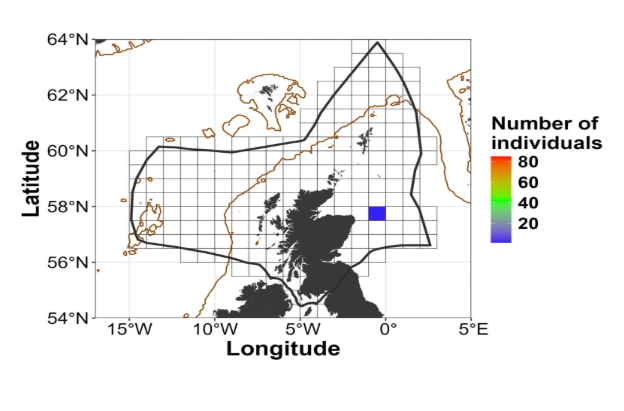
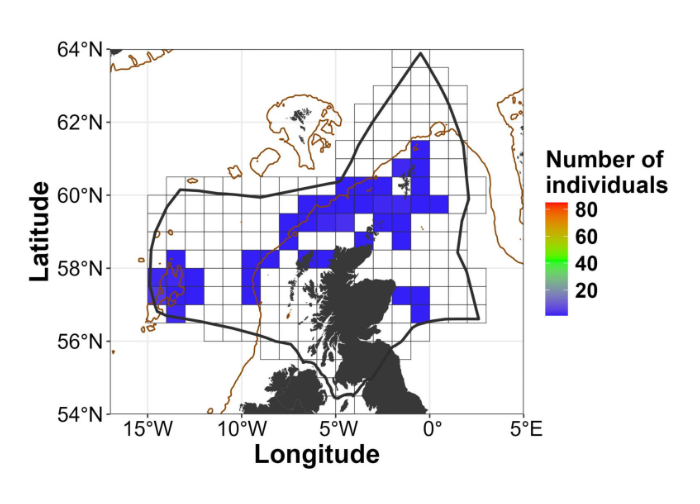
Landings data from commercial fishing vessels in ICES rectangles for Black dogfish (Centroscyllium fabricii) 2011-2019.
Click for a full description
Map of the economic exclusion zone (EEZ) of Scotland showing landings data per ICES (International Council for the Exploration of the Sea) rectangle for Black dogfish (Centroscyllium fabricii) recorded by commercial fishing vessels from 2011 to 2019. Values are presented as the number of individuals landed per trip. Data is illustrated in a heat map, colouring each ICES rectangle from 0 (white) to 81 (red). Small numbers of landings illustrated by a single blue rectangle representing 0 to 20 individuals were reported east of Peterhead.
Habitat
Black dogfish are a shoaling species that can be found on outer continental shelves and slopes at depths of 180 to 2250 m, but mostly below 275 m (Ebert & Stehmann, 2013). They are considered to be one of the most abundant shark species in these habitats and are recorded where bottom water temperatures range from 3.5 to 4.5oC, with a minimum temperature tolerance of 1oC (Ebert & Stehmann, 2013). The sharks are quite active swimmers and often occur above the bottom, actively feeding on prey in the mid-water (Ebert & Stehmann, 2013). They may also swim up towards the surface at night during winter months at higher latitudes in the North Atlantic (Ebert & Stehmann, 2013).
Biology and Ecology
Black dogfish are a medium-sized shark species reaching a maximum total length of about 107 cm in the North Atlantic, with females generally growing larger than males (Ebert & Stehmann, 2013). Radiocarbon dating of eye lenses indicates that they can attain an age of at least 53 years (Hedeholm et al., 2021). Male and female Black dogfish off western Greenland were found to reach sexual maturity at 55 cm TL and 65 cm, respectively. They are a viviparous species, producing young that measure approximately 16–19 cm in length at birth, and litter sizes ranged from 4 to 40, with an average of 16 to 4 pups (Yano, 1995). The breeding season is not well defined (Yano, 1995; Jakobsdóttir, 2001), although more gravid females appear to be present between August and November than at other times of the year (Ebert & Stehmann, 2013).
Black dogfish show clear patterns of segregation according to sex and size within the water column, with greater proportion of females being found in deeper water (>1000 m), whereas males were more numerous in the shallower parts of the species range (<1000 m) (Yano, 1995; Jakobsdóttir, 2001). In addition, smaller individuals (<48 cm total length) have been found to occur in shallower water (mostly less than 800 m) than the adults, which occur mostly below 750 m. Shoaling of Black dogfish increases during winter and spring, when populations have been found to move into shallower water (Ebert & Stehmann, 2013). Evidence from the Gulf of St. Lawrence in Canada suggests that females move into the shallower water to give birth. The deep Laurentian channel which bisects the gulf is a pupping and nursery ground for the species, with juvenile Black dogfish moving through the channel out to the continental slope as they grow (Kulka et al., 2022). Dietary studies have found that larger Black dogfish mainly feed on teleost fish, but smaller individuals feed more opportunistically on a rage of species, including teleosts, cephalopods and crustaceans (Jakobsdóttir, 2001).
Human interactions
There is currently no targeted fishery for this species, and it has been subject to a zero TAC since 2010 and the species has been listed as prohibited since 2015 (ICES, 2024). Bycatch and discards are thought to be relatively low, with discard mortality unknown (ICES 2024). The species is offered some refuge from fisheries because a large proportion of the population occurs at depths beyond the limit of deepwater fisheries (<1000 m) in the Northeast Atlantic.
References
Blasdale, T. et al., (2015) Black Dogfish, Centroscyllium fabricii, The IUCN Red List of Threatened Species 2015: e.T161521A48945920. (Accessed: 28 February 2020).
Ebert, D. A. and Stehmann, M. F. W. (2013) Sharks, batoids, and chimaeras of the North Atlantic. FAO Species Catalogue for Fishery Purposes. No. 7. Rome: Food and Agricultural Organization of the United Nations (FAO).
ICES (2024). Report of the Working Group on Elasmobranch Fishes (WGEF). ICES Scientific Reports. 06:75. 994 pp.
Hedeholm, R., Qvist, T., Frausing, M., Olsen, J., Nielsen, J., & Grønkjær, P. (2021). Age of black dogfish (Centroscyllium fabricii) estimated from fin spines growth bands and eye lens bomb radiocarbon dating. Polar Biology, 44, 751-759.
Jakobsdóttir, K.B. (2001) ‘Biological aspects of two deep-water squalid sharks: Centroscyllium fabricii (Reinhardt, 1825) and Etmopterus princeps (Collett, 1904) in Icelandic waters’, in Fisheries Research. Elsevier, pp. 247–265. doi: 10.1016/S0165-7836(01)00250-8.
Kulka, D.W., Anderson, B., Cotton, C.F., Herman, K., Pacoureau, N. & Dulvy, N.K. 2020. Centroscyllium fabricii. The IUCN Red List of Threatened Species 2020: e.T161521A124499082.
Kulka, D. W., Sulikowski, J. A., & Cotton, C. F. (2022). Spatial ecology of black dogfish (Centroscyllium fabricii) in deep waters off Canada: first record of a nursery, pupping ground and long-distance migration for a deepwater demersal shark. Marine and Freshwater Research, 73(8), 1025-1040.
Neat, F.C. et al., (2015) ‘The diversity, distribution and status of deep-water elasmobranchs in the Rockall Trough, north-east Atlantic Ocean’, Journal of Fish Biology. Blackwell Publishing Ltd, 87(6), pp. 1469–1488. doi: 10.1111/jfb.12822.
Yano, K. (1995) ‘Reproductive Biology of the Black Dogfish, Centroscyllilim Fabricii Collected from Waters off Western Greenland’, Journal of the Marine Biological Association of the United Kingdom. Cambridge University Press, 75(2), pp. 285–310. doi: 10.1017/S002531540001818X.