Scottish Biodiversity Strategy: Delivery Plan Action 2.1
Landscape and catchment scale nature restoration: Next steps
March 2026
Summary
Following an engagement paper on landscape scale nature restoration in October 2025 and careful consideration by agencies, a set of landscape scale exemplar projects and priorities for agency engagement have now been agreed. This document:
- Sets out the priorities for the year ahead
- Responds to feedback from the engagement process and provides an action plan to address challenges identified
- Sets out the next steps for the delivery of Scottish Biodiversity Strategy (SBS) action 2.1
Catchments, resilience and the climate emergency
Based on feedback to the engagement paper and further work within the agencies, we have strengthened the focus on river catchments and climate adaptation / resilience. In 2025, the urgent need to adapt to climate change became ever more apparent, with unprecedented flooding, wildfires and droughts affecting communities, land managers and businesses across Scotland.
Nature restoration has an essential role to play in building resilience to climate change (Scottish National Adaptation Plan 3 – action NC2) particularly in the agriculture, drinking water and food and drink sectors. We have taken this into account when identifying the exemplars and priorities set out below. We will work with SEPA to further refine this approach in the development of River Basin Management Plan 4 to ensure agencies are targeting our resources at the locations where we can best help Scotland’s communities and economy adapt to climate change, taking account of the Flood Resilience Strategy and other plans.
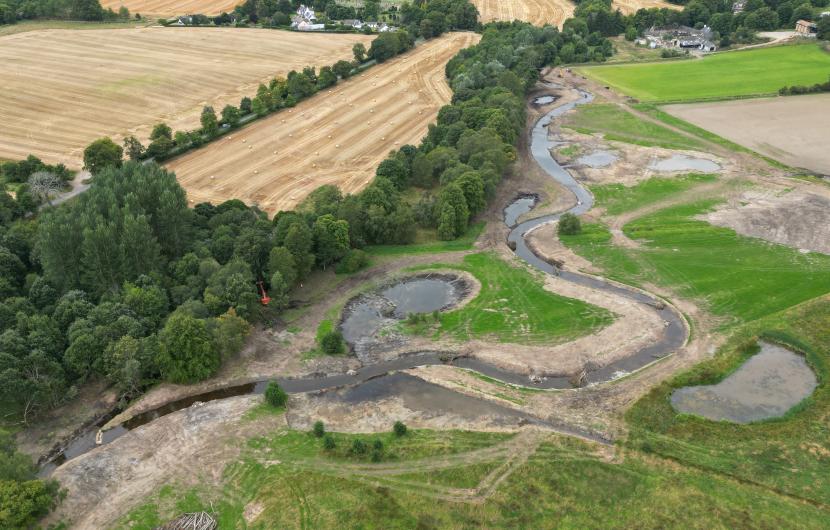
Aerial image of River Peffery Restoration Project
River catchments are the most appropriate scale at which to prioritise action to build climate resilience and resolve conflict between competing priorities. We will focus our efforts on finding new ways to scale up delivery in two ‘Pioneer’ catchments, the Dee and South Esk / Angus Glens, helping to deliver Public Service Reform.
Background
NatureScot, working with the Scottish Government, Forestry and Land Scotland, Scottish Environment Protection Agency, Scottish Water and Scottish Forestry, has reviewed and prioritised the existing landscape scale restoration projects across Scotland and identified 9 exemplar projects. These are the priorities for the agencies involved – to steer where we will focus our efforts and resources as agencies in the next financial year. They are not ‘priority landscapes’ – they are a prioritised list of current landscape scale projects in Scotland.
There are three categories of project, summarised in the diagram below. The “Exemplars” are the highest priority for agencies, followed by “Areas of Focus” and then “Landscape scale projects led by local partners.”
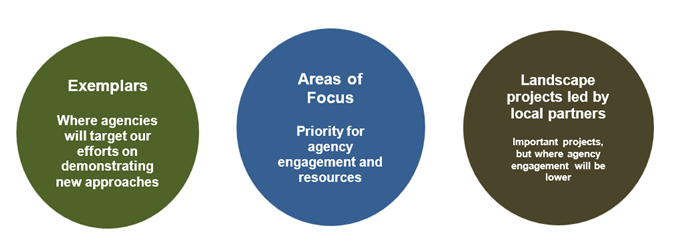
Delivery Plan Action 2.1 - Project Summary
Click for a full description
Graphic showing the three categories of landscape scale project identified and explaining what these are:
- Exemplars: Where agencies will target our efforts on demonstrating new approaches;
- Areas of Focus: Priority for agency engagement and resources;
- Landscape projects led by local partners: Important projects, but where agency engagement will be lower
It is important to emphasise that we have prioritised the landscape scale nature restoration projects in terms of agency engagement and resources. These priorities are not intended for, and should not be used by, other funders, stakeholders and investors to determine your own priorities. They are designed to target agency resources alone, helping us to deliver our own corporate outcomes. We encourage those investing in these projects to continue doing so using your own criteria and priorities and we welcome dialogue to help align our approaches to make sure that all landscape scale nature restoration projects in Scotland continue to receive the investment and support required.
We also emphasise that we have been prioritising existing projects through this process, not ‘landscapes’. We recognise that there are gaps across Scotland where landscape scale approaches will be needed in future and we will consider these in 2026/27. We are not suggesting that other landscapes aren’t important or that restoration isn’t needed – we’ve only prioritised the existing projects so far.
The projects listed below sit alongside:
National Parks
National Parks are de facto Areas of Focus. They are defined places where the public sector already works collaboratively to prioritise and focus effort around a set of ambitious targets for nature restoration at landscape scale. National Park Partnership Plans set the framework for all public bodies that work within the National Parks, supported and delivered by a range of private and voluntary organisations. The Park Authorities bring the additional resource, coordination and finance to make things happen on the ground.
Scotland’s two National Parks are already high profile examples of the nation’s ambitions for collaborative action to deliver nature restoration at a landscape scale. Both have led or helped deliver existing exemplar projects such as Cairngorms Connect and The Great Trossachs Forest, which are already demonstrating the value of a landscape scale approach.
National Nature Reserves
National Nature Reserves also sit within, and have often helped drive forward, landscape scale restoration projects. Those reserves, owned and managed by a range of agencies and NGOs are, like the National Parks, important places where we can demonstrate what the highest standards of nature restoration look like. Increasingly, National Nature Reserves are also demonstrating what high integrity, responsible private investment looks like to support delivery of the Natural Capital Markets Framework.
Existing case studies
Landscape partnerships, rivers trusts, NGOs and communities across Scotland have been working at landscape scale for many years. The projects listed below, and the exemplars which we will focus on in the year ahead, sit alongside other examples of landscape scale restoration available on our website. We commend these projects and partnerships for leading the way, and we seek to build on your success.
Other actions in the Scottish Biodiversity Strategy
This action is just one of over 100 in the SBS Delivery Plan. This work sits alongside a wide range of other activity including the Nature Restoration Fund, Peatland Action, Species on the Edge and the Scottish Invasive Non Native Species (INNS) plan, for example, all of which are helping to restore nature and tackle climate change. However, by driving landscape scale activity, action 2.1 is an overarching task which brings together a wide range of SBS actions to deliver these on the ground.
Priorities for 2026/27
Exemplars
The purpose of the exemplar projects, which have been confirmed by Ministers, is to demonstrate how collaborative, landscape scale nature restoration can support nature and help us adapt to climate change (see annex 1). We will work together to accelerate and scale up restoration in these areas.
The agencies will work with local partners to deliver benefits for biodiversity, climate resilience, communities, infrastructure and the economy. These will be ‘lighthouse’ projects which will demonstrate the benefits of a landscape scale approach. We will scale up public and private investment in these areas, using FIRNS, LENS and other models to attract nature finance.
We will use existing funding streams and tools to do this. Exemplar projects, and smaller projects within in them, are not guaranteed funding – they still need to meet the criteria in the various public grant schemes.
We have selected a range of exemplar projects which will demonstrate different approaches in different landscapes across Scotland, including: peatland, agricultural, rainforest, coastal and lowland contexts and across a wide range of land tenures.
Within the exemplar projects, two are particularly important: the Dee Catchment and the S Esk / Angus Glens. These ‘pioneer’ catchment projects will test new approaches to delivering Public Service Reform and attracting nature finance at catchment scale. They have a strong focus on resilience, demonstrating how nature restoration can protect communities, businesses and infrastructure from climate change.
Areas of Focus
These are landscape scale nature restoration projects which are high priority for agency engagement. The engagement of agencies varies depending on the project scope and priorities. The Areas of Focus are not guaranteed funding from agencies and the existing criteria for funding schemes still apply. They are primarily about where we focus our discretionary staff time and effort.
The extent to which the agencies can pivot funding towards both the Exemplars and the Areas of Focus varies from fund to fund. For example, there is some flexibility in the way NatureScot targets the Nature Restoration Fund compared to the specific outcomes that are supported through the Water Environment Fund managed by SEPA. Similarly, the Scottish Forestry Grant Scheme (SFGS) is already targeted at specific outcomes identified in the Scottish Forest Strategy (the SFGS will be reviewed in due course and until such time the SFGS criteria won’t change). Staff in Scottish Forestry will consider the landscape scale priorities alongside the existing SFGS criteria.
Landscape scale projects led by local partners
These projects will make an important contribution to the delivery of the SBS (and other plans and strategies) but are of lower priority for agency staff engagement (see Annex 3). We will continue to fund projects in these areas where they meet the criteria in grant funding schemes and budgets allow. We will continue to fulfil our statutory / regulatory duties for these projects (e.g. consents, advice on protected areas, protected species, licensing etc) – but our proactive engagement will be lower than for the “Exemplars” and “Areas of Focus”. Individual agencies may of course put more resource into some of these projects depending on statutory roles, individual corporate plans and any risks identified.
Maps
Maps showing these projects are included on our webpage: Nature Restoration at Landscape Scale. It is important to stress that:
- The maps do not imply that nature restoration will be delivered across the entire area shown
- The boundaries show the scale at which partnerships are working, but not all land managers will be engaged, and some may not support, or be able to accommodate, nature restoration on their land
- These maps do not replace existing plans such as National Park Partnership Plans, Regional Land Use Frameworks and other plans and strategies. They simply show the extent of collaborative landscape scale partnerships
Responses to engagement paper
NatureScot shared an engagement paper on landscape scale restoration in October 2025 and received 25 responses. The agencies involved in this work greatly value the feedback received and appreciate the time that was put into these. The responses helped to:
- Shape our approach to this process
- Refine the list of exemplar projects, with one new project being added to the list and others being merged to provide a comprehensive suite of projects covering the habitat and land use types highlighted in responses
- Improve our understanding of the challenges faced by the organisations delivering landscape scale restoration projects on the ground.
Summary of feedback
The key messages in the responses were:
- Broad support for the process and the need to prioritise
- Support for landscape scale approaches and greater collaboration
- No specific criticism of proposed exemplars
- Several new projects identified and some additional projects proposed as exemplars
- Perception that the priorities are overly focussed on public land and agency projects
- Gaps identified for: Islands, pollinators, grassland, communities
- Expectation of wholly ‘new’ projects and some disappointment that ambition and resources are not being increased
- Concerns about the impact of prioritisation on funding and nature finance
- Habitat restoration, species and INNS should be prioritised together
Key challenges identified
The key challenges identified in the responses to the engagement paper included:
- The need for long term funding for projects and organisations delivering projects. This was raised by the majority of responses and highlighted as a key barrier.
- The need to test the use of regulation 9d on protected areas to allow for appropriate habitat change to support nature restoration
- The slow pace of change on Agricultural Reform, which creates uncertainty amongst land managers
- Deer management and the impact of high deer densities on the delivery and cost of projects on the ground
Action Plan
To address the challenges identified in the responses to the engagement paper we have developed a short action plan in annex 4. The agencies will work together to address these challenges and provide an update on progress later in 2026.
Next steps
In financial year 2026/27 we will:
- Set up a community of practice to share lessons from the exemplars and other landscape scale projects
- Publish a new nature restoration dashboard on our website to show the range of restoration activity across Scotland
- Report on progress in the exemplars in summer 2026 and then again at the end of 2026
- Identify new projects in Q2 26/27
- Start work to co design a pipeline of projects out to 2045, including new landscape scale projects, with a wide range of stakeholders
- Work together on the development of River Basin Management Plan 4 to identify priority catchments for nature restoration
FAQs and Annexes 1-4
Frequently Asked Questions
If you have questions about the prioritisation of these projects which aren’t answered below, please visit the FAQs section on our website or contact [email protected]
What’s changed from 2025/26 to 2026/27?
A set of interim priorities were agreed by the agencies in June 2025 and shared on NatureScot’s website. These were updated in December 2026. The main changes are:
- Projects which have been confirmed as ‘exemplars’ have been removed from the Areas of Focus list
- Three new Areas of Focus have been added in the Nith and Spey catchments and in Affric Highland
- Six new projects have been added to the list of projects ‘led by local partners’: Ericht catchment; Muir to Forth, Summit to Sea, Rannoch Connections, Lunan Burn wildlife cluster, Caerlaverock landscape restoration
Which projects have been included?
The dataset we have prioritised includes:
- Long term restoration projects which will take many years to deliver, not short-term interventions
- Projects working across multiple land holdings, including private, public, NGO and community land holdings. We have not included projects on single estates or land holdings – but recognise the good work being delivered by them.
- Generally larger projects, but we have included some smaller projects which we know are looking to or are actively working to scale up their activity
- Projects in which NatureScot and the other agencies have a significant role.
We aim to add additional projects in 2026/27, including those being led by single estates, emerging community led projects and other new projects that have emerged since June 2025.
Are these designations?
No. These are voluntary nature restoration initiatives. The boundaries shown do not imply that nature restoration will be delivered across the entire area, nor are the boundaries fixed. The projects are working with land managers to identify suitable locations to restore nature alongside existing land use, protected areas and development.
How did we reach these conclusions?
Each of the landscape scale nature restoration projects has been objectively scored against six criteria and then discussed by the Landscape Scale Nature Restoration Governance Group. The process included a wide range of policy considerations (SBS, Climate Change Plan, SNAP3, RBMP) as well as operational considerations for each agency (e.g. Scottish Water highlighted where they face the greatest challenges for climate adaptation; SEPA considered factors such as flood risk and diffuse pollution, and Scottish Forestry considered the Rainforest Strategic Approach and other policy documents). We then took account of feedback from stakeholder engagement through summer and autumn 2025.
What about communities and community engagement?
The landscape scale projects listed below will, or in many cases already have, engage with communities locally. Engagement is best delivered at the local level, and guidance is available from the Scottish Land Commission to support this. There are several community led projects in the dataset, and one community led exemplar.
Is this just about habitat restoration?
All of the projects listed below are delivering, or planning to deliver, habitat restoration. That involves many forms of restoration and can include the control of invasive non-native species (INNS), natural flood management, the management of deer and may involve species or plant reintroduction.
What about green infrastructure and urban areas?
The delivery of green infrastructure, nature networks and climate resilience in urban areas, towns and communities is vitally important. These are being driven by other plans and strategies, including Nature Network Strategies, Local Development Plans and NPF4 and have not been prioritised through this process – through some projects such as the Climate Forests will deliver benefits in urban areas.
How will these projects be scaled up?
Agencies will make better use of public funding streams and work with local partners to find new ways to pay for restoration using nature finance. For example, we are supporting the development of Landscape Enterprise Networks and Riverwoods to mobilise private capital alongside public funding, while investment in peatland and woodland through the carbon codes continues to grow.
What about other projects?
Other projects protecting species, habitats and communities are also important and are funded through different funding streams. We still need businesses, charitable organisations and other funders to help finance the restoration of nature and hope to see private and philanthropic contributions continue to increase.
What support is there to help my project deliver restoration?
There are several public funding streams supporting nature restoration:
- Peatland Action
- Nature Restoration Fund
- Scottish Forest Grant Scheme
- Water Environment Fund
- Agri Climate Environment Scheme
The Facility for Investment Ready Nature in Scotland (FIRNS) funds projects to develop mechanisms to attract nature finance. The Nature Finance Pioneers is a space where projects, developers and investors come together to explore nature finance and a new investment prospectus will be live shortly. The Natural Capital Tool is free for projects to use to help identify opportunities and prioritise interventions. Support for communities is available from the Natural Capital Community Partnerships Programme led by Community Land Scotland.
Agencies have limited resources to engage in and help support projects which are not Exemplars or Areas of Focus. Please refer to the webpages for the above public grant schemes first.
A community of practice to support projects will be developed next year.
Is there new funding available for these projects?
No. We will use existing funding streams and resources to support these projects and we anticipate that nature finance will make an increasing contribution
When will these priorities be reviewed?
The priorities will be reviewed in Q3 (Oct – Dec) each year and can be adjusted as new projects emerge, policies evolve and to reflect delivery on the ground. They are not set in stone.
Each year we will go through a cycle of identifying new projects, prioritising these alongside existing projects and then assigning resources in Q4 as shown in the graphic below.
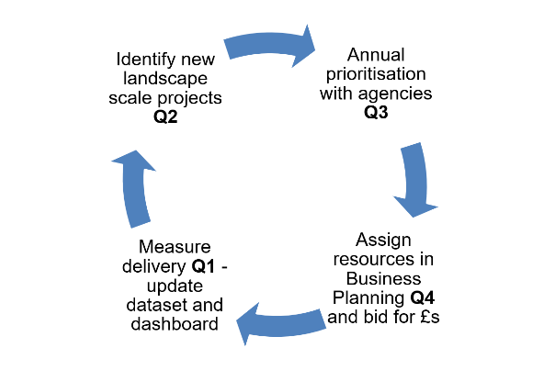
Project prioritisation cycle
Click for a full description
Graphic showing the annual cycle of prioritisation for landscape scale restoration projects in Scotland. Q1 Measure delivery; Q2 identify new projects; Q3 annual prioritisation by agencies; Q4 assign resources in business plans.
What about INNS and species projects working at landscape scale?
These projects are being prioritised through separate processes, including the emerging Scottish INNS Plan, Scottish Biodiversity List and other SBS actions. Some of the projects in the lists below are also tackling INNS and species issues – but their primary focus is habitat restoration. The teams prioritising these projects are working together to make sure that activity is focussed on the most important locations and issues across Scotland and we will continue to jointly prioritise our resources.
What about new projects?
If you are involved in, or aware of, the development of new landscape scale restoration projects which meet the criteria above and are not listed below, please send details, including a map, to [email protected]. We will put out a call for new projects in summer 2026.
Annex 1 – Landscape scale exemplars
| Project | Key opportunities for demonstration |
|---|---|
| Dee catchment restoration | Catchment scale working, climate adaptation, Public Service Reform |
| Flow Country | Peatland finance, carbon emissions, forest to bog, community land |
West coast rainforest and pinewoods, including
| Pinewood, rainforest, community led projects, community land holding, nature finance |
Climate Forests, including; Forth, Clyde, Fife, East and West Lothian and potentially further climate forests if developed | Benefits to communities, climate adaptation, health and wellbeing, SIMD, nature finance |
| South Esk catchment restoration, including the Angus Glens | Catchment scale working, climate adaptation, LENS, Public Service Reform |
Loch Lomond and Trossachs Landscape Connections, including;
| Drinking water, climate resilience, nature finance, Nature Networks, recreation and access |
| Flowing Forward – Restoring Galloway’s Rivers and Solway Coast and Marine Project, Landscape Connections | Coastal edge and source to sea, climate adaptation, nature finance, river restoration, water quality |
Tweed catchment, including;
| Climate adaptation, nature finance, pollinators, riparian woodland, drinking water resilience, LENS |
| Moray Farm Cluster | Piloting new ways to pay for nature restoration and nature networks in an intensively farmed landscape |
Annex 2 - “Areas of Focus” – landscape scale nature restoration projects which are high priority for multiple agency engagement in 2026/27
- A83 Rest and Be Thankful
- Affric Highland
- Allan Water Partnership
- Appin / Glen Creran Woodland Restoration Project
- Cairngorms Connect
- Clyde Mission
- Cowal Rainforest
- Craignish Rainforest
- Eden catchment (Fife)
- Esk (Lothian)
- Glasgow Clyde Valley Green Network Partnership
- Glen Torridon Partnership
- Knapdale Rainforest
- Leven Programme (Fife)
- Metropolitan Glasgow Strategic Drainage Partnership
- Nevis Landscape Partnership / Nature Network
- Nith Catchment
- Spey Catchment Initiative
- Ugie Peatlands Partnership
Annex 3 – “Landscape scale projects led by local partners” which are lower priority for agency engagement in 2026/27
These projects will make an important contribution towards the delivery of the SBS and other plans and strategies. Agencies will still fund these projects where budgets allow, and they meet the criteria for our funding streams. Other funders should not be influenced by these priorities which are for agencies only.
- Aline Catchment Restoration
- Almond Headwaters project
- Beyond the Endrick
- Cairnsmore to Loch Ken landscape project
- Caerlaverock landscape restoration
- Central Scotland Green Network
- Coalfield Communities Landscape Partnership
- Coigach and Assynt Living Landscape
- Cumbernauld Living Landscape
- Devon Restoration
- East Cairngorms Moorland Partnership
- Eddleston Water Project
- Ericht Catchment
- Findhorn Watershed Initiative
- Glenkens - community led landscape scale restoration
- Inner Forth Futures
- Loch Abar Mor
- Loch Leven Catchment Partnership and Loch Leven LENS
- Lunan Lochs Farm Cluster
- Monadhliath DMG peatland restoration
- Moray Farm Cluster
- Muir to Forth
- Pairc (Lewis)
- Peffery Catchment Project
- Pentland Hills Land Managers Assoc
- Perthshire Nature Connections Partnership
- Rannoch Connections
- Restoring the St Andrews Coastal Habitat Network
- Shetland Peatland Partnership
- Skye Connect
- South Assynt Rainforest
- Strathmore - community led flood management
- Summit to Sea
- Tarras Valley nature reserve
- Upper Leader Water Restoration
- West Grampian DMG nature restoration project
- West Loch Ness Farm Cluster
Annex 4 – action plan
This action plan summarises the main challenges identified by responses to the engagement paper in autumn 2025 and how the agencies intend to respond to these in financial year 2026/27. We will report on progress in summer 2026.
The list below show the challenges identified, proposed action and the lead agency/group:
Need for long term funding for projects and organisations delivering projects
- The agencies will discuss whether it is possible to make longer term funding commitments to projects using existing funding streams. We recognise that annualised or short-term budget commitments are a barrier to delivery and affect retention of staff.
NatureScot - The agencies will explore with Scottish Government whether longer term commitments to the NRF and other funds can be made year on year.
Governance Group - Agencies will redouble our efforts to support nature finance approaches that secure longer term finance for nature restoration.
All agencies, FIRNS team, Private Investment in Natural Capital team - Agencies will work with HLF, the Environment Funders Network and others to help secure longer-term funding for projects.
NatureScot funding team
Test the use of regulation 9d on protected areas to allow for appropriate habitat change to support nature restoration
- The cabinet secretary has committed to a short-term working group to consider whether new guidance is needed on the habitats regulations.
Scottish Government
Agricultural Reform
- All agencies will continue to work with the Scottish Government to shape future agricultural support and develop incentives for collaborative landscape scale restoration.
All agencies
Deer
- NatureScot is already working with the other agencies to adjust Deer Priority Areas to reflect the landscape scale priorities and ensure that resource on wildlife management is focussed in the right locations. We will use the statutory powers (including the new 6ZB provision in the Natural Environment Act, 2026) and resources we have available to deliver deer management in the priority areas.
NatureScot
Links between species conservation / INNS projects
- We will review the relative priority of all landscape scale and species / INNS projects by the end of 2026/27.
NatureScot