Proposal to implement BACI monitoring for South Arran MPA and Sound of Barra SAC in relation to proposed PMF management areas
Please note - The advice below was produced by NatureScot (initially in July 2023, and finalised in March 2024) to assist the development of proposed management measures for fishing activity for MPAs and PMFs (11 most sensitive to bottom contact gear) outwith MPAs. Further considerations were made by Marine Directorate and the final proposed management measures being consulted upon in 2026 are available via Scottish Government’s website.
Note since this advice was provided the Sound of Barra is now a SAC rather than a Site of Community Importance (SCI), but the SCI terminology has been retained. In the March 2024 finalised advice, there was reference to consultation dates that were planned at that time. These have been removed to reduce the potential for confusion. Minor updates have also been made to the maps so that these reflect the proposed PMF management areas being consulted upon in 2026.
March 2024
Introduction
To assess the effectiveness of management measures on maerl habitats NatureScot proposes the continuation of BACI (BACI (Before After Control Impact) survey design is a statistically powerful and effective method to assess the magnitude of anthropogenic variables whilst isolating such impacts from natural variability (definition taken from Ocean Science Consulting Survey Design) monitoring principles for two MPAs with maerl bed protected features: Sound of Barra SCI and South Arran MPA. This would benefit our ability to evidence the outcomes attributable to the introduction of management measures at these two MPAs and the wider network, but requires the removal of two proposed Priority Marine Feature (PMF) management areas from further consideration under the project ‘Improving protection given to Priority Marine Features outside the Marine Protected Area network’ initiated in May 2017. (See Improving protection given to Priority Marine Features outside the Marine Protected Area network). This paper outlines why NatureScot considers this proposal achieves an appropriate balance between monitoring priorities and the national status of this PMF, and seeks agreement with the Scottish Government’s Marine Directorate to proceed on the recommended basis.
Background
The Scottish Marine Protected Areas (MPA) Monitoring Strategy (See Scottish Marine Protected Areas (MPA) Monitoring Strategy) sets out the direction, principles and priorities for MPA-related monitoring in Scotland. Section 6 of the Strategy commits us to an adaptive approach to the management of MPAs, and outlines the key objectives a monitoring programme should fulfil to enable an evidence-led approach:
- to determine the condition of the protected features;
- to identify any changes in the features over time;
- to assess whether implemented management measures are effective in meeting their objectives.
Maerl beds are a protected feature of 11 MPAs in Scotland’s territorial waters: Loch Laxford; Loch nam Madadh; Sound of Arisaig; Luce Bay; Sound of Barra; Fetlar to Haroldswick; Wyre and Rousay Sounds; Loch Sween; Wester Ross; South Arran; and Loch Carron.
There is considerable evidence (See Feature Activity Sensitivity Tool (FeAST) for summary) to show that scallop dredging negatively impacts on maerl bed condition (and other MPA seabed habitat features) primarily through abrasion, removal of non-target species and increased siltation. Based on that evidence, the South Arran Marine Conservation Order 2015 (See South Arran Marine Conservation Order 2015) prohibits the use of dredges and limits the use of demersal trawls within the MPA to promote the conservation objectives of the site (including the recovery of its maerl beds). Similar measures are in place or are active proposals across the other 10 MPAs. For example, the Scottish Government’s Marine Directorate plan to consult on management measures for Sound of Barra SCI. Relevant to fishing activity, NatureScot’s management advice for the subtidal sandbanks feature of the SCI is as follows:
‘Remove or avoid pressures is recommended where maerl beds and seagrass beds are present. Spatial exclusion of demersal mobile/active gear is recommended in the areas of these habitats within the site.
The introduction of restrictions on dredging in nine MPAs in 2015/16 and the potential for similar measures (in particular at Sound of Barra SCI) next year, have been contentious in some locations due to the predicted socio-economic impact on fishing and local communities. In addition, despite evidence from elsewhere, there is scepticism amongst some stakeholders about whether the management is necessary for the conservation objectives of the sites to be met, or to deliver feature recovery.
NatureScot considers that by investing time and resources in a proportionate BACI monitoring approach we will be better placed to evidence change as a result of management measures and review their effectiveness within a robust statistical framework. The approach is in line with the Scottish MPA Strategy and would help meet our obligations under section 91 of the Marine (Scotland) Act 2010.
What a BACI approach to monitoring maerl beds within MPAs could look like
A key principle set out in the 2017 Monitoring Strategy is that the adoption of a sample-based approach to monitoring will help deliver a cost-effective means to meeting our assessment requirements. Sound of Barra SCI and South Arran MPA constitute two examples where we are fortunate to have good ecological baseline data (pre-management measures), a partial understanding of previous and current fishing activity which overlaps with maerl beds (and the wider subtidal sandbanks feature for Sound of Barra SCI) and the presence of adjacent control sites that remain subject to fishing pressure. That is not the case with the other nine MPAs listed above. Between them the two sites are broadly representative of the diversity of maerl bed habitat types likely to be most frequently exposed to towed, bottom-contacting fishing within Scotland’s inshore waters. As a consequence, South Arran and Sound of Barra represent the best opportunities to adopt a BACI approach to determining site condition and fisheries management effectiveness for maerl beds. By selecting both Sound of Barra and South Arran sites for a BACI monitoring approach NatureScot considers that an appropriate balance would be struck between costs and providing the evidence to underpin and review the management measures seeking to protect maerl bed features within MPAs.
Adopting BACI principles to monitoring Sound of Barra SCI and South Arran MPA relies on being able to undertake a comparative analysis of maerl bed condition before and after the introduction of management measures, both within and outwith the site’s management boundaries for fishing activities. Having areas of ecologically comparable maerl bed close to each site that are not subject to management measures, ensures a significantly higher level of confidence in attributing the causes of changes in maerl bed condition observed over time. The method, described in the Strategy as Type 3 monitoring (See Appendix 1 of this paper (below) detailing the four monitoring types defined in the Strategy.), enables an analysis of the impacts of fisheries management measures in isolation from other potential drivers of change, such as storm events and climate change.
We have designed a sampling approach to inform BACI studies at both sites and have undertaken monitoring to establish baseline conditions, and in South Arran to investigate any early indications of the effectiveness of management measures. The approach at each site is detailed below.
Figure 1 below shows the established monitoring boxes for South Arran MPA. Boxes D1 – 6 are those identified for coarse substrate habitat features including maerl beds. The other monitoring boxes are for burrowed mud which are not considered in this paper as this is not one of the features being considered for the development of the PMF management areas. These locations which were first surveyed in 2016, are expected to be incorporated into the ongoing BACI study design. The only established control site (box D3 to the north-east of the MPA) overlaps with the proposed Merkland proposed PMF management area (see inset) that if approved would close it to mobile demersal fishing pressure and remove its viability as a control.
Figure 2 shows the selected monitoring boxes for Sound of Barra. Boxes S2-11 are those identified for maerl beds and other coarse sediments habitats that form part of the Annex I subtidal sandbanks feature. Further work has been undertaken this year to repeat the surveys prior to the anticipated 2024 consultation regarding the potential introduction of fisheries management measures for the site. Two of the control boxes (S8 and S9 to the south of the MPA) are within the South-East Barra proposed PMF management area.
NatureScot had originally proposed that a third BACI study be adopted for Wester Ross MPA using Red Point and Port Erradale/Gairloch proposed PMF management areas as control sites. We have since chosen not to proceed with that proposal after further consideration of what additional evidence a third study might add, weighed against the resources required to undertake such a study. Wester Ross MPA is considered to be less suitable for a BACI study given the relative lower confidence in the viability of the proposed control sites, and the relative lack of ‘before’ data there is in comparison to Sound of Barra SCI and South Arran MPA. In 2023 NatureScot undertook video and grab sampling within the Red Point and Port Erradale/Gairloch proposed PMF management areas. The data gained here and elsewhere could prove beneficial in the development of a monitoring approach for PMF management areas.
The results of these two BACI studies would complement a wider benthic monitoring programme to provide a proportionate approach to the monitoring of the MPA network by utilising Type 1 (undertaking an assessment of feature condition) and Type 2 (understanding pressure-state relationships which explore the association between activities, the level of intensity and the resultant influence on feature condition) methods elsewhere. For further detail on monitoring types please see Appendix 1. The development of a monitoring programme that utilises a range of approaches including these two BACI studies, will benefit our ability to fulfil our reporting obligations and in future review the effectiveness of management measures.
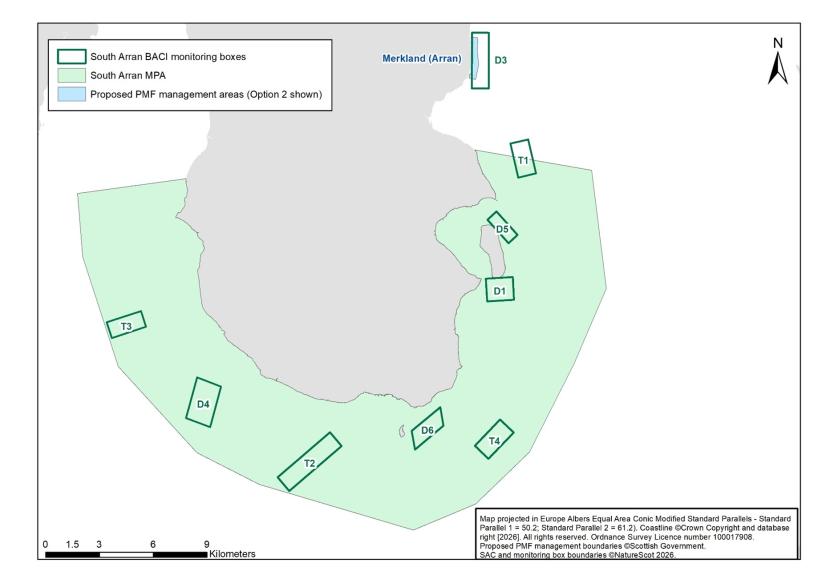
Figure 1. Proposed South Arran BACI monitoring approach showing established monitoring boxes and proposed PMF management areas
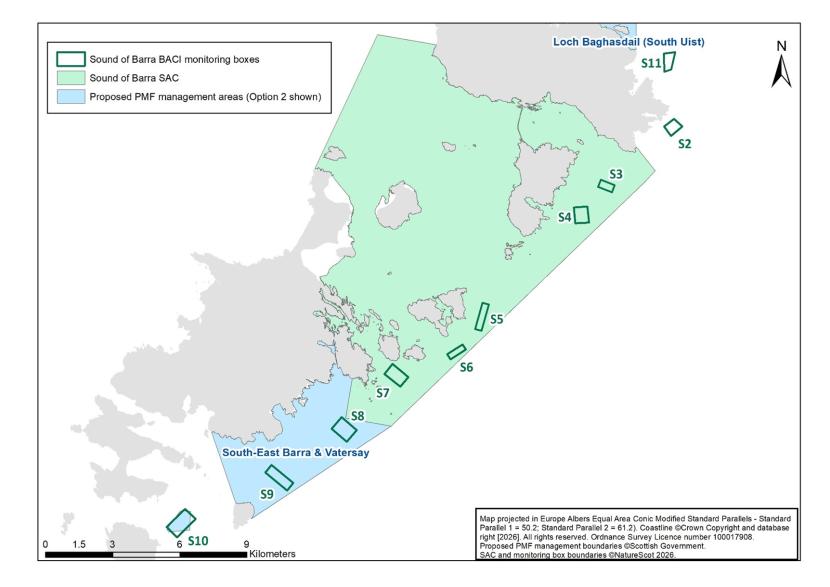
Figure 2 Proposed Sound of Barra BACI monitoring approach showing established monitoring boxes and proposed PMF management areas including South-East Barra Limitations in Survey Design
Given the fragility and slow growing nature of maerl, recovery rates at both sites are liable to vary dependent on the severity of current impacts and the condition and proximity of remnant healthy areas / discrete beds. Realistically recovery here and elsewhere is likely to be measured in decades or centuries for the maerl beds themselves. We would suggest reviewing the evidence from the BACI studies as part of the Report to Parliament on MPAs and the implementation of management measures. NatureScot are exploring various experimental mechanisms by which we can determine changes in maerl bed condition over a shorter period. These include using machine learning to pick out changes in metrics such as percentage maerl live cover and mean/median fragment length/complexity that cannot easily be picked out by eye. Visual data can also be used to identify trends in the abundance of conspicuous epifauna (including commercially important species) that are associated with maerl. Similarly expanding our use of baited remote underwater video (BRUVs) in our monitoring programme could allow us to monitor the community composition, distribution and relative abundance and size of associated fish species. Data derived from a time series of grab samples can also be used to quantify changes in the biodiversity or biomass of associated infaunal communities, and there is the potential to use a Biological Trait Analysis (BTA) approach to identify differences. (For example see NatureScot Research Report 1213) Finally, we are investigating the potential use of SPI (sediment profile imaging) cameras (For example see Inspire Environmental - Sediment Profile Imaging.) to pick up changes over time with SEPA, Cefas and Ocean Imaging Services.
Maerl beds themselves are biodiverse habitats known to provide important ecosystem functions and support a number of ecosystem services. The diversity of this habitat type is likely to depend on the proportion of maerl substrate present at any particular bed (live maerl and /or dead maerl gravels), although overall diversity can be driven by a number of environmental factors. Studies in the UK have found that maerl beds provide a habitat for commercially important fish and shellfish including queen scallops and gadoid fish. As such, these habitats are considered to have an important role in supporting and provisioning services. Maerl beds are highly productive habitats that can be compared to seagrass meadows in terms of contribution to overall ecosystem functioning in temperate waters. Whilst we haven’t traditionally focussed analyses and interpretive reporting around the ecosystem services that maerl beds and other PMFs provide, we anticipate greater emphasis on this in future.
The proposed approach relies on a combination of research vessel time supplemented by diver and small boat work. Key considerations in delivering successful outcomes include enabling access to the monitoring boxes and an ability to deliver temporal and spatial replication. It is important to acknowledge that there is an experimental aspect to our proposed BACI approach for maerl beds as we seek to reduce the timelines over which the proposed BACI studies conclude.
Implications for National Status of Priority Marine Features
The forthcoming consultation on ‘Improving the protection given to Priority Marine Features outside the MPA network’ has the potential to compromise the proposed BACI approach by removing viable control areas outside both MPAs. The consultation is expected to seek views on the Scottish Government’s proposals to deliver the protection of the national status of Priority Marine Features as required by Scotland’s National Marine Plan. (See General policy 9b of Scotland’s National Marine Plan)
Following an incident in Loch Carron in April 2017 when a flame shell bed was damaged by scallop dredging activity, the then Cabinet Secretary for Environment, Climate Change, and Land Reform requested that necessary steps were taken to ensure that Priority Marine Features (PMFs) were being protected in accordance with our National Marine Plan. NatureScot have advised that PMF management areas should be developed in key locations outside of MPAs to address the potential for impacts associated with demersal mobile fishing activitites in Scottish inshore waters. For maerl beds, areas for management consideration were identified focusing on locations where there are multiple records and/or extensive beds, except where smaller or fragmented beds are the only (remaining) examples in a geographic area. These included South-East Barra and Merkland and it remains the case that their inclusion would offer a contribution to safeguarding the national status of maerl beds. However, as outlined above the BACI studies rely on the establishment of control sites outside of the protected area that remain open to mobile demersal fishing activity. It is therfore not possible to protect the maerl beds at Merklend and South-East Barra and undertake the BACI studies to evidence fisheries management effectiveness in the two adjacent MPAs and, through inference, other maerl beds afforded protection in Scottish territorial waters.
Recommendation
NatureScot recommends that the Scottish Government’s Marine Directorate prioritise the BACI studies at the Sound of Barra SCI and South Arran MPA over the wider protection of maerl beds outside of the MPA network in two specific circumstances (only). We recommend that Merkland, Arran and South-East Barra proposed PMF management areas be excluded from further consideration prior to the launch of the PMF consultation. Our recommendation for the exclusion of these two areas is, in our view, a proportionate approach to delivering the requirements of the Scottish MPA Monitoring Strategy and General Policy 9b of the National Marine Plan
It is recognised that while introducing management measures for maerl beds in South-East Barra and Merkland would offer a contribution to safeguarding the national staus of the PMF, these two locations offer an unparalleled opportunity to evidence the effectiveness of management measures. We therefore consider that, in this specific circumstance, this benefit should be balanced against the potential risk to the national status of this feature.
Recommendation: that we retain the maerl beds BACI studies and remove Merkland, Arran and South-East Barra from the proposed PMF Management Areas (leaving these open to ongoing fishing pressure).
Conclusions
Should the Scottish Government’s Marine Directorate decide to accept NatureScot’s recommendation detailed above we suggest that we jointly engage with local stakeholder groups relevant to both MPAs to outline the rationale behind the changes prior to the proposed consultation.
If the decision is not to accept the recommendations, this may affect our ability to determine the effectiveness of MPA-related management measures for maerl beds. However, by employing a combination of type 1 and 2 monitoring it would be possible to infer management impacts albeit with a lesser degree of confidence.
Appendix 1. The four monitoring types
Type 2 and 3 monitoring studies are generally expected to be time limited.
Type 0 Monitoring to determine the continued presence of a feature in a site
Objective: To determine feature presence / absence.
Description: The data from this type of monitoring do not need to be quantitative and can take the form of presence or presence / absence observations. Type 0 work may trigger more detailed monitoring (Types 1 - 3 below). Type 0 monitoring may take the form of a rapid ‘health check’ and may be appropriate for completion by non-specialists. Such monitoring is likely to be restricted to coastal and accessible nearshore features. Type 0 monitoring may not necessarily have a defined frequency e.g. could occur on a randomised feature selection basis or be triggered if there were concerns about status.
Type 1 Monitoring designed to assess the condition of a protected feature at a site
Objective: To measure rate and direction of long-term change.
Description: Type 1 monitoring data are quantitative (for example, density data or data that allow assessment of the status of populations of mobile species e.g. photo-ID) and statistically robust, allowing the rate and direction of change in the feature of interest over time to be quantified. The design of Type 1 monitoring should include consideration of known activities / pressures. The use of reference areas outside of MPAs may be considered to provide context for any changes observed. This monitoring provides data that are appropriate for the assessment of status against MPA feature conservation objectives - recovery (trajectory) and / or maintenance - informing management action and reporting obligations.
Type 2 Monitoring or analyses undertaken to explore pressure-state relationships
Objective: To measure state and relate observed change to possible causes.
Description: This monitoring is best suited to exploring the likely impacts of anthropogenic pressures on habitats and species and identifying emerging problems. It allows testing of hypotheses about observed patterns, and is generally best applied in areas where a gradient of pressure is present (e.g. no pressure increasing gradually to ‘high’ pressure). It relies on finding relationships between observed changes in biodiversity and observed variability in pressures and environmental factors. It provides inference but it is not proof of cause and effect. The spatial and temporal scale for this type of monitoring will require careful consideration of the reality on the ground to ensure inference will be reliable; for example, inference will be poor in situations where the presence of a pressure is consistently correlated to the presence of an environmental driver (e.g. depth stratum).
Type 3 Monitoring or analyses undertaken to explore the effectiveness of MPA management measures
Objective: To investigate the cause of change.
Description: Monitoring that provides evidence of causality within a robust statistical framework, examining changes in the feature of interest against the onset of the putative impact (for example, the establishment of management measures that exclude fishing activity). The “beyond BACI” statistical methodology associated with this monitoring is rigorous, requiring multiple baseline surveys across multiple control and impact sites to be undertaken prior to the onset of the putative impact and thereafter. Conclusions from this monitoring may be applicable to other MPAs with similar habitats that exhibit similar trends (inferred from Type 1 monitoring). The frequency of Type 3 monitoring is likely to be higher than the other monitoring categories due to its requirement for multiple surveys to be undertaken before and after the implementation of management measures.