Priority Marine Feature - Serpulid aggregations
Improving the protection given to Priority Marine Features
An overview of serpulid aggregation records
Description
Characteristics
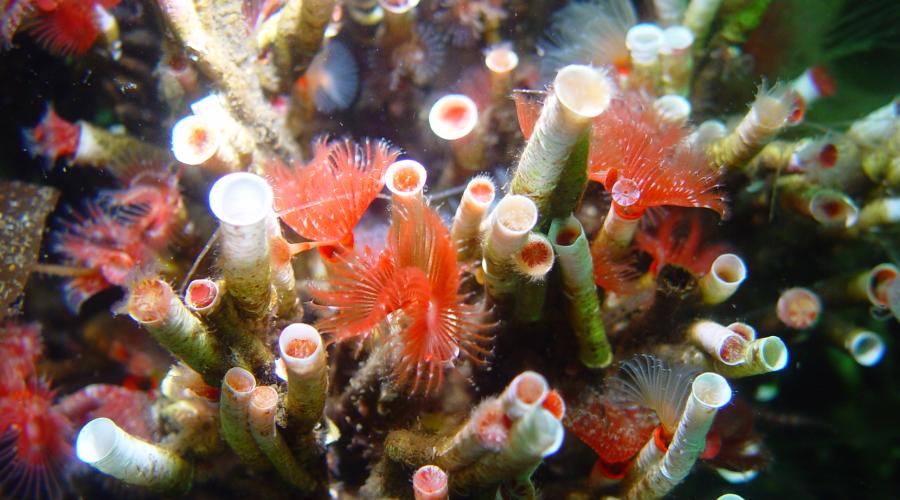
Dense clumps of white chalky tubes, each containing a Serpula vermicularis worm. When feeding, the worms extend red, white or orange feathery tentacles. Serpulid aggregations can reach over 1 m in height and 2 m wide, composed of individual tubes, each up to 5 mm wide and 15 cm in length, growing on top of one another anchored to pebbles, shells or stones in muddy sediment. Serpulid aggregations provide solid substrata in an otherwise sedimentary area. Sea squirts, sponges, sea firs and seaweeds grow on the calcareous tubes, while the complex three dimensional structures provide shelter and habitat for crabs, shrimps, squat lobsters, brittlestars, starfish, worms and snails. The aggregations also provide refuge for a number of fish species (Chapman et al., 2012).
Definition
Serpulid aggregations are not defined by a minimum number of tubes but rather their clumping together, growing vertically up from the seabed (generally greater than 10 cm in height) and forming a discrete community different from the surrounding seabed. More substantial aggregations (approx. >1 m diameter) are recognised as biogenic reefs (see Holt et al., 1998; European Commission, 2013). The calcareous remains of old serpulid tubes may serve as substrate for new aggregations to grow on.
Environmental preferences
Serpulid aggregations occur in sheltered to extremely sheltered sea lochs or inlets with weak or very weak water flow, at depths of 6-10 m.
Distribution
Scottish distribution
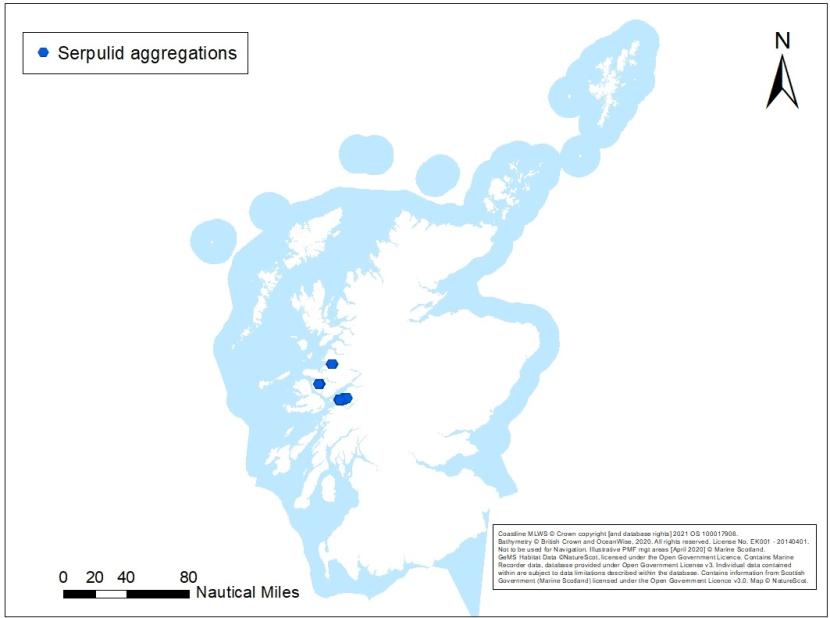
Loch Creran and Loch Ailort. A locally extinct population with some small aggregations is known from Loch Teacuis (an arm of Loch Sunart).
Estimated known Scottish extent
Aggregations in Loch Ailort and now extinct ones in Loch Teacuis have been up to 0.5 m in diameter and height. The aggregations in Loch Creran have developed into larger reefs up to 3 m across, although typically only a metre, and 0.75 m high. An estimated ~108 ha of serpulid habitat was present in Loch Creran in 2005 (Moore et al., 2006) though recent studies (Moore et al., 2020) estimated that ~20% of all serpulid habitat in the loch has been lost since 2005.
Wider distribution
Only recorded from a few other locations worldwide: Killary Harbour, Ardbear Lough and Blacksod Bay (MERC Consultants, 2008) in Ireland; and Mar Piccolo, a lagoon near Taranto in Italy.
Status
Scottish waters support all UK records of this habitat. The reefs in Loch Creran represent the best example and the largest extent of this habitat in the world. The first accounts described serpulid reefs in 1882 standing above the surface of Loch Creran at low tide (Moore et al., 1998). This suggests their distribution has declined over the last 120 years. The extent of the reefs within Loch Creran appeared to be stable through the 1990s, however survey work indicates there has been a significant deterioration in condition since 2005 (Tulbure, 2015). Recent studies (Moore et al., 2020) concluded that reef fragmentation is now widespread, estimating that ~20% of all serpulid habitat in the loch has been lost since 2005. It is hypothesised that serpulid reefs go through natural cycles of growth and collapse and ongoing academic studies in Loch Creran are exploring this in more detail. The serpulid aggregations in Loch Creran are recognised as biogenic reefs which can be part of the broadscale habitats protected in Special Areas of Conservation (SACs) under Annex 1 of the EU Habitats Directive (European Commission, 2013). The Directive is transposed into domestic legislation through The Conservation (Natural Habitats, &c.) Regulations 1994 (as amended in Scotland) (Habitats Regulations).
Small aggregations of serpulid worms were discovered in Loch Teacuis in 2006 (Mercer et al., 2007; Dodd et al., 2009), but these have also since declined (SNH, 2015) and are now locally extinct in many areas of the loch, with some small aggregations
only present in a small number of areas (Sim, 2022; NatureScot, unpublished). The aggregations in Loch Ailort were first recorded in 2015 by recreational Seasearch divers.
Drivers for improving protection
Serpulid aggregations are included on the PMF list which means that National Marine Plan General Policy 9(b) (avoiding significant impact on national status) applies. The Scottish Biodiversity Strategy to 2045, the Scottish Biodiversity Duty and UK Marine Strategy Good Environmental Status provide further drivers to ensure biological diversity is restored, and ecosystems are safeguarded.
Sensitivity (including recovery)
[Key sources: FeAST, Fisheries Management Guidance]
Serpulid aggregations are extremely sensitive to physical disturbance and abrasion, and are also sensitive to changes in water flow and salinity. Threats to serpulid aggregations include bottom-contacting fishing activities, anchoring and coastal developments that alter water flow.
Serpulid aggregations may be vulnerable to future climate impacts associated with ocean acidification (see Chan, 2013) and de-oxygenation. Projected increases in the frequency and strength of storm events associated with climate change may also pose a threat to serpulid aggregations.
There is evidence that habitat restoration may be possible in areas where serpulid aggregations have declined. Small aggregations were well established on experimental scallop shell substrates deployed in Loch Creran in 2012 as part of restoration studies (Cook, 2016; Moore et al., 2020). However, in areas where there is no longer a viable population to provide larvae, regeneration will not occur naturally (Lancaster et al., 2014). Serpulid growth has been estimated at c. 3 cm per annum (Moore et al., 2006; Hughes et al., 2008). Survivorship studies to determine the feasibility of artificial restoration in Loch Sween using stock translocated from Loch Creran were inconclusive. Aggregations present in Loch Sween during the 1980s died out in the 1990s for reasons that are still not understood (Hughes et al., 2008).
Connectivity
Between serpulid aggregations
Serpulid aggregations are mostly present in sheltered locations with low larval dispersal potential. Populations tend to become self-seeding, especially when isolated. Serpulid worms (in non-aggregated form, and not part of this PMF) are widely distributed on rocky habitats around the Scottish coastline.
With other PMFs
The only known functional link or association between serpulid aggregations and other PMFs is with kelp and seaweed communities on sublittoral sediments PMF which occurs in the same depth band. Colonisation of serpulid aggregations in Loch Teacuis by the sugar kelp Saccharinalatissima may have contributed to their decline here. When kelp grows on small serpulid aggregations it is likely that even modest tidal water flow generates sufficient drag to cause the aggregation attachment to snap off or dislodge from the hard substrates anchoring it to the soft muddy seabed. An accumulation of drifting sugar kelp with holdfasts overgrowing broken up serpulid tubes was observed to the east of the tidal narrows entrance to the loch in 2015 (SNH, 2015).
Ecosystem services
The habitat provided by serpulid aggregations supports a number of other species and contributes to the protection of biodiversity. Serpulid aggregations also have a role in sediment stabilisation, nutrient cycling and waste breakdown as well as providing shelter to commercial fish and shellfish particularly juveniles.
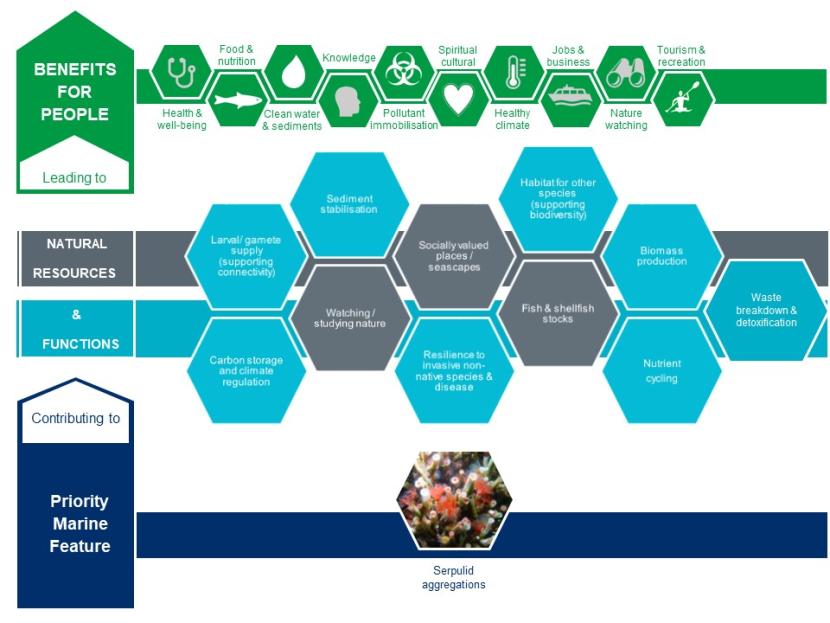
The contribution serpulid aggregations make to natural resources and functions and the benefits for people that these lead to.
Click for a full description
- Priority Marine Feature: Serpulid aggregations contributing to
- Natural resources (NR) and functions (F)
- Waste breakdown and detoxification of water and other sediments (F)
- Socially valued places/seascapes (NR))
- Resilience to invasive non-native species & disease (F)
- Formulation of habitat for other species (supporting biodiversity) (F)
- Fish and shellfish stocks (NR)
- Watching/studying nature (NR)
- Laval/gamete supply (supporting connectivity (F)
- Carbon storage & climate regulation (F)
- Sediment stabilisation (F)
- Biomass production (F)
- Nutrient cycling (F)
- Which leads to benefits for people
- Health & wellbeing
- Knowledge
- Clean water and sediments
- Jobs and business
- Spiritual/cultural
- Nature watching
- Food and nutrition
- Tourism and recreation
- Pollutant immobilsation
- Healthy climate
Existing Marine Protected Areas
Serpulid aggregations are a protected feature of Loch Creran MPA and Loch Sunart MPA where the Loch Teacuis population has declined (SNH, 2015).
Existing and proposed fishing measures providing PMF protection
Serpulid aggregations are protected by the following existing fishing measures:
- The Inshore Fishing (Scotland) Order 2015 (Loch Creran and Loch Sunart)
New fishing measures are proposed, which will protect serpulid aggregations that are found outside of the MPA network:
- Sound of Arisaig SAC (proposed measures extend beyond the boundary of the site and would encompass serpulid aggregations in Loch Ailort).
Approach to assessing improvements in management needed to protect serpulid aggregations from impacts related to towed bottom-contacting fishing gear
The assessment presented in this document relates to fishing using towed bottom-contacting gear only. It is consistent with the approach taken for assessing proposed developments.
All recent or extant records in Scottish nearshore waters are already afforded protection or will be afforded protection against damage from towed bottom-contacting fishing gear within the Loch Creran MPA, Loch Sunart MPA and Sound of Arisaig SAC. Any new records of this habitat would also warrant protection.
Any towed bottom-contacting fishing activity that leads to the loss of entire aggregations or damage to aggregations, such that function or provision of ecosystem services cannot be maintained, should be considered to have a significant impact on national status and as a result not meet General Policy 9(b) in the National Marine Plan. Existing licensing and consenting processes will continue to consider the potential for significant impacts serpulid aggregations.
Key locations for the protection of serpulid aggregations outside designated sites and existing towed bottom-contacting fisheries restrictions
There are currently no other known, verified records of serpulid aggregations outside the existing MPA network in Scottish territorial waters.
Data confidence
We have recent records from 2022 (including null records in Loch Teacuis). The majority of the records are from 2005 (>3000) and come from NatureScot commissioned MPA monitoring studies, with additional records from Seasearch diving surveys. Records primarily come from diving, with some ROV and drop-down video surveys (e.g. Poloczanska et al., 2004). New records of this feature (Loch Ailort) were made in 2015, with targeted mapping surveys undertaken in this location in 2016 (SNH, 2016) and 2017.
Knowledge gaps and other recommended work
We recommend continuing efforts to explore opportunities for collaborative monitoring, survey and research to improve our understanding of this habitat, for example:
- The remains of former serpulid aggregations in soft muddy sediments in West Loch Tarbert were noted in 2017 and also signs of potential new aggregation development (Paisley, 2017). Future survey work will be required to determine whether aggregations develop.
- There have been other reports of serpulid aggregation development in Loch Sween. Future survey work will be required here to determine whether aggregations develop.
- There have been anecdotal reports of serpulid aggregations in other sheltered sea lochs (e.g. Loch Glendhu and Loch Reasort). New survey work would be required to validate these observations.
Key locations for the protection of serpulid aggregations
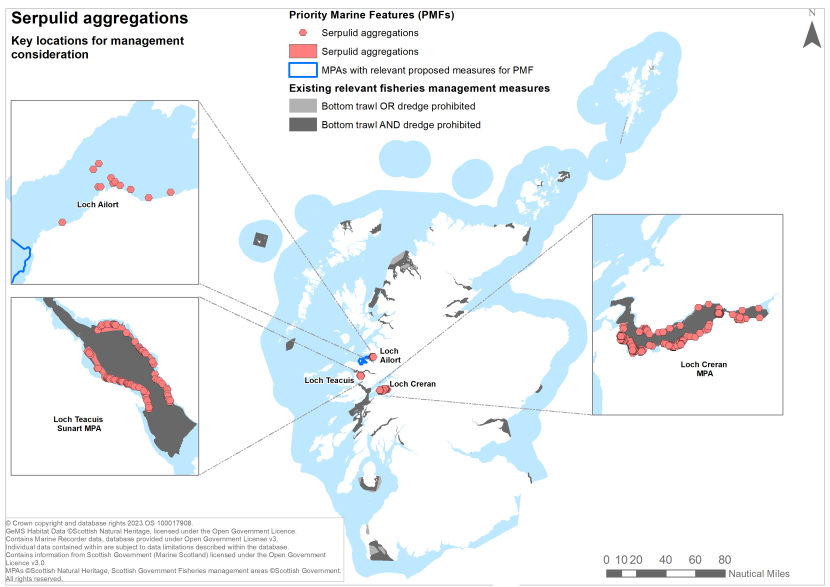
Key locations for the protection of serpulid aggregations are all located within MPAs with management measures (or proposed management measures) and existing towed bottom-contacting fisheries restrictions
Click for a full description
The map shows known locations at Loch Ailort, Loch Creran and Loch Teacuis Sunnart.
References
Chan, B.S. 2013. Climate change impacts on the serpulid tubeworm Hydroides elegans - a biomineralization perspective. A thesis submitted for the degree of Doctor of Philosophy, University of Hong Kong. Pokfulam, Hong Kong.
Chapman, N.D., Moore, C.G., Harries, D.B. & Lyndon, A.R. 2012. The community associated with biogenic reefs formed by the polychaete, Serpula vermicularis. Journal of the Marine Biological Association of the United Kingdom, 92(4): 679-685.
Cook, R.L. 2016. Development of techniques for the restoration of temperate biogenic reefs. A thesis submitted for the degree of Doctor of Philosophy, Heriot-Watt University.
Dodd, J., Baxter, L. & Hughes, D.J. 2009. Mapping Serpula vermicularis (Polychaeta: Serpulidae) aggregations in Loch Teacuis, western Scotland, a new record. Journal of Marine Biology Research, 5(2): 200-205.
European Commission. 2013. Interpretation manual of European Union habitats. EUR 28, 144 pages.
Holt, T.J., Rees, E.I., Hawkins, S.J. & Seed, R. 1998. Biogenic reefs (volume IX). An overview of dynamic and sensitivity characteristics for conservation management of marine SACs. Scottish Association of Marine Science (UK Marine SACs Project), 170 pages.
Hughes, D.J., Poloczanska, E.S. & Dodd, J. 2008. Survivorship and tube growth of reef-building Serpula vermicularis (Polychaeta: Serpulidae) in two Scottish sea lochs. Aquatic Conservation: Marine and Freshwater Ecosystems, 18(2): 117-129.
Lancaster, J. (Ed.), McCallum, S., Lowe A.C., Taylor, E., Chapman A. & Pomfret, J. 2014. Development of detailed ecological guidance to support the application of the Scottish MPA selection guidelines in Scotland’s seas. Scottish Natural Heritage Commissioned Report No. 491. Serpulid aggregations - supplementary document.
MERC Consultants. 2008. Surveys of sensitive sublittoral benthic communities in Mullet/Blacksod Bay Complex SAC; Rutland Island and Sound SAC; and, Mulroy Bay SAC. A report to the National Parks and Wildlife Service, Galway.
Mercer, T., Howson, C.M. & Moore, J.J. 2007. Site Condition Monitoring: Loch Sunart marine SAC and SSSI. Scottish Natural Heritage Commissioned Report No. 286.
Moore, C.G., Harries, D.B., Tulbure, K.W., Cook, R.L., Saunders, G.R., Lyndon, A.R., Kamphausen, L. & James, B. 2020. The current status of serpulid reefs, horse mussel beds and flame shell beds in Loch Creran SAC and MPA. Scottish Natural Heritage Research Report No. 1156.
Moore, C.G., Saunders, G.R. & Harries, D.B. 1998. The status and ecology of reefs of Serpula vermicularis L. (Polychaeta: Serpulidae) in Scotland. Aquatic Conservation: Marine and Freshwater Ecosystems, 8(5): 645-656.
Moore, C.G., Saunders, G.R., Harries, D.B., Mair, J.M., Bates C.R. & Lyndon, A.R. 2006. The establishment of site condition monitoring of the subtidal reefs of Loch Creran Special Area of Conservation. Scottish Natural Heritage Commissioned Report No. 151.
NatureScot. 2024. Geodatabase of Marine features adjacent to Scotland (GeMS). GeMS V10 (i26).
Paisley, O. 2017. Seasearch Argyll 2017 report.
Poloczanska, E.S., Hughes, D.J. & Burrows, M.T. 2004. Underwater television observations of Serpula vermicularis (L.) reefs and associated mobile fauna in Loch Creran, Scotland. Estuarine, Coastal and Shelf Science, 61(3): 425-435.
SNH: Scottish Natural Heritage. 2015. Loch Teacuis serpulid survey: March 2015. SNH Field Report. Unpublished.
SNH: Scottish Natural Heritage. 2016. SNH seabed habitats survey - September 2016. Sound of Arisaig and the head of Loch Ailort. Drop-down video and diver surveys. SNH Field Report.
Tulbure, K.W. 2015. Investigating the condition of the Priority Marine Feature, ‘serpulid aggregations’ (Serpula vermicularis) in Loch Creran Scotland. BSc dissertation, Heriot-Watt University. Edinburgh.