New National Park - Report on the proposal for a National Park in south-west Scotland - Method Statement
Published: May 2025
Method Statement
This is one of 21 reports that accompany NatureScot’s Reporter advice on the Scottish Government’s proposal for a new National Park in southwest Scotland. The advice was submitted on 5 May 2025. The paper outlines the work undertaken to fulfil Scottish Government’s commissioning of NatureScot for this task.
Overall approach
NatureScot was appointed by Scottish Ministers as the Reporter on 22 July 2024. The commission followed the selection of Galloway as the preferred location for a new National Park in Scotland. The selection process itself, in 2023-2024, followed a consultation on the future of National Parks in Scotland, which Scottish Government launched in 2022 following its commitment to designate at least one new National Park. The timeline for this overall programme of National Park work is summarised in Annex 1.
To meet the requirements set by Scottish Ministers, the overall approach to our reporting work comprised three phases:
| Phase of work | Purpose | Timing |
|---|---|---|
| Pre consultation Engagement | To raise awareness of the proposal and work with local interests and other stakeholders to design an effective consultation strategy and to develop the draft proposals for consultation. | August 2024 to mid-October 2024 |
| Formal Consultation | To gauge opinion on draft proposals and the support or opposition to the proposal through a formal 14-week consultation. | November 2024 to mid-February 2025 |
| Analysis and Advice | To analyse the responses received and finalise advice for Ministers taking account of the views expressed. | February 2025 to April 2025 |
The detailed actions underpinning each of these phases of work were set out in the reporter plan which was published in August, as required, within one month of our commission from Scottish Government. The commission also details the requirements on NatureScot to undertake the task in an inclusive and engaging manner. As well as being developed to ensure we meet the requirements on us, our work was informed by Scottish Government good practice on consultations and the national standards of community engagement.
A small core reporter project team was established to plan and undertake the work, with the Senior Responsible Owner, Project Manager, Project Coordinator, Project Administrator and Research and Evidence Officer all based in the People & Places activity team. Seven other members of that team, and four colleagues from South Operations and West Central Operations who cover the Southwest of Scotland, all worked on engagement, consultation, and developing area and governance options. Staff from communications and geographical information teams contributed throughout on information provision and communications, and mapping and data. Specialist colleagues provided input as needed on aspects such as agriculture and land use, biodiversity and geodiversity, forestry, landscape, marine, and planning. A team of 22 staff with relevant skills and experience was selected to undertake the analysis of the consultation responses, drawn from staff already engaged in the project as well as others in NatureScot.
A Project Board was also established with terms of reference to oversee the task, provide advice and monitor progress against the agreed project plan. Membership included a NatureScot Board member, senior NatureScot staff, the CEO of CEMVO, the Chief Executive Officers of the existing National Parks, and Scottish Government.
Phase 1 - pre-consultation/engagement - 22/07/24 to 06/11/24
Statutory requirements
We followed statutory requirements to inform local and community councils of the proposal and our role as reporter. We wrote to:
- the three local authorities in the region.
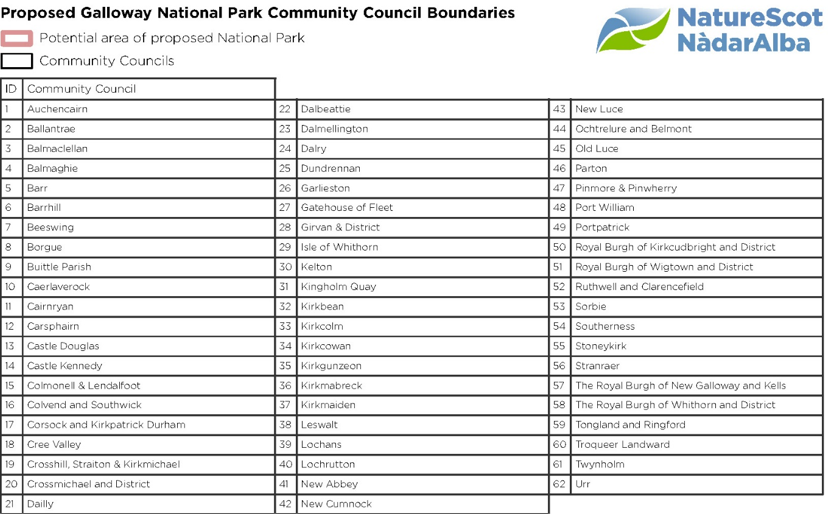
- all Community Councils whose area overlapped with the potential National Park coverage, and to community development organisations. See Annex 2 for list and map.
In line with our corporate commitments to equalities, we also produced an Equalities Impact Assessment which shaped the planning and implementation of our work. Separate strategies were also prepared for bespoke engagement work with young people, black and ethnic minorities, disability groups, and other under-represented groups. Separate accompanying reports provide detail on this.
Communication and engagement
We provided information and updates on our National Park web pages with monthly updates on our work from August. A report of the engagement was published in December to provide feedback on the work to date.
We set up an email inbox for queries. This enabled us to manage all incoming correspondence through one route, which could be monitored by a small team of people.
We launched an online community information hub on 10 September 2024. This presented opportunities for people to find out more but also, importantly, to contribute their thoughts and ideas. The hub remained open for surveys until the formal consultation period was launched, when it was retained for information provision only. A separate report provides the findings from the hub.
We circulated an introductory leaflet in October summarising the consultation process and providing links to further information. This was sent to 52,000 addresses within and near the proposed area. The leaflet and associated branding were designed in-house with support from our digital accessibility team.
We arranged and held sector-led meetings with key stakeholders (see list in Annex 3) including land managers, tourism, renewables, conservation as well as local authorities and community councils. These were a mixture of in-person and online meetings and were intended to both raise awareness of the proposal and the reporter work and to gather information and opinions to shape the development of options for consultation. These meetings were particularly crucial in allowing us to understand the issues and concerns of a range of interests.
We planned a series of in-person events and drop-ins to offer opportunities as part of the formal consultation. We commissioned consultants Outside the Box to design and facilitate these events.
Information and options development
We collated information on various aspects such as population demographics, land-use, visitor levels and economy of the region. We also obtained evidence from current Parks on key topics such as changes in visitor numbers and house prices.
We undertook fieldwork and analysis of the proposed area in terms of the conditions of the National Parks Act to provide additional geographical area options for the consultation. We published a separate report on this in December alongside the consultation.
Consultation survey development
We prepared the consultation questions required, building on engagement with stakeholders and the feedback from the online information hub and email in-box. This was also based on experience from the first two Parks.
The questions were finalised, checked with relevant staff (analysis, communications) and, for the paper version, incorporated into an explanatory leaflet with input from our design team. We decided not to provide a postage-paid return option. This followed the practice from the reporting work for the first two Parks when all responses were submitted on paper and postage-paid returns were not provided.
We prepared a Data Protection Impact Assessment. This included protocols for dealing with and storing the responses and their metadata.
Phase 2 - Consultation - 07/11/24 to 14/2/25
Consultation surveys
The consultation was launched on Thursday 7 November 2024, via our website where the consultation paper was hosted. The consultation paper provided the background information and details on the proposal, e.g. geographical area options, and alternatives for functions, powers and governance. There were two versions of the online consultation: summary (circa 10 questions) and technical (circa 30 questions).
The consultation leaflet, consisting of the summary survey with some background information was distributed in early November. It was sent to the same 52,000 addresses as the information leaflet. Several leaflets were returned with no postage or under-paid postage. We clarified on our website that we would not accept these. In the event, sixteen leaflets arrived with no, or under-paid postage and we paid for almost all the unstamped returns. The exceptions were three that were received over the Christmas holiday fortnight when the office was unstaffed.
Consultation events
The consultation events were held in November, December and January. Thirty events and four drop-in surgeries were held across the region (shown on map 1 and listed in Annex 4).
The events were arranged around six hubs, with satellite events in nearby, smaller settlements. As well as providing for a wide range of locations to be covered, this was more efficient for travel for the consultants and staff attending. The hubs were Dalmellington and Bellsbank, Dumfries, Girvan, Kirkcudbright, Newton Stewart and Stranraer.
They took place at a range of times - mornings, afternoons and evenings - to ensure overlap with either lunchtimes or evenings within each group of hub and satellite locations to maximise convenience where possible. Most of the venues for the events were public buildings but all were selected to allow people with a range of disabilities to access them. The list of events was provided on our website. Additional publicity was via social media and local flyers.
The team of facilitators from Outside The Box were joined at every event by NatureScot staff to provide technical information. NatureScot board members attended several of the consultation events as observers. The events and drop-in surgeries drew nearly 1,220 attendees.
As well as a providing a summary of the programme as whole, separate reports have been prepared by the consultants for each event and each hub.
Preparation for response analysis
We commissioned Progressive Partnership – an analytical consultancy - to help process the high number of responses anticipated. The consultants also provided guidance on the analysis methodology and data integrity. This informed the planning undertaken with the group of staff who would be carrying out the analysis.
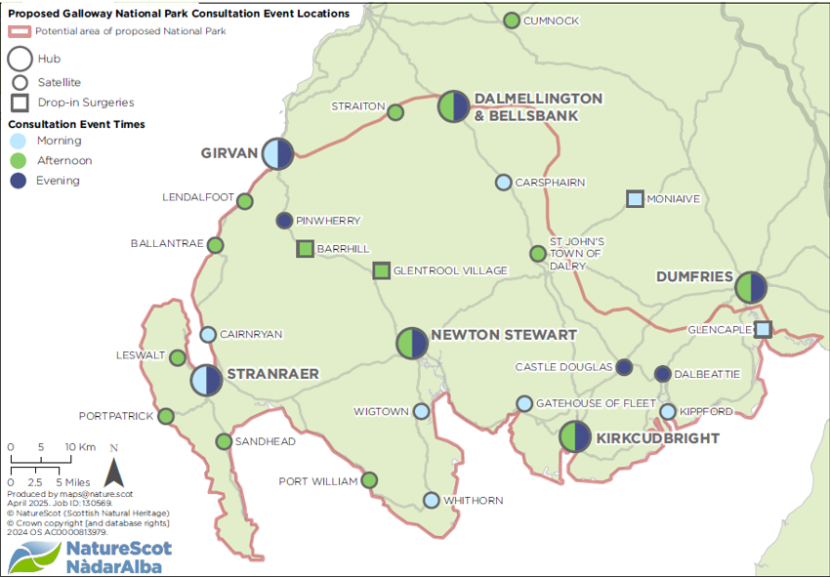
Enlarge map in a new window.
Phase 3 - Advice - 17/02/25 to 05/05/25
Analysis
We undertook the analysis of submitted responses using a team of 22 NatureScot staff, with help from the consultants who processed the responses into spreadsheets. The consultants also contributed to the approach taken and the guidance we prepared for the analysis team.
The consultants securely transferred the responses, digitised the paper responses, and helped with the quantitative data. They checked and ‘cleaned’ the data to remove blank responses and initially identify multiple responses. They sent NatureScot the qualitative responses in dataset format to aid analysis.
The qualitative questions were processed by systematically categorising the content of responses in order to identify “codes”, which were subsequently combined into themes. These were then reported on, e.g. percentage of respondents opposed or in favour of the park; those in favour of the park authority having access powers.
Questions were allocated among the analysis team for coding and for separate quality assurance, and to ensure more than one analyst worked on each question. Separate accompanying reports provide details of the analysis and how it was undertaken.
NatureScot Board familiarisation visit and reception
In March, members of NatureScot’s Board and senior leadership team spent two days in southern Ayrshire and Galloway on a familiarisation visit. This included site meetings with landowners, businesses and community organisations across the region.
The Board also held a reception at Glentrool Hive to hear directly from a range of interests and stakeholders, at which nineteen organisations were represented.
In a separate private session, Board members and senior staff discussed the emerging findings from the ongoing analysis of the responses to the consultation and its implication for our advice.
Advice preparation and submission
The reporter advice was developed based on the analysis the responses received and other relevant information provided during the course of the reporting work. In line with our requirements, it included consideration of the outcomes of the consultation; assessing the strengths and weaknesses of the arguments made; developing decision scenarios for Scottish Ministers; and refining the options for the geographical area and name of the National Park and the detailed arrangements for its National Park Authority.
The reporter advice was drafted from Mid-March to the end of April by the reporter team in discussion with a range of expert staff and the project board and senior leadership.
Three exceptional meetings of the NatureScot Board were held in private to discuss the draft advice on 17 April, 28 April, and 2 May.
This followed an agreed sequence of clearance and sign-off.
The final advice was submitted to Scottish Ministers on 5 May 2025. The advice will be published alongside this and the other accompanying reports following the Ministerial announcement on the next steps for this work.
ANNEXES 1-4
Annex 1 - Overall timeline
| Stage | Milestone | Timescales |
|---|---|---|
| non-statutory | 1) Public Consultation on the Future of National Parks in Scotland | May to June 2022 |
| non-statutory | 2) Development of NatureScot Advice on the approach and selection of National Parks (including public consultation) | May 2022 to January 2023 |
| non-statutory | 3) SG development of the selection process and legislative changes required (including public consultation) | February 2023 to September 2023 |
| non-statutory | 4) Nominations prepared and submitted by local groups with support from SG. | October 2023 to February 2024 |
| non-statutory | 5) SG evaluation of the five nominations and preparation of statutory proposal for selected area/s | March 2024 to May 2024 |
| statutory | Publication of statutory proposal and appointment of reporter | Ministerial announcement 22 July 2024 |
| statutory | Reporter Investigation (including public consultation on proposals for new National Park(s) and advice to Minister) | 22 July 2024 to 5 May 2025 |
| statutory | Designation Order process (including public consultation on a draft order, and parliamentary scrutiny and approval) | TBC. If Ministers decide to proceed with the designation, the earliest this stage could be completed would be spring 2026 with establishment of the National Park following later in the year |
Annex 2 - Local Authorities, Community Councils and Community Development Organisations contacted Local authorities
Local authorities
Dumfries and Galloway Council, East Ayrshire Council, South Ayrshire Council
Community councils
- Auchencairn
- Ballantrae
- Balmaclellan
- Balmaghie
- Barr
- Barrhill
- Borgue
- Buittle Parish
- Cairnryan
- Carsphairn
- Castle Kennedy
- Colmonell and Lendalfoot
- Colvend and Southwick
- Cree Valley
- Crossmichael and District
- Dailly
- Dalbeattie
- Dalmellington
- Dalry
- Dundrennan
- Garlieston (dormant)
- Gatehouse of Fleet
- Girvan and District
- Isle of Whithorn
- Kelton
- Kirkbean
- Kirkcolm
- Kirkcowan
- Kirkgunzeon (dormant)
- Kirkmabreck
- Kirkmaiden
- Kirkoswald, Maidens and Turnberry (dormant)
- Leswalt (dormant)
- Lochans
- New Abbey
- New Luce
- Old Luce
- Parton
- Pinwherry and Pinmore
- Port William
- Portpatrick (dormant)
- Royal Burgh of Kirkcudbright and District
- Royal Burgh of Wigtown and District
- Sorbie (dormant)
- Southerness
- Stoneykirk
- Stranraer, Ochtrelure and Belmont
- The Royal Burgh of New Galloway and Kells Parish
- The Royal Burgh of Whithorn and District (dormant)
- Tongland and Ringford
- Troqueer Landward (dormant)
- Twynholm (dormant)
The following Community Councils have been dis-established: Beeswing, Caerlaverock, Urr.
Community development organisations
- All Roads lead to Whithorn
- The Ballantrae Trust
- Barrhill Development Trust
- Castle Douglas Community Centre Development Trust
- Creetown Initiative Ltd
- Dalbeattie Community Initiative
- Dalmellington Community Association
- Glenkens Community and Arts Trust Limited
- Glenkens & District Trust
- Glentrool & Bargrennan Community Trust
- Kirkcolm Community Trust
- Kirkcowan Community Development Trust
- Kirkcudbright Development Trust
- The Mull of Galloway Trust
- Newton Stewart Initiative
- Old Luce Development Trust
- Port William Development Trust
- Portpatrick Community Development Trust
- Portpatrick Harbour Community Benefit Society
- Stranraer Development Trust
- The Whithorn Trust
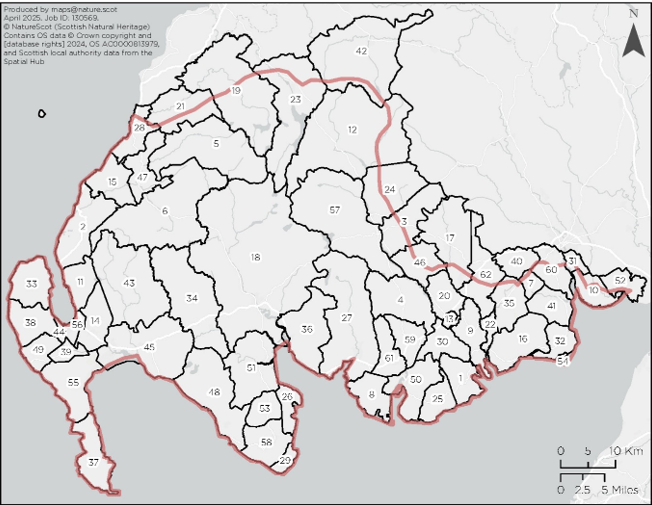
Enlarge map in a new window.
Annex 3 - List of stakeholders with whom meetings were held
- CEMVO
- Archaeology Scotland
- Confederation of Forest Industries (CONFOR)
- Dumfries and Galloway Council (staff and councillors)
- Dumfries and Galloway EDI Group
- Environmental Alliance of the South of Scotland (EASOS)
- East Ayrshire Council (staff and councillors; youth panel)
- Forestry and Land Scotland - South Region
- Galloway and Southern Ayrshire Biosphere Reserve
- Galloway Conservation Society
- Galloway National Park Association
- Health and Social Care Alliance Scotland
- Historic Environment Scotland
- Loch Doon Association
- Milk Suppliers Association
- National Farmers Union Scotland (Ayrshire, Dumfries & Galloway, national)
- Newton Stewart Initiative
- NHS Grampian
- No Galloway National Park Campaign
- Scottish and Southern Electric
- Scottish Forestry
- Scottish Land & Estates (SW Scotland committee, national)
- Scottish Power Energy Networks
- Scottish Power Renewables
- Scottish Renewables
- South Ayrshire Council (staff and councillors)
- South of Scotland Destination Alliance
- South of Scotland Economic Partnership
- South of Scotland Enterprise (staff, youth panel)
- Solway Firth Partnership
- SW Scotland Regenerative Farming Network
- Stranraer and District Local History Trust
- Transport Scotland
- VisitScotland
- West of Scotland Archaeology Service
- Whithorn Trust
In addition, we discussed the reporting work collectively with a range of national and regional bodies on the national park stakeholder advisory group.
We had regular meetings with the south of Scotland public sector team (comprising staff from Dumfries & Galloway Council, Scottish Borders Council, Skills Development Scotland and Visit Scotland).
We met the MSPs and the MP covering most of the proposed area, and Ward 2 councillors of Dumfries and Galloway Council.
We attended meetings of Girvan, Kirkmaiden, and the Group of 15 Stewary Community Councils.
Annex 4 - Consultation events and drop-in surgeries list
| Date | Location | Venue | Time |
|---|---|---|---|
| 20 Nov 2024 | Newton Stewart | McMillan Hall | 13:00 - 15:00 |
| 21 Nov 2024 | Wigtown | County Buildings | 11:30 - 13:30 |
| 21 Nov 2024 | Newton Stewart | McMillan Hall | 18:00 - 20:00 |
| 22 Nov 2024 | Whithorn | New Town Hall | 10:00 - 12:00 |
| 22 Nov 2024 | Portwilliam | Maxwell Hall | 14:00 - 16:00 |
| 22 Nov 2024 | Portwilliam | Maxwell Hall | 14:00 - 16:00 |
| 25 Nov 2024 | Bellsbank | Bellsbank Education Centre | 13:00 - 15:00 |
| 26 Nov 2024 | Carsphairn | Lagwayne Hall | 10:30 - 12:30 |
| 26 Nov 2024 | Dalry | Town Hall | 14:30 - 16:30 |
| 27 Nov 2024 | Straiton | McCandlish Hall | 12:00 - 14:00 |
| 02 Dec 2024 | Kirkcudbright | Community Centre | 14:00 - 16:00 |
| 03 Dec 2024 | Gatehouse | Community Centre | 11:00 - 13:00 |
| 03 Dec 2024 | Kirkcudbright | Community Centre | 17:00 - 19:00 |
| 04 Dec 2024 | Kippford | Village Hall | 10:00 - 12:00 |
| 11 Dec 2024 | Dalmellington | Community Centre | 18:00 - 20:00 |
| 8 Jan 2025 | Lendalfoot | Village Hall | 13:00 - 15:00 |
| 8 Jan 2025 | Girvan | Wave Hub | 18:00 - 20:00 |
| 9 Jan 2025 | Girvan | Community Garden | 10:30 - 12:30 |
| 9 Jan 2025 | Pinwherry | The Auld School Community Centre | 16:00 - 18:00 |
| 10 Jan 2025 | Cairnryan | Village Hall | 11:00 - 13:00 |
| 13 Jan 2025 | Leswalt | Memorial Hall | 13:00 - 15:00 |
| 13 Jan 2025 | Stranraer | Millennium Centre | 18:00 - 20:00 |
| 14 Jan 2025 | Portpatrick | Village Hall | 12:00 - 14:00 |
| 14 Jan 2025 | Sandhead | Community Hall | 16:00 - 18:00 |
| 15 Jan 2025 | Stranraer | Millennium Centre | 11:00 - 13:00 |
| 15 Jan 2025 | Ballantrae | Craigiemains Garden Centre | 14:00 - 16:00 |
| 21 Jan 2025 | Dalbeattie | Town Hall | 18:00 - 20:00 |
| 22 Jan 2025 | Castle Douglas | Town Hall | 18:00 - 20:00 |
| 23 Jan 2025 | Dumfries | Baptist Church Centre | 12:00 - 14:00 |
| 23 Jan 2025 | Dumfries | Baptist Church Centre | 18:00 - 20:00 |
| 27 Jan 2025 | Cumnock | Dumfries Arms Hotel | 12.00 - 14.00 |
| Date | Location | Venue | Time |
|---|---|---|---|
| 8 Jan 2025 | Glentrool | Glentrool Hive | 12:30 - 14:30 |
| 9 Jan 2025 | Moniaive | Glencairn Memorial Institute | 11:00 - 13.00 |
| 16 Jan 2025 | Glencaple | Barbour Memorial Hall | 11:00 - 13:00 |
| 21 Jan 2025 | Barhill | Barrhill Memorial Hall | 12:00 - 14:00 |