NatureScot Research Report 1367 - An analysis of Scottish Raptor Monitoring Scheme data to improve understanding of the impact of Avian Influenza in 2023 on raptors and raptor populations in Scotland
Year of publication: 2026
Authors: Wilson, M.W., Beckmann, B.C., Challis, A. and Wernham, C.V. (British Trust for Ornithology)
Cite as: Wilson, M.W., Beckmann, B.C., Challis, A. and Wernham, C.V. (British Trust for Ornithology). An analysis of Scottish Raptor Monitoring Scheme data to improve understanding of the impact of Avian Influenza in 2023 on raptors and raptor populations in Scotland. NatureScot Research Report 1367.
Contents
- Keywords
- Background
- Main Findings
- Acknowledgements
- Abbreviations
- 1. Introduction and aims
- 2. Methods
-
3. Results
- 3.1 Local Studies
- 3.2 Changes in numbers of pairs recorded in local studies
- 3.3 Changes in breeding success observed in local studies
- 3.4 Changes in fledged brood sizes observed in local studies
- 3.5 Regional and national comparisons adjusted for trends
- 3.6 Changes in breeding success
- 3.7 Changes in fledged brood size
- 3.8 Evidence of HPAI impacts from SRMS contributors
- 3.9 HPAI testing data from the Animal & Plant Health Agency (APHA)
- 3.10 Vole abundance data
- 4. Discussion
Keywords
raptor, Scotland, highly pathogenic avian influenza, HPAI, bird flu, breeding success
Background
An outbreak of Highly Pathogenic Avian Influenza (HPAI) in wild birds in Scotland, as well as the wider UK, has negatively impacted several species of wild birds (Pearce-Higgins et al., 2023). While seabirds and wildfowl have been the most visibly affected groups, other groups have also been impacted, including raptors. The first raptor cases detected in Scotland were in mid-November 2021 (Animal and Plant Health Agency, 2024). A report (Wilson et al., 2023) commissioned by NatureScot analysed Scottish Raptor Monitoring Scheme (SRMS) data from the breeding season of 2022 to improve understanding of the impact of HPAI on the numbers and productivity of Scotland’s raptors. The report compared raptor breeding data from 2022 with equivalent data from previous years to identify apparent effects of HPAI on breeding raptor populations. NatureScot commissioned a follow-up analysis of the 2023 breeding season data, and the results are presented in this report.
Main Findings
- Overall, the evidence for apparent impacts of HPAI on breeding populations and performance of raptors in Scotland is weaker for 2023 than it was for 2022.
- Breeding success of Golden Eagle and White-tailed Eagle, the two species for which impacts of HPAI in 2022 seemed likely to be most severe, appeared much improved in 2023. There is still evidence for reduced breeding success consistent with impacts of avian influenza on the breeding output, particularly of White-tailed Eagles, in some areas. However, in most areas, reduced breeding success was not as pronounced as it was in 2022.
- The most severe impacts on eagles (as judged by levels of breeding success) in 2023 appeared to be in some inland areas. This contrasts with the situation in 2022, when the lowest levels of breeding success were reported in areas adjacent to the coast, suggesting a link between HPAI risk and predation of coastal birds (or scavenging on their remains).
- The breeding performance of other raptor species in 2023 suggested fewer apparent or possible impacts of HPAI than were found in 2022. The most notable indications of possible impacts were for Peregrines in southern Scotland, where one local study showed a substantial decrease in the number of breeding pairs (although this was not quite statistically significant), and another local study reported similar concerns. In the south-east of Scotland, there appeared to be localised impacts on Peregrine breeding success. An unusually high number of immature birds (mostly females) were recorded holding territories in 2023 suggesting high mortality among territorial adult females since the previous breeding season. Only one of the nests with immature birds was successful.
- Other observations and analysis of APHA testing data support the impression from our analysis that possible impacts of HPAI are both less apparent and less severe in 2023 than in 2022 for most species, but they also highlight Peregrine as being of particular concern in terms of ongoing impacts and risk, in Scotland as well as across the whole of Britain.
- Although this analysis of 2023 data brings mostly good news in terms of decreases in the severity of apparent impacts for most species, this does not necessarily mean that the risks posed by HPAI have gone away. Moreover, the differences in apparent impacts between 2023 and 2022 emphasise how quickly these risks can change. In this context, continuing to monitor breeding raptors in Scotland is important. Where possible and practical, it may be wise to focus monitoring effort on populations where possible risks of HPAI are thought to be high, or the impacts poorly understood.
Acknowledgements
We are grateful to NatureScot for funding this work. We thank the hundreds of dedicated volunteers who contribute raptor breeding records to the Scottish Raptor Monitoring Scheme (SRMS), without whom there would have been no dataset for us to analyse. We are especially grateful to George Smith, Bob Swann, and Malcolm Whitmore for helpful input regarding their raptor monitoring data from 2023. Andrew Village generously made his small mammal data available for us to refer to in this report. We also thank the representatives of the SRMS partnership for facilitating access to SRMS data, and all SRMS partners for their financial and other support for the scheme. The BTO contribution to the scheme includes funding from gifts in Wills for which we are extremely grateful. Andrew Stevenson made helpful comments on drafts that preceded this report.
Abbreviations
HPAI – Highly Pathogenic Avian Influenza
SRMS – Scottish Raptor Monitoring Scheme
BTO – British Trust for Ornithology
RSPB – Royal Society for the Protection of Birds
JNCC – Joint Nature Conservancy Council
BBS – Breeding Bird Survey
NRS – Nest Record Scheme
SGAR – Second Generation Anticoagulant Rodenticide
The following terminology is used in this report:
Breeding success refers to the proportion of pairs with known breeding outcome which successfully fledge one or more offspring.
Fledged brood size refers to the number of young successfully reared by pairs that fledged at least one young.
Breeding productivity is used more generically to refer to the combined effects of breeding success and fledged brood size (i.e. the overall number of offspring reared by breeding pairs).
1. Introduction and aims
An outbreak of Highly Pathogenic Avian Influenza (HPAI) in wild birds in Scotland, as well as the wider UK, has negatively impacted several species of wild birds (Pearce-Higgins et al., 2023). The first raptor cases detected in Scotland were in mid-November 2021 (Animal and Plant Health Agency, 2024). Increased concern regarding impacts on raptors led to NatureScot commissioning analysis of SRMS data from the breeding season of 2022 to improve understanding of the impact of HPAI on the numbers and productivity of Scotland’s raptors. The Research Report 1331 (Wilson et al. 2023) found strong evidence for declines in breeding success consistent with impacts of avian influenza on the breeding productivity of Golden Eagle and White-tailed Eagle in 2022. It also found some evidence for changes in monitored breeding populations or productivity in a range of other scavenging birds (such as Buzzard, Red Kite, and Raven) and avian predators (particularly Peregrine), consistent with localised impacts of HPAI.
This information has been used to inform decision-making of NatureScot and other organisations related to monitoring and protecting raptor populations of conservation importance. This includes evaluating the need for measures to safeguard both humans and raptors in the context of future raptor monitoring, and other types of fieldwork. Where necessary, it can be used in developing recovery plans for these populations in the future.
Because risks posed by HPAI can change rapidly, and there is still a need for reliable evidence to underpin decision-making, NatureScot commissioned the present study to repeat the analysis using SRMS data from 2023. Again, the main aim was to compare 2023 data with equivalent data from previous years, to identify what, if any, effect HPAI may have had on breeding raptor populations across Scotland. Impacts were also compared to those observed in 2022. The two main objectives were:
- to quantitatively compare abundance and breeding productivity of raptors recorded in 2023 with data from previous years, and from 2022; and
- to summarise and qualitatively assess information reported by contributors to the SRMS that may describe HPAI occurrence in, or impacts on, monitored raptor populations.
2. Methods
Methods were similar to those used for the analysis of SRMS data for potential effects of HPAI in 2022 (Wilson et al., 2023), to ensure comparability of results across 2022 and 2023. The only differences in the methods were that regional comparisons in breeding success metrics were calculated for all species-region combinations for which sufficient data were available in 2023, not just for those which a preliminary comparison of annual summary tables suggested that metrics were unusual, and interpretation of results was aided by further context from HPAI testing data from the Animal & Plant Health Agency, and vole abundance data.
2.1 Scottish Raptor Monitoring Scheme (SRMS) data
The SRMS covers 19 species of raptor known to breed regularly in Scotland, plus the Raven (included as an ‘honorary raptor’ on the grounds of its ecological similarity to some raptor species). Breeding raptor records submitted to the SRMS comprise information about the annual occupancy status of ‘home ranges’ (areas known to have been occupied by breeding raptors) and the breeding outcomes of any nesting attempts found in these home ranges. Occupancy status describes whether home ranges were checked and, if they were, whether there was any evidence of occupation by any territorial birds. For home ranges found to be occupied by territorial pairs, several metrics are recorded, where feasible, that describe various breeding stages and outcomes. These are: the number of eggs laid, the number of eggs hatched, the number of large chicks (well-feathered and/or sufficiently well-grown to be ringed), breeding success and the number of young known to have fledged. Records from each year are standardised and cleaned to make sure that the information they contain is both reliable and, as far as possible, comparable across regions and years. SRMS Annual Reports (e.g. Challis et al., 2023) summarise the information relating to the number of breeding attempts recorded and their breeding productivity by species for each of 12 SRMS regions. The metrics summarised in these reports include the number of breeding pairs recorded, breeding success (the proportion of these pairs fledging one or more offspring) and fledged brood size (the average number of young recorded as being reared from successful breeding attempts). Since 2018, these summaries have been restricted to records for which the contributors have signed up to SRMS’s Data-Sharing Policy, giving explicit permission for their information to be used and shared in this way. At the time of writing, SRMS had published the annual reports for all years up to 2022. For the current project, data from 2023 were prepared in a manner comparable to previous years (using only records covered by the Data-Sharing Agreement) and used to produce equivalent summary tables of occupancy and breeding productivity for comparison with information from previous years.
In this report, breeding numbers and performance are evaluated for Buzzard, Golden Eagle, Goshawk, Hen Harrier, Kestrel, Merlin, Osprey, Peregrine, Raven, Red Kite, Sparrowhawk and White-tailed Eagle. These comprise 12 of the 14 species for which recent SRMS data were considered sufficient to analyse inter-annual changes in these metrics (Wilson et al., 2022). Annual changes in breeding numbers and performance of the other two species, Barn Owl and Tawny Owl, were considered too volatile for them to be suitable for detection of impacts of HPAI within a single year. This is because the breeding performance of these species is highly dependent on the abundance of small mammal prey, which can undergo dramatic changes from year to year.
2.2 Local Studies
During preparation for the recently published SRMS report on raptor population trends (Wilson et al., 2022), we identified local study areas to ensure that comparisons between years were not skewed by temporal variation in survey effort. This is particularly important for comparisons of numbers of breeding pairs, which would otherwise be directly influenced by survey effort. Preliminary study areas were first identified from clusters of home ranges for which records had been submitted to the SRMS in multiple years. These clusters indicated areas within which survey effort was relatively high and consistent. Study areas were then refined according to feedback from regional Scottish Raptor Study Group Species Coordinators, excluding areas with inconsistent coverage or adding back in additional areas where search effort was known to be high even when the number of records reported was low (Wilson et al., 2022).
For the current analyses, the number and location of home ranges checked in 2023 within each defined study area were compared visually (in ArcGIS Desktop 10.6.1) with the number and distribution of records from the years 2018-21. If the number of ranges checked in 2023 and the average number of ranges checked during 2018-21 was 10 or more, and the distribution of these home ranges suggested that monitoring coverage of the study area had remained broadly stable over time, the study area was used in our analyses. Where coverage in 2023 (as indicated by the distribution of 10 or more checked home ranges) appeared stable within part of a study area but decreased elsewhere, study areas were ‘trimmed’ to exclude areas with low monitoring effort in 2023 before being included in our analyses. An additional area covering inland White-tailed Eagle territories on the Scottish mainland that were not included in other study areas was also drawn in ArcGIS to facilitate a comparison between inland and coastal home ranges.
For each study area, generalised linear models (GLMs) were used to evaluate whether the measures of breeding population size or productivity were lower in 2023 than in earlier years as this would indicate a possible impact of the HPAI outbreak. Poisson GLMs were used to evaluate variation in the number of breeding pairs and fledged brood sizes while binomial GLMs were used to analyse the proportion of pairs recorded as successfully producing young. For each of these three metrics, a single GLM was run for each species. Explanatory variables included Study Area as a factor, Year as a numerical variable (to take account of linear trends in the response during the five years from which data had been drawn) and an additional binary variable ‘2023’ that separated 2023 data from data drawn from all other years. The Akaike Information Criterion (AIC) was used to compare models with both Year and 2023, and each of these variables separately, to evaluate whether inter-annual differences were best explained by a gradual change through time or by a difference between 2023 and all other years.
2.3 Regional comparisons adjusted for trends
As for local studies, analysis was also carried out for all combinations of species and SRMS regions for which sufficient data were available. SRMS records from the four years from 2018 to 2021 and from 2023 were extracted and individual GLMs were run for each combination of region (including the whole of Scotland, where this comparison was relevant), species and metric (for breeding success and fledged brood size). This was to evaluate whether the measures of breeding population size or productivity were lower in 2023 than in earlier years which would indicate a possible impact of HPAI. Region or area was not included in the models as an explanatory variable because each model dealt with data from an individual region, but otherwise the model structure was as described for the local studies analysis.
2.4 Evidence of HPAI impacts from SRMS contributors
Records submitted to the SRMS in 2023 were scrutinised for comments or evidence recorded by contributors, beyond the occupancy and breeding outcome information compared with equivalent information from previous years, which could indicate possible impacts of HPAI. An automated search was carried out on the whole 2023 dataset to identify any field containing the character strings “HPAI”, “Flu”, “bird flu”, “H5N1”, “postmortem”, “post mortem”, “avian”, “disease” or “influenza”. Unique values in all fields containing any of these search terms were examined. Any entry mentioning a possible impact of HPAI was categorised according to the type of suggested impact (impact on adult birds, impact on brood, both, or other – the latter including impacts on fieldwork), and robustness of evidence (‘Possible’ where no supporting observations or diagnoses were provided, ‘Probable’ where a good case was made but no proof given, and ‘Confirmed’ where a diagnosis of HPAI was obtained).
SRMS contributors were also asked, through the “Scottish Raptor” newsletter and through the Chairs of the Scottish Raptor Study Group regional branches, to submit any extra information they might have relating to impacts of HPAI in 2023 directly to the Coordinator of the SRMS. All such information was examined thoroughly and summarised for this report.
2.5 HPAI testing data from the Animal & Plant Health Agency
The Animal and Plant Health Agency (APHA) provides summary data concerning positive test results of wild animals for HPAI on its website. These data were downloaded for all wild birds for 2022 and 2023 and summarised by year, country and species for the raptor species considered in this report (Animal and Plant Health Agency, 2024).
2.6 Vole abundance data
Cyclic changes in the annual and seasonal abundance of voles can have a profound effect on the number of pairs and the breeding success of several raptor and owl species (e.g. Petty et al., 2000; Lambin et al., 2000). If vole populations reach a peak during the spring, predator populations can respond with increases in the number of pairs settling to breed and corresponding increases in brood size, nesting success, and productivity. There is a dearth of systematically collected information on variation in small mammal abundance across Scotland. However, since 2018 standardised monitoring of voles has been carried out by Andrew Village at 19 sites in the Scottish Borders according to the “Vole Sign Index” protocol (Hayne and Thompson 1965; Village and Myhill 1990). This involves a 25 × 25cm quadrat being thrown 25 times in suitable habitat, with approximately 25 paces between quadrats to minimise re-sampling of the same vole home ranges. Feeding signs and droppings of voles are then quantified within each quadrat. Surveys are carried out twice annually, in March and September, to coincide with annual lows and highs of vole populations. Andrew kindly provided his results for 2018 to 2023 for inclusion in this report to help provide context for interpretation.
3. Results
3.1 Local Studies
There were sufficient data to compare numbers of pairs between 2023 and the years 2018-21 for 32 local studies of 10 raptor species (Table 1). Comparisons of breeding success were possible for 22 studies of nine species (Table 2), while comparisons of fledged brood size were possible for 14 studies of nine species (Table 3). For numbers of pairs, two local studies which had sufficient data in 2022 were not included due to limited data in 2023 (Golden Eagle Mull & Lochaber and Osprey around mid-Argyll). For breeding success, three local studies which had sufficient data in 2022 were not included due to limited data in 2023 (Golden Eagle Mull & Lochaber and Peregrines on the south-west and Dumfries coasts), although one study was added (Hen Harrier on Hoy). For fledged brood size, two local studies which had sufficient data in 2022 were not included due to limited data in 2023 (Peregrine Dumfries Coast, White-tailed Eagle Inland), and one study was added (Osprey in Stirlingshire).
3.2 Changes in numbers of pairs recorded in local studies
Local study-based comparisons provide scant evidence of impacts of HPAI on the number of pairs recorded in these areas. Accounting for background population change, the number of pairs recorded in 2023 was lower than that for previous years in just two studies: the Buzzard study in Tain, Ross-shire, where numbers dropped from an average of 53 pairs in 2018-21 to 42 pairs in 2023, and the Peregrine study on the Dumfries coast where the number of pairs dropped from 14 to 8. Both decreases were only marginally statistically significant.
Several of the studies summarised in Table 1 recorded apparent increases in breeding population size in 2023: the Buzzard study on Bute; the Golden Eagle study in Central Lewis and Harris; the Hen Harrier studies on Mainland Orkney and (with marginal statistical significance) on Hoy; the Merlin study on Mainland Orkney; and the Raven studies on Colonsay and (with marginal statistical significance) in Shetland. For all these studies except the Buzzard study on Bute, the numbers of home ranges recorded as having been checked in 2023 were higher than the average numbers checked in 2018 to 2021. This means that these apparent increases in breeding population size could have been partially a result of increased survey effort in 2023. It is possible that some of the extra home ranges checked in 2023 were newly established territories, perhaps particularly for Ravens in Shetland (see below), but at least for the Golden Eagle study, the Hen Harrier study on Hoy and the Raven study on Colonsay, this seems unlikely as the increases in 2023 run counter to overall local decreases recorded by these studies from 2018 to 2021.
3.3 Changes in breeding success observed in local studies
Local studies provide some evidence of potential impacts of HPAI on breeding success in 2023, but this is much more limited than in 2022 when particularly the two eagle species were strongly affected. In 2023, two of the 22 studies summarised in Table 2 recorded lower levels of breeding success than in 2018 to 2021: the White-tailed Eagle Inland study, where breeding success dropped significantly from an average of 0.64 in 2018-21 to 0.50 in 2023, and the Peregrine study in Lothian & Forth where breeding success declined by 57% from an average of 0.51 in 2018-21 to 0.29 in 2023 (albeit with marginal statistical significance). In contrast, no eagle studies which had (often dramatically) reduced breeding success in 2022 and for which data was available in 2023 showed significantly lower breeding success in 2023 than in 2018 to 2021. As detailed in last year’s report, most of the studies with reduced breeding success in 2022 were substantially coastal or, in the case of the Trossachs Golden Eagle study, contain several recently occupied nest sites within five kilometres of sections of the coast and/or sea lochs (Wilson et al., 2023). In contrast, the only eagle study observing significantly reduced breeding success in 2023 was the White-tailed Eagle Inland study which had observed increased breeding success in 2022, even if not significantly so. This decline also contrasts with an observed underlying increase in breeding success for inland White-tailed Eagles over the period 2018 to 2021.
Three studies recorded higher breeding success in 2023 than during 2018 to 2021. The increase was significant for Buzzards in Tain where breeding success increased from a 2018-21 average of 0.59 to 0.76 in 2023. This increase contrasts with the decline to 0.52 observed in 2022 and represents a 46% increase in breeding success for the Tain Buzzards between 2022 and 2023. The increase in breeding success for Hen Harriers on Mainland Orkney is also statistically significant, increasing from an average of 0.18 in 2018-21 to 0.40 in 2023. For the Golden Eagle study in North-west Sutherland, breeding success rose near-significantly from an average of 0.40 in 2018-21 to 0.69 in 2023, contrasting greatly with the sharp decline to 0.11 observed there in 2022 – a more than five-fold increase in breeding success for this population between 2022 and 2023.
3.4 Changes in fledged brood sizes observed in local studies
There is some limited evidence for potential impacts of HPAI in 2023 fledged brood sizes from local studies. Of the 14 studies for which there were enough successful breeding attempts recorded to analyse fledged brood size, this metric differed for three: the Raven studies on Bute and on Shetland, where recorded fledged brood sizes were smaller in 2023 than in 2018 to 2021 (significantly so on Bute), and the Buzzard study in Tain where fledged brood sizes were larger (near-significantly). The observed decline in fledged brood sizes of Ravens on Bute was large – a 42% reduction from the 2018-21 average of 2.67 to 1.54 in 2023. However, the sample size in this study is small (13). Average fledged brood size for Raven on Shetland was lower in 2023 (2.68) than in 2018-21 (3.02), but this was still higher than expected in the context of a downward trend over the years 2018-21. Breeding success of Ravens on Shetland was significantly reduced in 2022 (see above and Table 2), likely at least in part due to HPAI, with several cases of dead birds found near nests with no obvious injuries. None of these - three dead breeding adults from three different pairs, at least six non-breeders and one nest of three young - were sent off for testing (Zetland Raptor Study Group, 2023; Wilson et al., 2023). Reduced fledged brood sizes in 2023 (even if higher than expected) may therefore be partly due to impacts of HPAI in 2023 and/or 2022 if breeding birds were affected in 2023 or younger, less experienced birds were taking the place of more experienced birds that died in 2022. However, numbers of breeding Ravens on Shetland appear to be increasing generally (Zetland Raptor Study Group, 2024; and see above and Table 1). Increasing numbers of younger, less experienced birds may therefore be joining the breeding population in any case, and/or competition between pairs may be increasing, both of which could also contribute to a reduction in fledged brood sizes independently of impacts of HPAI.
| Species | Study | Pairs 2018-21 | Pairs 2022 | Pairs 2023 | Significance | Trend |
|---|---|---|---|---|---|---|
| Buzzard [L] | Tain | 53.2 (n=82.5) | 42 (n=85) | 42 (n=80) | P=0.160 | - |
| Buzzard | Colonsay | 5.8 (n=47) | 9 (n=57) | 7 (n=57) | NS | - |
| Buzzard [H 2023] | Bute | 13.2 (n=48.2) | 10 (n=23) | 17 (n=21) | P=0.016 | Down |
| Golden Eagle | Trossachs | 28.5 (n=35.8) | 37 (n=44) | 29 (n=35) | NS | - |
| Golden Eagle [H] | Central Lewis & Harris | 13.2 (n=14.8) | 30 (n=31) | 23 (n=27) | P=0.005 | Down |
| Golden Eagle | NW Sutherland | 16.2 (n=21.5) | 19 (n=22) | 13 (n=23) | NS | - |
| Golden Eagle | Badenoch & W Inverness | 29.5 (n=38) | 35 (n=44) | 31 (n=38) | NS | - |
| Hen Harrier [H] | Orkney Mainland | 54.8 (n=163.8) | 77 (n=182) | 87 (n=195) | P<0.001 | - |
| Hen Harrier [L 2022] | Rousay | 6.3 (n=23) | 2 (n=21) | 5 (n=24) | NS | - |
| Hen Harrier [H 2023] | Hoy | 16 (n=37.5) | 6 (n=35) | 17 (n=46) | P=0.081 | Down |
| Kestrel | Orkney Mainland | 3 (n=28.5) | 3 (n=30) | 2 (n=30) | NS | - |
| Kestrel | Pentlands | 12.3 (n=21) | 11 (n=16) | 8 (n=22) | NS | Down |
| Merlin [H 2023] | Orkney Mainland | 3.2 (n=38.8) | 5 (n=42) | 9 (n=43) | P=0.019 | - |
| Merlin | Shetland | 24.8 (n=50) | 30 (n=48) | 25 (n=35) | NS | - |
| Merlin | Forest of Birse | 7.2 (n=21.8) | 8 (n=23) | 4 (n=15) | NS | - |
| Osprey | Stirlingshire | 23.3 (n=35.3) | 19 (n=37) | 19 (n=37) | NS | - |
| Osprey | Easter Ross & Inverness | 31.8 (n=48) | 40 (n=53) | 37 (n=44) | NS | - |
| Peregrine | Southern Uplands | 38.8 (n=105) | 38 (n=122) | 36 (n=107) | NS | - |
| Peregrine | SW Coast | 10 (n=19.8) | 12 (n=22) | 7 (n=19) | NS | - |
| Peregrine | Lothian & Forth | 17 (n=35.5) | 17 (n=35) | 14 (n=36) | NS | - |
| Peregrine | Southeast Coast | 12.8 (n=53.2) | 13 (n=48) | 12 (n=44) | NS | - |
| Peregrine [L 2023] | Dumfries Coast | 14.2 (n=20.2) | 12 (n=22) | 8 (n=18) | P=0.126 | - |
| Raven | Tiree | 4 (n=16) | 5 (n=17) | 4 (n=17) | NS | - |
| Raven [H] | Colonsay | 6 (n=18.8) | 8 (n=23) | 8 (n=23) | P=0.049 | Down |
| Raven [H 2023] | Shetland | 18.2 (n=28.8) | 29 (n=67) | 31 (n=67) | P=0.109 | Up |
| Raven | Bute | 16 (n=25.2) | 15 (n=23) | 18 (n=21) | NS | - |
| Red Kite [L 2022] | Central Scotland | 50.2 (n=103) | 45 (n=98) | 40 (n=93) | NS | - |
| Red Kite [H 2022] | Dumfries & Galloway | 59.8 (n=105.5) | 84 (n=114) | 45 (n=62) | NS | Down |
| W-tailed Eagle | Mull & Lochaber | 25.5 (n=26) | 26 (n=27) | 23 (n=24) | NS | - |
| W-tailed Eagle | N Skye | 14.8 (n=19.2) | 19 (n=25) | 18 (n=25) | NS | - |
| W-tailed Eagle | E Lewis | 11.2 (n=12.2) | 17 (n=17) | 13 (n=17) | NS | - |
| W-tailed Eagle | INLAND | 14.8 (n=17) | 22 (n=27) | 20 (n=26) | NS | Up |
| Species | Study | Success 2018-21 | Success 2022 | Success 2023 | Significance | Trend |
|---|---|---|---|---|---|---|
| Buzzard [H 2023] | Tain | 0.59 (n=53.2) | 0.52 (n=42) | 0.76 (n=42) | P=0.036 | - |
| Buzzard | Bute | 0.98 (n=13.2) | 1.00 (n=10) | 0.94 (n=17) | NS | - |
| Golden Eagle [L 2022] | Trossachs | 0.46 (n=28.5) | 0.27 (n=37) | 0.41 (n=29) | NS | - |
Golden Eagle [L 2022] | Central Lewis & Harris | 0.53 (n=13.2) | 0.17 (n=30) | 0.43 (n=23) | NS | - |
| Golden Eagle [L 2022, H 2023] | NW Sutherland | 0.40 (n=16.2) | 0.11 (n=19) | 0.69 (n=13) | P=0.062 | - |
| Golden Eagle | Badenoch & W Inverness | 0.55 (n=29.5) | 0.43 (n=35) | 0.68 (n=31) | NS | Up |
| Hen Harrier [H] | Orkney Mainland | 0.18 (n=54.8) | 0.27 (n=77) | 0.4 (n=87) | P<0.001 | - |
| Hen Harrier | Hoy | 0.25 (n=16) | - | 0.18 (n=17) | NS | - |
| Merlin | Shetland | 0.75 (n=24.8) | 0.67 (n=30) | 0.80 (n=25) | NS | - |
| Osprey [H 2022] | Stirlingshire | 0.59 (n=17.5) | 0.84 (n=19) | 0.63 (n=19) | NS | - |
| Osprey [H 2022] | Easter Ross & Inverness | 0.71 (n=31.8) | 0.85 (n=40) | 0.81 (n=37) | NS | - |
| Peregrine | Southern Uplands | 0.71 (n=38.8) | 0.61 (n=38) | 0.69 (n=36) | NS | - |
| Peregrine [L 2023] | Lothian & Forth | 0.51 (n=17) | 0.53 (n=17) | 0.29 (n=14) | P=0.127 | - |
| Peregrine | SE Coast | 0.61 (n=12.8) | 0.54 (n=13) | 0.58 (n=12) | NS | - |
| Raven [L 2022] | Shetland | 0.74 (n=18.2) | 0.55 (n=29) | 0.81 (n=31) | NS | Up |
| Raven | Bute | 0.80 (n=16) | 0.87 (n=15) | 0.72 (n=18) | NS | - |
| Red Kite [H 2022] | Central Scotland | 0.71 (n=50.2) | 0.84 (n=45) | 0.75 (n=40) | NS | - |
| Red Kite | Dumfries & Galloway | 0.82 (n=59.8) | 0.87 (n=84) | 0.93 (n=45) | NS | Up |
| W-tailed Eagle [L 2022] | Mull & Lochaber | 0.66 (n=25.5) | 0.50 (n=26) | 0.57 (n=23) | NS | - |
| W-tailed Eagle [L 2022] | North Skye | 0.59 (n=14.8) | 0.16 (n=19) | 0.44 (n=18) | NS | - |
| W-tailed Eagle [L 2022] | E Lewis | 0.64 (n=11.2) | 0.35 (n=17) | 0.69 (n=13) | NS | - |
| W-tailed Eagle [L 2023] | INLAND | 0.64 (n=14.8) | 0.77 (n=22) | 0.50 (n=20) | P=0.050 | Up |
| Species | Study | Fledged 2018-21 | Fledged 2022 | Fledged 2023 | Significance | Trend |
|---|---|---|---|---|---|---|
| Buzzard [H 2023] | Tain | 1.67 (n=31.2) | 1.82 (n=22) | 2.06 (n=32) | P=0.137 | - |
| Buzzard | Bute | 1.54 (n=13) | 1.30 (n=10) | 1.31 (n=16) | NS | - |
| Golden Eagle | Trossachs | 1.06 (n=13.2) | 1.00 (n=10) | 1.00 (n=12) | NS | - |
| Golden Eagle | Badenoch & W Inverness | 1.40 (n=16.2) | 1.20 (n=15) | 1.43 (n=21) | NS | - |
| Hen Harrier | Orkney Mainland | 2.02 (n=10) | 2.05 (n=21) | 2.31 (n=35) | NS | - |
| Merlin | Shetland | 3.47 (n=18.5) | 3.55 (n=20) | 3.75 (n=20) | NS | - |
| Osprey | Stirlingshire | 1.98 (n=10.2) | - | 1.75 (n=12) | NS | - |
| Osprey | Easter Ross & Inverness | 1.88 (n=22.5) | 1.88 (n=34) | 2.03 (n=30) | NS | - |
| Peregrine | Southern Uplands | 2.35 (n=27.5) | 2.61 (n=23) | 2.36 (n=25) | NS | - |
| Raven [L 2022, H 2023] | Shetland | 3.02 (n=13.5) | 3.06 (n=16) | 2.68 (n=25)1 | P=0.086 | Down |
| Raven [L 2023] | Bute | 2.67 (n=12.8) | 2.23 (n=13) | 1.54 (n=13) | P=0.022 | - |
| Red Kite | Central Scotland | 1.75 (n=35.8) | 1.47 (n=48) | 1.80 (n=30) | NS | - |
| Red Kite | Dumfries & Galloway | 1.24 (n=49) | 1.33 (n=73) | 1.29 (n=42) | NS | - |
| W-tailed Eagle | Mull & Lochaber | 1.19 (n=16.8) | 1.18 (n=17) | 1.38 (n=13) | NS | - |
3.5 Regional and national comparisons adjusted for trends
There were sufficient data to compare breeding success between 2023 and the years 2018-21 for 73 species-region combinations (Table 4). Comparisons of fledged brood size were possible for 60 species-region combinations (Table 5). For breeding success, one species-region combination which did have sufficient data for 2022 was not included due to limited data in 2023, i.e. Merlin in Highland. For fledged brood size, three species-region combinations which did have sufficient data for 2022 were not included due to limited data in 2023: Golden Eagle in Tayside, Merlin in Highland and Peregrine in Central.
3.6 Changes in breeding success
Breeding success (Table 4) was significantly lower than expected in 2023 for four species-region combinations and for one national comparison, mostly concerning eagles. These were significant reductions in breeding success for Golden Eagles in Tayside & Fife, for White-tailed Eagles in Argyll, in Lewis & Harris, and nationally across Scotland. For Golden Eagle, this nevertheless represents a considerable recovery from 2022 when large or very large declines in breeding success were observed in three regions as well as nationally. However, Golden Eagle breeding success in 2023 remained below the 2018-21 averages in all but one region as well as nationally. Similarly, breeding success of White-tailed Eagles was higher in most regions and nationally in 2023 than the low or very low levels observed in 2022 but remained below the 2018-21 averages in all cases. In Argyll breeding success remained at a similarly low level to that observed in 2022. Reduced breeding success was also observed for Peregrines in Lothian & Borders, with a substantial reduction to 0.46 in 2023 from an average of 0.58 in 2018-21, although this was not quite significant (P=0.14). There was also a small reduction in breeding success for Goshawks in Lothian & Borders from an average of 0.80 in 2018-21 to 0.71 in 2023, and a very small reduction nationally across Scotland from 0.78 to 0.77. Both were nevertheless higher than expected due to a negative trend over the years 2018-21. Similarly, a slightly smaller proportion of Raven pairs in Argyll were successful in 2023 (0.75) than in 2018-21 (average of 0.78), but this was nevertheless greater than expected due to a negative trend over the years 2018-21.
Significant or near-significant increases in breeding success were observed for several species-region combinations: for Buzzards in Dumfries & Galloway, Highland and nationally across Scotland; for Merlin in Lothian & Borders; for Osprey in Highland; and for Raven in South Strathclyde. The size of these increases was modest in most cases: the two statistically significant increases were a rise in breeding success of Buzzards in Dumfries & Galloway from a 2018-21 average of 0.82 to 0.87 in 2023 and in Highland from 0.73 to 0.83.
Breeding success of Ospreys in Dumfries & Galloway was slightly higher in 2023 (0.67) than the average in 2018-21 (0.63), but this was nevertheless lower than expected due to an upward trend over the years 2018-21. Similarly, a greater proportion of Red Kite pairs in North-East Scotland was successful in 2023 (0.94) than in 2018-21 (average of 0.85), but this was nevertheless lower than expected due to a positive trend over the years 2018-21. Breeding success of Sparrowhawks on Orkney was the same in 2023 as the average in 2018-21 (0.40), but this was lower than expected due to an upward trend over the years 2018-21.
3.7 Changes in fledged brood size
Regional comparisons of fledged brood sizes (Table 5) do not suggest that there was a decline of this aspect of breeding productivity for any species and regions in 2023.
A number of species and regions showed statistically significant, or near significant, increases in fledged brood size: Buzzards in Highland and in Tayside & Fife as well as nationally in Scotland; Hen Harriers on Uist; Kestrels in Highland, Tayside & Fife and nationally across Scotland; Ravens in Highland and Tayside & Fife; and Red Kites and Sparrowhawks nationally in Scotland.
Average fledged brood size for Ravens on Uist was slightly smaller in 2023 (2.5) than in 2018-21 (average of 2.73), but this was nevertheless larger than expected due to a downward trend over the years 2018-21.
Fledged brood sizes recorded in 2023 for both eagle species were larger than in 2022 for all regions where comparable figures were available, and nationally across Scotland for Golden Eagle.
| Species | Region | Success 2018-21 | Success 2022 | Success 2023 | Significance | Trend |
|---|---|---|---|---|---|---|
| Buzzard | Argyll | 0.85 (n=39.2) | 0.81 (n=31) | 0.86 (n=35) | NS | - |
| Buzzard [H 2023] | Dumfries & Galloway | 0.82 (n=32.5) | - | 0.87 (n=31) | P=0.019 | Down |
| Buzzard [H 2023] | Highland | 0.73 (n=101.8) | - | 0.83 (n=98) | P=0.050 | - |
| Buzzard | Lothian & Borders | 0.84 (n=68.8) | 0.81 (n=88) | 0.83 (n=89) | NS | - |
| Buzzard | Orkney | 0.42 (n=13) | 0.60 (n=15) | NS | - | |
| Buzzard | Tayside & Fife | 0.92 (n=135) | 0.86 (n=66) | 0.94 (n=31) | NS | - |
| Buzzard | Uist | 0.76 (n=12.5) | 0.70 (n=23) | NS | - | |
| Buzzard [H 2023] | Scotland | 0.82 (n=421.2) | 0.83 (n=185) | 0.83 (n=330) | P=0.075 | Down |
| Golden Eagle [L 2022] | Argyll | 0.40 (n=51) | 0.26 (n=66) | 0.32 (n=44) | NS | - |
| Golden Eagle [L 2022] | Highland | 0.49 (n=91.2) | 0.29 (n=121) | 0.57 (n=91) | NS | Up |
| Golden Eagle [L 2022] | Lewis & Harris | 0.54 (n=19) | 0.16 (n=31) | 0.42 (n=24) | NS | - |
| Golden Eagle [L 2023] | Tayside & Fife | 0.60 (n=18.2) | 0.48 (n=25) | 0.32 (n=22) | P=0.006 | Up |
| Golden Eagle | Uist | 0.45 (n=13.2) | 0.38 (n=13) | NS | - | |
| Golden Eagle [L 2022] | Scotland | 0.48 (n=203) | 0.28 (n=243) | 0.44 (n=205) | NS | - |
| Goshawk | Dumfries & Galloway | 0.71 (n=20.8) | - | 0.67 (n=18) | NS | - |
| Goshawk [H 2023] | Lothian & Borders | 0.80 (n=30) | - | 0.71 (n=34)1 | P=0.025 | Down |
| Goshawk [H 2023] | Scotland | 0.78 (n=78) | - | 0.77 (n=87)1 | P=0.057 | Down |
| Hen Harrier | Argyll | 0.73 (n=16) | - | 0.73 (n=22) | NS | - |
| Hen Harrier | Highland | 0.62 (n=24.5) | 0.79 (n=24) | 0.86 (n=37) | NS | Up |
| Hen Harrier | Orkney | 0.22 (n=79.2) | - | 0.37 (n=114) | NS | Up |
| Hen Harrier | Tayside & Fife | 0.34 (n=17.8) | - | 0.50 (n=10) | NS | - |
| Hen Harrier [L 2022] | Uist | 0.89 (n=13.5) | 0.40 (n=15) | 0.88 (n=33) | NS | - |
| Hen Harrier | Scotland | 0.46 (n=189.2) | - | 0.59 (n=271) | NS | Up |
| Kestrel [L 2022] | Central | 0.96 (n=22.5) | 0.88 (n=42) | 0.94 (n=36) | NS | - |
| Kestrel | Highland | 0.89 (n=18.5) | - | 0.84 (n=19) | NS | - |
| Kestrel | Lothian & Borders | 0.84 (n=24) | - | 0.72 (n=25) | NS | Down |
| Kestrel | Tayside & Fife | 0.91 (n=22) | 0.70 (n=10) | 0.90 (n=40) | NS | - |
| Kestrel [L 2022] | Scotland | 0.88 (n=118.8) | 0.85 (n=52) | 0.87 (n=169) | NS | - |
| Merlin [H 2023] | Lothian & Borders | 0.47 (n=14.2) | - | 0.75 (n=12) | P=0.093 | - |
| Merlin [H 2022] | North-East Scotland | 0.75 (n=31.5) | 0.90 (n=31) | 0.85 (n=26) | NS | - |
| Merlin | Shetland | 0.76 (n=29.8) | 0.56 (n=32) | 0.77 (n=31) | NS | - |
| Merlin | Scotland | 0.71 (n=139.5) | - | 0.73 (n=123) | NS | - |
| Osprey | Argyll | 0.74 (n=14.5) | - | 0.75 (n=12) | NS | - |
| Osprey | Central | 0.64 (n=23.8) | - | 0.59 (n=29) | NS | - |
| Osprey [L 2023] | Dumfries & Galloway | 0.63 (n=12.2) | - | 0.67 (n=12)2 | P=0.042 | Up |
| Osprey [H 2023] | Highland | 0.73 (n=47.8) | - | 0.86 (n=57) | P=0.053 | - |
| Osprey | Lothian & Borders | 0.65 (n=10.8) | - | 0.94 (n=16) | NS | Up |
| Osprey | North-East Scotland | 0.75 (n=18.2) | - | 0.81 (n=16) | NS | - |
| Osprey | Tayside & Fife | 0.81 (n=22.5) | - | 0.94 (n=35) | NS | Up |
| Osprey | Scotland | 0.72 (n=152.8) | - | 0.81 (n=188) | NS | Up |
| Peregrine | Central | 0.81 (n=13.5) | 0.72 (n=18) | 0.9 (n=10) | NS | Up |
| Peregrine | Dumfries & Galloway | 0.76 (n=50.8) | - | 0.77 (n=35) | NS | - |
| Peregrine | Highland | 0.85 (n=17) | - | 0.79 (n=14) | NS | - |
| Peregrine [L 2023] | Lothian & Borders | 0.58 (n=49) | 0.50 (n=48) | 0.46 (n=48) | P=0.142 | - |
| Peregrine | North-East Scotland | 0.80 (n=11.5) | - | 0.92 (n=12) | NS | - |
| Peregrine | South Strathclyde | 0.72 (n=32.5) | - | 0.79 (n=28) | NS | Up |
| Peregrine [L 2022] | Tayside & Fife | 0.72 (n=37.2) | 0.56 (n=32) | 0.75 (n=28) | NS | Up |
| Peregrine [L 2022] | Scotland | 0.71 (n=238.5) | 0.56 (n=98) | 0.71 (n=195) | NS | - |
| Raven [H 2023] | Argyll | 0.78 (n=52) | - | 0.75 (n=52)1 | P=0.069 | Down |
| Raven | Central | 0.78 (n=38.5) | - | 0.78 (n=45) | NS | - |
| Raven | Dumfries & Galloway | 0.82 (n=29.5) | 0.87 (n=27) | 0.91 (n=22) | NS | Up |
| Raven | Highland | 0.95 (n=27) | 0.89 (n=27) | 0.95 (n=19) | NS | - |
| Raven | Lothian & Borders | 0.85 (n=28) | - | 0.88 (n=33) | NS | - |
| Raven [L 2022] | Orkney | 0.63 (n=21.5) | 0.45 (n=29) | 0.59 (n=51) | NS | - |
| Raven [L 2022] | Shetland | 0.72 (n=17.8) | 0.53 (n=30) | 0.73 (n=30) | NS | - |
| Raven [H 2023] | South Strathclyde | 0.85 (n=25.5) | - | 0.96 (n=25) | P=0.179 | - |
| Raven | Tayside & Fife | 0.76 (n=42.2) | - | 0.82 (n=44) | NS | - |
| Raven | Uist | 0.73 (n=16.8) | - | 0.80 (n=30) | NS | - |
| Raven [L 2022] | Scotland | 0.79 (n=304.8) | 0.62 (n=86) | 0.79 (n=355) | NS | - |
| Red Kite [H 2022] | Central | 0.60 (n=23.8) | 0.77 (n=22) | 0.72 (n=18) | NS | - |
| Red Kite | Dumfries & Galloway | 0.84 (n=89.2) | - | 0.90 (n=62) | NS | Up |
| Red Kite [L 2022] | Highland | 0.83 (n=34.8) | 0.64 (n=39) | 0.74 (n=39) | NS | Down |
| Red Kite [L] | North-East Scotland | 0.85 (n=14.8) | 0.75 (n=20) | 0.94 (n=17)2 | P=0.069 | Up |
| Red Kite [H 2022] | Tayside & Fife | 0.80 (n=43.2) | 0.90 (n=42) | 0.83 (n=29) | NS | - |
| Red Kite | Scotland | 0.81 (n=208.2) | 0.77 (n=123) | 0.82 (n=174) | NS | - |
| Sparrowhawk | Central | 0.90 (n=15.2) | - | 1.00 (n=14) | NS | Down |
| Sparrowhawk [L 2023] | Orkney | 0.44 (n=13.5) | 0.53 (n=19) | 0.44 (n=18)2 | P=0.071 | Up |
| Sparrowhawk | Scotland | 0.82 (n=76.5) | - | 0.76 (n=89) | NS | - |
| White-tailed Eagle [L] | Argyll | 0.69 (n=34.5) | 0.58 (n=36) | 0.56 (n=32) | P=0.011 | Up |
| White-tailed Eagle [L 2022] | Highland | 0.63 (n=46) | 0.46 (n=68) | 0.60 (n=52) | NS | - |
| White-tailed Eagle [L] | Lewis & Harris | 0.66 (n=18.5) | 0.24 (n=25) | 0.48 (n=23) | P=0.019 | Up |
| White-tailed Eagle | Uist | 0.77 (n=11) | - | 0.46 (n=13) | NS | Down |
| White-tailed Eagle [L] | Scotland | 0.66 (n=114.2) | 0.45 (n=135) | 0.53 (n=128) | P=0.007 | - |
| Species | Region | Fledge 2018-21 | Fledge 2022 | Fledge 2023 | Significance | Trend |
|---|---|---|---|---|---|---|
| Buzzard | Argyll | 1.55 (n=33.5) | 1.36 (n=25) | 1.60 (n=30) | NS | - |
| Buzzard | Dumfries & Galloway | 1.44 (n=26.8) | - | 1.96 (n=27) | NS | Up |
| Buzzard [H 2023] | Highland | 1.70 (n=74.2) | - | 1.96 (n=81) | P=0.114 | - |
| Buzzard | Lothian & Borders | 1.80 (n=57.8) | 1.32 (n=71) | 1.64 (n=74) | NS | Down |
| Buzzard [H 2023] | Tayside & Fife | 1.34 (n=124.2) | 1.46 (n=57) | 1.72 (n=29) | P=0.084 | - |
| Buzzard [H 2023] | Scotland | 1.55 (n=346.5) | 1.38 (n=153) | 1.79 (n=274) | P=0.004 | - |
| Golden Eagle | Argyll | 1.02 (n=20.2) | 1.00 (n=17) | 1.07 (n=14) | NS | - |
| Golden Eagle | Highland | 1.20 (n=44.8) | 1.09 (n=35) | 1.23 (n=52) | NS | - |
| Golden Eagle | Lewis & Harris | 1.02 (n=10.2) | - | 1.00 (n=10) | NS | - |
| Golden Eagle | Scotland | 1.15 (n=98.2) | 1.06 (n=69) | 1.16 (n=91) | NS | - |
| Goshawk | Dumfries & Galloway | 1.92 (n=14.8) | - | 1.75 (n=12) | NS | - |
| Goshawk | Lothian & Borders | 1.86 (n=24) | - | 1.29 (n=24) | NS | Down |
| Goshawk | Scotland | 1.94 (n=60.8) | - | 1.81 (n=67) | NS | Down |
| Hen Harrier | Argyll | 2.62 (n=11.8) | - | 2.81 (n=16) | NS | - |
| Hen Harrier | Highland | 2.62 (n=15.2) | 2.00 (n=19) | 2.50 (n=32) | NS | - |
| Hen Harrier | Orkney | 2.08 (n=17.8) | - | 2.40 (n=42) | NS | Up |
| Hen Harrier [H 2023] | Uist | 2.25 (n=12) | - | 2.83 (n=29) | P=0.119 | - |
| Hen Harrier | Scotland | 2.56 (n=86.5) | - | 2.68 (n=160) | NS | - |
| Kestrel | Central | 3.95 (n=21.5) | 4.03 (n=37) | 3.91 (n=34) | NS | - |
| Kestrel [H 2023] | Highland | 2.89 (n=16.5) | - | 3.12 (n=16) | P=0.007 | Down |
| Kestrel | Lothian & Borders | 4.17 (n=20.2) | - | 3.83 (n=18) | NS | Down |
| Kestrel [H 2023] | Tayside & Fife | 2.38 (n=20) | - | 3.14 (n=36) | P=0.019 | - |
| Kestrel [H 2023] | Scotland | 3.25 (n=104) | 3.93 (n=44) | 3.35 (n=147) | P=0.020 | Down |
| Merlin | North-East Scotland | 2.72 (n=23.8) | - | 2.77 (n=22) | NS | - |
| Merlin [L 2022] | Shetland | 3.47 (n=22.5) | 3.37 (n=27) | 3.75 (n=24) | NS | - |
| Merlin | Scotland | 2.83 (n=98.8) | - | 2.89 (n=90) | NS | - |
| Osprey | Central | 2.00 (n=15.2) | - | 1.82 (n=17) | NS | - |
| Osprey | Highland | 1.90 (n=35) | - | 2.02 (n=49) | NS | - |
| Osprey | North-East Scotland | 2.04 (n=13.8) | - | 1.85 (n=13) | NS | - |
| Osprey | Tayside & Fife | 1.58 (n=18.2) | - | 1.94 (n=33) | NS | - |
| Osprey | Scotland | 1.90 (n=110.5) | - | 1.95 (n=152) | NS | - |
| Peregrine | Dumfries & Galloway | 1.91 (n=38.8) | - | 2.00 (n=27) | NS | - |
| Peregrine | Highland | 1.97 (n=14.5) | - | 1.91 (n=11) | NS | - |
| Peregrine | Lothian & Borders | 2.84 (n=28.2) | 2.67 (n=24) | 2.91 (n=22) | NS | - |
| Peregrine | South Strathclyde | 2.23 (n=23.2) | - | 2.41 (n=22) | NS | - |
| Peregrine | Tayside & Fife | 2.05 (n=26.8) | 2.33 (n=18) | 2.43 (n=21) | NS | - |
| Peregrine | Scotland | 2.17 (n=170) | 2.47 (n=55) | 2.29 (n=139) | NS | - |
| Raven | Argyll | 2.72 (n=40.8) | - | 2.54 (n=39) | NS | - |
| Raven | Central | 2.62 (n=30) | - | 2.40 (n=35) | NS | - |
| Raven [L 2022] | Dumfries & Galloway | 2.21 (n=24.2) | 1.50 (n=20) | 2.35 (n=20) | NS | - |
| Raven [H] | Highland | 2.47 (n=25.8) | 3.21 (n=24) | 2.89 (n=18) | P=0.008 | Down |
| Raven | Lothian & Borders | 2.91 (n=23.8) | - | 3.03 (n=29) | NS | - |
| Raven | Orkney | 2.93 (n=13.5) | 2.92 (n=13) | 3.20 (n=30) | NS | - |
| Raven [H 2022] | Shetland | 3.06 (n=12.8) | 3.12 (n=16) | 2.64 (n=22) | NS | Down |
| Raven | South Strathclyde | 2.80 (n=21.8) | - | 2.54 (n=24) | NS | - |
| Raven [H 2023] | Tayside & Fife | 2.56 (n=32) | - | 3.08 (n=36) | P=0.092 | - |
| Raven [H 2023] | Uist | 2.73 (n=12.2) | - | 2.50 (n=24)1 | P=0.070 | Down |
| Raven [H 2022] | Scotland | 2.65 (n=242) | 3.11 (n=53) | 2.72 (n=281) | NS | - |
| Red Kite | Central | 1.58 (n=14.2) | 1.12 (n=17) | 1.77 (n=13) | NS | - |
| Red Kite | Dumfries & Galloway | 1.31 (n=75.2) | - | 1.41 (n=56) | NS | - |
| Red Kite | Highland | 1.85 (n=29) | 1.92 (n=25) | 2.07 (n=29) | NS | - |
| Red Kite | North-East Scotland | 1.90 (n=12.5) | 2.00 (n=15) | 2.25 (n=16) | NS | - |
| Red Kite | Tayside & Fife | 1.83 (n=34.8) | 1.61 (n=38) | 1.92 (n=24) | NS | - |
| Red Kite [H 2023] | Scotland | 1.59 (n=168.2) | 1.95 (n=40) | 1.77 (n=143) | P=0.117 | - |
| Sparrowhawk | Central | 3.36 (n=13.8) | - | 3.07 (n=14) | NS | - |
| Sparrowhawk [H 2023] | Scotland | 2.54 (n=63) | - | 2.88 (n=68) | P=0.006 | Down |
| White-tailed Eagle | Argyll | 1.22 (n=23.8) | 1.10 (n=21) | 1.44 (n=18) | NS | - |
| White-tailed Eagle | Highland | 1.35 (n=29) | - | 1.32 (n=31) | NS | - |
| White-tailed Eagle | Lewis & Harris | 1.41 (n=12.2) | - | 1.18 (n=11) | NS | - |
| White-tailed Eagle | Scotland | 1.32 (n=75.8) | - | 1.29 (n=68) | NS | - |
3.8 Evidence of HPAI impacts from SRMS contributors
Out of 5,970 raptor records submitted to the SRMS for the breeding season of 2023, two reported suspected cases of HPAI. However, one referred to the carcass of a dead bird from the 2022 breeding season so only one concerned a suspected case of HPAI in 2023. No definite (tested and positive) cases of HPAI were reported in the 2023 SRMS data.
The single suspected 2023 case was a Red Kite in Aberdeenshire where a dead adult was found below the nest in mid-April. It was thought to have been dead for about a week, and the carcass had been scavenged. The case was reported as suspected HPAI. The suspected 2022 case mentioned in the 2023 SRMS data referred to a Raven in Shetland; the territory appeared to be occupied by a pair in March 2023 but was abandoned by April when both alternate nests were found empty and the remains of a bird suspected to have died of HPAI in 2022 were discovered.
Among records where observers did not mention HPAI, four records reported a dead adult at or near the nest – a Tawny Owl in Galloway found dead on eggs with an egg falling out of the carcass when it was removed (suspected “egg-bound”), a Barn Owl in Sutherland found dead in March (after a period of heavy snow), a Peregrine in Aberdeenshire found dead near the nest cliff (no suspected cause of death given), and a Goshawk in Stirlingshire found eaten 40m from the nest (suspected possible conspecific aggression).
Also, among records where observers did not mention HPAI, 19 records reported dead young in circumstances that did not obviously point to predation as a cause of death. These involved seven Barn Owl nests (five in Galloway, one in Cowal, one on Bute), two Buzzard nesting attempts in Argyll, one Golden Eagle chick in Wester Ross, one Goshawk nest in Stirlingshire, three Hen Harrier nesting attempts (two East Highlands, one on Lewis), one Merlin nest in Aberdeenshire, one Osprey nest in Inverness-shire, two Raven nests (Shetland and Argyll), one Red Kite nest in Perthshire and one Tawny Owl brood in Galloway.
In addition to the information contained in 2023 SRMS records, two SRMS contributors provided additional information on evidence for impacts of HPAI.
Malcolm Whitmore, who has been monitoring Peregrines on Arran for 19 years, reported exceptionally low territory occupancy and breeding success in 2023: four out of five sites for which there have been successful outcomes in most previous years of his observations were not occupied or did not have any evidence for breeding in 2023. The single successful site produced three chicks. He has not observed any direct or circumstantial evidence pointing to HPAI having affected Peregrines on Arran but thinks this may be a plausible explanation for the unusually low breeding output. From his observations, prey of these coastal birds seems to be mainly terrestrial species - pigeons, corvids, and passerines rather than auks or gulls.
George Smith, who monitors Peregrines in Lothian and Borders, observed that nine out of 52 occupied territories in 2023 were held by pairs which included an immature bird.This is the highest number, and highest proportion, of immature territory holders recorded in 39 years of monitoring in this area. At least seven of the immature birds were females which, in this population, are thought to have a more coastal distribution in winter than males which commonly stay on territories, so females may be at greater risk of encountering HPAI-infected prey. Only one of the nests with immature birds were successful in 2023. A paper further investigating potential effects of HPAI on ages of territory holders and turnover rates on the observations alongside an analysis of PIT tag data for this study population, has shown impacts consistent with an HPAI impact on adults but difficulty in detecting measurable impacts on occupancy, turnover and fledged brood size (Smith et al., 2025).
3.9 HPAI testing data from the Animal & Plant Health Agency (APHA)
Downloads of APHA data of positive tests for HPAI in wild birds yielded a total of 2,848 cases for 2022 and 2023 (Animal and Plant Health Agency, 2024). Table 6 summarises these by year, country and species for the raptor species considered in this report.
It is apparent that, for Scotland and England & Wales (as well as Great Britain as a whole), overall numbers of positive tests were significantly lower in 2023 than in 2022. The overall number of cases in Scotland for wild birds nearly halved between 2022 and 2023 (dropping by 49.7%), and the overall number of cases in England & Wales fell by a similar amount (47.5%). However, the reduction in the number of raptor cases in Scotland between 2022 and 2023 (75.4%) was much larger than the equivalent reduction in England & Wales (37.0%).
Out of all confirmed cases of HPAI in wild birds in Great Britain, the proportions of cases that were from Scotland are very similar for 2022 (30.4%) and 2023 (29.5%). In contrast, out of the confirmed cases in raptors only, the proportions that were from Scotland are markedly different for 2022 (33.4%) and 2023 (16.7%).
In general, it should be noted that variation in these numbers of confirmed cases between countries, species and years needs to be interpreted cautiously due to a) variation in detection and reporting of dead birds (according to habitat, human activity, and other factors); b) decisions made by APHA about which birds to test (this varied markedly according to species); c) the fact that negative test results are not included in these data; and d) the possibility that some dead birds sampled in 2023 have still to be tested. In May 2024, APHA released a positive test result for a Golden Eagle found dead on Lewis in October 2023 (Andrew Stevenson pers. comm.). It is worth bearing in mind that other test results from raptors found dead in 2023 may not have been reported, but their number is probably small.
| - | Scotland, Year 2022 | Scotland, Year 2023 | England & Wales, Year 2022 | England & Wales, Year 2023 | GREAT BRITAIN, Year 2022 | GREAT BRITAIN, Year 2023 |
|---|---|---|---|---|---|---|
| Buzzard | 53 | 12 | 88 | 51 | 141 | 63 |
| Golden Eagle | 3 | 1 | - | - | 3 | - |
| Goshawk | - | - | 1 | 1 | 1 | 1 |
| Hen Harrier | 1 | - | 5 | - | 6 | - |
| Kestrel | 8 | 1 | 8 | 1 | ||
| Osprey | 1 | - | - | - | 1 | - |
| Peregrine | 2 | 9 | 23 | 9 | 25 | |
| Red Kite | 3 | - | 3 | 1 | 6 | 1 |
| Sparrowhawk | 4 | 3 | 19 | 8 | 23 | 11 |
| White-tailed Eagle | 4 | - | 2 | - | 6 | - |
| RAPTORS | 69 | 18 | 135 | 85 | 204 | 102 |
| ALL SPECIES | 571 | 288 | 1305 | 685 | 1876 | 972 |
3.10 Vole abundance data
Vole abundance data for 2018 - 2023 from monitoring at 19 sites in the Scottish Borders was provided by Andrew Village for this report (Figure 1).
The data suggest that there were relatively high vole numbers in spring 2023. While these data are from a single region only and should obviously be interpreted with caution, anecdotal evidence provided by SRMS contributors suggests that vole numbers are likely to have been relatively high in 2023 in several regions and habitats.
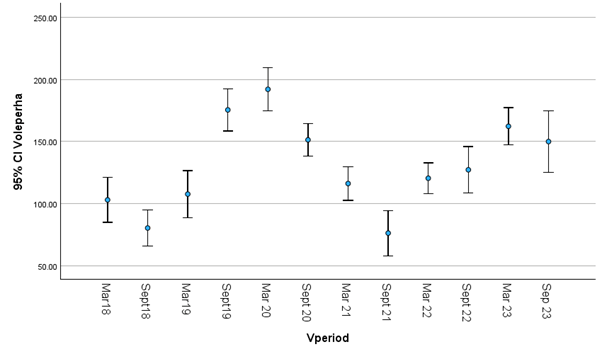
Figure 1. Vole abundance at 19 sites in the Scottish Borders in 2018 - 2023, based on monitoring using the “Vole Sign Index” protocol.
Click for a full description
For each survey, a 25x25cm quadrat is thrown 25 times in suitable habitat and feeding signs and droppings of voles are quantified in each quadrat. Surveys are carried out twice annually in March and September to coincide with annual lows and highs of vole populations. Data provided by Andrew Village.
4. Discussion
4.1 Species affected
Comparing 2023 with the period before the HPAI outbreak paints a more positive picture for raptors in Scotland than is suggested by the findings in 2022 (Wilson et al., 2023). Breeding success of both Golden Eagle and White-tailed Eagle, the two species that showed the strongest evidence of changes in breeding success consistent with impacts of HPAI in 2022, and for which risks of contracting this disease from both scavenged and live prey are probably higher than for most other UK raptors (Veen et al., 2007), seems to have largely recovered from 2022 levels.
For Golden Eagles, the mean level of breeding success recorded across the whole SRMS dataset in 2023 was 0.44, which is not significantly different from levels of breeding success recorded for this species from 2018-21 and represents a big improvement from the drop in breeding success reported for 2022 (from 0.48 to 0.28). Moreover, most local studies and regional analyses report numbers of breeding pairs and levels of breeding success and fledged brood size that compare favourably with pre-outbreak figures for these metrics. The one exception to this pattern is for breeding success in Tayside & Fife which fell in 2023 to levels that were nearly half those reported during 2018-21.
White-tailed Eagle breeding success in 2023 remained lower than in 2018-21 in some areas, with this difference being statistically significant in Argyll, Lewis & Harris, and for the whole of Scotland, but, as for Golden Eagles, was generally higher than in 2022. Among local studies, the only statistically significant difference in levels of breeding success between 2023 and previous years was for inland-breeding White-tailed Eagles, which declined from 0.64 in 2018-21, and 0.77 in 2022, to 0.50 in 2023.
Among other raptor species, there were fewer indications of changes consistent with HPAI impacts in 2023 than in 2022. The most notable of these were for Peregrines for which one local study on the Dumfries-shire coast found many fewer pairs in 2023 (eight) than in previous years (average of 14.2), despite similar levels of survey effort. Another in Lothian and Forth found that breeding success was substantially lower in 2023 (0.29) than during 2018-21 (average of 0.51). Both results were near-significant. The suggestion that Peregrine breeding productivity in southern Scotland might have been lower in 2023 than in previous years was supported by the regional comparisons: breeding success in Lothian & Borders was near-significantly lower in 2023 (0.46) than in 2018-21 (average of 0.58), and while breeding success in Dumfries & Galloway was similar in 2023 to previous years, a much-reduced number of pairs was found in 2023 (35) than in 2018-21 (average of 51). The observations of SRMS contributors as noted above further supported this picture. Of note in south-east Scotland was that occupancy by immature birds in 2023 was unusually high, and that breeding performance of these birds was extremely poor. Interestingly, at least seven of the nine immature territory holders observed in 2023 were females. The difference in size between male and female Peregrines means that the two sexes take different prey species, with larger prey being taken more often by females (Ratcliffe, 1993). In the south-east Scotland study area female Peregrines that breed in inland territories are thought more likely to move to coastal areas during the winter than their male partners (George Smith pers. comm.). These gender differences could put female Peregrines at higher risk of HPAI transmission from wildfowl or gulls wintering on the coast. However, Malcolm Whitmore’s observations of the diet of coastal Peregrines on Arran suggest that these birds predominantly prey on pigeons and passerines, including corvids, rather than auks or gulls. A study of the winter diet of Peregrines in south Scotland similarly found coastal birds mainly preying on pigeons and passerines (Mearns, 1982).
Overall, however, there seemed to be less evidence of potential HPAI impacts on non-eagle raptors monitored by SRMS in 2023. Scotland-level breeding success of Peregrines and Ravens, which had been lower in 2022 than in previous years, was no longer significantly different, and for Buzzards it was higher in 2023 than in previous years. In fact, Ravens and Buzzards, along with several other raptors, appeared to enjoy unusually productive breeding seasons in some parts of Scotland. A couple of factors could have contributed to these higher levels of productivity observed in some raptor populations. Firstly, monitoring of voles in the south of Scotland suggested the spring population was higher than for any other year during the period since 2018 apart from 2020, when raptor monitoring was affected by Covid-19 restrictions. This could have benefitted species for which small mammals are a key component of the diet. These include Buzzard, Hen Harrier, Kestrel, and Red Kite, all of which showed increases in breeding success and/or fledged brood size in 2023. Secondly, a National Hen Harrier Survey was carried out in 2023 with consequent higher-than-average survey effort for this species by volunteers and professional surveyors, which could have resulted in improved detection of successful breeding attempts. Increased survey effort for Hen Harrier could also have increased detection of other raptors occurring in similar habitat, particularly Merlin.
4.2 Areas affected
The apparent impact on Peregrine breeding success was greater for the smaller Lothian and Forth study area than in the wider Lothian and Borders region. Together with the account of George Smith, this suggests a relatively strong but localised impact. Elsewhere in southern Scotland there was a localised decline in the number of breeding pairs of Peregrine but no suggestion of an accompanying decrease in breeding success for those pairs that did breed. Assuming these inter-year differences are due to impacts of HPAI, these findings might suggest that areas can differ not only in the degree to which breeding pairs are impacted but also in how impacts manifest. This wouldn’t necessarily mean that HPAI was behaving very differently within these areas as, for example, it is possible that deaths of territorial female Peregrines could lead to higher levels of occupancy by immature females in areas where young birds were available to recruit into the breeding population and might simply result in vacant territories in areas lacking these new recruits.
Apart from a decline in the number of breeding Peregrines in the south-west, the only other negative impact apparent from local studies on numbers of breeding pairs was the near-significant reduction in the number of Buzzard pairs in the Tain study. This follows on from a similar effect in 2022 (Swann & Beckmann, 2025) and is in the context of very consistent levels of coverage. As described by Wilson et al. (2023), it is supported by Swann’s observations after the first year of the outbreak of a strong, but localised, impact on occupancy of Buzzard territories associated with scavenging and preying on dead and dying geese in nearby fields during the autumn, winter and spring of 2021/2022. It is not clear whether the continued low levels of territorial occupancy observed in 2023 are due to further impacts of HPAI on Buzzard survival after the breeding season of 2022, or a consequence of the impacts of HPAI in the initial year. Buzzards usually start breeding in their third (sometimes second) year (Cramp et al., 1977-1994), so if there was increased mortality across all age classes in 2022 this could be expected to result in reduced territorial occupancy beyond the initial year. It will be interesting to see how quickly Buzzard occupancy recovers in the coming years given the strong breeding performance of the pairs that did breed in this area in 2023. More generally, the high level of breeding success following apparent impacts of HPAI in this Buzzard study suggests that, in the likely event that other local populations of this species were similarly impacted, there is reason to be optimistic about their prospects of recovery.
In 2022, evidence of impacts on both species of eagles seemed to be strongest in coastal regions. This situation was reversed in 2023, with eagles in coastal regions appearing to be less impacted than in 2022, except for White-tailed Eagles in Argyll where the levels of breeding success reported in 2023 were similar to those observed in 2022. The only area where breeding success of Golden Eagles was lower in 2023 than in previous years was Tayside & Fife, where the species is restricted to the land-locked west of the region. It is worth noting that, during 2023, many mass mortality events and confirmed HPAI tests were reported for Black-headed Gull - more than for any other wild bird species in the UK (Animal and Plant Health Agency, 2024). In the northern half of Scotland, this species is a widespread breeder in eastern, inland areas. If there were dead and dying Black-headed Gulls in or near the territories of inland breeding White-tailed Eagles or Golden Eagles in Tayside, this may have contributed to lower breeding performance, but it is impossible to be certain about this. As in 2022, we cannot be certain that decreased breeding success in 2023 has been caused by impacts of HPAI rather than by other factors (Wilson et al., 2023).
4.3 Other corroborating sources of information
The conclusion from our analyses of SRMS data that impacts of HPAI on raptors in Scotland are likely to have been less severe in 2023 than in 2022 is supported by two other main sources of information. Firstly, the comments of contributors submitted with raptor records included only two mentions of suspected cases of HPAI, one of which is specifically in relation to a bird that died in 2022. This compares with 17 comments related to suspected cases and four confirmed cases of HPAI documented in the comments submitted with 2022 records. Admittedly, this source of information is not completely independent of the dataset on which our analyses are based, as both derive from the same set of raptor territory checks and breeding attempts. However, the interpretation of data contributors is both informed by familiarity with the territories in question and grounded in detailed field observations, many of which are not included in the data we analysed. As such, the conclusions of observers regarding the fates of specific breeding attempts are supportive to those of our analyses, which are based on patterns across multiple breeding attempts rather than evidence associated with individual territories.
The other source of information presented here is the summary of confirmed HPAI cases published by APHA (Table 6). This suggests that not only has the overall number of positive tests for HPAI reported for Scotland halved, as it also has for England & Wales, but also the proportion of these tests that concern raptors has halved, from 12% to 6%. As a result, the number of HPAI cases confirmed for raptors in Scotland in 2023 (18) is a quarter as many as were confirmed the previous year (69). Of note is the fact that numbers reported for Golden Eagle and White-tailed Eagle have dropped from three and four (six for the whole of Great Britain), respectively in 2022 to the single, late-released test result for a Golden Eagle found dead on Lewis in October 2023. The numbers of positive test results for eagles in 2022 appear to be small but, as pointed out previously (Wilson et al., 2023) they should be interpreted in the context of overall population size. The British breeding population estimates for Golden Eagle, White-tailed Eagle and Buzzard were estimated by Woodward et al. (2020) as 510 pairs, 127 pairs and 72,750 pairs, respectively. This puts the number of HPAI cases reported from these species in 2022 at 0.3%, 2.4% and 0.1% of their British breeding populations. In 2023 these proportions have decreased to 0.1% for Golden Eagle, 0% for White-tailed Eagle and less than 0.1% for Buzzard.
It is worth noting that, at least at a Britain-wide scale, the incidence of reported cases of HPAI in Peregrines appears to have increased steeply between 2022 and 2023. During this time, the overall number of cases reported in Britain for this species increased from nine to 25 – even more remarkable given that the overall number of cases for raptors halved during the same period. This increase tallies with observations that the rate of observed infections among some European Peregrine populations was increasing in 2023 (e.g. Gunther et al., 2023). In this context, the localised decreases in breeding pair number or success of Peregrines in southern Scotland, while not yet very alarming, suggest that we should keep a close eye on Peregrine numbers and breeding success in Scotland; even though only two Peregrines have been confirmed to have HPAI in Scotland.
The fact that APHA’s reported rate of positive HPAI cases for Peregrines in England and Wales is approximately 10 times higher than in Scotland should not be taken as a reliable indication that HPAI is less prevalent in or deleterious to wild birds in Scotland than it is further south. There are several reasons for which APHA data may not accurately reflect the incidence of HPAI in wild populations. Firstly, effective search effort and encounter rates for raptor carcasses are likely to vary markedly between different areas such that the proportion of HPAI-related deaths detected for species found mostly in remote areas is likely to be lower than for raptors commonly found in areas of high human population density. This could be an important source of bias for comparisons between Scottish and English Peregrine populations as the proportion of the population breeding in urban and lowland situations is considerably higher in England than in Scotland (Wilson et al., 2018). Another important consideration is that APHA do not test all cases reported to them, with different priorities ascribed to different species. Finally, APHA data do not include information on negative tests, making it impossible to work out what proportion of birds tested were positive.
4.4 Other factors that could contribute to observed effects
As noted in the previous report, factors such as weather and availability of prey can contribute to observed differences in breeding performance of raptors between different years (Newton, 1979; Ratcliffe, 1993). In 2022 there were periods of cold and of wet weather that could have affected the breeding outcomes of some pairs – particularly of early-breeding species, which were among those for which 2022 was a particularly poor breeding season. The weather during the breeding season in 2023 was largely favourable. Following a warmer and drier February than average, March 2023 was slightly colder and had typical amounts of precipitation compared to a 30-year average (1993-2022). April, May, and June were then all drier and mostly warmer than average. May 2023 was particularly dry with 39mm of mean rainfall, less than half of the long-term average. June 2023 was also dry, and particularly warm and sunny (2.6°C above average and 60% more sunshine). July 2023 had typical temperatures but was much wetter than normal with mean rainfall of 155mm compared to a long-term average of 103mm (Met Office National Climate Information Centre, 2024).
Weather in 2023 should, therefore, have been largely favourable for many breeding raptors, perhaps apart from late-breeding species potentially being affected by a very wet July, and some open nesting species perhaps being affected by heat stress in June. Weather may, therefore, have contributed to more positive breeding outcomes for some species in 2023 than in 2022, especially in the north and west of Scotland. However, it is unlikely to have been the sole or main factor behind the differences in breeding success between 2022 and earlier years (see Wilson et al., 2023 for more details) or to be the only reason for improvements in breeding output between 2022 and 2023.
In terms of prey availability, and as has already been mentioned, abundance of voles during the spring of 2023 was relatively high, which may partly explain high rates of breeding success and fledged brood sizes of small mammal predators in some areas. Vole abundance is unlikely to have contributed to inter-annual differences in breeding productivity for species like Golden Eagle, White-tailed Eagle, and Peregrine, for which possible effects of HPAI in one or both of 2022 and 2023 have been discussed. However, it seems plausible that high vole availability could have boosted Buzzard productivity in 2023 in some parts of Scotland. It is possible that such a boost could have masked negative effects of HPAI but, if it did, then it seems likely that such effects were probably not very notable, anyway.
SRMS monitoring can be considered sufficiently thorough and representative that, at least for the raptor species covered in this report, severe impacts on a large proportion of the breeding population, as reflected in the changes in productivity in Golden Eagle and White-tailed Eagle described by Wilson et al. (2023), would be reliably detected. That is, where any of these species were severely impacted by HPAI, we can be confident that the sample data from the SRMS would have detected these. However, where an HPAI impact was detected in a local study, it cannot be inferred from the sample data available that the impact occurred across a whole region or nationally. Reduced breeding productivity consistent with the effects of HPAI at a regional level can be localised if sampling within that region is concentrated at one or a few localities and should not be interpreted as occurring across a whole region without further supporting evidence.
It is worth noting that variation in surveyor effort could affect recorded occupancy and breeding outcomes in several ways relevant to the inter-annual comparisons on which the findings of this report are based. In situations where field effort is reduced, this is likely to result in fewer territorial pairs being recorded, particularly when there are fewer or less effective monitoring visits early in the breeding season. This is because even when the number of territories checked remains the same, reduced survey effort can lead to pairs being missed. Lower survey effort in the early part of the breeding season can mean that pairs that fail early have left their territories, or become much less easily detectable, by the time territories are checked. This also has consequences for measures of productivity. Every early failing breeding attempt that is not detected before it fails cannot contribute to the overall measure of breeding success. In a situation where many attempts fail early and a high proportion of these go undetected, estimates of breeding success can be much more positive than they should be. Finally, reduced effort towards the end of a season tends to result in the outcomes of more breeding attempts going unresolved. Because it is harder to prove a negative, this can lead to positive-biased estimates of breeding success and counts of fledged young being incomplete leading to underestimates of fledged brood size. During the period we considered, the most widespread, year-specific impacts on surveyor effort probably arose from restrictions due to the Covid-19 pandemic imposed on, and precautionary measures taken by, fieldworkers during 2020. However, the effect of these was probably short-lived, as the Scottish government was quick to realise that the transmission risk posed by most raptor monitoring was low.
4.5 Further information needs
Although this analysis of 2023 data brings mostly good news in terms of decreases in the severity of apparent impacts for most species, it does not prove that the risks posed by HPAI have gone away. Moreover, the differences in apparent impacts between 2023 and 2022 emphasise how quickly these risks can change. In this context, continuing to monitor breeding raptors in Scotland and evaluating the data the monitoring yields is likely to remain a useful exercise. As well as checking that the reproductive rates of breeding eagle populations continue to recover and remain stable subsequently, more information is required to determine whether and to what extent HPAI impacts on Peregrines in Scotland (and elsewhere in the UK).
As in previous years, it may be useful to emphasise to raptor monitors, most of whom are volunteers, the value and importance of some aspects of monitoring that underpin the value of SRMS data for studies like this one. These include the explicit recording of territorial occupancy and vacancy and ensuring that, wherever possible, timing and number of survey visits are sufficient to detect early failing pairs and minimise the frequency of unknown breeding outcomes. It will also be helpful to increase the number of SRMS contributors who take a rigorous Study Area approach to their coverage. This involves either comprehensively monitoring all breeding pairs within their Study Area or standardising survey effort over time in a way that allows abundance to be meaningfully compared between different years. This fits well with broader SRMS objectives of expanding and improving monitoring coverage, though that does not mean these objectives will be easy to achieve. Last year’s report (Wilson et al., 2023) mentioned the desirability of improvements to the SRMS Online data portal to facilitate systematic recording of causes of failure and associated evidence. These have been developed, implemented, and released for use in March 2024 (Challis, 2024), and the system now allows recording reasons for failure of breeding attempts and any supporting evidence in a standardised way. It will be valuable to promote use of this functionality among raptor workers to facilitate understanding of temporal and spatial patterns in causes of failure.
Beyond knowing that many infected adult raptors and some infected young have died, we still do not understand much about the relative importance of HPAI impacts at different stages of life history or the breeding cycle. Increasing the proportion of monitoring attempts for which the frequency of survey visits are enough to discern the stage at which unsuccessful attempts fail - at least, the four standard visits usually recommended in Hardey et al. (2013) - would be helpful. It would also help if a greater proportion of SRMS data were recorded on a visit-by-visit basis, as is being done by users of the SRMS Online system. Uptake of this system is still increasing and will improve our ability to identify the stage of breeding at which HPAI impacts occur which could, in turn, inform actions aimed at mitigating the risks or consequences of infection.
Beyond conventional breeding raptor monitoring, information on occurrence, transmission pathways, viral type, pathology and developing immunity could most transform our understanding of HPAI risks to, and impacts on, raptors. Improving the quantity and quality of these kinds of information will require sampling and testing of live and dead birds. Of these two activities, testing of dead birds already happens extensively (Animal and Plant Health Agency, 2023, 2024), but aspects of both the sampling and reporting for this testing could be improved. In terms of sampling, it would (as mentioned in Wilson et al., 2023) still be helpful to have testing conducted in a wider range of species and situations. For raptors in Scotland, the two most valuable types of information would be:
- sampling and testing of adults at different times of the year, and of adults and young involved in breeding attempts that are contributing data to the SRMS; and
- sampling and testing of a wider range of avian prey species, particularly species like Feral Pigeon (Columba livia), Woodpigeon (Columba palumbus), Jackdaw (Corvus monedula) and Rook (Corvus frugilegus) which are abundant, important prey species for Peregrines and other raptors, and are populations in which prevalence and effects of HPAI aren’t well understood.
Probably the single, biggest obstacle to improved pathological and immunological information, is capacity for testing samples. Professional sampling of either living or dead raptors is likely to be prohibitively expensive except on a small scale. Many SRMS contributors already visit nests to monitor their contents and to ring nestlings so are in an ideal position to take samples which could be combined with information on breeding outcomes in a way that could make them more useful than most samples taken from live raptors in other contexts. However, training, equipping, and licencing these fieldworkers, most of whom are volunteers, to take samples from live raptor nestlings may present significant logistical and regulatory challenges. Blood or tissue sampling, although the most valuable for immunological tests, are likely to be the most challenging to organise. If useful HPAI information can be gleaned from less invasive sampling techniques such as buccal swabbing (USDA, 2023), this may be the most feasible way for volunteers to collect samples.
However, there remains the issue of limited laboratory testing capacity. Because HPAI is dangerous to human health, sampling, and testing for HPAI in both live and dead birds is very tightly regulated and is currently restricted to highly controlled laboratories, making it difficult and expensive to increase the number of wild bird samples that can be included. It also limits the potential for testing a broader range of species.
Testing dead raptors whose cause of death might be HPAI-related in as wide a range of situations as possible – not just adults and chicks found at active nest sites, but also dead raptors found in other locations, and outside of the breeding season – is another source of information. As post-mortem examinations of dead raptors are often conducted to aid detection and prevention of wildlife crime, raptor carcasses are commonly reported to authorities. A positive HPAI test normally precludes further post-mortem tests such as X-rays or toxicological screening, so clear guidelines are required for determining when HPAI tests should be prioritised over other types of examination.
The inclusion of negative test results in APHA’s public reporting of HPAI testing data would allow a more sophisticated assessment of the prevalence of HPAI among tested birds. Information on reported and sampled birds that were not tested, the age and sex of tested birds, the location types, or habitats they were found in, and, where applicable, the variant of HPAI detected would also be helpful.
5 References
Animal and Plant Health Agency 2023. Scientific opinion on the incursion of High Pathogenicity Avian Influenza (HPAI) H5N1 into housed or not housed poultry flocks and captive birds. Updated in June 2023.
Animal and Plant Health Agency 2024. Bird flu (avian influenza): cases in wild birds. Confirmed cases of wild birds with highly pathogenic avian influenza (bird flu) in Great Britain. Last updated on 5th April 2024.
Challis, A. 2024. Scottish Raptor, Newsletter of the Scottish Raptor Monitoring Scheme, March 2024 issue accessed 28/03/2024.
Challis, A., Beckmann, B.C., Wilson, M.W., Eaton, M.A., Stevenson, A., Stirling-Aird, P., Thornton, M. & Wilkinson, N.I. (2023). Scottish Raptor Monitoring Scheme Report 2021 & 2022. BTO Scotland, Stirling
Cramp, S., Simmons, K.E.L., Perrins, C.M. 1977-1994. Handbook of the Birds of Europe the Middle East and North Africa, The Birds of the Western Palearctic, Volumes I-IX, Oxford University Press.
Günther, A., Krone, O., Globig, A., Pohlmann, A., King, J., Fast, C., Grund, C., Hennig, C., Herrmann, C., Piro, S., Rubbenstroth, D., Schulz, J., Staubach, C., Stacker, L., Ulrich, L., Ziegler, U., Harder, T., Beer, M. 2023. Pathogen-prey-predator relations of avian raptors during epizootics of highly pathogenic avian influenza virus HPAIV H5N1 (clade 2.3.4.4b) in Germany. bioRxiv 2023.11.19.567176
Hardey, J., Crick, H., Wernham, C., Riley, H., Etheridge, B. & Thompson, D. 2013. Raptors: a field guide to survey and monitoring (3rd Edition). The Stationery Office, Edinburgh.
Hayne, D. W., and Thompson, D. Q. (1965). Methods for estimating microtine abundance. Transactions of the Thirtieth North American Wildlife and Natural. Resources Conference. 393–400.
Lambin, X., Petty, S. J. & Mackinnon, J. L. (2000). Cyclic dynamics in field vole populations and generalist predation. Journal of Animal Ecology 69: 106-118.
Mearns, R. (1982). Winter occupation of breeding territories and winter diet of Peregrines in South Scotland. Ornis Scandinavica, Vol. 13, No. 1, 79-83.
Met Office National Climate Information Centre 2024. UK and regional series of precipitation, temperature, and sunshine hours. Accessed on 24th March 2024.
Newton, I. 1979. Population Ecology of Raptors. T & AD Poyser, Berkhamsted.
Pearce-Higgins, J.W., Humphreys, E.M., Burton, N.H.K., Atkinson, P.W., Pollock, C., Clewley, G.D., Johnston, D.T., O’Hanlon, N.J., Balmer, D.E., Frost, T.M., Harris, S.J. & Baker, H. 2023. Highly pathogenic avian influenza in wild birds in the United Kingdom in 2022: impacts, planning for future outbreaks, and conservation and research priorities. Report on virtual workshops held in November 2022. BTO Research Report 752, BTO, Thetford, UK.
Petty, S. J., Lambin, X., Sheratt, T.N., Thomas, C. J., Mackinnon, J. L., Coles, C. F., Davison, M. & Little, B. 2000. Spatial synchrony in field vole Microtus agrestis abundance in a coniferous forest in northern England: the role of vole-eating raptors. Journal of Applied Ecology 37 (Suppl.1): 136–147.
Ratcliffe, D.A. 1993. The Peregrine Falcon. T & AD Poyser, London.
Smith, G. D., McGrady, M. J., Beckmann, B. C., & Oli, M. K. (2025). Potential effects of HPAI on occupancy rates, breeding success, age, and turnover of breeding Peregrine Falcons Falco peregrinus in southern Scotland. Bird Study, 72(1), 69–73
Swann, R. L., & Beckmann, B. C. (2025). Significant decline of a Common Buzzard Buteo buteo population during an outbreak of high pathogenicity avian influenza (HPAI). Bird Study, 72(1), 61–68
USDA. 2023. Avian sample collection for Influenza A and Newcastle Disease. USDA Animal and Plant Health Inspection Service.
Animal and Plant Health Inspection Service Accessed on 23rd March 2023.
Veen, J., Brouwer, J., Atkinson, P., Bilgin, C., Blew, J., Eksiogv lu, S., Hoffmann, M., Nardelli, R., Spina, F., Tendi, C., & Delany, S. 2007. Ornithological data relevant to the spread of Avian Influenza in Europe (phase 2): further identification and first field assessment of Higher Risk Species. Wetlands International, Wageningen, The Netherlands.
Village, A., & Myhill, D. 1990. Estimating small mammal abundance for predator studies: snap-trapping versus sign indices. Journal of Zoology 222: 681-689.
Wilson, M.W., Challis, A. & Wernham, C.V. 2022. Scottish Raptor Monitoring Scheme Trends for 2009-2018 Methods and Analysis of Gaps (A report to the SRMG). BTO Scotland, Stirling.
Wilson, M. W., Balmer, D. E., Jones, K., King, V. A., Raw, D., Rollie, C. J., Rooney, E., Ruddock, M., Smith, G.D., Stevenson, A., Stirling-Aird, P. K., Wernham, C. V., Weston, J. M. & Noble, D. G. (2018). The breeding population of peregrine falcon Falco peregrinus in the United Kingdom, Isle of Man and Channel Islands in 2014. Bird Study 65: 1-19.
Wilson, M.W., Wetherhill, A.S., and Wernham, C.V. 2023. An analysis of Scottish Raptor Monitoring Scheme data to improve understanding of the impact of the 2022 Avian Influenza outbreak on raptors and raptor populations in Scotland. NatureScot Research Report 1331.
Woodward, I., Aebischer, N., Burnell, D., Eaton, M., Frost, T., Hall, C., Hearn, R., Stroud, D., & Noble, D. 2020. Population estimates of birds in Great Britain and the United Kingdom. British Birds 113: 69-104
Zetland Raptor Study Group 2023. Raptors breeding in Shetland 2022. Annual report of the Zetland branch of the Scottish Raptor Study Group, self-published, 16pp.
Zetland Raptor Study Group 2024. Raptors breeding in Shetland 2023. Annual report of the Zetland branch of the Scottish Raptor Study Group.