Priority Marine Feature - Native oysters
Improving the protection given to Priority Marine Features

An overview of native oyster records
Description
Characteristics
The native oyster Ostrea edulis is a bivalve mollusc that has an oval or pear-shaped shell with a rough, scaly surface. Native oysters grow up to 110 mm long (Philpots, 1890) and are found in highly productive, shallow, estuarine and coastal waters. Where conditions are suitable, native oysters may form dense beds, substantially increasing the biodiversity of an area (Barnes, 1973) by stabilising sediments, providing a solid surface for settlement and creating a complex three-dimensional structure that serves as a nursery ground for small fish and other species (OSPAR, 2009).
The sediments below an oyster bed are enriched by organic deposits that provide a rich food source for other animals. Dense beds can contribute to nutrient cycling in estuarine and coastal ecosystems, transferring phytoplankton primary production and nutrients to benthic secondary production (benthic-pelagic coupling) (Dame et al., 1984).
Definition
Beds of native oysters can occur on muddy fine sand or mixed sandy muds. Typical oyster densities range from between 0.2 - 3.5 individuals per m2. A minimum area of 5 m x 5 m of habitat is required to qualify as a bed. Dead oyster shells may make up a substantial portion of the substratum (Lancaster et al., 2014).
Environmental preferences
Native oysters are found on sheltered coasts from the intertidal zone down to 5 m depth and occasionally to 20 m. They are associated with firm mud, muddy sand and muddy gravel with shells and stones. Oyster larvae settle on hard substrates (with a preference for live settled oysters, recently dead oysters and oyster shell debris; Perry & Tyler-Walters, 2016).
Distribution
Scottish distribution
On the basis of existing information, the native oyster range in Scotland is reduced compared to historical accounts and is currently confined to the west coast and islands (University Marine Biological Station Millport, 2007). Most contemporary records for native oysters are species records, with oyster beds currently only recorded in Loch Ryan, Loch Sween, Loch Scridain and Loch Eishort.
Estimated known Scottish extent
Scottish beds of native oysters may be large (up to 15 km2) or occur in small fragmented clumps around the edges of sheltered lochs. The largest extant population in Scotland is in Loch Ryan (an actively managed fishery), with population estimates of over 5 million adults and 52 million spat in the Lefnoll area alone, which covers an area of just 1.6 km2, i.e. over 3 adults and 30 spat per m2 (University Marine Biological Station Millport, 2007).
Wider distribution
Native oysters have a confirmed sparse distribution around Ireland, western and southern England and Wales, and northern France. Native oyster beds have also been recorded in Norway, Denmark, Germany, Belgium, the Netherlands and Spain.
Status
The native oyster has been a popular food in the UK for centuries and dense beds were once common along the coast of Scotland, including Orkney, Shetland (see Shelmerdine & Leslie, 2009) and the Firth of Forth. However, overfishing in the late 1800s and early 1900s, together with pollution, disease and pests resulted in significant declines. Beds in the Firth of Forth covering 129 km2 landed 59 million oysters in 1834-36, but by 1957 they were extinct. Beds have been cultivated in some areas on a relatively small scale. The only active oyster fishery left in Scottish waters is in Loch Ryan, which appears to have a large, self-sustaining population. A detailed report on native oysters in Scotland (University Marine Biological Station Millport, 2007) indicates a wide distribution on the west coast and islands, however these are characteristically of moderate to low population size and geographically scattered.
Native oysters (as a species) and beds of the species (as a habitat) are both recognised as threatened and/or declining (T&D) under OSPAR (OSPAR, 2008). The species is considered to be under threat and/or in decline in the Greater North Sea (Region II), with native oyster beds under threat in all regions where they occur. There is evidence of unlawful gathering of oysters on a wide scale having a severe impact on native oyster populations in Scotland (Lancaster et al., 2014).
Drivers for improving protection
Native oysters are included on the PMF list which means that National Marine Plan General Policy 9(b) (avoiding significant impact on national status) applies. Native oyster beds are an OSPAR threatened and declining habitat in need of protection. The Scottish Biodiversity Strategy to 2045, the Scottish Biodiversity Duty and UK Marine Strategy Good Environmental Status provide further drivers to ensure biological diversity is restored, and ecosystems are safeguarded.
Sensitivity (including recovery)
[Key sources: FeAST, Fisheries Management Guidance]
Native oysters are sensitive to pressures including changes in water quality and organic enrichment, pathogens, genetic modification and non-indigenous species (pests/predators). They are also sensitive to disturbance including change or loss of substratum and surface abrasion.
Towed bottom-contacting fishing activity has the potential to impact on native oysters, both directly through the removal of the species and indirectly by altering the habitat or smothering with sediment. However, exposure of native oysters to towed bottom-contacting gears is likely to be low due to their distribution in shallow waters. Currently, the most significant pressure affecting native oysters in Scotland is unlawful gathering. Small, isolated populations are particularly vulnerable to over-exploitation.
Native oysters may be vulnerable to future climate impacts. Projected changes to sea level, water temperatures causing an increase in infections, seawater chemistry (ocean acidification - see OARUG, 2009; Birchenough et al., 2017; Lemasson et al., 2017) and the frequency and strength of storm events associated with climate change pose threats to native oysters.
Factors limiting recoverability in this species are diminished brood stock, shortages of high value settlement surfaces and high adult mortality (disease, pests and targeted exploitation). Relevant techniques for oyster restoration have been developed and restoration is underway or in the planning stages in locations around Scotland including the Dornoch Firth (Fariñas-Franco et al., 2018) and the Firth of Forth. Given ideal conditions, it is estimated that site-scale recovery could be possible within 6-12 years (Mazik et al., 2015).
Connectivity
Between native oyster beds
Native oysters spawn in summer and the pelagic larval dispersal phase lasts for 10-30 days. The reproductive strategy of females is internal brooding, where embryos are kept inside the mantle cavity where they are protected from external conditions before being released as larvae after 7-17 days (Colsoul et al., 2021). This relatively long dispersal phase, combined with larval behaviour and local hydrographic conditions, could mean that native oyster beds are relatively well-connected. Gallego et al., (2013) found that larvae from the Summer Isles may provide larvae to beds in the Firth of Forth. Genetics work by Beaumont and co-authors (2006) further supports this, with oysters at Loch Eriboll and West Loch Tarbet not genetically distinct. Elsewhere in the UK and Europe, beds are also relatively well-connected, with beds in England, Ireland and France falling within the same genetic cluster (Vera et al., 2016).
Although particle tracking models (i.e. Gallego et al.,2013) and genetics (i.e. Beaumont et al., 2006) suggest that beds are relativity well connected, recruitment within Scottish native oyster populations may be limited as a result of low population densities. Selective removal of sexually mature oysters by unlawful gathering may further supress recruitment (University Marine Biological Station Millport, 2007). Additional management could help provide connectivity between beds, including those within the MPA network.
With other PMFs
Native oyster beds are often associated with other PMFs, particularly blue mussel beds PMF and intertidal mudflats PMF (Lancaster et al., 2014). Native oysters are also known from shallow seagrass beds PMF and maerl beds PMF (e.g. in Loch Sween; Moore et al., 2013).
Ecosystem services
The habitat provided by native oyster beds can support a number of other species and contributes to the protection of biodiversity. Native oysters also have an important role in nutrient cycling as well as in filtering sea water and removing potentially toxic algae.
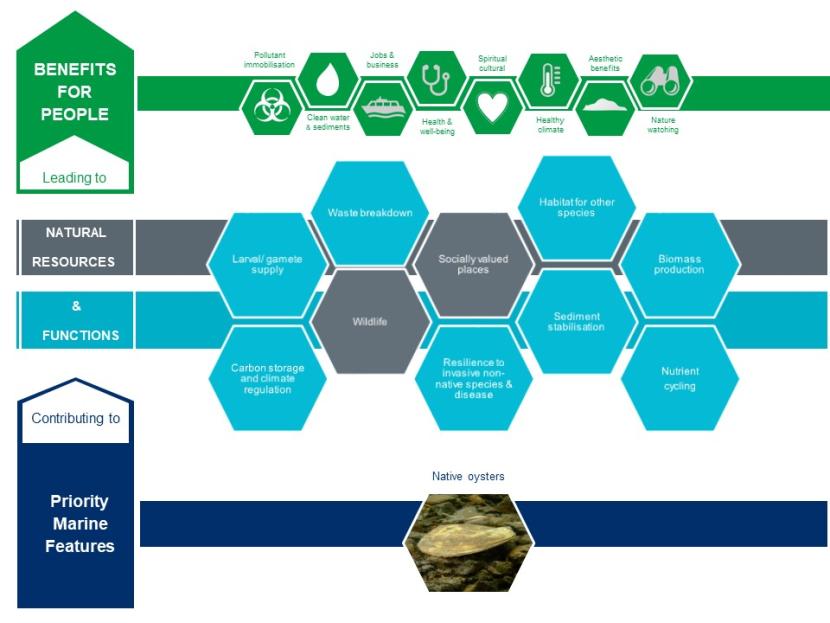
The contribution native oysters make to natural resources and functions and the benefits for people that these lead to.
Click for a full description
- Priority Marine Feature: Native oysters contributing to
- Natural resources (NR) and functions (F)
- Carbon storage & climate regulation (F)
- Laval/gamete supply (supporting connectivity (F)
- Waste breakdown (F)
- Wildlife (NR)
- Socially valued places (NR)
- Sediment stabilisation (F)
- Nutrient cycling (F)
- Biomass production (F)
- Resilience to invasive non-native species & disease (F)
- Formulation of habitat for other species (supporting biodiversity) (F)
- Which leads to benefits for people
- Health & wellbeing
- Knowledge
- Clean water and sediments
- Healthy climate
- Jobs and business
- Spiritual/cultural
- Aesthetic benefits
- Nature watching
Existing Marine Protected Areas
Native oyster beds are a protected feature of Loch Sween MPA.
Existing and proposed fishing measures providing PMF protection
Native oyster beds and individual native oysters are protected by the following existing fishing measures:
- The Inshore Fishing (Scotland) Order 2015 (Loch Sween; Upper Loch Fyne and Goil; Loch Creran; Lochs Duich, Long and Alsh (through the combined Southern Inner Sound measures CA150); Loch Sunart; and, Loch Laxford).
- The South Arran Marine Conservation Order 2015
- The Loch Sunart to the Sound of Jura Marine Conservation Order 2016.
- The Wester Ross Marine Conservation Order 2016.
- The Loch Carron Marine Conservation Order 2019.
- The Red Rocks and Longay Marine Conservation Order 2022.
- Loch Roag (CA67) fisheries areas.
The following new fishing measures are proposed which will protect native oysters in MPAs:
- Sound of Arisaig, Small Isles, Sullom Voe and Fetlar to Haroldswick.
The Inshore fishing (Scotland) Order 2004 restricts fishing with mobile or active gear in Loch Ryan, with an exemption for dredging mussels and oysters. A well-managed oyster fishery exists in the Loch operated by the Loch Ryan Oyster Fishing Company on behalf of the family who own the historic rights to the oysters there. The stock is maintained and harvested on a rotational basis with some permanently fallow areas. The current management of the bed by the Loch Ryan Oyster Fishing Company is believed to be appropriate for the ongoing protection of the PMF in Loch Ryan.
Approach to assessing improvements in management needed to protect native oyster beds from impacts related to towed bottom-contacting fishing gear
The assessment presented in this document relates to fishing using towed bottom-contacting gear only. It is consistent with the approach taken for assessing proposed developments.
When considering biodiversity evidence more weight has been given to clusters of native oyster records and records which show the extent of native oyster beds (i.e. polygon data) where available, in preference to isolated observations. There has been particular consideration of larger beds in comparison to smaller ones (where extent is known), except where smaller or fragmented beds are the only remaining examples in a geographic area and require protection to support recovery of the PMF.
Consideration of key locations for native oyster beds has included ensuring the areas/locations are distributed to cover the full range of environmental conditions in which native oyster beds occur (type of wider environment e.g. sea loch vs. coastal, depth, geographic range, substrate, etc.), and the connectivity of beds.
A greater biological diversity of associated faunal and floral communities and greater bed extents are factors which increase the conservation importance of a bed. Information on these characteristics does not exist for all records in Scottish waters precluding their detailed application in this assessment. However, such information should be sought and used in development licensing and consenting processes.
Any towed bottom-contacting fishing activity that leads to the loss or damage to native oyster populations, such that function or provision of ecosystem services cannot be maintained should be considered to have a significant impact on national status and as a result not meet General Policy 9(b) in the National Marine Plan.Existing licensing and consenting processes will continue to consider the potential for significant impacts on native oyster beds.
Key locations for the protection of native oysters outside designated sites and existing towed bottom-contacting fisheries restrictions
Summary
The distribution of native oysters in the wild in Scotland is generally confined to the west coast (Donnan et al., 2016). In a fisheries context, additional measures to protect native oyster beds from pressures associated with towed bottom-contacting gears should cover records of the feature within the following key locations (outside of MPAs that protect this feature and areas with existing fisheries measures). These are shown in Map 2: west coast of Mull and Ulva and Loch Eishort (Skye).
The recommendation for native oyster beds needs to be considered alongside the recommendations for the other 10 PMFs as part of the development of PMF management areas. These recommendations are based on biodiversity evidence taking into consideration the information above and have been provided to help inform the development of fishing measures, led by Marine Directorate.
If fisheries management measures were established to protect records in all these key locations it would achieve substantial protection for native oysters, complementing the protection already in place for some MPAs and proposed for other MPAs (see map 2).
Details of locations
Due to the sensitivity of native oysters this document does not detail information about their specific locations. This information has been compiled separately and additional details on specifc areas can be provided if approriate.
Fisheries management in Loch Ryan
Native oyster beds in Loch Ryan are considered managed because current and historic management of the beds in the loch for the purposes of harvesting oysters and maintaining the fishery are believed to be appropriate for the ongoing protection of the PMF in Loch Ryan.
Data confidence
Our understanding of native oyster bed distribution in Scotland is limited by current data availability. For the purposes of this review, records of individual native oysters have been considered and it has been assumed that clusters of such records indicate the presence of a larger population.
We have recent records from 2021 and include records from wide scale surveys including the Marine Nature Conservation Review (MNCR; Hiscock, 1996) as well as dedicated native oyster research projects, NatureScot commissioned surveys, local record centres / biological recording groups and Seasearch (carried out by volunteer divers). Additional records for areas such as Orkney, Firth of Forth and Solway Firth exist in the NBN Atlas. However, not all of these are observations of live animals (i.e. some are of shells only) so the data have not been fully utilised in this review. The University Marine Biological Station Millport (2007) study reported local information suggesting that there are no extant native oyster populations around Orkney.
Knowledge gaps and other recommended work
We recommend continuing efforts to explore opportunities for collaborative monitoring, survey and research to improve our understanding of this habitat, for example:
- It is likely that there are more beds around the west coast of Scotland. Future targeted surveys should be guided by species distribution / habitat suitability modelling studies as well as knowledge of historic presence.
- The paucity of data in relation to oyster abundance and distribution in the shallow subtidal currently limits further recommendations. Native oyster information is currently dominated by isolated presence / absence records and there is a lack of data from quantitative surveys that would enable confident identification of ‘beds’.
Key locations for the protection of native oysters
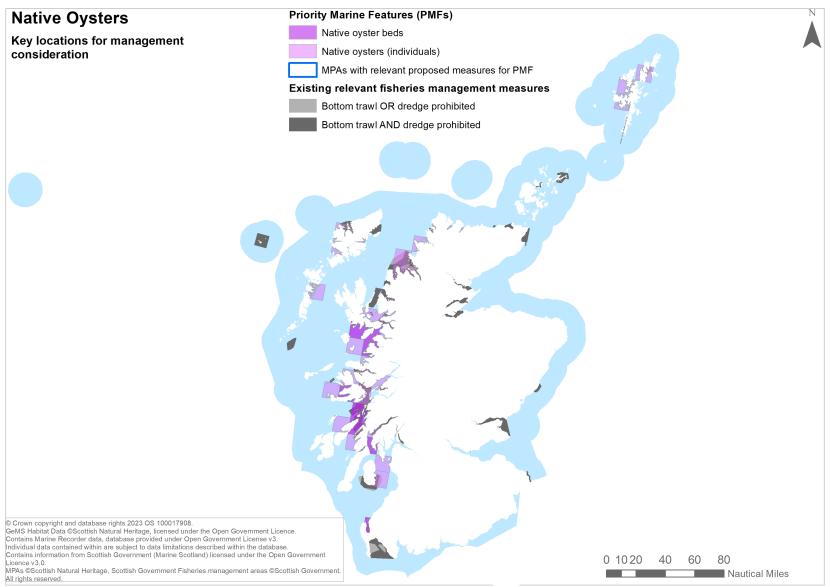
Key locations for the protection of native oysters outside of MPAs with management measures and existing towed bottom-contacting fisheries restrictions
Click for a full description
For further details about the locations marked in this map see above, section Key locations for the protection of native oysters outside designated sites and existing towed bottom-contacting fisheries restrictions.
References
Barnes, R.S.K., Coughlan, J., & Holmes, N.J. 1973. A preliminary survey of the macroscopic bottom fauna of the Solent, with particular reference to Crepidula fornicata and Ostrea edulis. Proceedings of Molluscan Journal,40(4): 253-275.
Beaumont, A., Garcia, M.T., Hönig, S. & Low, P. 2006. Genetics of Scottish populations of the nature oyster, Ostrea edulis: gene flow, human intervention and conservation. Aquatic Living Resources, 19(4): 389-402.
Birchenough, S., Williamson, P. & Turley, C. 2017. Future of the Sea: Ocean Acidification. Foresight - Future of the Sea Evidence Review. Foresight, Government Office for Science, 19 pages.
Colsoul, B., Boudry, P., Pérez-Paralle, M.L., Bratoš Cetinić, A., Hugh-Jones, T., Arzul, I., Mérou, N., Wegner, K.M., Peter, C., Merk, V. & Pogoda, B. 2021. Sustainable large-scale production of European flat oyster (Ostrea edulis) seed for ecological restoration and aquaculture: a review. Reviews in Aquaculture, 13(3): 1423-1468.
Dame, R.F., Zingmark, R.G. & Haskin, E. 1984. Oyster reefs as processors of estuarine materials. Journal of Experimental Marine Biology and Ecology, 83(3): 239-247.
Dipper, F. 2016. (ed). Intertidal and sublittoral survey of islands within the Staffa Island group, Inner Hebrides. September 16-20, 2016. Porcupine Marine Natural History Society Field Trip Report.
Donnan, D.W., Manson, F.J. & MacDonald, I. 2016. Native Oyster. In: Gaywood, M.J., Boon, P.J., Thompson, D.B.A. & Strachan, I.M, eds. 2016. The Species Action Framework Handbook. Perth, Battleby: Scottish Natural Heritage. ISBN 978-1-78391-478-4.
Fariñas-Franco, J.M., Pearce, B., Mair, J.M., Harries, D.B., MacPherson, R.C., Porter, J.S., Reimer, P.J. & Sanderson, W.G. 2018. Missing native oyster (Ostrea edulis L.) beds in a European Marine Protected Area: Should there be widespread restorative management?Biological Conservation, 221: 293-311.
Gallego, A., Gibb, F.M., Tulett, D. & Wright, P.J. 2013. Connectivity of benthic priority marine species within the Scottish MPA network. Scottish Marine and Freshwater Science, 4(2). Edinburgh: Scottish Government. 51 pages. DOI: 10.7489/1512-1.
Hiscock, K. (Ed).1996. Marine Nature Conservation Review: Rationale and Methods. Peterborough: Joint Nature Conservation Committee. Coasts and seas of the United Kingdom. MNCR series.
Lancaster, J. (Ed.), McCallum, S., Lowe A.C., Taylor, E., Chapman A. & Pomfret, J. 2014. Development of detailed ecological guidance to support the application of the Scottish MPA selection guidelines in Scotland’s seas. Scottish Natural Heritage Commissioned Report No. 491. Native oysters - supplementary document.
Lemasson, A.J., Fletcher, S., Hall-Spencer, J.M. & Knights, A.M. 2017. Linking the biological impacts of ocean acidification on oysters to changes in ecosystem services: A review. Journal of Experimental Marine Biology and Ecology, 492: 49-62.
Mazik, K., Strong, J., Little, S., Bhatia, N., Mander, L., Barnard, S. & Elliott, M. 2015. A review of the recovery potential and influencing factors of relevance to the management of habitats and species within Marine Protected Areas around Scotland. Scottish Natural Heritage Commissioned Report No. 771.
Moore, C.G., Harries, D.B., Atkinson, R.J.A., Clark, L., Cook, R.L., Hirst, N.E., Saunders, G.R., Lyndon, A.R., Sanderson, W.G. & Porter, J.S. 2013. The distribution and condition of proposed protected features within the Loch Sween possible Nature Conservation MPA. Scottish Natural Heritage Commissioned Report No. 621.
Ocean Acidification Reference User Group. 2009. Ocean acidification: The facts. A special introductory guide for policy advisers and decision makers. Laffoley, D. d’A., & Baxter, J.M, eds. European Project on Ocean Acidification (EPOCA), 12 pages.
OSPAR. 2008. OSPAR List of Threatened and/or Declining Species and Habitats. Reference Number: 2008-6e.
OSPAR. 2009. Background document for Ostrea edulis and Ostrea edulis beds. Biodiversity Series. OSPAR Commission. Publication number: 428. ISBN 978-1-906840-68-6.
Perry, F. & Tyler-Walters, H. 2016. Ostrea edulis beds on shallow sublittoral muddy mixed sediment. In: Tyler-Walters, H. & Hiscock, K, eds. Marine Life Information Network: Biology and Sensitivity Key Information Reviews, [on-line]. Plymouth: Marine Biological Association of the United Kingdom.
Philpots, J.R. 1890. Oysters and all about them. (2 volumes). London: John Richardson & Co.
Shelmerdine, R.L. & Leslie, B. 2009. Restocking of the native oyster, Ostrea edulis, in Shetland: habitat identification study. Scottish Natural Heritage Commissioned Report No. 396.
University Marine Biological Station Millport. 2007. Conservation of the Native Oyster Ostrea edulisin Scotland. Scottish Natural Heritage Commissioned Report No. 251.
Vera, M., Carlsson, J., Carlsson, J.E.L., Cross, T., Lynch, S., Kamermans, P., Villalba, A., Culloty, S. & Martinez, P. 2016. Current genetic status, temporal stability and structure of the remnant wild European flat oyster populations: conservation and restoring implications. Marine Biology, 163: 239.