Priority Marine Feature - Maerl or coarse shell gravel with burrowing sea cucumbers
Improving the protection given to Priority Marine Features
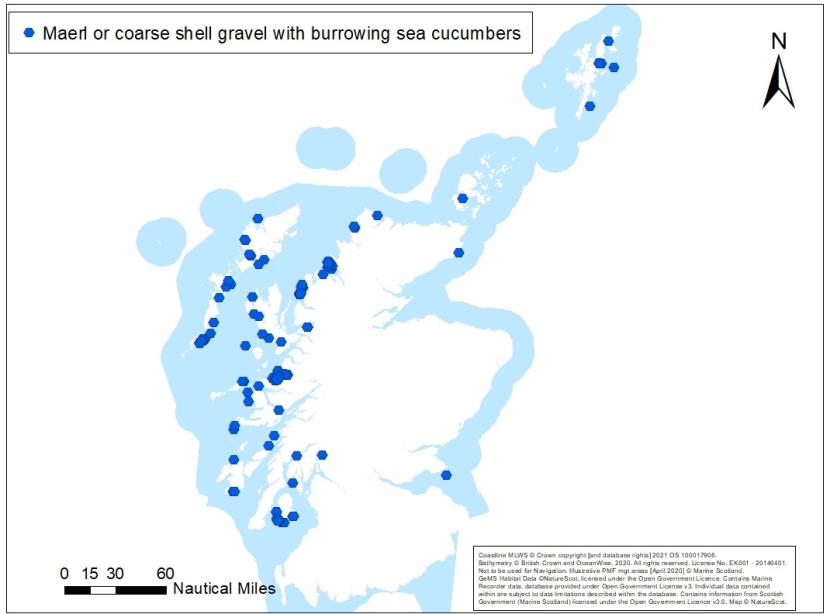
An overview of maerl or coarse shell gravel with burrowing sea cucumbers records
Description
Characteristics
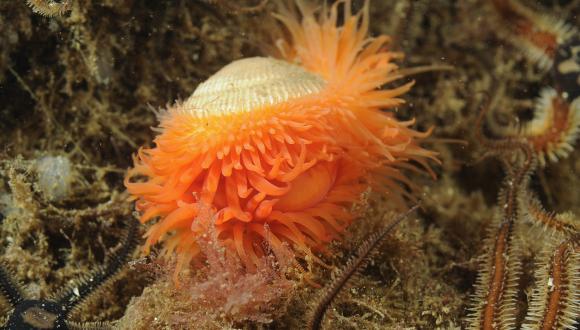
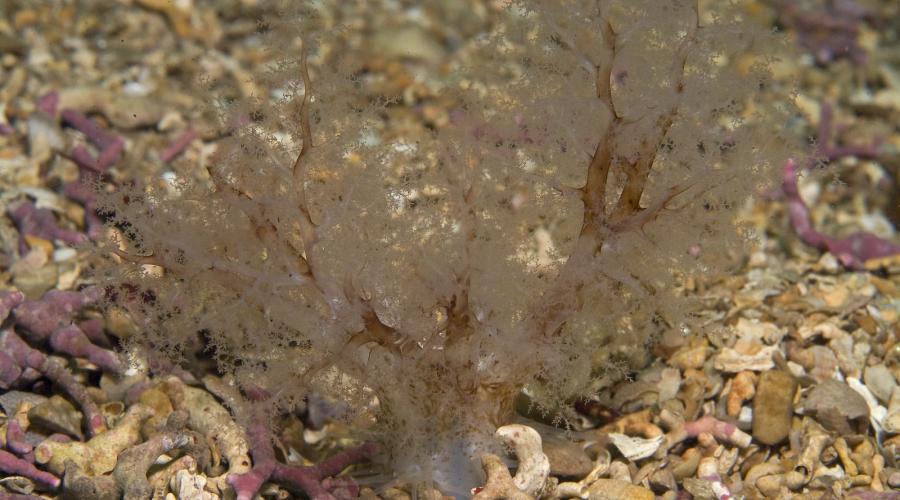
A species-rich sediment community characterised by the presence of the burrowing gravel sea cucumber Neopentadactyla mixta. Found on the margins of maerl beds in areas of dead maerl gravel, in plains of clean shell or stone gravels and occasionally coarse sands where water flow is quite strong. The sediments may be thrown into megaripples by wave action or tidal streams. [Note - whilst often found on the edge of maerl beds, this is not a maerl bed habitat - there is a distinct and more sensitive community covered by the maerl beds PMF that also supports gravel sea cucumbers.]
Other characterising species associated with this PMF vary but often include tube-building polychaetes (e.g. sand mason worms Lanice conchilega and parchment worms Chaetopterus variopedatus) and burrowing anemones (such as Cerianthus lloydii or Peachia cylindrica). These stabilise the sediments which host an assemblage of other polychaete worms and robust bivalve molluscs including Moerella donacina, Venus casina, Dosinia sp., razor clams (Ensis spp.) and king scallops (Pecten maximus). Mobile fauna such as brittle stars, starfish,crabs and dragonets live on the surface of the sediments which may also support sparse hydroids and, depending on depth, red algae (Connor et al., 2004). The loose structure of the sediment allows oxygen penetration to a greater depth than in finer sediments and permits a high diversity of infaunal organisms (Perry et al., 2024).
Definition
The PMF is defined by the presence of frequent (ca. >1-9 per 100 m2) gravel sea cucumbers in coarse sediments. This species lives gregariously and can reach densities of > 400 per square metre in loose gravels (Smith & Keegan, 1985). The habitat is likely to be under-recorded due to the seasonal (and potentially also daily) periodicity of sea cucumber emergence (Picton, 1993). Burrowing gravel sea cucumbers are most commonly observed in the summer months (May-August).
Environmental preferences
This species-rich habitat is found in subtidal clean, gravel, maerl gravel (dead maerl) and/or coarse sands in moderately wave-exposed or tide-swept (~1 to 3 knots or 0.5 to 1.5 m/sec.), fully saline conditions at depths of 10-50 m. The burrowing sea cucumbers require a reasonable flow of water for feeding.
Distribution
Scottish distribution
Found primarily along the west coast and the Outer Hebrides, with occasional records from Orkney (Scapa Flow), Shetland (Lunna Ness and Out Skerries) and the Isle of May (outer Firth of Forth).
Estimated known Scottish extent
The habitat varies considerably in patch size from isolated single records to multiple, scattered records distributed across extensive stretches of coastline. The habitat often occurs as a mosaic with maerl beds and patches of finer sediments, with a number of diver observations from around the current-swept bases of rocky reef outcrops.
Wider distribution
The habitat is not recorded outside of the British Isles. The gravel sea cucumber itself has a wider recorded distribution, from northern Norway to the Bay of Biscay.
Status
The current status of this habitat in Scottish waters is unknown. The PMF is known to occur at the margins of maerl beds which are listed as threatened and / or declining under OSPAR (OSPAR, 2008), with evidence of decline in both extent and quality in the Celtic Seas, (OSPAR Region III; Hall-Spencer et al., 2010).
Drivers for improving protection
Maerl or coarse shell gravel with burrowing sea cucumbers is included on the PMF list which means that National Marine Plan General Policy 9(b) (avoiding significant impact on national status) applies. Maerl or coarse shell gravel with burrowing sea cucumbers is an OSPAR threatened and deciling habitat in need of protection. The Scottish Biodiversity Strategy to 2045, the Scottish Biodiversity Duty and UK Marine Strategy Good Environmental Status provide further drivers to ensure biological diversity is restored, and ecosystems are safeguarded.
Sensitivity (including recovery)
[Key sources: FeAST, Fisheries Management Guidance]
There is little direct information on the sensitivity and recovery potential of the maerl or coarse shell gravel with burrowing sea cucumbers PMF. Habitat sensitivity is defined by the sensitivity of the characterising gravel sea cucumber because a significant reduction in the abundance or loss of this defining species affects the PMF determination. The sensitivity of other characteristic infaunal species is comparable with that of the shallow tide-swept coarse sands with burrowing bivalves PMF.
Gravel sea cucumbers (and other characterising species of the PMF living within the sediments) are highly sensitive to physical disturbance in the form of habitat change and have a medium sensitivity to habitat structure changes, sub-surface penetration, changes in water clarity and organic enrichment (Tyler-Walters & Durkin, 2016). Changes in siltation, water flow and salinity may also have an impact on this habitat. Activities such as intensive bottom-contacting fishing will have an impact.
Gravel sea cucumbers may be vulnerable to future climate impacts associated with salinity changes, deoxygenation and increased run-off from land.
There is little published information on larval development, recruitment and/or population dynamics in gravel sea cucumbers. Many echinoderms show sporadic and variable recruitment.
Connectivity
Between areas supporting the PMF
The degree of connectivity between different areas supporting this PMF is unknown. Connectivity depends on the reproductive strategy and recruitment success of gravel sea cucumber populations, and on availability of suitable substrates. Due to lack of information on the basic biology of Neopentadactyla mixta no further assessment can be made.
For sea cucumbers in general, spawning in temperate species is restricted to spring and summer (Pawson, 1982) and breeding is assumed to occur between April and September when the population is at the substratum surface (Perry et al., 2024). Most sea cucumbers are broadcast spawners (although some species brood their larvae), and larval development varies between those species where relevant information is available (Mazik et al., 2015). Further research is required to understand more about connectivity between areas supporting the PMF.
With other PMFs
The gravel sea cucumber also occurs within maerl beds (a discrete habitat encompassed by the maerl beds PMF). The maerl or coarse shell gravel with burrowing sea cucumbers PMF also often occurs on the margins of maerl beds where maerl substrates grade into coarse, non-maerl gravels (see relevant associations in the maerl beds PMF paper).
The infaunal community associated with the maerl or coarse shell gravel with burrowing sea cucumbers PMF may be comparable to that of the shallow tide-swept coarse sands with burrowing bivalves PMF (Connor et al., 2004; Moore 2014). The main difference being the absence of the burrowing sea cucumbers from the latter.
Ecosystem services
The complex habitat supports a moderately high biodiversity possibly including commercial fish and shellfish and contributes to the protection of biodiversity.

The contribution maerl or coarse shell gravel with burrowing sea cucumbers make to natural resources and functions and the benefits for people that these lead to.
Click for a full description
- Priority Marine Feature: Maerl or coarse gravel with burrowing sea cucumbers contributing to
- Natural resources (NR) and functions (F)
- Carbon storage & climate regulation (F)
- Nutrient cycling (F)
- Fish and shellfish stocks (NR
- Biomass production (F)
- Resilience to invasive non-native species & disease (F)
- Formulation of habitat for other species (supporting biodiversity) (F)
- Which leads to benefits for people
- Health & wellbeing
- Knowledge
- Food and nutrition
- Healthy climate
- Jobs and business
Existing Marine Protected Areas
Maerl or coarse shell gravel with burrowing sea cucumbers is a protected feature of six MPAs: Loch nam Madadh; Sound of Arisaig; Wester Ross; South Arran; Loch Laxford; and, Sound of Barra.
Existing and proposed fishing measures providing PMF protection
Maerl or coarse shell gravel with burrowing sea cucumbers is protected by the following existing fishing measures:
- The Inshore Fishing (Scotland) Order 2015 (Loch Laxford).
- The South Arran Marine Conservation Order 2015.
- The Wester Ross Marine Conservation Order 2016.
- The Loch Sunart to the Sound of Jura Marine Conservation Order 2016.
- The Loch Carron Marine Conservation Order 2019.
- The Loch Gairloch (CA58) and Loch Roag (CA67) fisheries areas.
The following new fishing measures are proposed which will protect maerl of coarse shell gravel with burrowing sea cucumbers in MPAs:
- Loch nam Madadh, Sound of Arisaig, Small Isles, Isle of May, Sound of Barra, Fetlar to Haroldswick.
Approach to assessing improvements in management needed to protect maerl or coarse shell gravel with burrowing sea cucumbers from impacts related to towed bottom-contacting fishing gear
Maerl or coarse shell gravel with burrowing sea cucumbers is protected by the following existing fishing measures:
- The Inshore Fishing (Scotland) Order 2015 (Loch Laxford).
- The South Arran Marine Conservation Order 2015.
- The Wester Ross Marine Conservation Order 2016.
- The Loch Sunart to the Sound of Jura Marine Conservation Order 2016.
- The Loch Carron Marine Conservation Order 2019.
- The Loch Gairloch (CA58) and Loch Roag (CA67) fisheries areas.
The following new fishing measures are proposed which will protect maerl of coarse shell gravel with burrowing sea cucumbers in MPAs:
- Loch nam Madadh, Sound of Arisaig, Small Isles, Isle of May, Sound of Barra, Fetlar to Haroldswick.
Key locations for the protection of Maerl or coarse shell gravel with burrowing sea cucumbers outside designated sites and existing towed bottom-contacting fisheries restrictions
Summary
In a fisheries context, further protection measures from pressures associated with towed bottom-contacting gear are most easily focussed on discrete areas that hold good examples of maerl beds (outside of MPAs that protect this feature and areas with existing fisheries measures). All areas apart from two that are proposed for consideration for this feature are also proposed for maerl beds. These are shown in map 2: Clyde; Orkney; around Skye; Lewis and Harris; Uists; Islay; Gairloch; Arisaig.
The recommendations for maerl beds and maerl or coarse shell gravel with burrowing sea cucumbers need to be considered alongside the recommendations for the other nine PMFs considered as part of the development of PMF management areas. These recommendations are based on biodiversity evidence taking into consideration the information above and have been provided to help inform the development of fishing measures, led by Marine Directorate.
Areas recommended for consideration of additional fisheries management of maerl beds encompass the known range of environmental conditions in which the PMF occurs (exposure, depth, geographic range, substrate, rhodolith form etc.). The areas that include both maerl beds and the maerl or coarse shell gravel with burrowing sea cucumbers PMF, it is recognise that these PMFs tend to form mosaic habitats (i.e. interspersed patches of these habitats).
If fisheries management measures were established to protect records in all these key locations it would achieve substantial protection for maerl beds and maerl or coarse shell gravel with burrowing sea cucumbers, complementing the protection already in place for some MPAs and proposed for other MPAs (see map 2).
Details of locations
There are unmanaged maerl or coarse shell gravel with burrowing sea cucumbers records scattered along the Scottish west coast and islands. In the Clyde, Upper Loch Long is one of only two areas where records are proposed for consideration which are not associated with maerl beds, but are present in the loch alongside other PMFs being considered in this review, blue mussel and horse mussel beds. Other records that should be condsidered in the Clyde are at Ardlamont point.
In Orkney records associated with the maerl beds at Hoy Sound to South Walls, West should be considered.
Records of maerl or coarse shell gravel with burrowing sea cucumbers are associated with several maerl beds around Skye including Loch Bracadale, Loch Scavaig, Lochs Eishort and Slapin.
In the Outer Hebrides records associated with maerl beds in East Loch Tarbert, Loch Tealasbaigh (Lewis), Sound of Taransay (Harris), Stulaigh (south Uist),and south-east Barra.
Other records that should be considered are Port Ellen (Islay), Port Erradale and Red Point in Gairloch and Loch nan Uamh (Arisaig). The latter is the only other area proposed for consideration not associated with maerl beds.
Data confidence
We have recent records from 2019. Surveys vary in scope from Seasearch (carried out by volunteer divers) to dedicated PMF validation surveys (e.g. SNH & MSS 2013 South Arran benthic camera survey). Records come from diving and remote video surveys.
Given that the gravel sea cucumber characterising this PMF remains burrowed in the sediment for several months each year, and even when exposed its semi-translucent, small white body is well camouflaged, it is highly likely that the feature is under-recorded. The difficulty in seeing the animals explains inconsistent recording of the PMF over time e.g. in Loch Laxford where it was recorded in 1991, not seen in monitoring work in 2010, but recorded again in 2015 (Moore et al., 2017).
Knowledge gaps and other recommended work
We recommend continuing efforts to explore opportunities for collaborative monitoring, survey and research to improve our understanding of this habitat, for example:
- It is likely that the habitat is under-recorded.
- The degree of association with the shallow tide-swept coarse sands and burrowing bivalves PMF requires further investigation.
- Additional information on the basic biology of the burrowing gravel sea cucumber is also required.
Key locations for the protection of maerl or coarse shell gravel with burrowing sea cucumbers

Key locations for the protection of maerl or coarse shell gravel with burrowing sea cucumbers outside of MPAs with management measures and existing towed bottom-contacting fisheries restrictions
Click for a full description
For further details about the locations shown in this map see above, section Key locations for the protection of Maerl or coarse shell gravel with burrowing sea cucumbers outside designated sites and existing towed bottom-contacting fisheries restrictions.
References
Connor, D.W., Allen, J.H., Golding, N., Howell, K.L., Lieberknecht, L.M., Northern K.O. & Reker, J.B. 2004. The Marine Habitat Classification for Britain and Ireland Version 04.05. In: JNCC. 2015. The Marine Habitat Classification for Britain and Ireland Version 15.03 [on-line].
Hall-Spencer, J.M., Kelly, J. & Maggs, C.A. 2010. Background document for maerl beds. Biodiversity Series. OSPAR Commission. Publication number: 491. ISBN 978-1-907390-32-6.
Howson, C.M. 1991. Surveys of Scottish sealochs. Loch Gairloch and Loch Ewe. (Contractor: University Marine Biological Station, Millport). Peterborough: Joint Nature Conservation Committee. JNCC Report No. 15.
Mazik, K., Strong, J., Little, S., Bhatia, N., Mander, L., Barnard, S. & Elliott, M. 2015. A review of the recovery potential and influencing factors of relevance to the management of habitats and species within Marine Protected Areas around Scotland. Scottish Natural Heritage Commissioned Report No. 771.
Moore, C.G. 2014. The distribution of maerl and other coarse sediment proposed protected features within the South Arran pMPA - a data review to inform management options. Scottish Natural Heritage Commissioned Report No. 749.
Moore, C.G., Cook, R.L., Porter, J.S., Sanderson, W.G., Want, A., Ware, F.J., Howson, C., Kamphausen, L. & Harries, D.B. 2017. 2015 site condition monitoring of marine sedimentary and reef habitats in Loch Laxford SAC. Scottish Natural Heritage Commissioned Report No. 943.
NatureScot. 2024. Geodatabase of Marine features adjacent to Scotland (GeMS). GeMS V10 (i26).
OSPAR. 2008. List of Threatened and/or Declining Species and Habitats. Reference Number: 2008-6.
Pawson, D.L. 1982. Holothuroidea. In: Parker, S.P, ed. Synopsis and Classification of Living Organisms. New York: McGraw-Hill: 813-818.
Perry, F., Jackson, A., Tyler-Walters, H., Garrard, S.L., & Watson, A. 2024. Phymatolithon calcareum maerl beds with Neopentadactyla mixta and other echinoderms in deeper infralittoral clean gravel or coarse sand. In Tyler-Walters H. & Hiscock K, eds. Marine Life Information Network: Biology and Sensitivity Key Information Reviews, [on-line]. Plymouth: Marine Biological Association of the United Kingdom.
Picton, B.E. 1993. A field guide to shallow-water Echinoderms of the British Isles. London: Immel Publishing Ltd.
Tyler-Walters, H. & Durkin, O.C., 2016. Neopentadactyla mixta in circalittoral shell gravel or coarse sand. In: Tyler-Walters, H. & Hiscock, K, eds. Marine Life Information Network: Biology and Sensitivity Key Information Reviews, [on-line]. Plymouth: Marine Biological Association of the United Kingdom.