Licensing Report: Hunting with Dogs Licensing Review 2024
Published: December 2025
Section 1: Introduction
Licenses to allow hunting a wild mammal with more than two dogs were introduced following the introduction of The Hunting with Dogs (Scotland) Act 2023 ("The Act"). We are responsible for implementing the licensing provision of The Act and developed a new licensing approach to do this in 2023. We have committed to carrying out an annual review of our licensing scheme for the first five years following its introduction. Due to the nature of licence applications received to date, this review will focus on licences requested to control foxes.
This is a ‘light-touch’ review and focuses on the published guidance on the NatureScot website, and our application process. Clear guidance on issuing licences is necessary to ensure the licences are legal and fit the principles and purpose of the legislation, and that they are robust to any legal challenge. We also need to consider the Better Regulation agenda and the Wildlife Management Shared Approach and ensure that licensing processes are accessible, efficient and proportionate.
Revisions to licensing guidance will provide clarity and transparency on how NatureScot assesses and awards or rejects licences. This clarity will help applications and applicants to be treated consistently and will provide transparency for other organisations and land managers to understand how licensing decisions are made. This will help build trust and provide a consistent and fair approach. The guidance will allow each application to be assessed against a consistent set of clear principles and criteria.
In addition to the review of guidance, we will take the opportunity to review our application forms and related licensing documents including the wording of the Statement of Reasons issued with an approved licence.
As a result, NatureScot will revise guidance on licences for hunting with more than two dogs and supporting documents. Alongside the guidance new supporting documents have also been developed. These will help staff to assess applications, help applicants identify what information they need to complete the form and will be available on the NatureScot website so that potential applicants can see what is required of them ahead of applying for a licence.
As part of the first annual review, we carried out stakeholder engagement in the form of a questionnaire (at Appendix 1) to help to inform any changes made to the scheme, and have included analysis of the key points raised by stakeholders within this report. We have also taken the opportunity to review our approach to compliance monitoring of licences to hunt a wild mammal with more than two dogs, which is detailed in this report.
This report combines the detailed first annual review, based on licences issued in 2023/24, and a light-touch second annual review based on licences issued in 2024/25. New applications forms and guidance developed will be implemented for licences in 2025/26.
We are committed to the delivery of an effective licensing scheme in support of the provisions of the Hunting with Dogs (Scotland) Act 2023.
Summary of Licensed Activity
In the first year following the introduction of licences to hunt a wild mammal with more than two dogs, we received a total of 72 applications. Of these, 43 licences were issued, and 27 were refused. Only 34 licences were utilised. Full figures for the first year of the licensing scheme are detailed below in Table 1.
2023/2024 Licences
| Year One | 2023/2024 Licences |
|---|---|
| Applications Received | 72 |
| Licences Issued | 43 |
| Licences Refused | 27 |
| Utilised Licences | 34 |
| Licences Attended by NatureScot (%) | 4 (12%) |
| Dog Handlers Observed (%) | *redacted for data protection* (50%) |
| Mammals Taken Under Licence | 87 |
In 2023/2024, NatureScot received 72 Hunting with Dogs licence applications. Of these, 43 licences were issued, and 27 applications were refused. Of the 43 issued licences, 34 were utilised: where an applicant has provided a notification of activity under their licence, we will refer to these as ‘utilised licences’. NatureScot undertook site visits to monitor compliance for 4 of the 34 utilised licences, which meant that 12% of the total number of licences, and 50% of dog handlers were observed. The number of dog handlers observed has been redacted for data protection. The total number of mammals taken under licence is 87, to date, all licences issued under the Act have been for the control of foxes.
In the second year following the introduction of licences to hunt a wild mammal with more than two dogs, we received a total of 89 applications. Of these, 77 licences were issued, and 6 were refused. Only 64 of these licences were utilised. Full figures for the second year of the licensing scheme are detailed below in Table 2.
2024/2025 Licences
| Year Two | 2024/2025 Licences |
|---|---|
| Applications Received | 89 |
| Licences Issued | 77 |
| Licences Refused | 6 (6 no longer required) |
| Utilised Licences | 64 |
| Licences Attended by NatureScot (%) | 12 (19%) |
| Dog Handlers Observed (%) | *redacted for data protection* (86%) |
| Mammals Taken Under Licence | 109 |
In 2024/2025, NatureScot received 89 Hunting with Dogs licence applications. Of these, 77 licences were issued, and 6 applications were refused and 6 were marked as “no longer required”. Of the 77 issued licences, 64 were utilised: where an applicant has provided a notification of activity under their licence, we will refer to these as ‘utilised licences’. NatureScot undertook site visits to monitor compliance for 12 of the 64 utilised licences, which meant that 12% of the total number of licences, and 86% of dog handlers were observed. The number of dog handlers observed has been redacted for data protection. The total number of mammals taken under licence is 109, to date, all licences issued under the Act have been for the control of foxes.
It is to be expected that the number of applications will increase in the second year of a new licensing scheme, as stakeholders and applicants get to grips with the new process and gain better understanding of our approach. In 2024/25 we focused on increasing our attendance at licensed activity in the form of compliance monitoring and stakeholder engagement visits. More on our compliance monitoring is detailed within Section 3 under the ‘Compliance Monitoring’ sub-heading.
Stakeholder Engagement
In 2024, we reached out to key stakeholders who were contacted during the development of the licensing scheme in 2023. Stakeholders contacted included organisations in the shooting and gamekeeping sector, applicants, animal welfare organisations and environmental NGOs. The questionnaire circulated is available at Appendix 1.
Key themes emerging from the stakeholder engagement were as follows; overall feedback from applicants centred on the application form being too complex, difficult to interpret, and taking too long to complete. All respondents indicated that they had read the guidance on the NatureScot website before completing their application. Feedback on the guidance noted that it was hard to follow and too general.
Feedback specific to the application form raised that it is overly complicated and requires unnecessary information. Stakeholders were concerned over the difficulty of completing the form and the time that it takes to complete alongside day-to-day responsibilities of landowners.
In response to the final, more general feedback question, stakeholders raised concerns over the interpretation of ‘cover’, the licensable period, and asked for more explanation behind refused applications. Stakeholders who had applied for licences to hunt a wild mammal with more than two dogs under the ‘Environmental Benefit’ purpose raised specific concerns over the ‘high-bar’ of evidence required and the difficulty of being issued such a licence. We would note that stakeholders also acknowledged the need for a longer and more complex application form as a result of the legislation and noted that they had been able to carry out successful fox control under licence.
Stakeholders appreciated the need for a longer and more complex application form for this licence, in accordance with the legislation itself. It was also acknowledged that stakeholders had been able to carry out effective fox control under licence. We have received positive feedback regarding the enhanced regulation and oversight of hunting with dogs in Scotland that has been created through the Act and the accompanying licensing scheme.
Concerns over the interpretation of cover and the start dates for hunting with dogs licences issued for preventing serious damage to newborn lambs have also been repeatedly raised in stakeholder correspondence during the course of the review. As such, we have included these topics in this report.
Section 2: Application Forms and External Guidance
Review of Application Forms
The existing application form is long and complex. This was raised by stakeholders in our engagement exercise and has also been recognised by licensing officers when they assess applications. We set out to make the application form more user friendly for both applicants to complete and for our staff to assess. The existing application form is repetitive and many applicants end up copying and pasting the same information into different sections of the form. As such, we have streamlined the form in key areas with the aim of making it easier to complete and to try and reduce the number of times our licensing staff are having to get in touch with applicants who have already spent a significant amount of time completing the form to acquire further information in support of their application. This approach is supported by the Scottish Government principles of Better Regulation – where we must be proportionate, consistent, accountable, transparent, and targeted: learn about the Principles. Through review of the application form, we have created a much more targeted process, which we have refined to ensure we only request the information that is required to fully assess an application. Encouraging applicants to complete detailed and robust applications will also ensure that time spent on assessing an application is proportionate.
We understand that the requirement to provide a map can be challenging depending on the software available to applicants. However, we would note that this is common across a variety of species licence applications. This will remain a requirement for hunting with dogs licences. We would highlight that applicants may print off, mark, and scan a map if they do not have access to mapping software. A well annotated map with clearly marked areas where damage may occur and areas of cover is very helpful in speeding up the assessment process. We are also encouraging applicants to provide photographic evidence of the nature of the areas of cover requested to help to inform our assessment.
The biggest difference in the new application form is an emphasis on the method statement. We will ask applicants to provide a method statement describing how they will carry out the activity in each area requested. This should include a justification for the number of guns and number of dogs requested to be used in that area. A good method statement will note positions of guns and the direction in which the dogs will flush the area. We will include an example ‘best practice’ method statement on our website to help applicants understand what we information we are looking for.
We have also made some changes to the other effective solutions section of the application form. We have altered the table to include a simple yes/no for each alterative and a justification. These changes should make it easier for licensing staff to assess applications, and the goal is to reduce the number of follow up question being asked on applications for hunting with more than two dogs.
The new application form is shorter and less repetitive than its existing counterpart. It has been reviewed by species licensing leads and we will review its efficacy in achieving our aims in the next review of the scheme.
We have also created a new ‘renewals’ form for applications to hunt a wild mammal with more than two dogs. This can be used where an applicant is applying for a licence covering the same areas, for the same purpose, as in the previous year. This new addition will save the applicant time and remove the requirement to repeat the initial application process year on year for the same activity. The renewal form will focus on the inclusion of relevant, up to date information on which an informed assessment can be made. The issuance of a licence in one year does not guarantee the approval of a renewal application.
Recommendations
- Introduce new application forms in time for applications for the 2025/26 licensing period. We aim to make these available on our website in May 2025 and will have a period of crossover where applicants can use either the old or the new form.
Review of Guidance
As informed by our feedback from stakeholders, we are clarifying key points of our guidance. There is a requirement for the guidance to be informative and detailed, dictated by the nature of The Act and the licensing scheme. We will also ensure that our internal guidance for licensing officers aligns with published guidance. Key differences include the creation of an ‘FAQ’ document, and the inclusion of more ‘best practice’ application examples to increase transparency around the assessment process and help applicants better understand what we are looking for to inform our decision making.
We have identified key areas that require clear description and justification. These include the licensable period, the use of GPS collars, the number of dogs permitted to be used, , the interpretation of cover, and the licensable area. These have been included in our new FAQ document, to be used by both licensing staff and applicants.
Recommendations
- Elements of the guidance required clarification and have been updated. This should be updated on our website to be easily accessible to applicants.
Section 3: Topics Raised by Stakeholders and Internal Guidance
This section of the review will address key topics, questions, and concerns raised by stakeholders in the course of the review, that do not relate directly to the guidance or application forms.
Interpretation of Cover
In regard to the concerns raised around the definition and relevance of cover, we would note that the definition of cover, as stated in the Act, is clear. To avoid the potential for any confusion, we have already removed the reference to “dense woodland” or "gorse or other thick vegetation” in our guidance – which was provided as example. We are conscious that there is no blanket approach that can be taken to determine what vegetation is and is not ‘cover’. However, we maintain that, depending on the nature of the cover, there may be other effective solutions that can be effectively employed to control foxes, including but limited to, lamping and where possible flushing with two dogs. For us to be satisfied of the need for a licence, we must be satisfied that there are no other effective solutions for the activity. It is for the applicant to demonstrate to us and for us to be satisfied. We are creating a portfolio of examples of cover to help our licensing officers assess this element in an equitable and consistent manner.
Recommendations
- Continue to consider licensable areas of cover and test of whether there are other effective solutions to licensed activity.
- Create portfolio of examples of different areas of cover to aid licensing officers and ensure that decision-making is consistent.
Timing and Licensable Period
A licence ‘may be granted for a maximum period of 14 days, which must fall within a period of 6 consecutive months’. We consider that the period of fox control with the use of more than two dogs should be informed by when the foxes are likely to cause serious damage, and that control outside of the months immediately prior to lambing would not in many circumstances be an effective means of preventing serious damage. This ensures that issued licences meet the licensable purpose of ‘Preventing Serious Damage’. This decision has been informed by the following research:
White, P. C. L., Groves, H. L., Savery, J. R., Conington, J., and Hutchings, M. R. (2000a). Fox predation as a cause of lamb mortality on hill farms. The Veterinary Record 147, 33–37.
R. Hewson (1984). Scavenging and Predation Upon Sheep and Lambs in West Scotland. J. Appl. Ecol. 21, 843–868
Burns (2000). Report of the Committee of Inquiry into Hunting with Dogs in England and Wales.
Baker, P.J. and Harris, S. (2006). Does culling reduce fox (Vulpes vulpes) density in commercial forests in Wales, UK?. European Journal of Wildlife Research, 52, pp.99-108.
Start dates are imposed pursuant to section 4(4)(f) of the 2023 Act in terms of which licences “…may be subject to compliance with such conditions as the relevant authority considers appropriate.” Conditions restricting licenced activity to periods of optimal effectiveness can also be imposed under section 4(4)(f), where we consider that to be appropriate. The imposition of any conditions relating to the timing of licensed activity is considered on the basis of the particular circumstances of each case. Applications for the prevention of serious damage to lambs is a category where NatureScot may consider the imposition of such conditions to be appropriate, for example, to restrict licensed activity only to periods during which we consider it will achieve the licensable purpose. We consider that approach to be consistent with the legislation. It would be contrary to the legislation and to the principles of public law were NatureScot to issue licences which could be used at times which we consider would not contribute to achieving the licensable purpose.
NatureScot has an obligation, as a responsible public body, not to issue licenses which increase the risk of offending. Therefore, when considering appropriate licence conditions, we will also continue to take account of the risks of using more than two dogs to flush foxes in the autumn months. We consider that such activity undertaken when cubs and juvenile foxes are present can pose an increased risk of those young individuals being caught by dogs in cover rather than being flushed from the cover to the waiting guns, which may result in a breach of licence conditions and/ or a criminal offence.
The provisions of the Act are not licensing predator control, but the use of more than two dogs in certain circumstances as part of an approach to predator control. Other methods of fox control may be undertaken legally during the summer and autumn months, including lamping and where possible flushing with two dogs. We will consider applications on a case by case basis, and where there is sufficient justification (such as early lambing) we will consider earlier start dates for licensable activity.
Recommendations from Year 1
- Maintain current approach, with a core period of licensed activity and extended licensable periods in specific circumstances.
Recommendations from Year 2
- Discuss approach with Scottish Animal Welfare Commission.
GPS Collars
There is currently a condition applied to all HWD licences that requires 25% of dogs used for licensable activity must be fitted with a GPS tracking device. This is a compliance condition and allows the Dog Handler to track the position of the dogs and staff to view. Data may also be used to prove whether or not the dogs have remained working within the licensable area and can form part of evidence in the case of a reported breach of licence conditions. GPS data can also be used to confirm compliance with the licence conditions, not just to confirm whether an offence has occurred. Although this condition was originally suggested by stakeholders in engagement sessions as a means of displaying compliance and as an existing measure used by some practitioners, we have received complaints and feedback regarding the requirement for GPS Collars, primarily concerning the welfare of dogs used in the licensable activity, and the usefulness of the data.
Taking into account this feedback from applicants, we are committing to the ongoing review of this licence condition. The condition was maintained in 2024 -25. The maintenance of this licence condition is supported by the National Wildlife Crime Unit due to its value as a prevention and monitoring tool. For the current licensing period, we will request GPS data from licence holders as part of the compliance monitoring work. This data will be used as part of our revised compliance monitoring scheme and will also enable us to review the data itself to determine its value. We will use this information to inform a decision as to whether this condition will be retained on licences in 2025/26. In regard to dog welfare, we would advise that breakaway collars may be used where practitioners have concerns about collars being caught on vegetation or similar and posing a risk to the dog.
Recommendations from Year 1
- Maintain GPS Collars condition for 2024/25 licensing period.
- Request GPS data from a random subset of licence holders, or to support compliance investigations, to determine the true usefulness of the data generated.
- Taking the above into account, review the inclusion of the condition on 2025/26 licences.
Recommendations from Year 2
- Maintain condition and continue to monitor for licences issued in 2025/26.
Number of Dogs
In accordance with the provisions of the Act, we licence applicants to use the minimum number of dogs considered to be effective for the activity. This approach results in issued licences noting the maximum number of dogs that are permitted to be used. In short, licence holders must use as few dogs as possible, and the licence dictates the maximum number that they are allowed to use. This enables practitioners to use fewer dogs than licensed and still remain compliant with their licence, and contrasts with the approach used to licence the number of guns required for the activity. We also consider that the use of too many dogs may increase the chances of a wild mammal being caught and killed by the dogs within cover before it is flushed. We have issued one licence allowing the use of up to 25 dogs, and the majority of licences are issued with 18-20 dogs maximum. The decision to licence a particular number of dogs is taken on a case-by-case basis and is based on a series of factors including the size of the licensable area, and the nature of the cover (larger areas and denser cover will likely require a higher number of dogs for the activity to be carried out effectively). Decisions are supported by the method statement provided by the applicant.
Recommendations from Year 1
- Amend guidance to clarify minimum vs maximum number of dogs.
Number of Guns
The Act dictates that NatureScot set a minimum number of guns required for the activity. This is because more guns being present increases the likelihood of the wild mammal being shot ‘as soon as reasonably possible’. Therefore, a licence holder must use at least as many guns as stated on their licence but are welcome to use more where appropriate. Where we consider the number of guns to be insufficient to achieve the provisions of the Act, and there is insufficient justification in the method statement, we will go back to the applicant for further information. There are some mitigating factors that we will consider justify the use of fewer guns, including the use of ‘mobile guns’ (generally on quadbikes), that will move along the cover in line with the dogs. Best practice is to use a higher ratio of guns:dogs to improve the efficacy of the activity.
Recommendations
- Maintain existing approach.
Environmental Benefit Licences
We must be satisfied that any activity applied for can achieve a legal licensable purpose. As such, applications for control of a wild mammal with more than two dogs for environmental benefit will require specific supporting information to help us determine whether there is likely to be a benefit to the conservation status of the species the applicant is applying to conserve. This process is shared across other licence types for environmental benefit, including licences for the conservation of wild birds. Applicants are expected to provide a sufficient level of detail in their application to show that the purpose applied for is appropriate, achievable and that alternatives have not been effective in providing environmental benefit.
We acknowledge the feedback that we have received regarding licences for environmental benefit, and that the application process is rigorous. Following review of our licensing scheme and of the legislation, we are not proposing that we make any changes (beyond the improved application forms) to our approach to the assessment of these licences. The existing approach is justified as a result of the intent and the wording of the legislation. The result of this approach is that applicants are expected to provide a sufficient level of detail in their application to meet the licensing tests. Applications for environmental benefit require there to be scheme in place. We have provided details of what constitutes a scheme in our guidance, which states that a landscape scale approach is necessary to meet the definition of a scheme.
Recommendations
- Maintain existing approach.
Application Assessment
We are implementing some changes to assist our licensing officers in their assessment of applications. We recognise the benefit of collaboration to ensure consistency across licensing decisions. A new system of regular drop in ‘discussion sessions’ will be employed for licensing officers assessing HWD licences to share their processes and raise any questions with senior licensing officers and policy staff. The goal of this system is to make sure that all of our licensing officers are working consistently across the licence type, and to help speed up the assessment process/reduce the number of times we go back to applicants with follow up questions. We are also developing a ‘portfolio’ of cases with details of decisions made, this will NOT alter our current approach of licensing on a case-by-case basis, but it will provide an element of guidance to aid licensing officers in their consideration of certain aspects of the applications (primarily cover and suitable alternatives, method statements including number of guns).
We have also changed the way in which we request advice from our colleagues in wildlife management. Now that licensing officers have more experience of assessing licence applications to hunt a wild mammal with more than two dogs, we are reducing the requirement for advice from wildlife management officers. Licensing officers will only request advice in specific circumstances, as opposed to defaulting to requesting advice on every application received. This will enable faster processing of licence applications.
Recommendations
- Draft case portfolio to form additional guidance for licensing officers.
- Set up regular discussion sessions to improve consistency and share challenges.
Compliance Monitoring
We committed to increasing our compliance monitoring for hunting with dogs licences following the first annual review. We developed designated compliance teamlets across Scotland, who attended licensed activities in their area. We aimed to ensure that compliance checks were carried out at least once for each dog handler.
We consider that judging our attendance by the proportion of dog handlers visited is the most effective method of assessing compliance monitoring activity. This is because, whilst there are a relatively high number of licence holders, the number of dog handlers associated with these licences is much lower. As the dog handler is effectively the person carrying out the activity (or at least the person in charge of the dogs), monitoring their compliance with the provisions of the licence is essential.
We have also requested the GPS Data from dog collars. This will enable us to review the usefulness and application of the GPS Data, whilst also providing evidence as to compliance with the licence conditions.
A comparative graph of our compliance monitoring input from 2023/24 and 2024/25 is depicted in Figure 1.
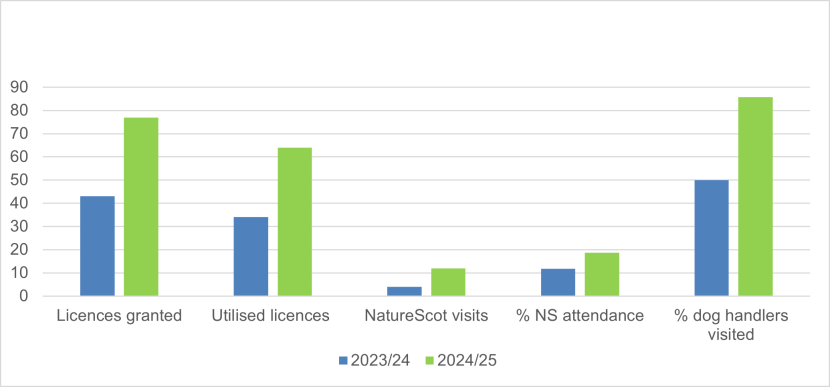
Figure 1. NatureScot compliance monitoring of licences issued under the Hunting with Dogs (Scotland) Act 2023.
Click for a full description
NatureScot granted 43 licences for the licence period 2023/24, and granted 77 in 2024/25. In 2023/24, 34 licences were utilised of the licences issue, 64 in 2024/25. NatureScot completed 4 compliance monitoring visits over 2023/24, 12 over 2024/25, that is 12% of all licences issued in 2023/24, versus 19% in 2024/25. In 2023/24, 50% of all named dog handlers were visited for compliance monitoring, versus 86% in 2024/25.
Recommendations from Year 1
- Enhanced compliance monitoring will help to demonstrate compliance and best practice when working under a licence to hunt a wild mammal with more than two dogs. It will also help to identify compliance breaches and concerns.
- Aim to attend at activity carried out by 100% of dog handlers named on utilised licences.
Result
We tripled our compliance monitoring visits in the second year of the licensing scheme, from 4 licences attended in 2023/24 to 12 in 2024/25. These visits were beneficial for multiple reasons, including the identification of compliance breaches, engagement with licence holders, and the opportunity to observe licensed activity ‘on the ground’. Visits resulted in amendments to two licences following observations made in regard to the nature of the cover, where both licences were extended to include areas originally refused on application. We did not quite make our 100% target attendance rate for dog handlers, but we did visit 86% of dog handlers who carried out licensed activity. Due to the small number of dog handlers operating in Scotland, we cannot provide the total number of dog handlers.
2024/25 provided a useful foundation and essential learning experience for us to develop our approach to in-person compliance monitoring.
Recommendation from Year 2
- We will continue to aim to observe 100% of dog handlers operating under licence in 2025/26.
Appendix 1
Questions circulated to stakeholders as part of first annual review.
1. Which licensable purpose was applied for?
- Environmental Benefit
- Preventing Serious Damage
- Both
2. Please rate the overall experience of applying for a HWD licence.
- Very Satisfied (5)
- Satisfied (4)
- Neutral (3)
- Dissatisfied (2)
3. Please explain the reason for this rating.
4. Did you read the guidance available on the NatureScot website before applying?
- Yes
- No
5. Please rate the experience of using the guidance.
- Very Satisfied (5)
- Satisfied (4)
- Neutral (3)
- Dissatisfied (2)
- Very Dissatisfied (1)
6. Please explain the reason for this rating.
7. Please rate the experience of completing the application form
- Very Satisfied (5)
- Satisfied (4)
- Neutral (3)
- Dissatisfied (2)
- Very Dissatisfied (1)
8. Please explain the reason for this rating.
9. Please enter any other comments about the HWD licensing scheme.