Isle of May National Nature Reserve - Annual Report 2025
Published on 24 March 2026
Contents
- 1. Introduction
-
2. Biological recording
- 2.1 Introduction to breeding seabirds
- 2.2 Population monitoring of cliff-nesting seabirds
- 2.3 Results of cliff-nesting seabirds
- 2.4 Population monitoring of ground-nesting seabird species
-
2.5 Other breeding birds
- 2.5.1 Shelduck (Tadorna tadorna)
- 2.5.2 Mallard (Anas platyrhynchos)
- 2.5.3 Oystercatcher (Haematopus ostralegus)
- 2.5.4 Feral pigeon (Columba livia domestica)
- 2.5.5 Swallow (Hirundo rustica)
- 2.5.6 Rock pipit (Anthus petrosus)
- 2.5.7 Pied wagtail (Motacilla alba)
- 2.5.8 Carrion crow (Corvus corone)
- 2.5.9 Peregrine falcon (Falco peregrinus)
- 2.5.10 Wood pigeon (Columba palumbus)
- 2.5.11 Wren (Troglodytes troglodytes)
- 2.5.12 Chiffchaff
- 2.6 Migrant birds
- 2.7 Mammals
- 2.8 Lepidoptera
- 3. Research and monitoring
- 4. Visitor review
- 5. Media coverage
- 6. Volunteers and support
- 7. Infrastructure and island work
- 8. Weather
ANNEX 1: Seabird data
ANNEX 2: Research project summaries
1. Introduction
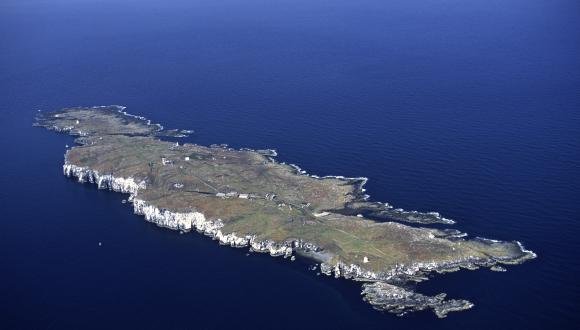
The Isle of May National Nature Reserve (NNR) was staffed by the NatureScot team from March until November. Reserve Manager David Steel returned for his eleventh season and Assistant Reserve Manager Thomas Skinner returned for his third season. Other organisations involved in working on the NNR include the Isle of May Bird Observatory (IOMBOT); the UK Centre for Ecology and Hydrology (UKCEH); Edinburgh University; Manchester University; St Andrews University; the Royal Society for the Protection of Birds (RSPB); the Sea Mammal Research Unit (SMRU) and the various boat operators bringing daily visitors to the island.
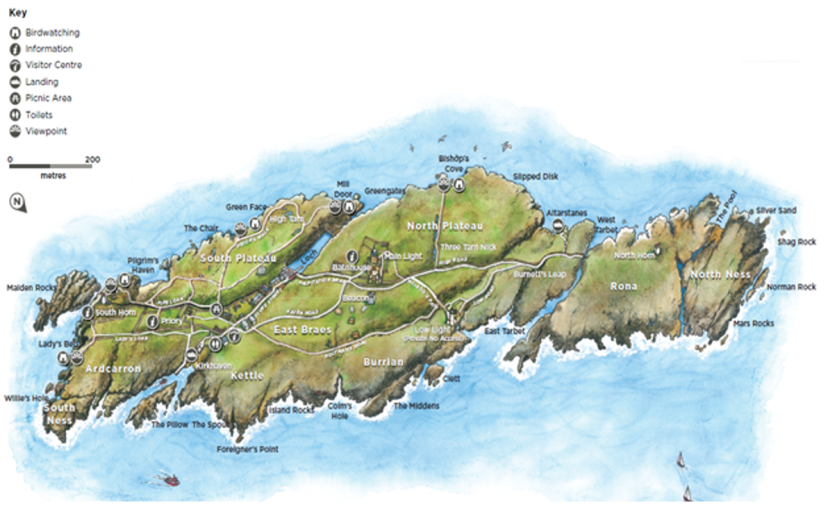
Figure 1: Map of Isle of May National Nature Reserve
Click for a full description
Map showing locations for birdwatching, information, the Visitor Centre, landings, picnic area, toilets and viewpoints.
1.1 Acknowledgements
The information and data collected for this report came from a variety of sources, including the NatureScot team of David Steel, Thomas Skinner, Rebecca Davies, Imogen Sylph, Vivian Marko, Phoebe Marshman and Shem Weekes; the UKCEH staff team of Mark Newell, Josie Hewitt, Erin Taylor, Holly Pickett, Francis Daunt; and the Edinburgh University team of Amelia Corvin and Eve Sharples. Also, thanks to the Isle of May Bird Observatory Trust and members, various boatmen and others who contributed throughout the season.
2. Biological recording
2.1 Introduction to breeding seabirds
The Isle of May is one of four strategic seabird monitoring sites around the UK, part of the JNCC’s national long-term seabird monitoring programme. The other sites are Skomer, Canna and Fair Isle. The status of seabirds on the Isle of May is also reported to NatureScot for the assessment of qualifying species within Special Protection Areas (SPA): Firth of Forth SPA and Outer Firth of Forth and St Andrews Bay Complex SPA. The seabird monitoring programme is completed by NatureScot working alongside UKCEH. This monitoring work makes up the core part of NatureScot’s NNR management work. UKCEH contributes to the seabird monitoring on the Isle of May, under contract to the British Trust for Ornithology (BTO).
NatureScot staff complete the whole island breeding seabird counts. Every year, reserve staff count the number of breeding cliff-nesting seabirds (fulmar, shag, kittiwake, razorbill and guillemot) and nesting tern species. Staff count the number of breeding ground-nesting seabirds (large gulls, puffins and eiders) every two years. Puffins are now being counted every second year rather than every five years to provide greater detail about status and trends of the puffin colony. NatureScot staff on the island also carry out productivity work for Arctic tern and great black-backed gull (the number of chicks raised per pair). Every year, UKCEH monitors the productivity, return rate, survival and diet of the auks (guillemot, puffin and razorbill), shags, fulmar and kittiwakes. Other island partners such as the Isle of May Bird Observatory Trust (IOMBOT), Edinburgh University, the British Trust for Ornithology (BTO) and St Andrews University provide data on seabird phenology, the date of first eggs laid and chicks hatched.
Summary of breeding seabirds in 2025
The weather in the 24/25 winter period was relatively calm compared to the severe weather conditions in the winter of 23/24. Breeding commenced around average dates and especially early for European shags. Breeding success was good for many of the seabird species, especially productive for European shags and poor for great black backed gull; many chicks died during chick rearing, possibly due to HPAI.
Bird flu was confirmed in five species during the breeding season: great black-backed gull, herring gull, lesser black-backed gull, black-legged kittiwake and Atlantic puffin. Mortalities of black-legged kittiwake were the most significant, and ring recoveries suggest breeding birds were being affected, unlike in 2023, when ring recoveries suggested that non-breeding birds were being affected.
Following seabird counts in May we saw an increase in:
- European shag
- northern fulmar
- common guillemot
- razorbill
- black-legged kittiwake (sixth year of increase), and
- great cormorant (sixth year of increase)
And a decrease in:
- common eider (compared to the last census in 2022)
No terns nested on the Isle of May this season and large gulls and puffins will be counted in 2026.
2.2 Population monitoring of cliff-nesting seabirds
2.2.1 Sections and timings
It is challenging and time-consuming to count cliff-nesting seabirds as the colonies are very busy with birds coming and going and often nesting in inaccessible locations. To capture a snapshot of the Isle of May breeding populations, the breeding birds are counted once during the first ten days of June. The island is divided into standardised count sections that have been used in previous years and all cliff-nesting species are counted. Counts from sea (using boat) were added in 2018 to count birds nesting in caves and areas inaccessible from land and included in the all-island population counts. Most of the all-island count was carried out by David Steel from 1-8 June. Mark Newell, UKCEH, counted areas that are sensitive, to avoid disturbing shags. The methodology for the five cliff-nesting bird species (guillemot, razorbill, kittiwake, fulmar and shag) is set out in the Isle of May Monitoring Handbook (NatureScot, 2001, revised 2002, 2011, 2021).
2.2.2 Cornerstone plot counts
It is difficult to estimate the number of breeding pairs by counting the number of birds on the cliff face because the attendance of auks (razorbill and guillemot) on the cliffs can vary over the course of a day. This is overcome by converting individual counts of birds from the all-island cliff count into pairs using a known k-value. The k-value is the difference between the number of individuals counted at the Cornerstone cliff plot at the beginning of an all-island count session and the number of known breeding pairs at the Cornerstone cliff plot from detailed observations made by UKCEH. By multiplying this k-value with the number of individual auks counted during the all-island counts, the total number of pairs across the island can be estimated.
2.3 Results of cliff-nesting seabirds
Key tables for breeding seabirds can be found in Annex 1 - quick reference guide:
- Table 5: Phenology (key breeding dates) for breeding seabird species
- Table 6: Seabird population numbers for the six key seabird species since 2019
- Table 7: All-island count of the breeding population of cliff-nesting species by section
- Table 8: Survival rates of the six key breeding seabird species (data provided by UKCEH)
- Table 9: Productivity of the six key breeding seabird species (data provided by UKCEH)
- Table 10: Population counts of the main seabird species, 1980-2025
2.3.1 Northern fulmar (Fulmarus glacialis)
We recorded 306 apparently occupied sites (AOS) in 2025 (Figure 2).
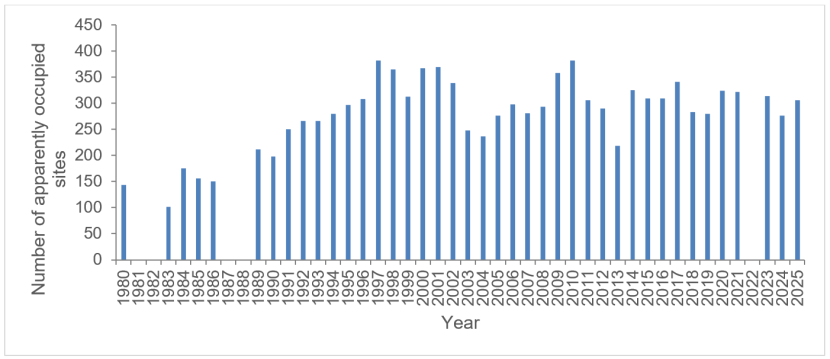
Figure 2: The number of apparently occupied sites (AOS), for fulmar recorded on the Isle of May from 1980-2025 but recorded annually from 1990. Data from 2022 not available.
Click for a full description
Bar chart showing number of apparently occupied sites for fulmar from 1980 to 2025, except for 1981, 1982, 1987,1988 and 2022. Year is along the x axis, from 1980 to 2025, and number of apparently occupied sites is along the y axis, with a scale that runs from 0 to 450. Counts are quite variable but have shown an overall increase. A visual representation of some of the data from Table 10, which gives figures for fulmar, shag, kittiwake, guillemot, razorbill and puffin.
The number of breeding fulmars increased by 11% from 276 AOS in 2024, closer to the five-year average of 308 AOS. The first incubating fulmar was discovered on 12 May, the first chick on 5 July and the first chicks fledging on 21 August. Productivity was average with 0.41 chicks per pair.
2.3.2 European shag (Phalacrocorax aristotelis)
We recorded 223 apparently occupied nests (AON) in 2025 (Figure 3).
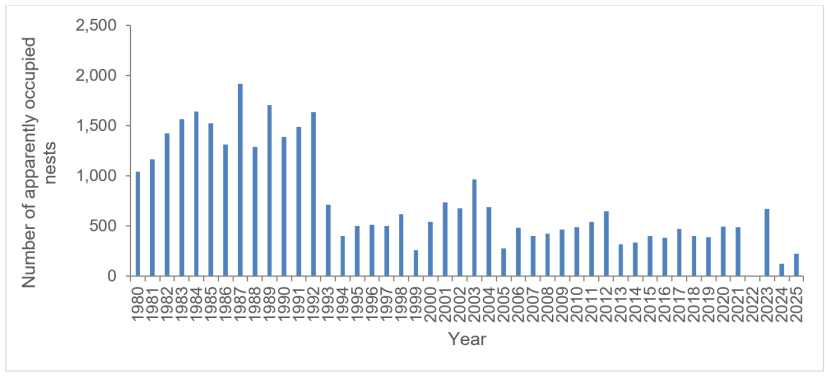
Figure 3: The number of apparently occupied nests (AON) for European shag recorded on the Isle of May annually from 1980-2025. Data from 2022 not available.
Click for a full description
Bar chart showing number of apparently occupied nests for European shag from 1980 to 2025, except for 2022. Year is along the x axis, from 1980 to 2025, and number of apparently occupied nests is along the y axis, with a scale that runs from 0 to 2,500. Counts are quite variable and show an overall decline. A visual representation of some of the data from Table 10, which gives figures for fulmar, shag, kittiwake, guillemot, razorbill and puffin.
The number of breeding European shags increased by 75% this season. The population is showing positive signs of recovery after 2024, when we recorded 127 AON, the lowest number of breeding shags on record, declining by 81% from 674 pairs in 2023. However, the number of breeding pairs is still less than the five-year average of 446 AON.
The first egg was discovered on 19 March. The first chick was discovered on 16 April and the first fledged on 28 May. Productivity was 1.84 chicks per pair, well above the average (1.24).
2.3.3 Black-legged kittiwake (Rissa tridactyla)
We recorded 6,068 apparently occupied nests (AON) in 2025 (Figure 4).
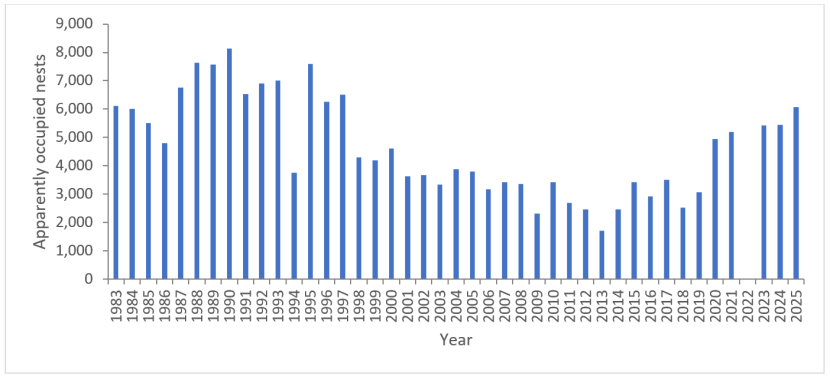
Figure 4: The number of apparently occupied nests (AON) for black-legged kittiwake recorded on the Isle of May annually from 1983-2025. Data not available for 2022.
Click for a full description
Bar chart showing the number of apparently occupied nests for black-legged kittiwake from 1983 to 2025, except for 2022. Year is along the x axis, from 1983 to 2025, and number of apparently occupied nests is along the y axis, with a scale running from 0 to 9,000. Counts are quite variable. A visual representation of some of the data from Table 10, which gives figures for fulmar, shag, kittiwake, guillemot, razorbill and puffin.
The number of breeding kittiwakes increased by 11% this season, the fifth year of increases and higher than the five-year average of 5,252 AON.
Nest building began on 13 May, and the first egg was discovered on 22 May. The first chicks hatched from 20 June, and the first fledgling was seen on 25 July. Productivity was 0.68 chicks per nest, slightly below the average (0.70).
2.3.4 Common guillemot (Uria aalge)
We recorded 16,011 individuals with an estimate of 13,332 pairs in 2025 (Figure 5).
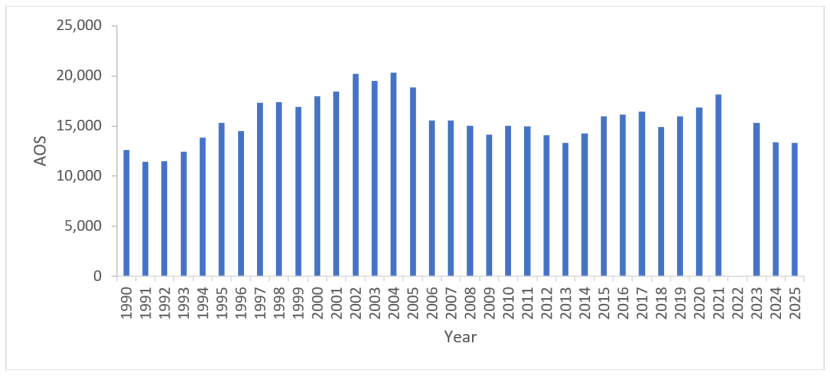
Figure 5: The number of guillemot pairs recorded on the Isle of May annually from 1990-2025. Data from 2022 not available.
Click for a full description
Bar chart showing the number of guillemot pairs from 1990 to 2025, except for 2022. Year is along the x axis, from 1990 to 2025, and number of pairs is along the y axis, with a scale running from 0 to 25,000. Counts are quite variable. A visual representation of some of the data from Table 10, which gives figures for fulmar, shag, kittiwake, guillemot, razorbill and puffin.
The number of guillemot pairs remained stable in 2025 compared to 2024, but still less than the five-year average of 15,927 pairs.
The first egg was discovered on 25 April. The first chick was seen on 29 May and the first chicks were seen jumping on 22 June. Productivity was 0.72 chicks per pair laying.
2.3.5 Razorbill (Alca torda)
We recorded 5,316 individuals with an estimate of 3,594 pairs in 2025 (Figure 6).
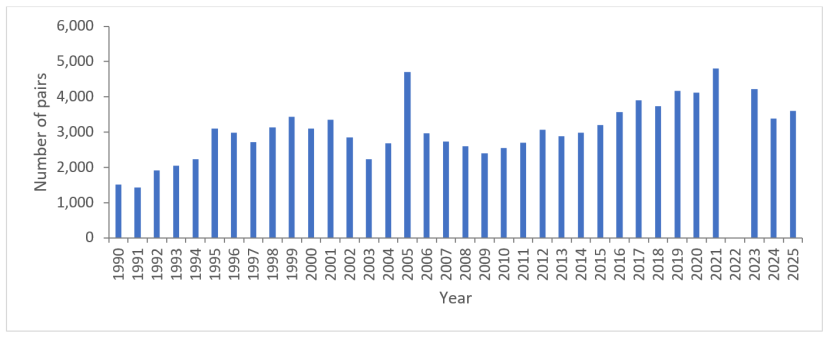
Figure 6: The number of razorbill pairs recorded on the Isle of May from 1990 to 2025. Data from 2022 not available.
Click for a full description
Bar chart showing the number of razorbill pairs from 1990 to 2025, except for 2022. Year is along the x axis, from 1990 to 2025, and number of pairs is along the y axis, with a scale that runs from 0 to 6,000. Numbers have been quite variable, with an overall upward trend. A visual representation of some of the data from Table 10, which gives figures for fulmar, shag, kittiwake, guillemot, razorbill and puffin.
The number of razorbill pairs increased by 5% from 3,392 pairs in 2024, but is still less than the five-year average of 4,138 pairs.
The first egg was discovered on 20 April. The first chicks were observed on 25 May and the first chicks were seen jumping on 13 June. Productivity was 0.63 chicks per pair laying.
2.3.6 Great cormorant (Phalacrocorax carbo)
We recorded 46 apparently occupied nests (AON) in 2025.
The number of cormorant AON increased by 35% this season. The colony continues to grow since establishing on the North Ness in 2020. We try not to disturb the colony, so observations are made from afar and phenology is just estimated.
Birds were established and settled by late March with birds appearing to be incubating by 30 March. The first chick was noted on 24 April and the first fledgling on 1 June.
2.4 Population monitoring of ground-nesting seabird species
2.4.1 Puffin (Fratercula arctica)
The colony was not counted this year. We recorded 52,104 apparently occupied burrows (AOB) in 2024.
The Atlantic puffin breeding population is censused every two years; the next census will be in 2026. In 2024, the number of puffin AOBs increased by 33% from 39,000 AOB recorded during the previous census in 2017. It is thought that the breeding population of puffins peaked between 2017 and 2024 and has since dropped.
Puffins returned to the Isle of May on 26 March. The first puffin observed with fish in its bill was on 11 May, indicating that the first chick had hatched. The first puffling was seen on 26 June. Productivity was 0.75 chicks per pair laying.
2.4.2 Large gulls
In 2024, the gull count was completed in June after a failed attempt on 30 May due to windy conditions. The delay in timing might contribute to some of the dramatic reduction we observed in the breeding population of herring and lesser black-backed gull.
Since 2021, the large gulls on the island have been counted every second year, using images taken from a UAV (Unmanned Aerial Vehicle, also known as a drone). This new method of counting was implemented to increase accuracy (allowing the large gulls to be counted in situ on their nests) whilst also reducing disturbance to the breeding bird assemblage across the island, as the previous method involved a large team of people walking across the entire island. The UAV allows a composite image of the island to be taken, then a desk-based study implemented counting the various nesting gulls. The last census was in 2024; the next will be in 2026.
Herring gull (Larus argentatus)
We recorded 3,009 apparently occupied nests (AON) in 2024.
The number of herring gull AON decreased by 42% between the 2021 and 2024 census.
In 2025, the first eggs were discovered on 27 April, with the first chicks hatching from 24 May. Chicks started fledging from 9 July.
Lesser black-backed gull (Larus fuscus)
We recorded 1,250 apparently occupied nests (AON) in 2024.
The number of lesser black-backed gull AON decreased by 28% between the 2021 and 2024 census.
In 2025, the first eggs were discovered on 5 May, with the first chicks hatching from 29 May.
2.4.3 Great black-backed gull (Larus marinus)
We recorded 111 apparently occupied nests (AON) in 2024.
The number of great black-backed gull AON decreased by 4% between the 2021 and 2024 census.
In 2025, the first eggs were discovered on 17 April, with the first chicks hatching from 12 May and chicks fledging from 11 July. Productivity was 0.3, the second lowest on record after 0.29 in 2022. The ten-year average is 1.0.
2.4.4 Terns
No nesting attempts were made by any tern species this season. Arctic terns arrived around early May. Nest scraping and copulating were observed on 13 May; thereafter, the colony abandoned and was not seen on breeding sites after that. This is the third year in a row with no breeding success of Arctic and common terns on the Isle of May.
2.4.5 Eider (Somateria mollissima)
The eider census took place on 25-31 May
The number of breeding female eiders decreased by 20% this season, the third consecutive census indicating that the breeding population has declined and the lowest count since 1986.
The first egg was discovered on 10 April. The first creche was discovered on 9 May and the last creche on 26 July.
2.4.6 European storm petrel (Hydrobates pelagicus)
We recorded eight apparently occupied sites (AOS) in 2025.
We continued to establish European storm petrel breeding range, using a hybrid of monitoring methodologies: passive acoustic monitoring, audio playback and night-time surveys using thermal optics.
2.4.7 Manx shearwater (Puffinus puffinus)
The island supports the only east coast breeding pair of manx shearwater in the United Kingdom. The pair returned in late March but the nesting attempt failed due to unknown circumstances.
2.5 Other breeding birds
2.5.1 Shelduck (Tadorna tadorna)
As usual, the first birds arrived in late March, with a peak count of six birds on 9 April. Due to the secretive nature of their nesting behaviour (nesting underground), it is always difficult to assess the actual number of breeding pairs. It was considered that two pairs bred, and a family party of 11 ducklings was seen on 6 June.
2.5.2 Mallard (Anas platyrhynchos)
One pair bred on the island, with three ducklings seen at Colm’s Hole on 2 May.
2.5.3 Oystercatcher (Haematopus ostralegus)
Birds were present all year round, with a minimum of 18 pairs nesting across the island (there was no full census this year).
2.5.4 Feral pigeon (Columba livia domestica)
The species remains a common resident, with breeding recorded throughout the year, with 500 counted in October.
2.5.5 Swallow (Hirundo rustica)
Another good year as birds returned to breeding areas from late April and six breeding pairs were found: nests at the Visitor Centre, Fluke Street freezer room, Fluke Street coal shed, Fluke Street woodshed, the engine room and at the main lighthouse. Only five of the pairs were successful.
2.5.6 Rock pipit (Anthus petrosus)
This common resident was present all year round, with a minimum of 13 pairs, although the population was not surveyed this year. Pairs were spread across the island and large numbers of young fledged mid-summer.
2.5.7 Pied wagtail (Motacilla alba)
There was no census of the population this year, but good numbers were present throughout the summer, with successful breeding recorded. Breeding pairs utilised stone walls, buildings and natural nest sites. As usual, the species departed the island with no over-wintering individuals.
2.5.8 Carrion crow (Corvus corone)
One pair was present in the spring and two young fledged in June; however, both were predated, one by great black-backed gull. Birds remained around all season, including ‘Patch’, the distinctive individual which has successfully bred on the island in recent years.
2.5.9 Peregrine falcon (Falco peregrinus)
For the third consecutive year, the pair nested successfully on the island. This year, the pair changed nesting site. The birds were evident from March and vocal displays commenced from late March. Prey items were very varied, from seabirds to migrant birds. The pair were successful in fledging one chick on 25 June.
2.5.10 Wood pigeon (Columba palumbus)
The first breeding wood pigeons for the island were recorded as recently as 2015 and have since established into a healthy population. As in recent years, a total of seven pairs bred on the island and at least three of these pairs were ground-nesting, showing the variety of sites the birds can use.
2.5.11 Wren (Troglodytes troglodytes)
Two pairs were observed breeding this season, one at the Low Light and another in a cavity in a stone wall outside the Fluke Street accommodation. Adults were observed bringing food to the nest on 20 June, indicating chicks had hatched, and the first fledglings were observed on 8 July.
2.5.12 Chiffchaff
For only the second ever occasion, a pair successfully bred on the island, with a family party of five seen in late summer. The male was heard in territory throughout late May and June and it was evident breeding had occurred with the appearance of three juveniles in mid-July.
2.6 Migrant birds
The Bird Observatory opened its doors on 5 April; occupancy was excellent once again. As usual, weather played a factor for groups arriving on the designated Saturday, but in general it was a smooth season. The Bird Observatory members concentrated on recording bird migration through daily census and bird ringing operations.
It proved to be an exceptionally quiet year for migrant birds across the island, both in spring and autumn migration. The lack of suitable weather at the right times resulted in slow passage with low numbers of common migrants and even fewer scarce/rare birds. A total of 163 species were recorded, with the main highlights including:
- 3rd Little egret
- 5th -7th White-billed diver
- 6th Kingfisher
- 7th Spotted redshank, little tern
- 8th Blyth’s reed warbler
- 10th Great crested grebe
- 11th -15th Cory’s shearwaters
Other species of note included red-backed shrike (2) and red-breasted flycatcher with island ‘rarities’ including house sparrow, gadwall, mute swan and treecreeper. The year was noticeable for a number of birds which did not appear, including bluethroat, common rosefinch, icterine warbler, roseate tern and barred warbler to name but a few.
2.7 Mammals
2.7.1 Rabbit (Oryctolagus cuniculus)
The previous year had seen the total decimation of the population through myxomatosis. The virus had swept through the population in the latter half of the year and numbers were incredibly low by the winter months. The early part of 2025 appeared to indicate a very low survival rate, as several visits in January-February revealed only 1-2 animals surviving around the Beacon area. It wasn’t until the end of March that an increase was noted, with 10 counted on 31 March. As the summer progressed, it was evident that animals were occupying traditional warrens across the entire island but numbers remained low and were far from their peak of a few years ago. It may be another twelve months (at least) before we see numbers restored, but in the meantime, there were some benefits. Without the grazing pressure, the island’s vegetation flourished, especially the maritime grassland and flowering plants such as thrift.
2.7.2 Grey seals (Halichoerus grypus)
Unlike the previous decade, the last few seasons have been late to start. The first pup was discovered on Rona on 11 October (7 October last year) but the colony appeared more healthy (than the previous year), with good numbers of pups born in October - December. First-born pups were found on Rona on 11 October, Kirkhaven on 14 October, Burnett’s Leap on 15 October, and Ardcarron and Pilgrim’s Haven on 17 October. Numbers appeared good, with six born by 15 October, 31 by 20 and 80 by 23 October. The usual count on 5-6 November revealed higher numbers than last year but still lower than average. The suggestion is that the colony has changed (decreased) across the Isle of May in recent years and the full population counts by the Sea Mammal Research Unit (SMRU) will hopefully reveal this decline.
Table 1: Grey seal numbers and locations
| Location | 6 November 2025 | 5 November 2024 | 5 November 2022 | 5 November 2021 |
|---|---|---|---|---|
| Pilgrim’s Haven | 28 | 23 | 34 | 36 |
| Tennis Courts | 47 | 11 | 56 | 31 |
| Ardcarran and Kirkhaven | 145 | 164 | 215 | 152 |
| Mill Door | 2 | 3 | 4 | 5 |
| Horse Hole | 2 | 4 | 4 | 4 |
| East Side | 1 | 2 | 5 | 4 |
| Burnett's Leap | 23 | 36 | 47 | 34 |
| Rona | 211 | 138 | 406 | 462 |
| Total | 459 | 381 | 771 | 728 |
2.7.3 Cetaceans
In general, it was an average year for cetacean recording, partly attributed to windy weather during the latter part of the summer, making recording difficult at the peak time. Despite this, it was a memorable year, as the island recorded orca on two occasions in early summer, the first sightings since 2015, and common dolphin was noted for the third consecutive year.
Orca (Orcinus orca)
The event of the year unfolded in early June as a pod of seven (two bulls and five female/youngsters) were discovered off the Bass Rock at 13:00 on 2 June. At range, the animals were seen from the west cliffs of the island, including the impressive dorsal fins of the males. Gradually they worked their way across the Firth of Forth before turning east between the island and Anstruther. The animals were actively feeding and were seen breaching the surface before being last seen at 18:44 passing Crail and heading further east. This pod was part of the well-known 65s Pod from Shetland which included the bull 'Busta' who last visited the Isle of May in 2015!
Impressively, a second pod of seven was discovered off Elie (Fife) at 08:45 on the morning of 9 June before heading east along the coast. The animals were picked up from the island at 09:30 and continued to move east and were last seen at 10:40, again heading east and out of the Forth. This pod consisted of a bull, five female-types and one calf and was part of the 27s, another well-known Shetland pod. These represented the first sightings from the Isle of May since May 2015.
Minke whale (Balaenoptera acutorostrata)
Once again, well reported, especially in the late summer, as the species was noted on 31 dates (22 dates in 2024). The months of August and October produced the bulk of records. As usual, reports remain scarce in the spring, although an individual off the east side on 18 March was particularly early. Thereafter, singles, possibly relating to the same animal, were seen on two April and five May dates, with singles on 2 and 8 June. Following one off the west side on 12 July, August produced 1-3 on thirteen dates, including animals lingering in feeding frenzies off the favoured south-east and west side of the island. Although September was quiet, with only two records, October produced 1-3 on seven dates, including three together on 15 October seen actively lunge feeding off the east side.
Harbour porpoise (Phocoena phocoena)
There were reports on 27 dates (14 dates in 2024) across the season, with reports in every month between February - October. These records usually involved 1-3 animals, with occasionally four seen on 26 February, 30 August and 14 September. Bigger counts included six on 12 August and eight on 19 June and 15 October.
Bottlenose dolphin (Tursiops truncates)
The species is frequently seen along the Fife coastline and reported by boatmen throughout the summer, but these animals are just outside of our recording area. The species is much rarer around the island and this year was particularly scarce, with only two confirmed sightings, a single on 18 February and four on 11 July.
Common dolphin (Delphinus delphis)
Interestingly, records are starting to increase as for the third consecutive year the species was recorded. Two were seen heading west, viewed from the South Horn on 2 August, and an active pod of twelve was seen in a rapid feeding frenzy off the east side on 12 October. This follows records in recent years on 29 September 2024 and 25-26 August 2023.
Basking shark (Cetorhinus maximus)
Although not a cetacean, it is worth noting that a basking shark was seen swimming close to the island off the south end on 29 September; the animal continued west and it is the second consecutive year the species has been recorded, having not been seen since 2015.
2.8 Lepidoptera
2.8.1 Butterflies
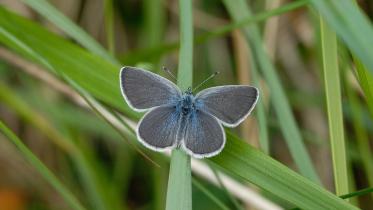
It was a good season for butterfly observations, with a total of 11 species and ~3355 individual observations. These butterflies were recorded using transects for the United Kingdom Butterfly Monitoring Scheme (UKBMS) and casual sightings by staff from the Bird Observatory. The seven most common species remain the same as those since 2007 (red admiral, small tortoiseshell, small white, painted lady, large white, peacock, and green-veined white).
Red admiral (Vanessa atalanta)
The most abundant butterfly species with 2000 records; it was observed from April until October. The highest number of individuals sighted in a single day was 197 in July. Although red admirals were sighted regularly, their population frequently fluctuated – as soon as the population peaked, the population would then dramatically fall. The sudden decrease in numbers was observed to often be owing to either predation or weather conditions.
Small tortoiseshell (Aglais urticae)
One of the earliest observed species and the second most abundant, first seen in March and last seen in September. Similar fluctuations in population to red admirals were also observed in small tortoiseshells. However, the number of individuals overall is much lower; for instance, the highest number of individuals seen in a single day was 34 in July. Interestingly, there were no sightings in May.
Small white (Pieris rapae)
A single individual was observed in April and then none were seen until June. They then continued to be sighted until October. Their numbers remained relatively consistent, with a peak of 27 sighted on a single day in August. Although fluctuations in abundance were observed, it was thought this could be owing to migration, unlike red admirals and small tortoiseshells. Small whites were the third most abundant species sighted, but the confidence in identification is not high owing to the difficulty of distinguishing between white butterfly species.
Painted lady (Vanessa cardui)
Painted lady was first observed in May and was last recorded on 30 September. Painted lady numbers fluctuated owing to predation and weather conditions as well as their long-distance migration from Africa. June saw the highest number of individuals in a single day at 40; otherwise, they were more commonly observed at peaks of 10 to 20 individuals. A notable total of 255 individuals was recorded this season.
Large white (Pieris brassicae)
Recorded from July to October with similar fluctuations in numbers to small whites. However, they only peaked at 17 individuals in a single day in July. There is a possibility some large whites were misidentified as small whites.
Peacock (Aglais io)
The first species sighted in the season, on 19 March, and recorded until October. Similar fluctuations to red admirals and small tortoiseshell in the population were observed. Also, there were no sightings over May and June. In 2024, they were the second most abundant species recorded, but this year they are sixth. However, the total number of records and days (118, 50 days) is similar to the results in 2024 (117, 41 days), which could suggest there has not been a negative impact on the population overall.
Green-veined white (Pieris napi)
The only species out of the seven most common with less than 100 records. First sighted in May, they were recorded through until September. The maximum seen in a single day was only six in July. Fluctuations in the population were difficult to observe given their consistent low numbers.
Other species
The remaining uncommon species recorded included comma, wall brown, speckled wood and small copper. All these species were sighted in August/September, with comma being the only species also recorded in July. Comma, wall brown and speckled wood have potentially become more likely to be recorded on the island at least once a year. Small copper was the most unusual species sighted this season.
Table 2: Butterfly species - total records and days this season
| Species | Number of days | Total records |
|---|---|---|
| Large white | 40 | 161 |
| Small white | 67 | 361 |
| Green-veined white | 31 | 48 |
| Peacock | 50 | 118 |
| Red admiral | 133 | 2,000 |
| Painted lady | 65 | 255 |
| Small tortoiseshell | 97 | 395 |
| Comma | 6 | 7 |
| Wall brown | 4 | 6 |
| Speckled wood | 2 | 2 |
| Small copper | 2 | 2 |
2.8.2 Moths
Moth trapping was carried out by island staff between 11 April and 16 October using an MV light trap primarily positioned in the garden outside the Principal Keeper’s cottage (PK). During adverse weather conditions, the trap was moved into the outdoor shelter and on favourable nights could be operated at the Visitor Centre, reducing sampling pressure on one area. These two locations are selected for reliable access to power and shelter. A second trap, operated by the Isle of May Bird Observatory (IOMBO), ran in the low light bushes, though less frequently.
Trapping occurred on 61 nights at Fluke Street and the Visitor Centre, bringing in a total of 5,739 moths which included 4,397 macro-moths and 1,342 micro-moths. This consisted of 83 macro-species and 35 micro-species. As usual, dark arches was the most abundant species, with 1,444 individuals caught across 44 nights over a five-month period. Other abundant species included marbled coronet (604) and common/lesser rustic (336). Marbled coronet and bright-line brown-eye moths were observed for the longest duration, present for six of the eight survey months. The most frequently recorded micro-moth was Crambus perlella for all sites.
At the IOMBO site, dark arches was again most numerous, with 216 recordings across 14 nights, followed by flounced rustic and garden dart. Variations between sites likely reflect differences in trapping frequency and identification effort.
Casual observers included cinnabar moths and hummingbird hawk-moths alongside other invertebrates found within the trap, such as caddisflies, lacewings and an abundance of sexton beetles.
3. Research and monitoring
3.1 Research teams
As usual, research teams were based on the island throughout the year, studying various aspects of the island’s flora and fauna. The research teams totalled 1,023 bed nights on the island, demonstrating the importance of the island for research. During the summer months, UKCEH, led by Francis Daunt, were present from 17 April until the end of July. The team included Mark Newell, Josie Hewitt, Erin Taylor and Holly Pickett and were supported by fourteen other individuals during that period, totalling 490 bed nights. Edinburgh University, led by Emma Cunningham, had a team of four present throughout the summer months looking at HPAI and totalled a further 116 nights. Manchester and Edinburgh University worked together on the island’s mice, and they were based in Fluke Street from 26 August - 4 October and again from 3 November – 12 December.
Please refer to Annex 2 for research project summaries.
4. Visitor review
The island opened its doors on 1 April and remained open until 30 September, with planned closures one day per week in the months of May and June, whilst, as usual, boats were cancelled due to bad weather on several dates.
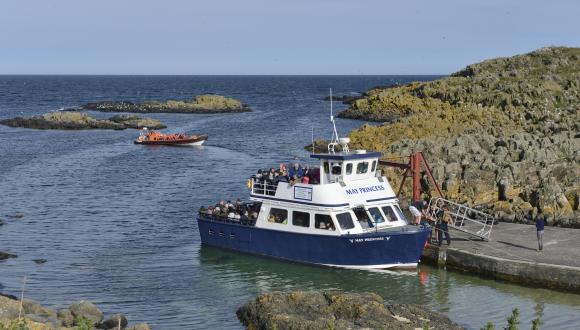
The visitor boats departing from Anstruther brought most of the visitors, with the May Princess bringing 11,649 (11,018 last year) whilst the fast RIB Osprey carried a further 1,776 visitors (1,610 visitors last year). During the season, boats travelled from the Lothian side of the Firth of Forth, with the Seabird Centre RIB, Seafari Express, bringing 1,417 visitors (1,389 visitors last year) and BlueWild a further 796 visitors (525 visitors last year). Small private leisure craft, cruise ships (two) and kayaks carried a further 499 visitors, bringing the annual total to 16,137, setting a new annual record surpassing the 15,603 set in 2023.
Table 3: Visitor numbers on individual boats, 2025
| Month | May Princess | Osprey | Seafari | BlueWild | Other boats | Total | Days open | Days closed | Days cancelled |
|---|---|---|---|---|---|---|---|---|---|
| April | 2,083 | 321 | 309 | 106 | 20 | 2,839 | 29 | 0 | 2 |
| May | 1,861 | 282 | 165 | 177 | 397 | 2,882 | 19 | 4 | 8 |
| June | 2,439 | 298 | 263 | 181 | 6 | 3,187 | 25 | 4 | 1 |
| July | 2,839 | 364 | 348 | 244 | 37 | 3,832 | 30 | 0 | 1 |
| August | 2,098 | 320 | 255 | 74 | 33 | 2,780 | 28 | 0 | 3 |
| September | 329 | 191 | 77 | 14 | 6 | 617 | 23 | 0 | 7 |
| Totals | 11,649 | 1,776 | 1,417 | 796 | 499 | 16,137 | 154 | 8 | 22 |
Table 4: Annual totals for each individual boat operator, 2015-2025
| Year | May Princess | Osprey | Seafari | BlueWild | Others | Total |
|---|---|---|---|---|---|---|
| 2025 | 11,649 | 1,776 | 1,417 | 796 | 499 | 16,137 |
| 2024 | 11,018 | 1,610 | 1,389 | 525 | 245 | 14,787 |
| 2023 | 11,470 | 1,655 | 1,417 | 616 | 445 | 15,603 |
| 2022 | 7,446 | 1,169 | 862 | 138 | 41 | 9,656 |
| 2021 | 7,981 | 1,280 | 1,043 | 98 | 152 | 10,554 |
| 2020 | 2,466 | 328 | 390 | 10 | 93 | 3,287 |
| 2019 | 11,551 | 1,474 | 984 | 0 | 239 | 14,248 |
| 2018 | 11,112 | 1,373 | 1,029 | 19 | - | 13,533 |
| 2017 | 10,385 | 1,349 | 798 | 112 | - | 12,644 |
| 2016 | 9,830 | 1,327 | 743 | 0 | - | 11,900 |
| 2015 | 8,803 | 1,219 | 669 | 0 | - | 10,691 |
5. Media coverage
The Isle of May appeared regularly on various media outlets throughout the year:
- The acclaimed Sky television series by Robson Green was filmed in mid-May and will be aired in February 2026.
- The University of Belfast filmed short interviews and footage from the island featuring the life and times of the Isle of May.
As usual, social media was very popular, with the island’s blog attracting over 90,000 hits whilst Facebook remained popular, with 7,500 people following the page.
6. Volunteers and support
The island’s long-term volunteer programme continued this season. Rebecca Davies joined the team on 21 April and Imogen Sylph joined on 23 May. Both contributed a total of 200 working days over the season and departed on 17 October and 19 September respectively. Further help and support was given by short-term volunteers Pheobe Marshman (29 days), Vivian Marko (24 days) and Nicole Hegarty (nine days). Overall, volunteers contributed an invaluable total of 281 working days on the Isle of May in 2025. NatureScot volunteer groups also offered good support, especially with larger projects including weeding of the Priory, open days including the Doors Open Day event, tern management and closing down the island.
7. Infrastructure and island work
As usual, various island work was undertaken during the season, dependent on weather and the seabird breeding season. Jobs included:
- Construction of stone steps up to Priory
- Painting of the North and South Horn exteriors
- Internal removal of damp and painting in Fluke Street
- New concrete step on Logan’s Road jetty
- All chimneys cleaned in Fluke Street
- Road resurfaced between Visitor Centre and Fluke Street
- Glass windows replaced in the Assistant Keeper’s cottage and PK
7.1 Water supply
Water continued to be a problem for island life this season; residents were restricted to one shower per week until early October. Drinking water is extracted from a well which is replenished by rainwater. Reduced rainfall over the summer months means water is scarce; this season the well did not start pumping water until after heavy rainfall during Storm Amy in early October (See section 8: Rainfall).
7.2 Boat activity around the island
Boating activity was recorded around the island by the island residents from the end of May to the end of July. It is important to note that this was based on incidental sightings, recorded by varying numbers of island residents while engaged in other tasks, and is by no means a complete record of all boat activity in these months. To reduce disturbance to breeding seabirds, especially cliff-nesting birds, there is a 50 m voluntary buffer around the island. Despite this, a total of 20 incidences of boats coming within the voluntary limit were observed.
8. Weather
For the second full year, we have been able to collect hourly weather observations directly on the island from professional-grade weather stations. Two Davis Vantage Pro stations were installed in mid-2023 (acquired through the Isle of May Mouse Project), with ongoing maintenance, data collection and data processing facilitated by a NatureScot weather volunteer role. The stations monitor air temperature, rainfall, humidity, wind speed and wind direction. Two further sub-modules monitor ground temperature and moisture at two depths. Observations pertaining to the 12-month period October 2024 to September 2025 are given below.
General climate
As noted last year, comparison with nearby observations on the mainland (Leuchars Met Office station, Fife) show that the island generally experiences less extreme temperature variations (cold periods are milder, hot days are cooler) and significantly higher wind speeds (gusts frequently exceed 50 mph). There are also indications that the island experiences less rainfall compared to nearby coastal areas.
Wind direction
The predominant wind direction on the island was recorded as westerly or west-south-westerly. Similarly to the previous year, we saw significant periods with easterly winds between February and May 2024. Significant periods with winds from the south-east were also recorded in September 2025.
Wind speed
The 2024/2025 season saw a reduction in the number of Met Office named storms (just six compared to 11) compared to the previous season. Five of these can be seen directly in the wind speed record for the island. We also recorded our highest speed wind gust so far, of 98 mph, as Storm Eowyn arrived in January 2025.
Temperature
As last year, we did not see temperature extremes on the island, with a maximum of 22.6oC in July 2025, and a minimum of 0.6oC in December; the air temperature did not dip below freezing. The coldest months were Jan to Feb, with mean daily temperatures of around 5oC, while the warmest months were July to August, with a mean daily temperature of just over 15oC.
Rainfall
As noted last year, observed rainfall appears to vary quite considerably on a local scale around the coastline of Fife and East Lothian, making direct observations on the island particularly valuable. Rainfall on the island appears to be most similar to (although somewhat lower than) the SEPA observations at St Monance located approximately 13 km ENE from the island on the Fife coast. Using this as a reference point, we are able to infer how typical the rainfall in the current season was compared to the long-term (2014-2023) average.
Total rainfall on the island was significantly lower than the expected long-term average, just 396.8 mm compared to a long-term average at St Monance of 638 mm. Although we do not yet have long-term rainfall records on the Isle of May, using St Monance as a proxy, we estimate this is around 60-70% of the long-term average. Reductions in rainfall were particularly drastic in November 2024, February-April 2025 and August 2025. In these months, we saw less than 50% of the long-term average; only June and September 2025 had rainfall close to the long-term average.
ANNEX 1: Seabird data
| Species | Nest building or copulating | First egg | First chick | First fledger | Last fledger |
|---|---|---|---|---|---|
| Common eider | - | 10 April | 9 May | - | 26 July |
| Common guillemot | 15 April | 25 April | 29 May | 22 June | - |
| Razorbill | 30 March | 20 April | 25 May | 13 June | - |
| Atlantic puffin | 29 March | 11 April | 11 May | 26 June | 17 August |
| European shag | - | 19 March | 16 April | 28 May | 17 August |
| Great cormorant | - | 30 March | 24 April | 1 June | - |
| Black-legged kittiwake | 26 April / 5 May | 22 May | 20 June | 25 July | - |
| Herring gull | 5 April | 27 April | 24 May | 9 July | - |
| Lesser black-backed gull | - | 5 May | 29 May | - | - |
| Great black-backed gull | 26 March | 17 April | 12 May | 11 July | 20 August |
| Northern fulmar | 7 April | 12 May | 5 July | 21 August | - |
| Arctic tern | 13 May | Did not breed | Did not breed | Did not breed | Did not breed |
| Common tern | - | - | - | - | - |
| Species | 2025 | 2024 | 2023 | 2022 | 2021 | 2020 | Five-year average |
|---|---|---|---|---|---|---|---|
| Northern fulmar | 306 | 276 | 314 | N/A | 321 | 324 | 309 |
| Common guillemot | 13,332 | 13,372 | 15,314 | N/A | 18,156 | 16,865 | 15,927 |
| Razorbill | 5,316 | 3,392 | 4,223 | N/A | 4,813 | 4,124 | 4,138 |
| European shag | 223 | 127 | 674 | N/A | 491 | 495 | 447 |
| Black-legged kittiwake | 6,068 | 5,443 | 5,425 | N/A | 5,193 | 4,947 | 5,252 |
| Atlantic puffin | N/C | 52,104 | N/C | N/C | N/C | N/C | 52,104 |
| Section | Northern fulmar (AOSs) | European shag (AONs) | Black-legged kittiwake (AONs) | Common guillemot (Ind) | Common guillemot (Pairs) | Razorbill (Ind) | Razorbill (Pairs) |
|---|---|---|---|---|---|---|---|
| A: Rona (West) | 25 | 26 | 173 | 453 | 369 | 165 | 101 |
| B: Altarstanes to Peregrine's Nest | 38 | 14 | 807 | 1,312 | 1140 | 832 | 622 |
| C: Greengates | 27 | 3 | 1018 | 3,187 | 2,705 | 1039 | 647 |
| D: South Plateau | 29 | 6 | 1,393 | 5019 | 4175 | 1,130 | 784 |
| E: Cornerstone to Pilgrim's Haven | 14 | 2 | 764 | 2,896 | 2,349 | 846 | 627 |
| F: Pilgrim's Haven to Lady's Cave | 23 | 11 | 551 | 1,323 | 1,047 | 474 | 287 |
| G: The Maidens | 14 | 29 | 73 | 160 | 127 | 140 | 85 |
| H: South Ness to Lady’s Bed | 1 | 16 | 115 | 264 | 224 | 105 | 65 |
| I: South Ness to Colm's Hole | 21 | 32 | 216 | 0 | 0 | 47 | 30 |
| J: Colm's Hole to Low Light | 23 | 83 | 406 | 546 | 468 | 108 | 70 |
| K: Low Light to Tarbet | 29 | 274 | 783 | 670 | 296 | 191 | |
| L: Rona (North and East) | 12 | 1 | 0 | 0 | 0 | 0 | 0 |
| M: Lochside (South) | 37 | 0 | 39 | 0 | 0 | 1 | 1 |
| N: Lochside (North) | 13 | 0 | 124 | 0 | 0 | 45 | 27 |
| O: Boat counts | 0 | 0 | 115 | 68 | 58 | 88 | 57 |
| Total | 306 | 223 | 6,068 | 16,011 | 13,332 | 5,316 | 3,594 |
| Species | 2025 | 2024 | 2023 | 2022 | 2021 | 2020 | Five-year average |
|---|---|---|---|---|---|---|---|
| Common guillemot | 82% | 59% | 68% | 79% | 87% | 74% | 73% |
| Razorbill | 83% | 50% | 93% | 87% | 90% | 77% | 79% |
| European shag | 88% | 17% | 86% | 87% | 94% | 71% | 71% |
| Black-legged kittiwake | 88% | 84% | 86% | 84% | 84% | 87% | 85% |
| Atlantic puffin | 82% | 80% | - | - | - | - | 80% |
| Species | 2025 | 2024 | 2023 | 2022 | 2021 | 2020 | Five-year average |
|---|---|---|---|---|---|---|---|
| Common guillemot | 0.72 | 0.65 | 0.71 | 0.74 | 0.75 | 0.63 | 0.70 |
| Razorbill | 0.63 | 0.64 | 0.69 | 0.56 | 0.54 | 0.68 | 0.62 |
| European shag | 1.84 | 1.64 | 1.81 | 2.04 | 2.04 | 1.87 | 1.88 |
| Black-legged kittiwake | 0.68 | 0.77 | 0.77 | N/A | 0.8 | N/A | 0.78 |
| Atlantic puffin | 0.75 | 0.95 | 1.04 | 1.38 | 1.34 | 1.09 | 1.16 |
| Northern fulmar | 0.41 | 0.37 | 0.36 | 0.55 | 0.49 | 0.56 | 0.47 |
| Year | Northern fulmar (AOS) | European shag (AON) | Black-legged kittiwake (AON) | Common guillemot (Individual) | Common guillemot (Estimated pairs) | Razorbill (Individual) | Razorbill (Estimated pairs) | Atlantic puffin (Estimated pairs) |
|---|---|---|---|---|---|---|---|---|
| 1980 | 143 | 1,041 | N/C | N/C | - | n/c | - | - |
| 1981 | N/C | 1,163 | N/C | 16,300 | - | 2,086 | - | - |
| 1982 | N/C | 1,425 | N/C | N/C | - | n/c | - | - |
| 1983 | 101 | 1,567 | 6,115 | 22,550 | - | 2,220 | - | - |
| 1984 | 175 | 1,639 | 6,012 | 19,005 | - | 2,051 | - | - |
| 1985 | 156 | 1,524 | 5,510 | 18,390 | - | 1,825 | - | - |
| 1986 | 150 | 1,310 | 4,801 | 19,151 | - | 1,864 | - | - |
| 1987 | N/C | 1,916 | 6,765 | 17,546 | - | 1,887 | - | - |
| 1988 | N/C | 1,290 | 7,638 | 16,791 | - | 2,128 | - | - |
| 1989 | 212 | 1,703 | 7,564 | 18,328 | - | 2,613 | - | - |
| 1990 | 198 | 1,386 | 8,129 | 16,778 | 12,632 | 2,368 | 1,508 | - |
| 1991 | 250 | 1,487 | 6,535 | 16,834 | 11,440 | 1,633 | 1,425 | - |
| 1992 | 266 | 1,634 | 6,916 | 17,512 | 11,511 | 2,581 | 1,909 | - |
| 1993 | 266 | 715 | 7,009 | 17,919 | 12,418 | 3,022 | 2,052 | - |
| 1994 | 279 | 403 | 3,751 | 19,186 | 13,843 | 3,034 | 2,227 | - |
| 1995 | 296 | 503 | 7,603 | 25,754 | 15,326 | 4,248 | 3,108 | - |
| 1996 | 308 | 512 | 6,269 | 24,468 | 14,500 | 3,405 | 2,989 | - |
| 1997 | 382 | 502 | 6,518 | 26,711 | 17,340 | 3,478 | 2,719 | - |
| 1998 | 365 | 621 | 4,306 | 26,963 | 17,384 | 3,859 | 3,126 | - |
| 1999 | 312 | 259 | 4,196 | 21,694 | 16,933 | 3,786 | 3,429 | - |
| 2000 | 367 | 541 | 4,618 | 27,045 | 17,979 | 3,958 | 3,105 | - |
| 2001 | 369 | 734 | 3,639 | 28,103 | 18,442 | 4,114 | 3,346 | - |
| 2002 | 338 | 676 | 3,666 | 24,369 (Based on the first AIC) | 20,185 | 3,050 (Based on the first AIC) | 2,844 | - |
| 2003 | 248 | 968 | 3,335 | 26,722 (Based on the first AIC) | 19,519 | 3,105 (Based on the first AIC) | 2,233 | - |
| 2004 | 236 | 687 | 3,876 | 22,970 (Based on the first AIC) | 20,332 | 3,313 (Based on the first AIC) | 2,677 | - |
| 2005 | 276 | 281 | 3,790 | 22,667 (Based on the first AIC) | 18,858 | 4,109 (Based on the first AIC) | 4,713 | - |
| 2006 | 298 | 485 | 3,167 | 21,444 (Based on the first AIC) | 15,578 | 3,811 (Based on the first AIC) | 2,975 | - |
| 2007 | 281 | 399 | 3,424 | 16,770 (Based on the first AIC) | 15,536 | 3,635 (Based on the first AIC) | 2,735 | - |
| 2008 | 293 | 427 | 3,354 | 17,157 (Based on the first AIC) | 15,036 | 3,464 (Based on the first AIC) | 2,591 | - |
| 2009 | 358 | 465 | 2,316 | 16,888 (Based on the first AIC) | 14,143 | 3,008 (Based on the first AIC) | 2,400 | - |
| 2010 | 381 | 492 | 3,422 | 18,096 | 15,029 | 3,234 | 2,557 | - |
| 2011 | 306 | 540 | 2,685 | 15,691 | 14,955 | 3,012 | 2,705 | - |
| 2012 | 290 | 648 | 2,465 | 16,991 | 14,100 | 3,305 | 3,068 | - |
| 2013 | 218 | 322 | 1,712 | 14,764 | 13,349 | 3,155 | 2,879 | - |
| 2014 | 325 | 338 | 2,464 | 16,602 | 14,248 | 3,796 | 2,987 | - |
| 2015 | 309 | 401 | 3,433 | 21,598 | 15,945 | 4,590 | 3,202 | - |
| 2016 | 309 | 387 | 2,922 | 23,038 | 16,132 | 5,117 | 3,570 | - |
| 2017 | 341 | 474 | 3,507 | 20,531 | 16,468 | 5149 | 3,899 | 39,000 |
| 2018 | 283 | 404 | 2,516 | 18,705 | 14,902 | 4,867 | 3,738 | - |
| 2019 | 280 | 389 | 3,061 | 21,493 | 15,974 | 5,377 | 4,166 | - |
| 2020 | 324 | 495 | 4,947 | 23,306 | 16,865 | 6,292 | 4,124 | - |
| 2021 | 321 | 491 | 5,193 | 26,134 | 18,156 | 6,184 | 4,813 | - |
| 2022 | N/A | N/A | N/A | N/A | N/A | N/A | N/A | - |
| 2023 | 314 | 674 | 5,425 | 22,113 | 15,314 | 5,493 | 4,223 | - |
| 2024 | 276 | 127 | 5,443 | 15,506 | 13,372 | 5,493 | 3,392 | 52,000 |
| 2025 | 306 | 223 | 6,068 | 16,011 | 13,332 | 5,316 | 3,594 | - |
ANNEX 2: Research project summaries
1. GPS tracking of Isle of May seabirds to assess effects of offshore renewable developments
M Newell, M Bogdanova, E Benninghaus, J Hewitt, H Pickett, E Taylor & F Daunt
UKCEH Edinburgh, Bush Estate, Penicuik, Midlothian, EH26 0QB
RESEARCH PERMIT NUMBER: MON/RP25/05
Neart na Gaoithe offshore wind farm are undertaking GPS tracking of Isle of May seabirds as part of their post-construction environmental monitoring programme signed off by Scottish Government. They have contracted UKCEH to undertake the work. This study will undertake GPS tracking of kittiwakes, puffins, guillemots and razorbills to quantify distribution on foraging trips, overlap with wind farm footprints and, together with work in later years during wind farm construction and operation, the potential impact of these developments on SPA breeding birds in the region.
In 2025, we successfully deployed GPS devices on 25 guillemots, 58 kittiwakes, 32 puffins and 15 razorbills. The data from these deployments will inform on the usage of the Neart na Gaoithe wind farm area by these seabirds.
2. Long-term studies of breeding seabirds on the Isle of May
M Newell, J Hewitt, E Taylor, C Gunn, H Pickett & F Daunt
UKCEH Edinburgh, Bush Estate, Penicuik, Midlothian, EH26 0QB
RESEARCH PERMIT NUMBER: MON/RP25/03
The 2023/24 autumn and winter was a tough period for seabirds, which resulted in a poor 2024 breeding season. The 2024/25 non-breeding season was a much more benign period of weather, which resulted in an improved breeding season in 2025.
It was the earliest breeding season on record for European shags, with the median egg date 25 days earlier than the long-term average. Northern fulmar, razorbill and Atlantic puffin were also all earlier than average. Based on the first adult Atlantic puffin seen carrying fish (indicating the first chick hatching), it was the second earliest season on record. Although the average lay date for common guillemot was three days later than average, it was ten days earlier than 2024. Conversely, razorbill laying was five days earlier than normal and eleven days earlier than 2024.
Return rates of individually colour marked birds revealed a significant improvement from the previous winter. Only common guillemot had a below average return rate, but it was still the highest for four years. Razorbill and Atlantic puffin had an average return rate while European shag and black-legged kittiwake were above average; the latter was the highest for eight years.
Breeding success was average for northern fulmar, common guillemot, razorbill and Atlantic puffin. European shag breeding success was above average for the 18th year in succession. Although black-legged kittiwake breeding success was only slightly below average, it is likely to be an overestimate as many chicks died at fledging age. There was a steady increase in mortality through chick rearing this year compared to 2024 when there was a sudden die-off at fledging age. In 2024, this was thought to be due to food shortage, whereas in 2025 there was the potential added impact of avian influenza. Highly Pathogenic Avian Influenza was detected in a number of species on the Isle of May in 2025 and while results on some samples are still forthcoming, the mortality of black-legged kittiwakes was the most significant. Ringing recoveries from the last significant outbreak in 2023 suggested it was non-breeding birds that were most affected; however, in 2025 the ringing recoveries suggested that more breeding birds were hit, which may have affected breeding success in addition to poor food availability.
- Northern fulmar breeding success (0.41 chicks per incubating pair) was average.
- European shags had a successful season (1.84 chicks per pair), well above the average of 1.24. Adult return rate at 88.2% was well above average (76.5%) and a big improvement on 2024 (16.7%).
- Black-legged kittiwakes had a slightly below average breeding season at 0.68 chicks per completed nest (average 0.70). However, mortality was noted in chicks at fledging age with significant numbers dead in the sea and under cliffs. Unless birds were seen dead in nests, it was not possible to quantify which had actually failed. Consequently, breeding success recorded is likely an overestimate. Adult return rate (88.4%) was the highest for eight years and above average (80.2%).
- Common guillemots had an average breeding season (0.72 chicks leaving per pair laying). Return rate of adults (81.7%) was below average (88%) but an improvement on the previous three years.
- Razorbills had an average breeding season (0.63 chicks leaving per pair laying) and the adult return rate (91.2%) was above average.
- Atlantic puffins had an average breeding season (0.75 chicks per pair laying). The return rate for adults (82.4%) matched the long-term average.
3. Over-wintering foraging ecology of seabirds
M Newell, M Bogdanova, S Burthe, J Hewitt, H Pickett, E Taylor & F Daunt
UKCEH Edinburgh, Bush Estate, Penicuik, Midlothian, EH26 0QB
RESEARCH PERMIT NUMBER: MON/RP25/04
This project aims to obtain fine-scale data on movements and foraging behaviour of seabirds in winter, by attaching specially designed loggers to European shags, Atlantic puffins, black-legged kittiwakes, razorbills and common guillemots. The loggers record daily location and foraging effort. Detailed data on location-specific foraging effort of seabirds will enable patterns of distribution and behaviour in relation to season and breeding status to be analysed.
The work on shags is a continuation of work commenced in 2002. A total of 12 geolocators were deployed in 2025 which we plan to retrieve in 2026. A total of eight loggers were retrieved in 2025.
- In 2025, 19 retrievals of geolocator loggers were made from guillemots, with a further 23 deployments.
- In 2025, 15 loggers were deployed on puffins, with seven retrieved from previous deployments. These deployments will be targeted for retrieval in 2026.
- A total of 13 loggers were retrieved from kittiwakes in 2025 which had been deployed in previous years. A further 24 new deployments were made.
- A total of 10 loggers were retrieved from razorbills in 2025 and 25 geolocators were deployed on razorbills which will be targeted for retrieval in 2026.
4. Isle of May non-breeding season shag resightings
M Newell, J Hewitt, E Taylor, S Burthe, C Scott & F Daunt
UKCEH Edinburgh, Bush Estate, Penicuik, Midlothian, EH26 0QB
Seabirds in the Firth of Forth are under pressure from multiple stressors. The effects of these stressors are important during the non-breeding season when most mortality of seabirds takes place. Contaminants and parasites are two such stressors known to have detrimental impacts on hosts. Increasing quantities of contaminants originating from land are found in coastal marine food webs, especially in locations with high human population density and long industrial histories such as the Firth of Forth. Seabirds foraging in these regions are potentially exposed to high concentrations through food ingestion, and European shags (Phalacrocorax aristotelis) are likely to have particularly high exposure because of their coastal distribution in proximity to sources of contaminants. Accordingly, results from past work show that Isle of May shags have very high levels of polychlorinated biphenyls (PCBs), dichlorodiphenyltrichloroethane metabolites (DDTs) perfluoroalkyl compounds (PFAs) and mercury. However, the demographic consequences of these chemicals are unknown, and there is increasing concern about emerging contaminants such as pharmaceuticals, personal care products and microplastics. Shags are also heavily parasitized with endoparasitic worms, and we know that these parasites impact behaviour and reproductive performance. Understanding the effects of contaminants and parasites requires a detailed understanding of a bird’s exposure outside the breeding season. Exposure is closely associated with migration strategy – some individuals remain resident on the Isle of May and others migrate to other locations where environmental concentrations of contaminants and parasites may differ. This variation in exposure could in turn have consequences for the survival and subsequent breeding performance of residents and migrants, which is vital to quantify in order to understand the effects on the dynamics of this declining population. Accordingly, we wish to obtain resightings of colour-ringed individuals throughout the non-breeding season on the Isle of May, as part of a wider programme of resightings taking place in eastern Scotland encompassing the wintering range of this population. We will then relate migration strategy to breeding success and survival at the individual level to understanding the demographic consequences of these stressors on this population. We also wish to collect pellets outside the breeding season to obtain an estimate of diet, which will be used to inform estimates of exposure through ingestion of different prey. This work is funded by a Natural Environment Research Council (NERC) Highlight Topic grant on Legacy Waste in the Coastal Zone.
In the winter of 2024/25, a total of 3,499 observations were made of 559 individual colour-ringed shags on the Isle of May. This impressive total will form an invaluable analysis along with the sightings of shags made from the mainland over the same period. The total is significantly down on previous winters due to the significant mortality event in the autumn/winter of 2023. With about 80% of the Isle of May population lost along with similar losses at other east coast colonies, the number of colour-ringed birds available for resighting will be massively reduced over the coming years.
5. The impact of infection on seabird movement and demography
RESEARCH PERMIT NUMBER: MON/RP25/06 and NatureScot Licence 265964
Note: this Licence has been amended from Licence Number 294306
Project details
As part of a research project investigating 'The impact of infection on seabird movement and demography' on the Isle of May NNR, this licence permits the Licence Holder, Agents and Assistants to take and sample (including blood and swab) from up to 30 (thirty) adult and 100 (one hundred) fulmar chicks; 30 (thirty) adult and 30 (thirty) shag chicks from a total of 30 nests; up to 100 (one hundred) adult kittiwake; up to 60 (sixty) adult guillemot; up to 100 (one hundred) adult puffin; up to 60 (sixty) adult razorbill; up to 60 (sixty) adult Arctic terns; up to 100 (one hundred) herring gull chicks; and up to 60 (sixty) great black-backed gull chicks; and 100 (one hundred) lesser black-backed gull chicks for the purpose of science, research or education. This licence also permits the taking and possession of and taking samples from up to 30 (thirty) broods of shags to identify changes in the population genetic structure. All work was carried out in accordance with the supporting document entitled: "Daunt_NatureScot Research Licence Application_2025, By Francis Daunt sent enclosed in email dated, 10/01/2025, The Impact of Infection on Seabird movement and Demography" and subsequent correspondence agreed in writing with the NatureScot Licensing Team, but subject to modifications or amendments imposed by the conditions of this licence.
Returns
The licence requested the following licence returns:
- The species, numbers, dates and locations (with a minimum six-figure grid reference) of any birds/eggs/feathers disturbed, taken, killed or released (licence condition 26)
- The details of any injuries, mortalities or failed breeding attempts (licence condition 26)
- Full record of return times and any abnormal behaviour shall be provided with the licence return (licence condition 10)
These are described in point-by-point fashion below.
1. The species, numbers, dates and locations (with a minimum six-figure grid reference) of any birds/chicks/eggs taken
All individuals were of the species fulmar (fulmarus glacialis), herring gull (larus argentatus), lesser black-backed gull (larus fuscus), great black-backed gull (larus marinus), black-legged kittiwake (rissa tridactyla), common guillemot (uria aalge), Atlantic puffin (fratercula arctica), razorbill (alca torda) and European shag (gulosus aristotelis).
The work was undertaken on the Isle of May (NT656992).
Captures for blood sampling and swabbing were undertaken on 27/05 – 26/07/25. The total numbers of adults and chicks temporarily taken are detailed in the table below.
| Species | Age | Sample size | First date | Last date |
|---|---|---|---|---|
| Fulmar | Adult | 8 | 24/07/2025 | 26/07/2025 |
| Fulmar | Chick | 5 | 24/07/2025 | 24/07/2025 |
| Guillemot | Adult | 60 | 18/06/2025 | 28/06/2025 |
| Great black-backed gull | Chick | 40 | 29/05/2025 | 24/06/2025 |
| Lesser black-backed gull | Chick | 33 | 17/06/2025 | 13/07/2025 |
| Herring gull | Chick | 68 | 05/06/2025 | 26/06/2025 |
| Kittiwake | Adult | 100 | 28/05/2025 | 27/06/2025 |
| Puffin | Adult | 98 | 30/05/2025 | 12/07/2025 |
| Razorbill | Adult | 53 | 13/06/2025 | 24/06/2025 |
| Shag | Adult | 30 | 27/05/2025 | 01/06/2025 |
| Shag | Chick | 30 | 04/06/2025 | 08/06/2025 |
| Grand total | - | 525 | - | - |
The details of any injuries, mortalities or failed breeding attempts (licence condition 26)
There were no known instances of injury, mortality or failed breeding attempts associated with activities undertaken with this licence except for one fulmar chick. The fulmar chick (ring-FH41961) was caught on 24 July, ringed and blood sampled but then went limp and died. Any fulmar catching immediately ceased. The Reserve Manager was absent from the isle on leave but the Assistant Reserve Manager was informed. It was believed that the chick may have died from asphyxiation on its own vomit. This situation had never occurred before during ringing of several hundred chicks on the Isle of May but it was agreed not to continue sampling chicks but only to sample adults. No further issues were observed. The Reserve Manager was informed on his return to the isle and agreed with this course of action.
3. Full record of return times and any abnormal behaviour shall be provided with the licence return (licence condition 10)
Summary: no abnormal behaviour was recorded in association with sampling.
Herring gull, lesser black-backed gull, great black-backed gull: only chicks were sampled and all were placed back in the nest cup. All chicks sampled were only handled at a size that could take a ring.
Black-legged kittiwake: all birds returned to nests within two minutes.
Arctic tern: no terns nested on the Isle of May in 2025. As a result, no attempts were made to catch and sample any Arctic terns
Common guillemot: return times were not recorded because it would have entailed making return visits to the breeding ledges which are only visible from close proximity, thereby increasing disturbance.
Atlantic puffin: birds carrying fish were caught in mist nets set away from burrows, and birds were then released after sampling, where they flew off from the sampling station. It was not therefore possible to record return times to burrows.
Razorbill: return times were not recorded because it would have entailed making return visits to the breeding ledges which were only visible from close proximity, thereby increasing disturbance.
European shag: all birds returned to nests within two minutes unless the mate had taken over nest duties.
All samples are currently being processed from 2025.
6.Isle of May mouse research
University of Manchester and University of Edinburgh – third season (2025)
The Isle of May is home to a single species of rodent, the house mouse, or mus musculus domesticus. Usually found in close proximity with humans, the Isle of May house mice seem to be a hardy population, surviving on an island which has not seen continuous human habitation for decades. The mice are spread across the island living in rocky cracks, their own burrows and potentially sharing burrows with puffins and rabbits. Undergoing severe population crashes each winter, from several thousand in autumn to several hundred in spring, these mice offer an incredible opportunity to study what shapes their physiology in a fully natural setting.
A collaborative team from the University of Manchester and the University of Edinburgh have been funded by the Biotechnology and Biological Sciences Research Council (BBSRC) to carry out a three-year project working with the wild house mouse population on the Isle of May. The Isle of May mice are naturally infected with a parasitic whipworm that lives in the gut, and the way the immune system responds to this infection is key to disease progression and relevant to human populations affected by the human species of whipworm. One of our major knowledge gaps is how a beneficial immune response can be supported to allow the individual to get rid of the infection. The aim of the project is to understand how diet and the microbiome – the bacteria that live in the gut – shape the immune response to whipworm infection.
In order to meet this aim, the team had a first six-week-long field trip to the Isle of May in November 2023, live-trapping mice across two independent sites on the Isle of May, one near the Low Light and one near Fluke Street. One of those grids was supplemented with an overall highly nutritious mouse diet using feeders with small, mouse-sized entry holes, whilst the other grid was not provided with any additional nutritional supplementation.
Measurements and samples of individual animals were recorded across multiple captures over time, to follow any changes in physiology and whipworm infection levels between the two grids. In order to take into account how different seasons may affect infection levels, diet and the microbiome of these house mice, the team will perform field trips in late summer when the population is expanding, and early winter when it is declining, across several years. The goal by the end of the project is to have disentangled the ways in which an improved diet supports health and wellbeing and protects against parasitic infection in the real-world environment in which the immune system operates, with the help of this uniquely isolated population of house mice on the Isle of May.
Last updated: