Genetic Scorecard Indicator - Yorkshire Fog
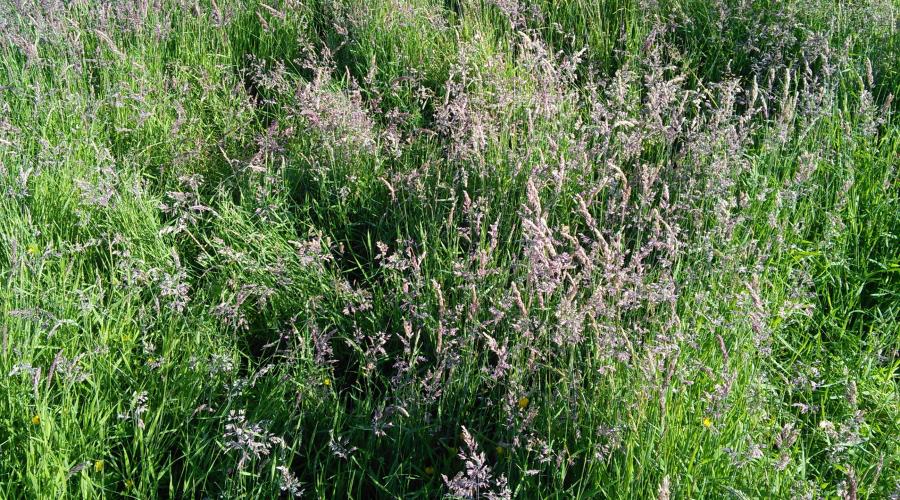
Yorkshire Fog (Holcus lanatus)

IUCN Category:
- Great Britain: Least Concern (indicated above)
- Europe: Least Concern
- Global: Least Concern

Genetic Health Status:
- Scottish Risk: Negligible (indicated above)
- UK Risk: Negligible
- Scottish Mitigation status: Not required
- UK Mitigation status: Not required
Background
Perennial tufted grass, mostly outcrossing with limited potential for vegetative spread (Bischoff et al., 2006) and persistent seed banks (Beddows, 1961). One of the commonest plants in the UK (Braithwaite et al., 2006). Used in seed mixtures for restoration and revegetation and for improving grazing in native swards (Beddows, 1961; Bischoff et al., 2006). Holcus lanatus comprises two varieties, both found throughout their ranges (Rich & Jermy, 1998).
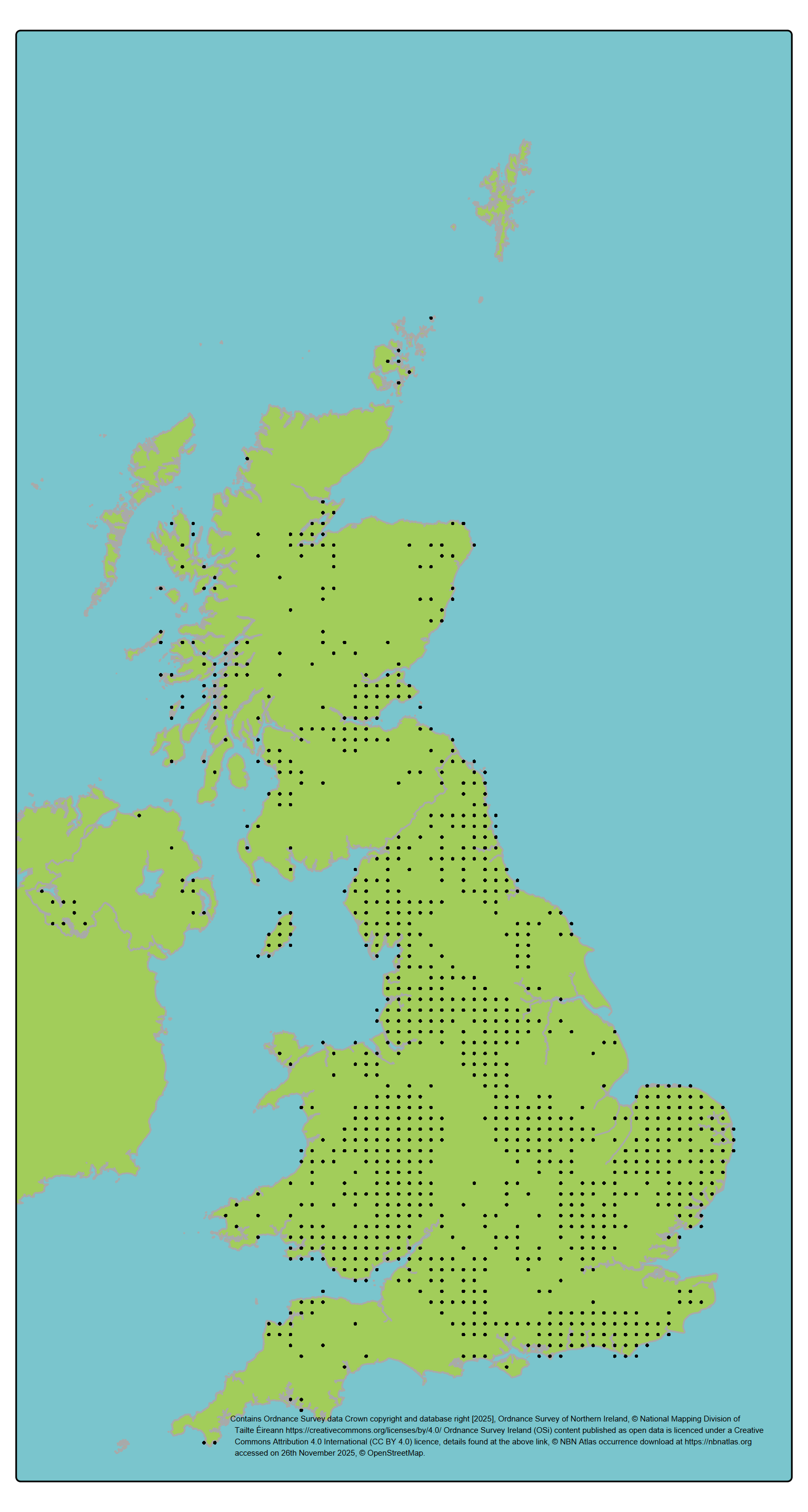
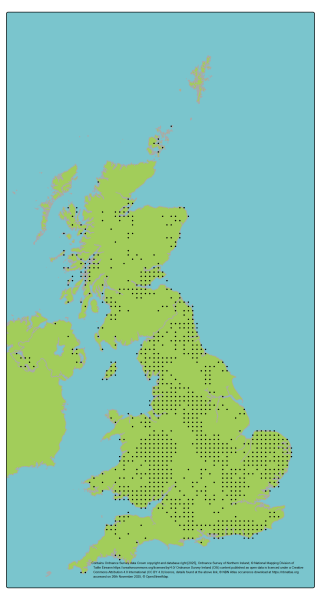
View a larger version of the distribution map for Yorkshire Fog.
Current Threats
Genetic swamping from introduction of non-native or non-local seed sources in restoration projects (Walker et al., 2004a).
Contribution of Scottish/UK population to total species diversity
Scottish and UK populations are likely to be among the most oceanic and may contain locally adapted genotypes.
Genetic risks
Diversity loss: population declines
No evidence of declines (Braithwaite et al., 2006), but rather of human-mediated propagation for restoration.
Global Biodiversity Framework Indicators
Population definitions:
Populations are defined based on management units. This species is widely and continuously distributed across UK in large numbers (Stroh et al., 2023; NBN, 2025). The four Great British Regions of Provenance (Hebert et al., 1999) were selected here to represent the major population groupings / management units (treating Northern Ireland as an additional region) as they broadly reflect the environmental variation across which the species is distributed and are likely to capture major patterns of genetic structure.
Ne500: The proportion of populations that have an effective population size of more than 500. Demographic (using the ratio Nc 5000 = Ne 500).
- Proportion of populations with Ne > 500 in Scotland = 2/2
- Proportion of populations with Ne > 500 in UK = 5/5
PM: Proportion of populations that existed in 2000 that still exist in 2025.
- Proportion of populations maintained in Scotland = 2/2
- Proportion of populations maintained in UK = 5/5
Diversity loss: functional variation
Functional variation
Functional variation is well characterized, but not apparently under threat: Evidence of local adaptation in seed collected from chalk vs mesotrophic grasslands (Bischoff et al., 2006); used as a model system for genetics of metal tolerance (e.g. Meharg et al., 1993; Rahman and Khan, 2023). A recent transcriptomic study comparing plants from contrasting habitats (acid bog and limestone quarry) from Northern Ireland found ecotypic differences and distinct microbiome responses (Young et al., 2018).
Divergent lineages
No direct evidence of losses; widespread evidence of local adaptation to extreme conditions, e.g. metalliferous soil and climate (Macel et al., 2007), with studies showing different levels of tolerance to acidic soils rich in aluminium (Chen et al., 2013) performed in the UK.
Hybridisation/Introgression
Holcus mollis is the tetraploid counterpart to diploid H. lanatus (Rich & Jermy, 1998). Some hybrids are known in the wild and can be produced by crossing (Beddows, 1961). Primary concern is hybridisation with non-local seed from restoration projects, but the species’ abundance limits the overall potential for negative impacts.
Low turnover - constraints on adaptive opportunities
Large populations, reproduction mostly by outcrossed seed and ability to re-establish on disturbed sites (e.g. Lowday et al., 1992) suggests no limits to adaptive opportunities. Studies suggest a loss of biomass production due to drought (Beierkuhnlein et al., 2011).
Cumulative Risk Summary
Overall Genetic Health Status
Scotland
- Risk: Negligible
- Mitigation: Negligible
Great Britain/UK
- Risk: Not required
- Mitigation: Not required
Overall Genetic Health status explanation
Though some potential risk from genetic swamping could be pinpointed in restoration projects using commercial seed, this species is able to colonize easily without seed additions (e.g. Lowday et al., 1992) and remains widespread and abundant.
In situ genetic threat level
In situ genetic threat level
- In situ Risk for Scotland: Negligible
- In situ Risk for UK: Negligible
Widespread and large populations reduce impacts of any existing pressures.
Confidence in in situ threat level
- Confidence score for Scotland: Medium
- Confidence score for UK: Medium
Assessment based on good demographic data supported by direct data on most aspects of species’ biology, cytotype distribution, and no major threats; however, no direct genetic data available.
Ex situ representation
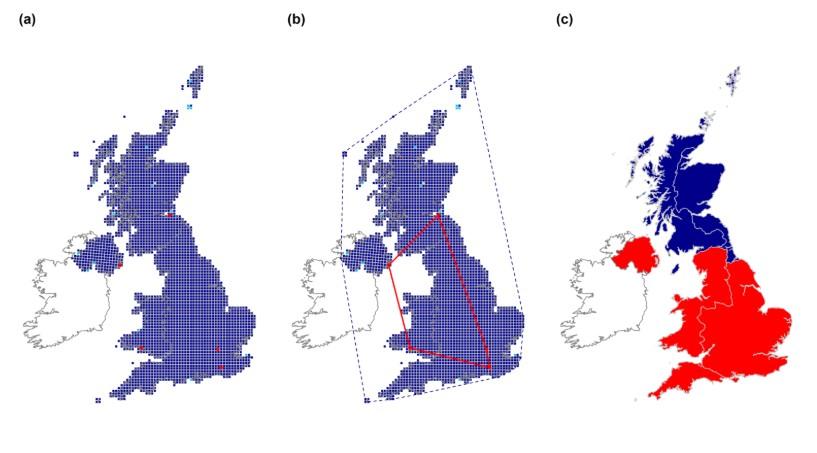
Seed collections in the Millenium Seed Bank (MSB) cover
Click for a full description
Dark blue = species distribution, red = represented in ex situ collection, light blue= pre 2000 records.
- (a) 6 of 2986 occupied 10-km squares (< 1%)
- (b) an EOO of 109,289 km² out of 585,383 km² occupied (19%)
- (c) 3 out of 5 Regions of Provenance (60%)
Current conservation actions
Recent consideration of policy shifts towards using local seed in restoration should help mitigate any potential risks from genetic swamping (De Vitis et al., 2017; Abbandonato et al., 2018) .
| Ex situ | Translocation | Habitat management | Legal protection of habitat or species | Regulation of exploitation | Control of INNS/pests/pathogens |
|---|---|---|---|---|---|
| X | - | X | - | - | - |
Population assessment/monitoring
Population
Demographic
N pops assessed/monitored in Scotland = 2/2
N pops assessed/monitored in UK = 5/5
Genetic
N pops assessed/monitored in Scotland = 0/2
N pops assessed/monitored in UK = 0/5
Further Research
Generation of whole genome sequencing data to given more direct insights into patterns of genetic diversity.
References
Beddows, A.R. (1961). Holcus lanatus L. Journal of Ecology, 49(2): 421-430.
Beierkuhnlein, C., Thiel, D., Jentsch, A., Willner, E. and Kreyling, J. (2011). Ecotypes of European grass species respond differently to warming and extreme drought. Journal of Ecology, 703-713.
Bischoff, A., Crémieux, L., Smilauerova, M., Lawson, C.S., Mortimer, S.R., Dolezal, J., Lanta, V., Edwards, A.R., Brook, A.J., Macel, M. and Leps, J.A.N. (2006). Detecting local adaptation in widespread grassland species–the importance of scale and local plant community. Journal of Ecology, 94(6): 1130-1142.
Braithwaite, M.E., Ellis, R.W. and Preston, C.D. (2006). Change in the British flora 1987-2004. Botanical Society of the British Isles.
Chen, Z. C., Yokosho, K., Kashino, M., Zhao, F.-J., Yamaji, N., & Ma, J. F. (2013). Adaptation to acidic soil is achieved by increased numbers of cis-acting elements regulating ALMT1 expression in Holcus lanatus. The Plant Journal, 76(1), 10-23
Herbert, R., Samuel, S. and Patterson, G. (1999). Using local stock for planting native trees and shrubs.
Lowday, J.E. and Marrs, R.H. (1992). Control of bracken and the restoration of heathland. III. Bracken litter disturbance and heathland restoration. Journal of Applied Ecology, 212-217.
Macel, M., Lawson, C.S., Mortimer, S.R., Šmilauerova, M., Bischoff, A., Crémieux, L., Doležal, J., Edwards, A.R., Lanta, V., Bezemer, T.M. and Van der Putten, W.H. (2007). Climate vs. soil factors in local adaptation of two common plant species. Ecology, 88(2): 424-433.
Meharg, A.A., Cumbes, Q.J. and Macnair, M.R. (1993). Pre-adaptation of Yorkshire fog, Holcus lanatus L. Evolution, 47(1): 313-316.
Rahman, I. M. M., & Khan, B. M. (2023). Physiological responses of wild grass Holcus lanatus L. to potentially toxic elements in soils: a review. Environmental Science and Pollution Research, 30, 54470-54482
Rich, T.C.G. & Jermy, A.C. eds (1998). Plant Crib 1998. Botanical Society of the British Isles, London.
Stroh, P.A., Walker, K.J., Humphrey, T.A., Pescott, O.L. and Burkmar, R.J. (2023). Plant atlas 2020: mapping changes in the distribution of the British and Irish Flora. Princeton University Press.
Walker, K.J., Hodder, K.H., Bullock, J.M. and Pywell, R.F. (2004). A review of the potential effects of seed sowing for habitat re-creation on the conservation of intraspecific biodiversity. Defra Contract BD1447.
Young, E., Carey, M., Meharg, A.A. and Meharg, C. (2018). Microbiome and ecotypic adaption of Holcus lanatus (L.) to extremes of its soil pH range, investigated through transcriptome sequencing. Microbiome, 6(1), 48
Websites:
Assessors:
- Rebecca Yahr, Royal Botanic Garden Edinburgh
- Alicia Mastretta, Yanes Royal Botanic Gardens Kew
Reviewers:
- Pete Hollingsworth, Royal Botanic Garden Edinburgh
- Aline Finger, Royal Botanic Garden Edinburgh