Genetic Scorecard Indicator - White-beaked dolphin
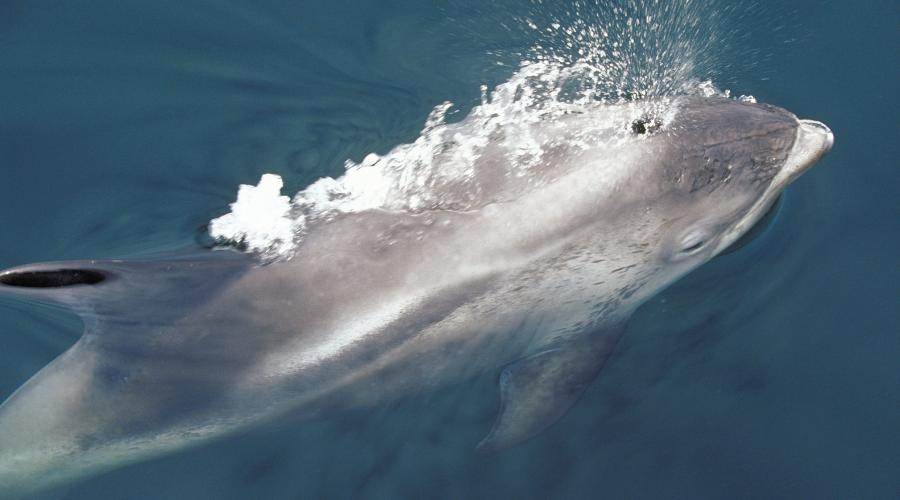
White-beaked dolphin (Lagenorhynchus albirostris)

IUCN Category:
- Great Britain: Not assessed (indicated above)
- Europe: Least concern
- Global: Least concern

Genetic Health Status:
- Scottish Risk: Moderate (indicated above)
- UK Risk: Moderate
- Scottish Mitigation status: Effective
- UK Mitigation status: Effective
Background
White-beaked dolphins (WBD) are cold-water obligates inhabiting continental shelf and slope waters of the cold temperate and subarctic North Atlantic. It is common in the Canadian Arctic, Greenland, Iceland, Barents Sea and parts of the North Sea, with range extending into adjacent UK and Irish waters (Kiszka & Braulik, 2018) .There has been an observed northward shift in UK distribution together with a decrease in strandings in the southern North Sea (IJsseldijk et al., 2020; Lambert et al., 2014) suggesting WBD habitat is being impacted by warming oceans although it is unclear whether this will result in a loss or gain of suitable habitat.
Diet varies regionally with gadoid fish, including Atlantic cod and whiting, being important in the eastern Atlantic. Some reports of WBD preying on squid (Fall & Skern-Mauritzen, 2014; Plint et al., 2023). WBD exhibit fluid fission-fusion social dynamics (Bertulli et al., 2021).
Genome-wide single-nucleotide polymorphisms (SNPs) have been catalogued from WBD (Fernández et al., 2016) and in conjunction with mitochondrial DNA from across the species’ NE Atlantic range showed evidence for broad- and fine-scale population structure, with UK and North Sea populations being distinct from other groups Gose et al., (2024) . This is largely consistent with previous studies using microsatellites and mitochondrial DNA control region in the eastern North Atlantic (Banguera-Hinestroza et al., 2010).
Current Threats
Threats include occasional entanglement in pelagic fisheries, consequences of high heavy metal and PCB burdens due to preference for upper trophic level prey (Williams et al., 2023) and warming seas are expected to drive WBD further north.
Like other delphinid species, seismic surveys, shipping and offshore energy development in North Atlantic shelf habitats could impact WBD (Fernandez-Betelu et al., 2021; Pirotta et al., 2013).
WBD has historically been hunted for subsistence in Greenland, Norway, Iceland and Canada, and increasing numbers have been targeted in recent years in Greenland and in the Grindadrap of the Faroe Islands, possibly reflecting a rise in local occurrence (Gose, 2024; Whaling.FO, 2024).
Contribution of Scottish/UK population to total species diversity
The Scottish populations are highly differentiation from Iceland, Barents Sea and Western North Atlantic populations. The East coast of Scotland acts as a link between North Sea and western Scotland and Ireland populations. Loss of Scottish populations would represent a reduction in species-wide genetic diversity as they contain unique genetic information not identified elsewhere.
Genetic risks
Diversity loss: population declines
Currently no evidence of recent loss of genetic diversity, and overall diversity levels appear to be intermediate compared to other toothed whales (Gose, 2024).
Global Biodiversity Framework Indicators
Population definitions:
Populations defined by geographic boundaries and genetic clusters. The species is continually distributed throughout the North Atlantic Ocean and within UK waters is considered a single management unit encompassing the Celtic and Greater North Seas (IAMMWG, 2023). Note however that recent genetic data suggest two distinct populations UK waters: a North Sea population and a western Scotland and Ireland population.
Ne500: The proportion of populations that have an effective population size of more than 500.
- Proportion of populations with Ne > 500 in Scotland = 2/2
- Proportion of populations with Ne > 500 in UK = 2/2
PM: Proportion of populations that existed in 2000 that still exist in 2025.
- Proportion of populations maintained in Scotland = 2/2
- Proportion of populations maintained in UK = 2/2
Diversity loss: functional variation
Functional variation
Currently no evidence for loss of functional variation however, genetically distinct UK populations may reflect underlying ecological differences. While the risk of population loss is likely low, any losses could result in the erosion of locally adaptive genetic variation.
Divergent lineages
UK populations are distinct from other parts of the species’ range and occur at the edge of its distribution. Although overall risk of lineage loss is probably low, any decline or local extinction could result in the loss of unique genetic diversity.
Hybridisation/Introgression
No evidence to date of interspecific hybridisation in WBD.
Low turnover - constraints on adaptive opportunities
WBD are long-lived (30+ years), reach sexual maturity in ~7–12 years), and a single calf is born every 2–3 years. Low reproductive output limits adaptive potential in rapidly changing environments.
Cumulative Risk Summary
Overall Genetic Health Status
Scotland
- Risk: Moderate
- Mitigation: Effective
Great Britain/UK
- Risk: Moderate
- Mitigation: Effective
Overall Genetic Health status explanation
Regional population structure and only moderate levels of genetic diversity, combined with Scottish populations lying at the edge of the species’ range, indicate a moderate level of genetic risk. Although mitigation is considered effective, the absence of targeted genetic monitoring and the species’ vulnerability to climate-driven change remain concerns.
In situ genetic threat level
In situ genetic threat level
- In situ Risk for Scotland: Moderate
- In situ Risk for UK: Moderate
Relatively widespread species but the presence of distinct genetic populations together with multiple threats create the potential for genetic diversity loss.
Confidence in in situ threat level
- Confidence score for Scotland: Medium
- Confidence score for UK: Medium
Assessment based on extensive genetic and genomic data from across the NE Atlantic.
Ex situ representation
There are no ex-situ populations in the UK.
Current conservation actions
In Scotland, the WBD is afforded legal protection through the Conservation (Natural Habitats, &c.) Regulations, which transposes the EU Habitats Directive into Scottish law. Annex IV of the Directive prohibits deliberate killing, capture or disturbance as well as the destruction of breeding or resting places.
WBD is recognised as a priority marine feature (PMF) in Scotland, meaning the species must be given special consideration in marine planning and decision making. This ensures that development and use of the marine environment do not have a significant effect on their national status.
Internationally, the species is covered under ASCOBANS, which commits parties to reduce bycatch, disturbance and other pressures on small cetaceans. WBD is also included in scientific assessments and monitoring under the North Atlantic Marine Mammal Commission (NAMMCO). Although WBD is not commonly traded, WBD is listed on CITES Appendix II, which regulates international trade in live animal parts or products to ensure that such trade is not detrimental to wild populations.
Defra and the Scottish Government fund national strandings schemes for cetaceans which aim to: collate, analyse and report data for all cetacean strandings around the coast of the UK; determine the causes of death (both natural and anthropogenic) in stranded cetaceans, including bycatch and physical trauma and; undertake surveillance on the incidence of disease in stranded cetaceans in order to identify any substantial new threats to their conservation status.
The UK has several voluntary wildlife watching guidelines/codes of conduct which are publicly available. However, while these are endorsed by the UK and national governments, there is no mandatory requirement for operators or individuals to adopt the guidelines.
The Scottish Biodiversity Strategy to 2024 provides an additional policy framework to protect WBD through reducing threats such as underwater noise, strengthening marine spatial planning and enhancing monitoring of marine species and habitats.
| Ex situ | Translocation | Habitat management | Legal protection of habitat or species | Regulation of exploitation | Control of INNS/pests/pathogens |
|---|---|---|---|---|---|
| - | - | X | X | X | - |
Population assessment/monitoring
Population
Demographic
NE Atlantic European waters are surveyed every six years through the international SCANS and Irish ObSERVE line transect surveys (e.g Gilles et al., 2023; Rogan et al., 2018).
N pops assessed/monitored in Scotland = 2/2
N pops assessed/monitored in UK = 2/2
Genetic
Genetic surveys of UK populations rely almost entirely on strandings collections, but no routine genetic monitoring takes place.
N pops assessed/monitored in Scotland = 0/2
N pops assessed/monitored in UK = 0/2
Further Research
- Whole-genome sequencing to understand demographic history and adaptive potential.
- Integration of genetic, ecological and stranding data to inform climate change vulnerability.
References
Addink, M., Hartmann, M. G., & Couperus, B. (1997). A note on life-history parameters of the Atlantic white-sided dolphin (Lagenorhynchus acutus) from animals bycaught in the Northeastern Atlantic. Reports of the International Whaling Commission, 47, 637–639.
Banguera-Hinestroza, E., Bjørge, A., Reid, R. J., Jepson, P., & Hoelzel, A. R. (2010). The influence of glacial epochs and habitat dependence on the diversity and phylogeography of a coastal dolphin species: Lagenorhynchus albirostris. Conservation Genetics, 11(5), 1823–1836.
Bertulli, C. G., Rasmussen, M. H., & Rosso, M. (2021). Fission-fusion dynamics of a pelagic delphinid in the arctic: The white-beaked dolphin (Lagenorhynchus albirostris). Integrative Zoology, 16(4), 512–526.
Fall, J., & Skern-Mauritzen, M. (2014). White-beaked dolphin distribution and association with prey in the Barents Sea. Marine Biology Research, 10(10), 957–971.
Fernández, R., Schubert, M., Vargas-Velázquez, A. M., Brownlow, A., Víkingsson, G. A., Siebert, U., Jensen, L. F., Øien, N., Wall, D., Rogan, E., Mikkelsen, B., Dabin, W., Alfarhan, A. H., Alquraishi, S. A., Al-Rasheid, K. a. S., Guillot, G., & Orlando, L. (2016). A genomewide catalogue of single nucleotide polymorphisms in white-beaked and Atlantic white-sided dolphins. Molecular Ecology Resources, 16(1), 266–276.
Fernandez-Betelu, O., Graham, I. M., Brookes, K. L., Cheney, B. J., Barton, T. R., & Thompson, P. M. (2021). Far-field effects of impulsive noise on coastal bottlenose dolphins. Frontiers in Marine Science, 8.
Galatius, A., Kinze, C. C., Olsen, M. T., Tougaard, J., Gotzek, D., & McGowen, M. R. (2025). Phylogenomic, morphological and acoustic data support a revised taxonomy of the lissodelphinine dolphin subfamily. Molecular Phylogenetics and Evolution, 205, 108299.
Gilles, A., Authier, M., Ramirez‐Martinez, N., Araújo, H., Blanchard, A., Carlström, J., Eira, C., Dorémus, G., Fernández‐Maldonado, C., Geelhoed, S., Kyhn, L., Laran, S., Nachtsheim, D., Panigada, S., Pigeault, R., Sequeira, M., Sveegaard, S., Taylor, N., Owen, K., … Hammond, P. (2023). Estimates of cetacean abundance in European Atlantic waters in summer 2022 from the SCANS‐IV aerial and shipboard surveys (p. 64)
Gose, M.-A. (2024). Connectivity, diversity, and demography of Lagenorhynchus dolphins of the North Atlantic [The University of Edinburgh].
Gose, M.-A., Humble, E., Brownlow, A., Wall, D., Rogan, E., Sigurðsson, G. M., Kiszka, J. J., Thøstesen, C. B., IJsseldijk, L. L., ten Doeschate, M., Davison, N. J., Øien, N., Deaville, R., Siebert, U., & Ogden, R. (2024). Population genomics of the white-beaked dolphin (Lagenorhynchus albirostris): Implications for conservation amid climate-driven range shifts. Heredity, 132(4), 192–201
IAMMWG. (2023). Review of Management Unit boundaries for cetaceans in UK waters (2023). JNCC Report 734, JNCC, Peterborough.
IJsseldijk, L. L., ten Doeschate, M. T. I., Brownlow, A., Davison, N. J., Deaville, R., Galatius, A., Gilles, A., Haelters, J., Jepson, P. D., Keijl, G. O., Kinze, C. Chr., Olsen, M. T., Siebert, U., Thøstesen, C. B., van den Broek, J., Gröne, A., & Heesterbeek, H. (2020). Spatiotemporal mortality and demographic trends in a small cetacean: Strandings to inform conservation management. Biological Conservation, 249, 108733.
Kiszka, J., & Braulik, G. (2018). Lagenorhynchus albirostris. The IUCN Red List of Threatened Species.
Lambert, E., Pierce, G. J., Hall, K., Brereton, T., Dunn, T. E., Wall, D., Jepson, P. D., Deaville, R., & MacLeod, C. D. (2014). Cetacean range and climate in the eastern North Atlantic: Future predictions and implications for conservation. Global Change Biology, 20(6), 1782–1793.
Pirotta, E., Laesser, B. E., Hardaker, A., Riddoch, N., Marcoux, M., & Lusseau, D. (2013). Dredging displaces bottlenose dolphins from an urbanised foraging patch. Marine Pollution Bulletin, 74(1), 396–402.
Plint, T., Ten Doeschate, M., Brownlow, A., Davison, N., Hantke, G., Kitchener, A., Longstaffe, F., McGill, R., Simon Nutbrown, C., & Magill, C. (2023). Stable isotope ecology and interspecific dietary overlap among dolphins in the Northeast Atlantic. Frontiers in Marine Science, 10.
Rogan, E., Breen, P., Mackey, M., Cañadas, M., Scheidat, M., Geelhoed, S., & Jessopp, M. (2018). Aerial surveys of cetaceans and seabirds in Irish waters: Occurrence, distribution and abundance in 2015-2017. Department of Communications, Climate Action & Environment.
Whaling.FO, 2024. Whales and whaling in the Faroe Islands. Catches 2020-2024.
Williams, R. S., Brownlow, A., Baillie, A., Barber, J. L., Barnett, J., Davison, N. J., Deaville, R., ten Doeschate, M., Murphy, S., Penrose, R., Perkins, M., Spiro, S., Williams, R., Jepson, P. D., Curnick, D. J., & Jobling, S. (2023). Spatiotemporal trends spanning three decades show toxic levels of chemical contaminants in marine mammals. Environmental Science & Technology, 57(49), 20736–20749.
Assessor: Emily Humble, University of Edinburgh
Reviewer: Eunice Pinn, NatureScot
Last updated: