Genetic Scorecard Indicator - Tangle
Tangle or Cuvie (Laminaria hyperborea)

IUCN Category:
- Great Britain: Not Assessed (indicated above)
- Europe: Not Assessed
- Global: Not Assessed

Genetic Health Status:
- Scottish Risk: Negligible (indicated above)
- UK Risk: Moderate
- Scottish Mitigation status: Effective
- UK Mitigation status: Not effective
Background
One of the largest brown algal kelp species in the UK. Restricted to the Northeast Atlantic, the species occurs from the Barents Sea down to the coasts of Portugal and Spain. In the UK, Laminaria hyperborea is found around all coastlines, though scarce in some areas of the southeast due to lack of habitat.
L. hyperborea grows on hard substrate (bedrock and large boulders) from extreme low water to depths of around 8 – 30 m, depending on light penetration. Populations from St Kilda have been reported from depths of up to 47 m (Tyler-Walters, 2007). It is thought to outcompete the closely related L. digitata at depths of 2 m below MLW. In general, L. hyperborea prefer exposed coastlines or strong tidal flows, and full salinity seawater.
L. hyperborea grow from microscopic sporophytes to stipe lengths of up to 3.5 m. Blades can grow a further 1 m or more in length. They are perennial, reaching full size and maturity at around 5 years, and can live for 10 to 20 years in good conditions. Blades are generally shed during autumn storms and regrow on an annual basis.
As with other large kelp species, L. hyperborea has two morphologically distinct reproductive phases. The large sporophyte kelp (diploid) releases flagellated spores which eventually settle and develop into male and female gametophyte (haploid) stages and become fertile. The male gametophyte releases sperm which fertilises the female gametophyte, leading to the development of the new sporophyte ‘plant’. Self-fertilisation is possible. Spore dispersal distances are uncertain but are generally thought to occur over distances of meters to 10s of kilometres.
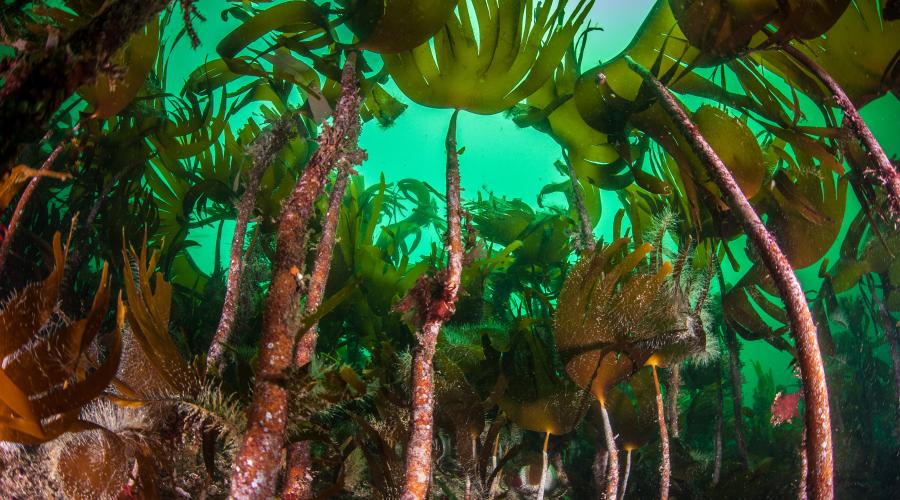
L. hyperborea is an important foundation habitat species in UK waters, forming dense ‘forests’ of adults and providing canopy effects which can provide biological and environmental shelter for other marine life (e.g. during marine heat waves). In contrast to the smooth stipe of L. digitata, L. hyperborea have thick, rough surfaced stipes, which support a wealth of epiphytic macrophytes (most notably Palmaria) and associated communities. The blades and holdfast also provide important habitats for specific communities. Modelled estimates of L. hyperborea abundance and distribution suggest a potential area coverage of over 3700 km2 of abundant L. hyperborea, and a total biomass estimate of around 19 M tonnes in Scotland (Burrows et al., 2018).
L. hyperborea has been the target of commercial harvesting for alginate production in the near past, with over 20,000 tons per year processed during the heyday of the 1960’s and 1970’s (Kenicer et al., 2000). Recent efforts to re-open wild harvest operations were challenged by local communities and environmental groups and plans were abandoned (Greenhill et al., 2017).
Current Threats
Trailing edge populations in Spain and France are at risk of climate (temperature) driven range shifts. Populations in Norway have suffered severe losses through eutrophication and climate driven community shifts (Assis et al., 2018; Filbee-Dexter et al., 2020).
In the UK, Laminaria habitat and population densities in the English Channel and up the east coast are thought to have decreased through fishing activities (dredging), coastal darkening, and pollution from historic and contemporary mining and industry waste disposal (Yesson et al., 2015, Forster et al., 2024).
Scottish populations (on the west coast) have been reported as healthy and stable over decadal periods and are not predicted to be adversely affected by warming sea temperatures in the near future (Smale et al. 2025). Distribution and abundance of Southern England populations have been impacted by warming and are predicted to be affected further by extreme temperature events in the future (Smale et al. 2025). Habitat distribution models suggest that under worst-case scenario warming, L. hyperborea will be lost from the south of the UK by 2100 (Assis et al., 2018).
Contribution of Scottish/UK population to total species diversity
Likely significant population genetic studies on L. hyperborea from western Ireland have shown relatively high genetic diversity and structuring over regional scales (Schoenrock et al., 2020). Similar structuring is likely in Scotland as phylogeographic studies in the closely related L. digitata have highlighted Ireland and the West Coast of Scotland as potential hotspots for genetic diversity, possibly associated with historic glacial refugia in the region (Neiva et al., 2020, Reynes et al., 2024).
Genetic risks
Diversity loss: population declines
There is no direct evidence of population decline in Scotland, though indications from northeast England might suggest that southeast Scotland may have had larger populations of Laminaria in the recent past, extending to greater depths (Forster et al., 2025). There is little risk of diversity loss in Scotland through population changes in the near future. At a UK level, populations in the English Channel are at risk from extreme temperature events, but populations are likely to persist to some degree for the near future.
Global Biodiversity Framework Indicators
Population definitions:
Populations are defined by geographic boundaries. Near-continuous distributions of L. hyperborea around the Scottish coastline, and effective short to mid-distance dispersal capabilities (<10s km), indicate the potential for a continuous population. However, there is insufficient data meaningfully assess effective population size.
Ne500: The proportion of populations that have an effective population size of more than 500.
- Proportion of populations with Ne > 500 in Scotland = not assessed
- Proportion of populations with Ne > 500 in GB = not assessed
PM: Proportion of populations that existed in 2000 that still exist in 2025.
- Proportion of populations maintained in Scotland = 1/1
- Proportion of populations maintained in GB = 1/1
Diversity loss: functional variation
Functional variation
There is no evidence of loss of functional variation at present and the immediate risk is small in Scotland. Marine heatwaves do present a risk to functional diversity in the near future, especially for southern UK populations facing increased extreme heat events, and cold-adapted northerly populations (Straub et al., 2019; Teagle & Smale, 2018).
Divergent lineages
No evidence of isolated population loss or decline in specific populations or lineages. Southern populations, and isolated populations may be more at risk of marine heatwave events and community shifts leading to overgrazing (e.g. urchin barrens) in the future.
Hybridisation/ Introgression
There are no known cases of natural hybridization between L. hyperborea and other Laminaria species in the UK (L. digitata and L. ochroleuca), despite their proximity and ecological similarity.
Low turnover - constraints on adaptive opportunities
Dispersal range remains uncertain but is thought to be in the range of meters to 10s of kilometres. Generation times are slow for an algal species (5 years to maturity, up to 20 years persistence), and new sporophytes require clear space to grow up to canopy height, meaning generational turnover, and potentially adaptation in L. hyperborea, will be slower than other kelp species.
Across their European distribution, L. digitata have been shown to exhibit strong local adaptation to thermal conditions (Liesner et al. 2021), suggesting a similar level of local adaptation could be present in L. hyperborea.
Cumulative Risk Summary
Overall Genetic Health Status
Scotland
- Risk: Negligible
- Mitigation: Effective (PMF designation)
Great Britain/UK
- Risk: Moderate
- Mitigation: Not effective (vs predicted temperature range shifts)
Overall Genetic Health status explanation
Widespread distribution around the UK. Likely strong population structuring from localised dispersal limitations and historic refugial processes.
In Scotland, populations are currently healthy and not predicted to be affected by warming in near future.
However predicted loss of populations in the Channel/south UK from temperature increases may result in loss of genetic diversity at a UK-wide level, and critically, of warm-acclimated populations in the south of the UK.
Additional threats from community shifts, for instance the development of urchin barrens, are hard to predict or mitigate.
In situ genetic threat level
In situ genetic threat level
- In situ Risk for Scotland: Negligible
- In situ Risk for GB: Moderate
Large populations, mid-distribution range (Scotland), predicted range loss in south of UK by 2100, some potential for adaption.
Confidence in in situ threat level
- Confidence score for Scotland: Medium
- Confidence score for Great Britain: Medium
Assessment based on genetic data for wider Laminaria genus from UK and EU populations. No direct data from UK L. hyperborea. Well characterised biology, and well-defined population trends.
Ex situ representation
Possibly some representation in cultivation strain banks, but no clear cases of L. hyperborea biobanking in the UK. L. digitata is more commonly explored for cultivation purposes (SAMS, 2025).
Current conservation actions
L. hyperborea stands are designated as a Priority Marine Feature in Scottish waters, which means that National Marine Plan General Policy GEN 9b applies. This ensures that development and use of the marine environment do not have a significant effect on their national status.
Laminaria populations are likely to benefit from the wider effects of MPA designations. The Scottish Biodiversity Strategy to 2045, the Scottish Biodiversity Duty and UK Marine Strategy Good Environmental Status provide further drivers to ensure biological diversity is restored, and ecosystems are safeguarded.
At least two projects in England are looking at active restoration approaches, including seeding techniques (Forster et al., 2024, Wilding et al., 2022).
| Ex situ | Translocation | Habitat management | Legal protection of habitat or species | Control of INNS/pests/pathogens |
|---|---|---|---|---|
| - | - | X | X | - |
Population assessment/monitoring
Population
Demographic
- N pops assessed/monitored in Scotland =0/1.
- N pops assessed/monitored in UK = 0/1.
No routine monitoring of population dynamics of L. hyperborea exists in Scotland or the UK. Ad-hoc monitoring of population dynamics by research groups (Smale et al., 2025), and population modelling approaches (Szewczyk et al., 2024)
Genetic
- N pops assessed/monitored in Scotland = 0/1
- N pops assessed/monitored in GB = 0/1
No routine monitoring of population genetics exists for L. hyperborea populations in Scotland or the UK.
Further Research
- Baseline genetic diversity of UK L. hyperborea, a critical marine habitat forming foundation species
- Development of species-specific microsatellites for population structure analysis
- Improved understanding of local adaptation and environmental (temperature) tolerance in L. hyperborea populations
- Improved understanding of community shifts, their environmental drivers, and threats from eg. urchin barrens on UK L. hyperborea forests
- Development of effective habitat recovery and restoration techniques for UK kelp forests
- Development of mitigation techniques to address predicted range shifts in L. hyperborea from warming and extreme temperature events
References
Assis, J., Serrao, E.A. & Araujo, M.B. (2018). Projected climate changes threaten ancient refugia of kelp forests in the North Atlantic. Global Change Biology, 24.
Burrows, M., Fox, C., Moore, P., Smale, D., Greenhill, L. and Martino, S. (2018). Wild seaweed harvesting as a diversification opportunity for fishermen.
Evankow, A., Christie, H., Hancke, K., Brysting, A.K., Junge, C., Fredriksen, S. and Thaulow, J. (2019). Genetic heterogeneity of two bioeconomically important kelp species along the Norwegian coast. Conservation Genetics, 20(3): 615-628.
Filbee-Dexter, K., Wernberg, T., Grace, S.P., Thormar, J., Fredriksen, S., Narvaez, C.N., Feehan, C.J. and Norderhaug, K.M. (2020) Marine heatwaves and the collapse of marginal North Atlantic kelp forests. Scientific Reports, 10, p.13388.
Fouqueau, L., Reynes, L., Tempera, F., Bajjouk, T., Blanfuné, A., Chevalier, C., Laurans, M., Mauger, S., Sourisseau, M., Assis, J. and Lévêque, L. (2024). Seascape genetic study on Laminaria digitata underscores the critical role of sampling schemes. Marine Ecology Progress Series, 740: 23-42.
Forster, RM et al (2025) The Great Yorkshire Kelp Project. An HML report to YMNP. Report No. HML_kelp_final_2025; June 2025.
Greenhill, L., Sundnes, F. and Karlsson, M. (2021). Towards sustainable management of kelp forests: An analysis of adaptive governance in developing regimes for wild kelp harvesting in Scotland and Norway. Ocean & Coastal Management, 212: 105816.
Kenicer, G., Bridgewater, S. and Milliken, W. (2000). The ebb and flow of Scottish seaweed use. Botanical Journal of Scotland, 52(2): 119-148.
King, N.G., McKeown, N.J., Smale, D.A., Bradbury, S., Stamp, T., Jüterbock, A., Egilsdóttir, H., Groves, E.A. and Moore, P.J. (2020). Hierarchical genetic structuring in the cool boreal kelp, Laminaria digitata: implications for conservation and management. ICES Journal of Marine Science, 77(5): 1906-1913.
Liesner, D., Fouqueau, L., Valero, M., Roleda, M.Y., Pearson, G.A., Bischof, K., Valentin, K. and Bartsch, I. (2020). Heat stress responses and population genetics of the kelp Laminaria digitata (Phaeophyceae) across latitudes reveal differentiation among North Atlantic populations. Ecology and Evolution, 10(17): 9144-9177.
Neiva, J., Serrão, E.A., Paulino, C., Gouveia, L., Want, A., Tamigneaux, É., Ballenghien, M., Mauger, S., Fouqueau, L., Engel-Gautier, C. and Destombe, C. (2020). Genetic structure of amphi-Atlantic Laminaria digitata (Laminariales, Phaeophyceae) reveals a unique range-edge gene pool and suggests post-glacial colonization of the NW Atlantic. European Journal of Phycology, 55(4): 517-528.
Reynes, L., Fouqueau, L., Aurelle, D., Mauger, S., Destombe, C. and Valero, M. (2024). Temporal genomics help in deciphering neutral and adaptive patterns in the contemporary evolution of kelp populations. Journal of evolutionary biology, 37(6): 677-692.
Robuchon, M., Le Gall, L., Mauger, S. and Valero, M. (2014). Contrasting genetic diversity patterns in two sister kelp species co‐distributed along the coast of Brittany, France. Molecular Ecology, 23(11): 2669-2685.
SAMS, 2025 – Seaweed nursery
Schoenrock, K.M., O’Connor, A.M., Mauger, S., Valero, M., Neiva, J., Serrao, E.A. and Krueger-Hadfield, S.A. (2020). Genetic diversity of a marine foundation species, Laminaria hyperborea (Gunnerus) Foslie, along the coast of Ireland. European Journal of Phycology, 55(3): 310-326.
Schoenrock, K., Krueger-Hadfield, S., Chan, K., O’Callaghan, R., O’Callaghan, T., Golden, A. and Power, A.M. (2022). The Diversity and Resilience of Kelp Ecosystems in Ireland.
Smale, D.A., King, N., Pessarrodona, A., Burrows, M.T. and Moore, P.J. (2025). Intra‐and Inter‐Decadal Scale Variability in Kelp Population Structure Reveal Both Stability and Decline in a Critical Foundation Species. Diversity and Distributions, 31(6): 70042.
Straub, S.C. et al., 2019. Resistance , Extinction , and Everything in Between – The Diverse Responses of Seaweeds to Marine Heatwaves. Frontiers in Marine Science, 6 (December): 1–13.
Szewczyk, T.M., Moore, P.J., Smale, D.A., Adams, T. and Burrows, M.T. (2024). Mechanistic simulations of kelp populations in a dynamic landscape of light, temperature, and winter storms. Ecological Modelling, 488: 110590.
Teagle, H. & Smale, D.A. (2018). Climate-driven substitution of habitat-forming species leads to reduced biodiversity within a temperate marine community. Diversity and Distributions, 24(October 2017):1367–1380.
Tyler-Walters, H. (2007). Laminaria hyperborea. Tangle or cuvie.
Wilding, C.M., Earp, H.S., Cooper, C.N., Lubelski, A. and Smale, D.A. (2022). British Kelp Forest Restoration: Feasibility Report. Natural England.
Yesson, C., Bush, L.E., Davies, A.J., Maggs, C.A. and Brodie, J. (2015). Large brown seaweeds of the British Isles: evidence of changes in abundance over four decades. Estuarine, coastal and shelf science, 155: 167-175.
Assessor: Alex Thomson, Seawilding
Reviewer: Jack Burton, Queens University Belfast