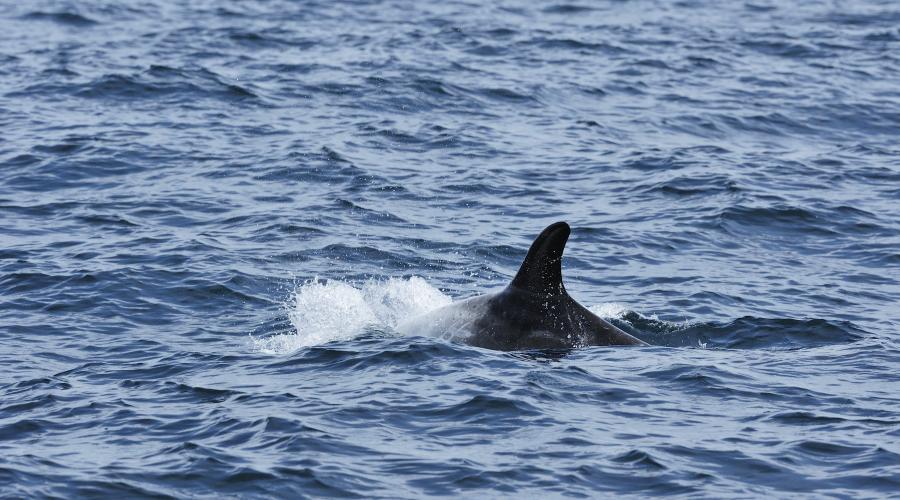
Genetic Scorecard Indicator - Risso's Dolphin
Risso's Dolphin (Grampus griseus)

IUCN Category:
- Great Britain: Not Assessed (indicated above)
- Europe: Least Concern
- Global: Least Concern

Genetic Health Status:
- Scottish Risk: Moderate (indicated above)
- UK Risk: Moderate
- Scottish Mitigation status: Effective
- UK Mitigation status: Effective
Background
Risso’s dolphins are widely distributed across temperate and tropical oceans, typically inhabiting deep offshore waters along continental slopes (Kiszka & Braulik, 2018). In UK waters, they are associated with the continental shelf and shelf edge, with the highest concentrations recorded around Scotland, particularly the Outer Hebrides, and around the Isle of Man (Hodgins et al., 2024). Population trends are poorly understood due to the species’ elusive behaviour. Its predicted core range is thought to have remained stable since 2013 (Paxton et al., 2016). However, more regular sightings in the northern extent of its range most likely due to a northward shift in their prey species (Evans & Bjørge, 2013). Risso’s dolphins feed on benthic and pelagic species of squid, octopus and cuttlefish (Bloch, 2012). They form pods of various sizes and exhibit stratified social organisation based on age and sex classes (Hartman et al., 2008).
Strong genetic differentiation at mitochondrial DNA occurs between North Pacific and North Atlantic populations (Chen et al., 2018), and UK populations appear differentiated from Mediterranean populations, with lower genetic diversity in the UK population, based on microsatellite and mitochondrial DNA (Gaspari et al., (2007).
Current Threats
Current threats to Risso’s dolphins include climate-driven prey shifts may shift their distributional range into more northerly waters (Evans & Bjørge, 2013), exposure to contaminants and heavy metals (e.g. PCBs, mercury) is likely although little is known about their impact in the North Atlantic (Shoham-Frider et al., 2002), and underwater noise disturbance from shipping, seismic surveys, pilling and naval exercises (Carlucci et al., 2024). The threat from bycatch and incidental capture in fishing gear is generally low in the Northwest Atlantic although Risso’s dolphins are reported to have been caught in pelagic longline fisheries that use squid as bait (Kiszka et al., 2009; Kiszka & Braulik, 2018).
Contribution of Scottish/UK population to total species diversity
Genetic evidence indicates that Scottish animals are differentiated from those in the Mediterranean and North Pacific and therefore they represent a unique contribution to total species diversity.
Genetic risks
Diversity loss: population declines
There is currently no evidence for genetic diversity loss; however limited data on population genetics and dynamics makes risk assessment difficult. Evidence of population declines elsewhere in the range further highlights the need for improved genetic monitoring.
Global Biodiversity Framework Indicators
Population definitions:
Populations defined by geographic boundaries. Species is continually distributed throughout tropical and temperate waters in the Atlantic, Pacific, and Indian Oceans.
Within UK waters, Risso’s dolphins are considered a single management unit encompassing the Celtic and Greater North Seas (IAMMWG, 2023).
Scotland/UK/Great Britain estimated census population size for Scotland and the UK: 9076 (95% CI: 3389–24307, Gilles et al., 2023).
Ne500: The proportion of populations that have an effective population size of more than 500.
- Proportion of populations with Ne > 500 in Scotland = 1/1
- Proportion of populations with Ne > 500 in UK = 1/1
PM: Proportion of populations that existed in 2000 that still exist in 2025.
- Proportion of populations maintained in Scotland = 1/1
- Proportion of populations maintained in UK = 1/1
Diversity loss: functional variation
Functional variation
No direct evidence exists for the erosion of functional genetic variation. As a cephalopod specialist, they may be functionally vulnerable to changes in prey availability, particularly shifts in squid distribution and abundance driven by climate change. However, their broad habitat range and evidence of dietary flexibility will likely buffer against loss of functional variation.
Divergent lineages
There is no evidence of divergent lineages within the Northeast Atlantic portion of the range based on the limited UK sampling to date. However, UK animals are significantly differentiated from the Mediterranean population (mitochondrial DNA and microsatellites), and the UK group is genetically less diverse, indicating regionally distinct units at the basin scale. Broader range-wide assessment is required to fully assess risk.
Hybridisation/Introgression
There have been several reported sightings of Bottlenose dolphin (Tursops) x Risso’s dolphin hybridisation in the wild (Fraser, 1938; Hodgins et al., 2014; van Geel et al., 2022).
Low turnover - constraints on adaptive opportunities
Late maturity (~8–10 years), single calf births and long gestation (13–14 months) mean slower generational turnover and potential constraints under rapid environmental change.
Cumulative Risk Summary
Overall Genetic Health Status
Scotland
- Risk: Moderate
- Mitigation: Effective
Great Britain/UK
- Risk: Moderate
- Mitigation: Effective
Overall Genetic Health status explanation
Evidence of genetic differentiation between the UK and Mediterranean populations, combined with lower genetic diversity in UK animals, indicates some level of genetic risk. This risk is compounded by the absence of targeted monitoring and the limited overall understanding of the species’ population dynamics in UK waters.
In situ genetic threat level
In situ genetic threat level
- In situ Risk for Scotland: Moderate
- In situ Riskfor UK: Moderate
Low comparative genetic diversity and population genetic structure within the NE Atlantic.
Confidence in in situ threat level
- Confidence score for Scotland: Low
- Confidence score for UK: Low
Assessment based on limited genetic and data from patchy locations across the NE Atlantic.
Ex situ representation
There are no ex-situ populations in the UK, but they do exist in captivity in other parts of the world.
Current conservation actions
In Scotland, Risso’s dolphins are legally protected through the Conservation (Natural Habitats, &c.) Regulations, which transposes the EU Habitats Directive into Scottish law. Annex IV of the Directive prohibits deliberate killing, capture or disturbance as well as the destruction of breeding or resting places.
Additional measures are implemented under the Marine (Scotland) Act 2010, which enables the designation of Marine Protected Areas (MPAs) and regulation of marine activities to safeguard cetaceans. Risso’s dolphin are a designated feature of the North‐east Lewis Nature Conservation MPA. Risso’s dolphins are also recognised as a priority marine feature (PMF) in Scotland, meaning the species must be given special consideration in marine planning and decision making. This ensures that development and use of the marine environment do not have a significant effect on their national status.
The UK has several voluntary wildlife watching guidelines/codes of conduct which are publicly available. However, while these are endorsed by the UK and national governments, there is no mandatory requirement for operators or individuals to adopt the guidelines.
Internationally, the species is covered under ASCOBANS, which commits Parties to reduce bycatch, disturbance and other pressures on small cetaceans. Risso’s dolphins are also included in scientific assessments and monitoring under the North Atlantic Marine Mammal Commission (NAMMCO). Finally, although Risso’s are not commonly traded they are listed on CITES Appendix II, which regulates international trade in live animal parts or products to ensure that such trade is not detrimental to wild populations.
Defra and the Scottish Government fund national strandings schemes for cetaceans which aim to: collate, analyse and report data for all cetacean strandings around the coast of the UK; determine the causes of death (both natural and anthropogenic) in stranded cetaceans, including bycatch and physical trauma and; undertake surveillance on the incidence of disease in stranded cetaceans in order to identify any substantial new threats to their conservation status.
The Scottish Biodiversity Strategy to 2024 provides an additional policy framework to protect Risso’s through reducing threats such as underwater noise, strengthening marine spatial planning and enhancing monitoring of marine species and habitats.
| Ex situ | Translocation | Habitat management | Legal protection of habitat or species | Regulation of exploitation | Control of INNS/pests/pathogens |
|---|---|---|---|---|---|
| - | - | X | X | X | - |
Population assessment/monitoring
Population
Demographic
NE Atlantic European waters are surveyed every six years through the international SCANS and Irish ObSERVE line transect surveys (e.g., Gilles et al., 2023; Rogan et al., 2018).
N pops assessed/monitored in Scotland = 1/1
N pops assessed/monitored in UK = 1/1
Genetic
Genetic surveys of UK cetacean populations rely almost entirely on strandings collections, but no routine genetic monitoring takes place.
N pops assessed/monitored in Scotland = 0/1
N pops assessed/monitored in UK = 0/1
Further Research
- Comprehensive assessment of population structure and genetic diversity across the Atlantic.
- Integration of genetic, ecological and stranding data to inform climate change vulnerability.
References
Bloch, D. (2012). Life History of Risso’s Dolphin (Grampus griseus) (G. Cuvier, 1812) in the Faroe Islands. Aquatic Mammals, 38(3), 250–266
Carlucci, R., Cipriano, G., Bonato, M., Buscaino, G., Crugliano, R., Fanizza, C., Gatto, S., Maglietta, R., Papetti, C., Pelagatti, M., Ricci, P., Santacesaria, F. C., & Papale, E. (2024). Anthropogenic noise effects on Risso’s dolphin vocalizations in the Gulf of Taranto (Northern Ionian sea, central Mediterranean sea). Ocean & Coastal Management, 254, 107177
Chen, I., Nishida, S., Chou, L.-S., Tajima, Y., Yang, W.-C., Isobe, T., Yamada, T. K., Hartman, K., & Hoelzel, A. R. (2018). Concordance between genetic diversity and marine biogeography in a highly mobile marine mammal, the Risso’s dolphin. Journal of Biogeography, 45(9), 2092–2103
Evans, P. G. H., & Bjørge, A. (2013). Impacts of climate change on marine mammals [Pdf]. MCCIP Science Review 2013, 15 pages
Fraser, F. C. (1938). Three anomalous dolphins from Blacksod Bay, Ireland. Proceedings of the Royal Irish Academy. Section B: Biological, Geological, and Chemical Science, 45, 413–455.
Gaspari, S., Airoldi, S., & Hoelzel, A. R. (2007). Risso’s dolphins (Grampus griseus) in UK waters are differentiated from a population in the Mediterranean Sea and genetically less diverse. Conservation Genetics, 8(3), 727–732
Gilles, A., Authier, M., Ramirez‐Martinez, N., Araújo, H., Blanchard, A., Carlström, J., Eira, C., Dorémus, G., Fernández‐Maldonado, C., Geelhoed, S., Kyhn, L., Laran, S., Nachtsheim, D., Panigada, S., Pigeault, R., Sequeira, M., Sveegaard, S., Taylor, N., Owen, K., … Hammond, P. (2023). Estimates of cetacean abundance in European Atlantic waters in summer 2022 from the SCANS‐IV aerial and shipboard surveys (p. 64)
Hartman, K. L., Visser, F., & Hendriks, A. J. E. (2008). Social structure of Risso’s dolphins (Grampus griseus) at the Azores: A stratified community based on highly associated social units. Canadian Journal of Zoology, 86(4), 294–306
Hodgins, N. K., Dolman, S. J., & Weir, C. R. (2014). Potential hybridism between free-ranging Risso’s dolphins (Grampus griseus) and bottlenose dolphins (Tursiops truncatus) off north-east Lewis (Hebrides, UK). Marine Biodiversity Records, 7, e97
Hodgins, N. K., Steel, E. M., Dyke, K., Walters, A. E. M., Dolman, S. J., Hall, K., Neave-Webb, E., Evans, P. G. H., Bird, C., Robinson, K. P., Marwood, E. M., Foubister, R., Harrop, H., Knight, A., & Munro, K. (2024). Using citizen science to better understand Risso’s dolphin (Grampus griseus) presence in northeast Scotland and the Northern Isles. Frontiers in Conservation Science, 5.
IAMMWG. (2023). Review of Management Unit boundaries for cetaceans in UK waters (2023). JNCC Report 734, JNCC, Peterborough
Kiszka, J., & Braulik, G. (2018). Grampus griseus. The IUCN Red List of Threatened Species
Kiszka, J., Muir, C., Poonian, C., Cox, T., Amir, O., Bourjea, J., Razafindrakoto, Y., Nina, W., & Bristol, N. (2009). Marine mammal bycatch in the Southwest Indian Ocean: Review and need for a comprehensive status assessment. Western Indian Ocean J. Mar. Sci, 7, 119–136.
MacLeod, C. D. (1998). Intraspecific scarring in odontocete cetaceans: An indicator of male ‘quality’ in aggressive social interactions? Journal of Zoology, 244(1), 71–77
Paxton, C., Scott-Hayward, L., Mackenzie, M., Rexstad, E., & Thomas, L. (2016). Revised Phase III Data Analysis of Joint Cetacean Protocol Data Resources with Advisory Note (No. JNCC Report 517). JNCC
Rogan, E., Breen, P., Mackey, M., Cañadas, M., Scheidat, M., Geelhoed, S., & Jessopp, M. (2018). Aerial surveys of cetaceans and seabirds in Irish waters: Occurrence, distribution and abundance in 2015-2017. Department of Communications, Climate Action & Environment.
Shoham-Frider, E., Amiel, S., Roditi-Elasar, M., & Kress, N. (2002). Risso’s dolphin (Grampus griseus) stranding on the coast of Israel (eastern Mediterranean). Autopsy results and trace metal concentrations. Science of The Total Environment, 295(1), 157–166
van Geel, N., Marr, T., Hastie, G., & Wilson, B. (2022). First reported observation of an apparent reproductive bottlenose × Risso’s dolphin hybrid. Aquatic Conservation: Marine and Freshwater Ecosystems, 32(10), 1710–1716
Assessor: Emily Humble, University of Edinburgh
Reviewer: Eunice Pinn, NatureScot