Genetic Scorecard Indicator - Pollack
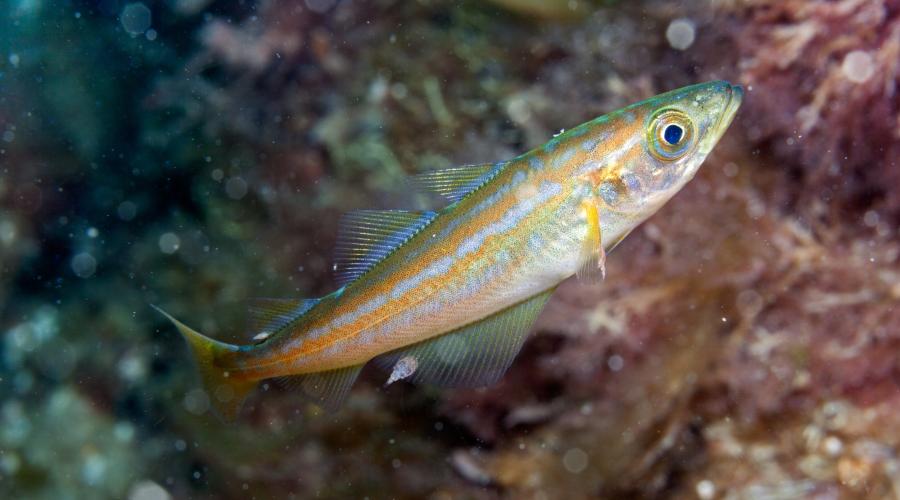
Pollack (Pollachius pollachius)

IUCN Category:
- Great Britain: Least Concern (indicated above)
- Europe: Least Concern
- Global: Least Concern

Genetic Health Status:
- Scottish Risk: Moderate (indicated above)
- UK Risk: Moderate
- Scottish Mitigation status: Partially Effective
- UK Mitigation status: Partially Effective
Background
The species has a wide distribution and is found throughout the Northeast Atlantic. It occurs from Iceland and Norway to the Bay of Biscay (Cook et al., 2014). Pollack (a member of the cod family) is commonly found in UK waters around rocky areas, kelp beds and wrecks (Rowley, 2008). Juvenile pollack are coastal, while adults are found further offshore at depths between 40 and 100 m (Pawson, 1995). There is limited understanding of the population size, although significant declines in landings have been recorded leading to concerns about overexploitation (ICES, 2024).
Charrier et al. (2006) found a very low but significant genetic differentiation between pollack from the southern Bay of Biscay, the western Channel, and the northern North Sea. The authors, however, recognised further work was required due to the low sample size. The stock definition of pollack in the Northeast Atlantic remains unresolved (Gonse et al., 2025).
A previous study by Charrier et al. (2006) using six microsatellite loci showed an overall weak genetic structure for the species, indicating high levels of gene flow. This may be due to significant levels of larval dispersal through passive drift with oceanic currents. The UK was therefore treated as one continuous population although the ICES advisory framework developed three stock populations which they admitted does not represent biologically meaningful units (see link to the genetic fact sheet for pollack and the NBN atlas map).
Current Threats
The greatest threat to pollack is over-exploitation, including recreational fisheries which account for up to 43% of removals in the English Channel and Celtic Sea (Cook et al., 2014; Radford et al., 2018; ICES, 2024). Other potential threats include habitat degradation through the impacts of demersal trawling (Eigaard et al., 2016) and climate change. Although the specific impact of climate change on pollack is not well understood, water temperature contributes to variability in recruitment and growth, which can impact the recovery of exploited stocks (Suquet et al., 2005; Person-Le Ruyet et al., 2006).
Contribution of Scottish/UK population to total species diversity
Information is currently lacking regarding whether populations in the UK and Scotland are differentiated from other European populations. However, it is unlikely that populations from the UK/Scotland are differentiated and hence do not represent an internationally important population.
Genetic risks
Diversity loss: population declines
The current declining population in the UK (especially the Celtic Sea and English Channel where a 72% decline in commercial landings have been observed over the last 20 years) suggests there is a likelihood of diversity loss (ICES, 2023; Williams, 2023).
Global Biodiversity Framework Indicators
Population definitions:
The population is defined based on geographic boundaries.
Ne500: The proportion of populations that have an effective population size of more than 500.
- Proportion of populations with Ne > 500 in Scotland = 1/1
- Proportion of populations with Ne > 500 in UK = 1/1
PM: Proportion of populations that existed in 2000 that still exist in 2025.
- Proportion of populations maintained in Scotland = 1/1
- Proportion of populations maintained in UK = 1/1
Diversity loss: functional variation
Functional variation
No evidence of risks to loss of functional variation.
Divergent lineages
No evidence of divergent lineages or loss.
Hybridisation/Introgression
No evidence of hybridisation/introgression.
Low turnover - constraints on adaptive opportunities
No evidence of constraints on adaptive opportunities. Even though a decline in spawning stock biomass has been observed, the population is still large (> 5,000 individuals). The measures introduced appear to be effectively rebuilding the stocks (ICES, 2025a).
Cumulative Risk Summary
Overall Genetic Health Status
Scotland
- Risk: Moderate
- Mitigation: Partially Effective
Great Britain/UK
- Risk: Moderate
- Mitigation: Partially Effective
Overall Genetic Health status explanation
Pollack stocks have reduced over the last 20 years, especially in the Celtic Sea and the English Channel, potentially leading to a loss of genetic diversity due to genetic drift and inbreeding. Following management measures, there is some evidence that stocks in the English Channel and Celtic Seas are rebuilding. This will halt further genetic diversity loss.
In situ genetic threat level
In situ genetic threat level
- In situ Risk for Scotland: Moderate
- In situ Risk for UK: Moderate
Declining population over the last 20 years means potential threat that genetic diversity has been lost.
Confidence in in situ threat level
- Confidence score for Scotland: Medium
- Confidence score for UK: Medium
Limited data available with only one genetic study based on six microsatellites (no UK samples included).
Ex situ representation
Ex situ representation
There are no ex-situ populations.
Current conservation actions
Pollack is mostly a bycatch species rather than being targeted directly and is also an important recreational fish species. In order to protect and rebuild pollack stocks in the English Channel and Celtic Sea, ICES advised a zero-catch policy (ICES, 2023; ICES, 2024). Defra followed this advice by reducing the pollack catch quotas in certain areas and setting it to zero in others in order to protect pollack stocks. Defra also launched a compensation scheme to support fisheries that rely on pollack for their income and are actively engaging with the stakeholders to explore other management options (DEFRA, 2024). Following a benchmark assessment (ICES, 2025a), the ICES advice for pollack was updated and a TAC proposed for the 2026 fishing season (ICES, 2025b).
| Ex situ | Translocation | Habitat management | Legal protection of habitat or species | Regulation of exploitation | Control of INNS/pests/pathogens |
|---|---|---|---|---|---|
| - | - | - | - | X | - |
Population assessment/monitoring
Population
Demographic
N pops assessed/monitored in Scotland = 1/1
N pops assessed/monitored in UK = 1/1
Genetic
N pops assessed/monitored in Scotland = 0/1
N pops assessed/monitored in UK = 0/1
Further research
Due to a declining population over the last 20 years, there is a potential threat that genetic diversity has been lost. This loss has not been quantified, and more research is needed to confirm this.
References
Charrier, G., Durnad, J-D., Quiniou, Laroche, J. 2006. An investigation of the population genetic structure of pollack (Pollachius pollachius) based on microsatellite markers. ICES Journal of Marine Science, 63(9), 1705-1709.
Cook, R., Fernandes, P., Florin, A., Lorance, P. & Nedreaas, K. 2014. Pollachius pollachius. The IUCN Red List of Threatened Species 2014: e.T18125103A45098355.
DEFRA, 2024. Government announces next steps to support pollack fishermen.
Eigaard, O.R., Bastardie, F. Breen, M. et al. 2016. Estimating seabed pressure from demersal trawls, seines and dredges based on gear design and dimensions. ICES Journal of Marine Science, 73(Supplement 1), i27-i43.
Gonse, M., Laurans, M., Magin, J., Odaka, T., Delouis, J.M., Martin, S., Garren, F., Lazard, C., Drogou, M., Stamp, T., Davies, P., Hall, A., Sheehan, E., & Woillez, M. (2025). Combining acoustic telemetry with archival tagging to investigate the spatial dynamic of the understudied pollack, Pollachius pollachius. Journal of Fish Biology, 106(5), 1400–1421.
ICES. 2023. EU standing request on catch scenarios for zero TAC stocks 2023: pollack (Pollachius pollachius) in subareas 6–7 (Celtic Seas and the English Channel). In Report of the ICES Advisory Committee, 2023. ICES Advice 2023, sr.2023.09f
ICES, 2024. Pollack (Pollachius pollachius) in subareas 6-7 (Celtic Seas and the English Channel). In Report of the ICES Advisory Committee, 2024. ICES Advice 2024, pol.27.67.
ICES, 2025a. Benchmark workshop on application of Stock Synthesis (SS3) on selected stocks (WKBSS3). ICES Scientific Reports. 7:25. 191 pp.
Person-Le Ruyet, J., Buchet, V., Vincent, V., Le Delliou, H., Quéméner, L. 2006. Effects of temperature on the growth of pollack (Pollachius pollachius) juveniles. Aquaculture, 251 (2–4), 340-345.
Pawson, M. G. 1995. Biogeographical identification of English Channel fish and shellfish stocks. Citeseer.
Radford, Z., Hyder, K., Zarauz, L., Mugerza, E., Ferter, K., Prellezo, R., Strehlow, H. V., et al. 2018. The impact of marine recreational fishing on key fish stocks in European waters. PLoS ONE, 13: e0201666.
Rowley, S.J. 2008. Pollachius pollachius Pollack. In Tyler-Walters H. and Hiscock K. Marine Life Information Network: Biology and Sensitivity Key Information Reviews. Plymouth: Marine Biological Association of the United Kingdom.
Suquet, M., Normant, Y., Gaignon, J.L., Quéméner, L., Fauvel, C. 2005. Effect of water temperature on individual reproductive activity of pollack (Pollachius pollachius). Aquaculture, 243 (1–4), 113-120.
Williams, A. 2023. Study furthers aim of offering new insights into pollack populations.
Websites:
Marine Life Information Network (MarLIN) - Pollack
Angling Trust - Angling Trust seek clarification on commercial catch limits for pollack in 2024
Marine Conservation Society - Pollack
University of Plymouth - Study furthers aim of offering new insights into pollack populations
Written Record of fisheries consultations between the United Kingdom and the European Union for 2023
ICES/CIEM - Celtic Seas ecoregion - Ecosystem Overview
ICES/CIEM - Working Group for the Celtic Seas Ecoregion (WGCSE)
Fisheries and Seafood Scheme – Guidance for pollack fishers
Assessor: Isa-Rita Russo, University of Cardiff
Reviewer: Eunice Pinn, NatureScot