Genetic Scorecard Indicator - Lungwort
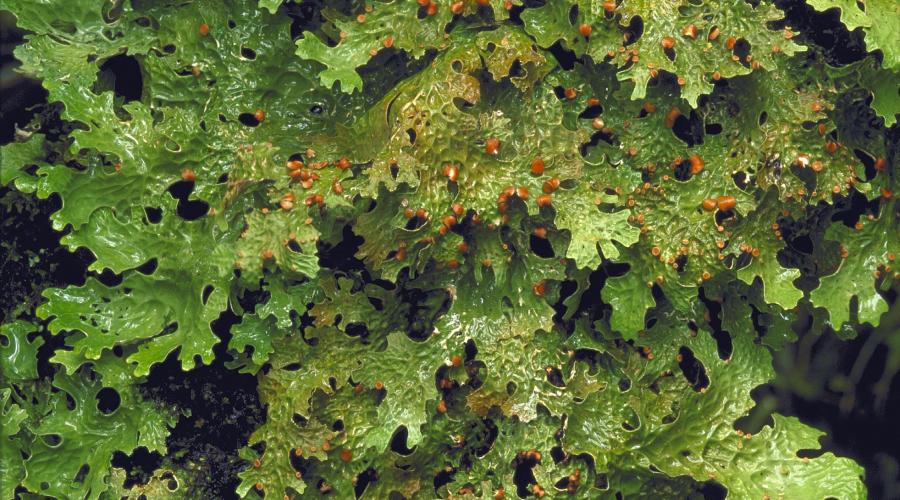
Lungwort (Lobaria pulmonaria)

IUCN Category:
- Great Britain: Least Concern (indicated above)
- Europe: Not Evaluated
- Global: Not Evaluated

Genetic Health Status:
- Scottish Risk: Negligible (indicated above)
- UK Risk: Negligible
- Scottish Mitigation status: No Required
- UK Mitigation status: No Required
Background
This leafy lichen is large and conspicuous in addition to being a model species for population genetics and an important indicator for ecological continuity. It has declined dramatically across large parts of Europe and the southern parts of the United Kingdom due to pollution and habitat loss and declines have not ceased in some parts of its range (Scheidegger and Werth, 2009), but populations are large and apparently stable in western Scotland. Reproduction is by asexual propagation and spore production by outcrossing (Walser, 2004). Generation times can be as rapid as seven years between establishment and sexual reproduction in Scotland (Eaton and Ellis, 2014), and microhabitat specificity interacts with climate variables, such that it is more common and less habitat-specialist in the wetter west (Lisewski and Ellis, 2010). Further east, it is found especially on hardwoods with base-rich bark, and ash dieback is therefore expected to strongly impact some parts of its distribution. It is widespread across the northern hemisphere, though threatened in parts of this range. Genetic studies suggest that there are two large admixed European populations experiencing continuing gene flow at large spatial scales, with Scottish samples clustering with others from across southern and western Europe (Hilmo et al., 2012; Widmer et al., 2012), but that genetic diversity and unique alleles are proportional to population size (Otalora et al., 2015).
Current Threats
Pollution and habitat loss are still threats in some parts of the UK particularly in England and Wales, but ash dieback may also reduce small and isolated populations, particularly in the east, where suitable habitat is much more restricted.
Contribution of Scottish/UK population to total species diversity
The populations in western Scotland are probably some of the largest in Europe and are therefore expected to support relatively large amounts of genetic diversity (Otalora et al., 2015), but Atlantic populations (Macaronesia and Ireland) appear to have recent gene flow, confirming earlier genetic links (Widmer et al., 2012). Smaller pockets of suitable habitat and colonized trees exist outside this core area and may be more isolated with unique genetic variants, but the species is widespread, and large populations exist outside of the UK as well.
Genetic risks
Diversity loss: population declines
Many known historic localities in the east of Scotland and in England and Wales have been lost and are now fragmented due to effects of pollution and habitat loss, including the loss of ash trees, a frequent tree on which it grows. In a review of Welsh sites, 45 are known to have lost this species of a total of 168 known, with others suspected to have been lost without having been documented (Bosanquet, 2022). Recent recording effort has resulted in many new records at the individual tree level, masking overall declines country-wide.
Global Biodiversity Framework Indicators
Population definitions:
The populations are defined by ecological and biogeographic proxies. The large and mostly well-connected western localities are spatially isolated from those further south and east. Populations are therefore based on regions of provenance.
Ne500: The proportion of populations that have an effective population size of more than 500.
- Proportion of populations with Ne > 500 in Scotland = 2/2
- Proportion of populations with Ne > 500 in UK = 2/5
PM: Proportion of populations that existed in 2000 that still exist in 2025.
- Proportion of populations maintained in Scotland = 2/2
- Proportion of populations maintained in UK = 2/5
Diversity loss: functional variation
Functional variation
There is no information about functional variation.
Divergent lineages
There is no published information about standing or historic genetic variation, though some populations have been sampled and are part of large datasets (e.g. Widmer et al., 2012).
Hybridisation/Introgression
No information on hybridisation, but in the UK, no close relatives occur, so this is unlikely to be a risk.
Low turnover - constraints on adaptive opportunities
Generation time in the UK is more than 3x lower than that observed in Swiss populations (Eaton and Ellis, 2014; Scheidegger and Goward, 2002), so turnover is expected to be rapid, with plenty of new juvenile individuals in some of the larger populations in the west. Farther east and south, where populations are small, lack of outcrossing may limit genetic recombination (Zoller et al., 1999).
Cumulative Risk Summary
Overall Genetic Health Status
Scotland
- Risk: Negligible
- Mitigation: Not Required
GB/UK
- Risk: Negligible
- Mitigation: Not Required
Overall Genetic Health status explanation
Populations in western Scotland are locally abundant and apparently stable, but ongoing losses and threats in other parts of the UK are still limiting recovery. Some small translocations and relocations have occurred locally in England when isolated host trees fall, but these are small scale and cannot recover the species throughout its historic UK range. Still, the genetic data to date suggest Scottish/UK populations are part of a larger, widely-distributed European gene pool.
In situ genetic threat level
In situ genetic threat level
- In situ Risk for Scotland: Negligible
- In situ Risk for UK: Negligible
Populations are large and stable across parts of western Scotland and part of a larger European gene pool, despite declines.
Confidence in in situ threat level
- Confidence score for Scotland: High
Though there have been historic losses across the UK due to habitat loss, the species persists in large core populations and even along wayside trees in large parts of the west.
- Confidence score for UK: Medium
Historic and ongoing population losses in the south and east of the UK have resulted in highly fragmented, small relict populations, suggesting losses of genetic diversity along with ongoing genetic drift, though the overall European population is apparently large and stable.
Ex situ representation
None
Current conservation actions
As part of SSSI management and monitoring, extant individual sites are sometimes re-surveyed (e.g. Sanderson, 2003), while historic UK localities for this species have been revisited, documenting changes in distribution. In Wales, the species is threatened, and a recent status survey compiled information for all known localities (Bosanquet, 2022). Direct and localised efforts to document colonisation (Woods, 2014) or attempt translocations from fallen source trees are sometimes undertaken in parts of its range (e.g. Gilbert, 1992a, b). The species is listed on Schedule 13.2, banning its commercial collection in England and Wales.
| Ex situ | Translocation | Habitat management | Legal protection of habitat or species | Regulation of exploitation | Control of INNS/pests/pathogens |
|---|---|---|---|---|---|
| - | X | X | X | X | - |
Population assessment/monitoring
Population
Demographic
N pops assessed/monitored in Scotland = 0/2
N pops assessed/monitored in UK = 2/5
Historic records of Lobaria pulmonaria have been resurveyed across England and Wales, with many historic locations lost. In Wales, a recent re-survey showed losses of over 25% of known sites (Bosanquet, 2022).
Genetic
N pops assessed/monitored in Scotland = 2/2 (5 population genetic samples representing both of the areas of provenance/seed zones)
N pops assessed/monitored in UK = 5/5 (7 population genetic samples including sites in each of the 5 seed-one derived populations)
Sampling for population genetic studies (e.g. Hilmo et al., 2012; Widmer et al., 2012) use small, geographically delimited clusters of individuals at a relatively larger distance from other such clusters to define populations for sampling. A study of European genetic structure sampled 8 sites (across 3 of the 5 provenance zones) in Great Britain and Ireland: 5 in Scotland, Wales, England and Ireland (Widmer et al., 2012) and confirmed a general pattern of post-glacial expansion from Mediterranean and Balkan refugia. The fungal gene pools found in Great Britain and Ireland are broadly shared across Western Europe (Widmer, et al., 2012). These sites have not been resampled.
Further Research
An understanding of the geographic distribution of unique genetic variation with respect to Europe, and with respect to eastern/southern populations versus western Scottish populations would help prioritize efforts to restore lost populations and recover isolated ones if unique genetic variation exists.
References
Eaton, S. and Ellis, C.J. (2014). High demographic rates of the model epiphyte Lobaria pulmonaria in an oceanic hazelwood (western Scotland). Fungal Ecology, 11: 60-70.
Gilbert, O.L. (1992a). Lichen survey of Monk Wood SSSI 1992. A report for English Nature.
Gilbert, O.L. (1992b). Lichen survey of Warks Burn Woodland SSSI 1992. A report for English Nature.
Hilmo, O., Lundemo, S., Holien, H., Stengrundet, K. and Stenøien, H.K. (2012). Genetic structure in a fragmented Northern Hemisphere rainforest: large effective sizes and high connectivity among populations of the epiphytic lichen Lobaria pulmonaria. Molecular Ecology, 21(13): 3250-3265.
Lisewski, V. and Ellis, C.J. (2010). Epiphyte sensitivity to a cross-scale interaction between habitat quality and macroclimate: an opportunity for range-edge conservation. Biodiversity and conservation, 19(14): 3935-3949.
Otalora, M.A., Belinchon, R., Prieto, M., Aragon, G., Izquierdo, P. and Martinez, I. (2015). The threatened epiphytic lichen Lobaria pulmonaria in the Iberian Peninsula: Genetic diversity and structure across a latitudinal gradient. Fungal Biology, 119(9): 802-811.
Sanderson, N.L. (2003). Lichen Survey of Eastdean Park 2003. A report for English Nature.
Scheidegger, C., & Goward, T. (2002). Monitoring lichens for conservation: red lists and conservation action plans. In Monitoring with lichens—monitoring lichens (163-181). Dordrecht: Springer Netherlands.
Scheidegger C, Werth S (2009) Conservation strategies for lichens: insights from population biology. Fungal Biol Rev 23: 55–66.
Walser, J.C., Gugerli, F., Holderegger, R., Kuonen, D. and Scheidegger, C. (2004). Recombination and clonal propagation in different populations of the lichen Lobaria pulmonaria. Heredity, 93(4): 322-329.
Widmer, I., Dal Grande, F., Excoffier, L., Holderegger, R., Keller, C., Mikryukov, V.S. and Scheidegger, C. (2012). European phylogeography of the epiphytic lichen fungus Lobaria pulmonaria and its green algal symbiont. Molecular Ecology, 21(23): 5827-5844.
Woods, R. (2014). Lobaria pulmonaria colonisation events in Breconshire, Mid Wales. British Lichen Society Bulletin, Winter 2014: 26-29.
Zoller, S., Lutzoni, F. and Scheidegger, C. (1999). Genetic variation within and among populations of the threatened lichen Lobaria pulmonaria in Switzerland and implications for its conservation. Molecular Ecology, 8(12): 2049-2059.
Assessor: Rebecca Yahr
Reviewer: Kat O’Brien