Genetic Scorecard Indicator - Heather
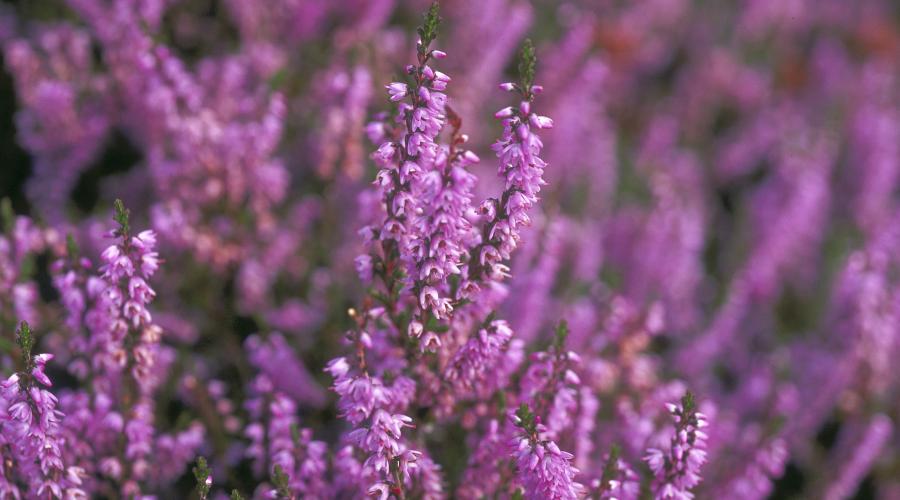
Heather (Calluna vulgaris)

IUCN Category:
- Great Britain: Least Concern (indicated above)
- Europe: Least Concern
- Global: Least Concern

Genetic Health Status:
- Scottish Risk: Negligible (indicated above)
- UK Risk: Negligible
- Scottish Mitigation status: Not required
- UK Mitigation status: Not required
Background
Perennial, hermaphrodite low shrub, widespread with a cool-temperate Eurasian oceanic distribution and wide ecological amplitude, dominant in oceanic heaths (Gimingham, 1960). Insect pollinated; spreads by outcrossed seed (Rendell & Ennos, 2002).
View a larger version of the distribution map for Heather.
Current Threats
Evidence for declines across UK and Europe due to habitat loss (afforestation, agricultural expansion and changes in pastoral management; Stevenson & Birks, 1995) and nitrogen deposition, with direct effects of ammonia toxicity. Marked decreases in Calluna from increases in competitive grasses, especially in lowland heath (Bobbink et al., 2010). Upland Calluna at risk from winter damage; dwarf shrub heath at risk from heather beetle (APIS, 2019). Grazing and burning regimes can also result in declines (Marrs et al., 2004). A recent assessment of plant health risks for the natural environment in Scotland identified potential risks to Calluna vulgaris from plant pests and diseases (Mitchell, 2023).
Contribution of Scottish/UK population to total species diversity
Scottish and Belgian populations are closely related and separate from other European populations (Mahy et al., 1999a), with Scotland probably harbouring core populations. Ecotypic variation known for some flower forms and populations on toxic soil (Gimingham, 1960).
Genetic risks
Diversity loss: population declines
Habitat losses due to conversion and eutrophication over centuries have resulted in long, slow declines in heathland (Norton et al., 2009) and Calluna distribution (Braithwaite et al., 2006). Long-lived individuals and persistent seed banks (150 years) help ensure standing diversity. High levels of temporal and spatial gene flow minimize risks to genetic variation (Rendell & Ennos, 2002).
Global Biodiversity Framework Indicators
Population definitions:
Populations are defined based on management units. This species is widely and continuously distributed across UK in large numbers (Stroh et al., 2023; NBN, 2025). The four Great British Regions of Provenance (Herbert et al., 1999) were selected here to represent the major population groupings / management units (treating Northern Ireland as an additional region) as they broadly reflect the environmental variation across which the species is distributed and are likely to capture major patterns of genetic structure.
Ne500: The proportion of populations that have an effective population size of more than 500.
- Proportion of populations with Ne > 500 in Scotland = 2/2
- Proportion of populations with Ne > 500 in UK = 5/5
PM: Proportion of populations that existed in 2000 that still exist in 2025.
- Proportion of populations maintained in Scotland = 2/2
- Proportion of populations maintained in UK = 5/5
Diversity loss: functional variation
Functional variation
Negligible imminent risk of loss of adaptive / functional variation, as despite demographic changes, Calluna remains abundant and widespread in Scotland and much of upland UK.
Divergent lineages
Negligible risk as no divergent lineages have been detected in genetic studies.
Hybridisation/Introgression
None known.
Low turnover - constraints on adaptive opportunities
Heavy grazing can lead to loss of stands and reduction of seedling establishment (Stevenson & Birks, 1995), but seed banks have similar levels of genetic diversity as above ground plants (Mahy et al., 1999b). Overall, negligible risk from limits on turnover.
Cumulative Risk Summary
Overall Genetic Health Status
Scotland
- Risk: Negligible
- Mitigation: Negligible
Great Britain/UK
- Risk: Not required
- Mitigation: Not required
Overall Genetic Health status explanation
Populations in Scotland and UK are large with little imminent risk of genetic diversity loss.
In situ genetic threat level
In situ genetic threat level
- In situ Risk for Scotland: Negligible
- In situ Risk for UK: Negligible
There has been significant population declines UK-wide, but the plant exists in extremely large populations with no evidence of unique variation in UK.
Confidence in in situ threat level
- Confidence score for Scotland: High
- Confidence score for UK: High
Based on good distribution data and by direct data on most aspects of species’ biology including population level variation.
Ex situ representation
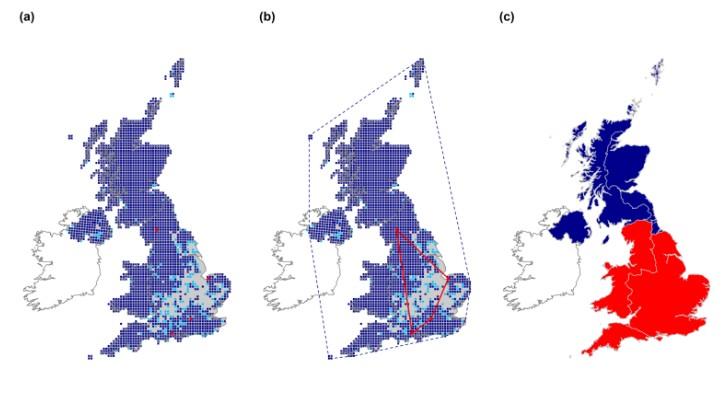
Seed collections in the Millenium Seed Bank (MSB) cover
Click for a full description
Dark blue = species distribution, red = represented in ex situ collection, light blue= pre 2000 records.
- (a) 4 of 2446 occupied 10-km squares (< 1%)
- (b) an EOO of 41,761 km² out of 578,761 km² occupied (7%)
- (c) 2 out of 5 Regions of Provenance (40%)
Current conservation actions
Species largely protected by wider habitat management efforts.
| Ex situ | Translocation | Habitat management | Legal protection of habitat or species | Regulation of exploitation | Control of INNS/pests/pathogens |
|---|---|---|---|---|---|
| X | - | X | X | - | X |
Population assessment/monitoring
Population
Demographic
N pops assessed/monitored in Scotland = 2/2
N pops assessed/monitored in UK = 5/5
Genetic
N pops assessed/monitored in Scotland = 0/2
N pops assessed/monitored in UK = 0/5
Further Research
Genetic surveys utilising the Darwin Tree of Life reference genome and subsequent resequencing across populations would provide more directly quantified insights into patterns of genetic diversity.
Useful links
References
APIS, 2019. Nitrogen deposition - dwarf shrub heath.
Bobbink, R., Hicks, K., Galloway, J., Spranger, T., Alkemade, R., Ashmore, M., Bustamante, M., Cinderby, S., Davidson, E., Dentener, F. Emmett, B., Erisman, J-W., Fenn, M., Gilliam, F., Nordin, A., Pardo, L. & De Vires, W. 2010. Global assessment of nitrogen deposition effects on terrestrial plant diversity: a synthesis. Ecological Applications, 20(1), 30-59.
Braithwaite, M.E., Ellis, R.W. & Preston, C.D. 2006. Change in the British Flora 1987-2004. Botanical Society of the British Isles, London.
Gimingham, C. 1960. Calluna, a monotypic genus. British Ecological Society, 48, 455-483.
Herbert, R., Samuel, S., & Patterson, G. (1999). Using Local Stock for Planting Native Trees and Shrubs. Forestry Commission Practice Note.
Mahy, G., Ennos, R.A. & Jacquemart, A-L. 1999a. Allozyme variation and genetic structure of Calluna vulgaris (heather) populations in Scotland: the effect of postglacial recolonization. Heredity, 82(6), 654.
Mahy, G., Vekemans, X. & Jacquemart, A.L. 1999b. Patterns of allozymic variation within Calluna vulgaris populations at seed bank and adult stages. Heredity, 82(4), 432.
Marrs, R.H., Phillips, J.D.P., Todd, P.A., Ghorbani, J. & Le Duc, M.G. 2004. Control of Molinia caerulea on upland moors. Journal of Applied Ecology, 41(2), 398-411.
Mitchell, R.J. (2023). Plant Health and the Natural Environment: Project Final Report. PHC2020/03. Scotland's Centre of Expertise for Plant Health (PHC). DOI: 10.5281/zenodo.8297811
Norton, L.R., Murphy, J., Reynolds, B., Marks, S. & Mackey, E.C. 2009. Countryside Survey: Scotland Results from 2007. NERC/Centre for Ecology & Hydrology, The Scottish Government, Scottish Natural Heritage, 83pp.
Rendell, S. & Ennos, R.A. 2002. Chloroplast DNA diversity in Calluna vulgaris (heather) populations in Europe. Molecular Ecology, 11(1), 69-78.
Stevenson, A.C. & Birks, H.J.B. 1995. Heaths and moorland: long-term ecological changes, and interactions with climate and people. In: D.B.A. Thompson, A.J. Hester & M.B. Usher, eds. Heaths and moorland: cultural landscapes. HMSO, Edinburgh. pp. 224-239.
Stroh, P.A., Walker, K.J., Humphrey, T.A., Pescott, O.L. and Burkmar, R.J., 2023. Plant atlas 2020: mapping changes in the distribution of the British and Irish Flora. Princeton University Press.
Assessor: Rebecca Yahr, RBGE
Reviewer: Pete Hollingsworth, RBGE