Genetic Scorecard Indicator - Harebell/Scottish Bluebell
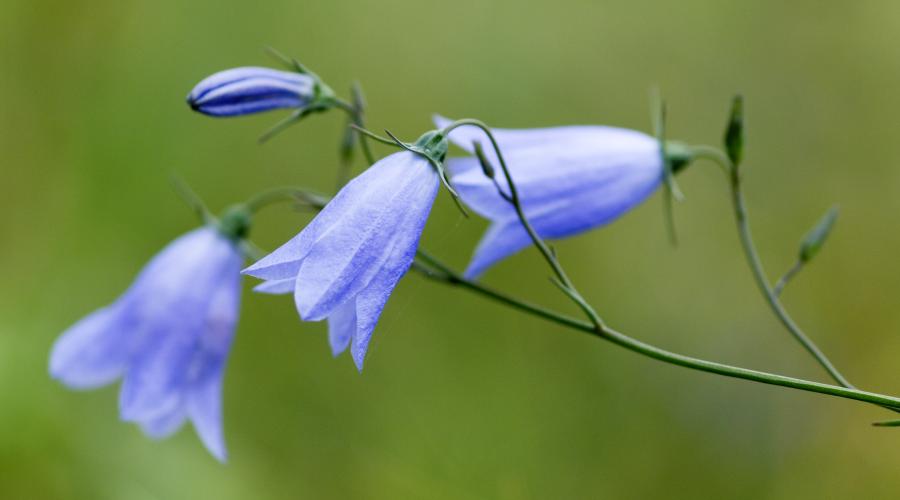
Harebell/Scottish Bluebell (Campanula rotundifolia)

IUCN Category:
- Great Britain: Least concern (indicated above)
- Europe: Data deficient
- Global: Data deficient

Genetic Health Status:
- Scottish Risk: Moderate (indicated above)
- UK Risk: Moderate
- Scottish Mitigation status: Partially effective
- UK Mitigation status: Partially effective
Background
Perennial, hermaphrodite herb, widespread with a circumpolar distribution and wide ecological amplitude. Pollination by insects, self-incompatible, spreads by seed and rhizomes. The UK population contains two polyploid races (tetraploid and hexaploid), which have previously been classified as subspecies (ssp. rotundifolia and ssp. montana, Stevens et al., 2012). However, overlap between the subspecies classifications and the polyploid races is not complete, and current opinion may take the view that this as a single species with two cytological races (e.g. Naturescot’s Species at Risk project). Comprehensive survey of the distribution of cytotypes has been undertaken (Wilson et al., 2020) that found strong spatial structuring with hexaploids largely confined to NI (only hexaploids are present on the island of Ireland), western and far northern Great Britain (coastal fringes, Scottish western islands, eastern parts of NW Highlands). Notable inland hexaploid clusters occur, with occasional pentaploids present. Diploids were not detected in the UK. Chloroplast haplotypes were also strongly structured and followed cytotype patterns. Common garden studies showed some indications of local adaptation in flowering phenology. Data indicate local in situ polyploidisation in specific sites (upland, usually associated with historic mining; Wilson et al., 2020).
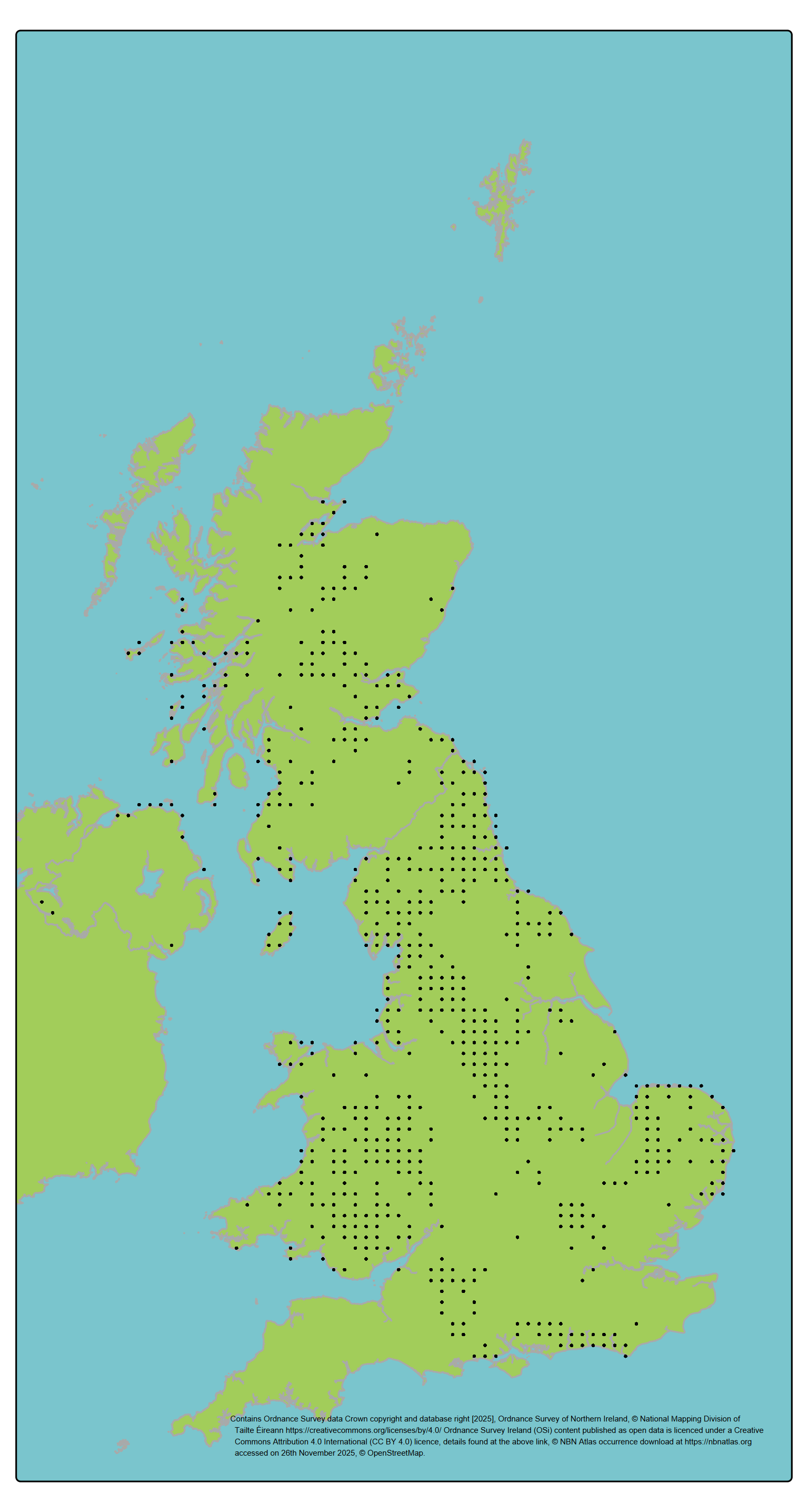
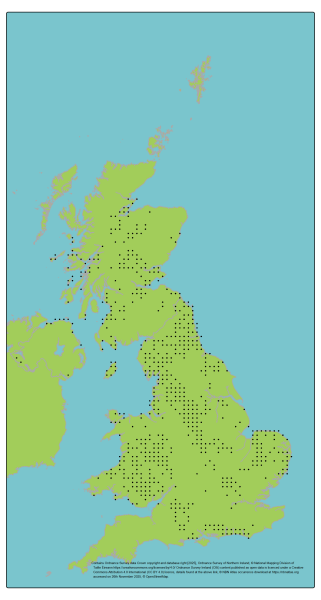
View a larger version of the distribution map for the Harebell.
Current Threats
Declines in abundance and range due to intensification of agriculture and regeneration of woodlands and scrub; nitrogen deposition associated with population declines (Stevens et al., 2012; BSBI Plant Atlas 2020 indicates ‘strong decline’ based on post-1987 effort adjustment). Potential for introgression from non-native genotypes planted for habitat restoration (Walker et al., 2004a, b). Seedlings are poor competitors and require disturbed open ground. Seed banks mostly persist for short intervals (<5 yrs).
Contribution of Scottish/UK population to total species diversity
Hexaploid plants have strongholds in Scotland (Stevens et al., 2012) and both major cytotypes occur in the country; an important local in situ polyploidisation site is present in the Wanlockhead / Leadhills area. Distinct and spatially structured chloroplast haplotypes are present in Scotland.
Genetic risks
Diversity loss: population declines
Moderate risk of genetic diversity loss. Diploid race 2n=34 apparently lost (Stevens et al., 2012) or more likely has never occurred (Wilson et al., 2020) in Britain. Population declines reported, especially at range edges (Braithwaite et al., 2006) and 39% in Countryside Survey (as cited in Stevens et al., 2012). These population declines may lead to further genetic diversity loss.
Global Biodiversity Framework Indicators
Population definitions:
Populations are defined based on management units. This species is widely and continuously distributed across UK in large numbers (Stroh et al., 2023; NBN, 2025). The four Great British Regions of Provenance (Herbert et al., 1999) were selected here to represent the major population groupings / management units (treating Northern Ireland as an additional region) as they broadly reflect the environmental variation across which the species is distributed and are likely to capture major patterns of genetic structure.
Ne500: The proportion of populations that have an effective population size of more than 500.
- Proportion of populations with Ne > 500 in Scotland = 2/2
- Proportion of populations with Ne > 500 in UK = 5/5
PM: Proportion of populations that existed in 2000 that still exist in 2025.
- Proportion of populations maintained in Scotland = 2/2
- Proportion of populations maintained in UK = 5/5
Diversity loss: functional variation
Functional variation
Population declines have been reported in the north of Scotland (Stevens et al., 2012) and this may disproportionately affect the hexaploid cytotype.
Divergent lineages
Strong local structuring is apparent in distribution of tetraploids vs hexaploids: declines in north Scotland mostly impact the hexaploid populations (Stevens et al., 2012).
Hybridisation/Introgression
Tetraploids and hexaploids are usually geographically separate, but rare hybrids occur where ranges overlap with occasional aneuploids. Notable sites at which in situ polyploidisation has occurred generate occasional pentaploids. There is potential for hybridisation between in situ populations and polyploid races or non-native genotypes in seed mixes used for habitat restoration. As hybrid introgression is biased in favour of the tetraploid, hexaploid populations are particularly vulnerable to introduction of tetraploids.
Low turnover - constraints on adaptive opportunities
Late summer mowing in road verges can prevent regeneration and spread from seed.
Cumulative Risk Summary
Overall Genetic Health Status
Scotland
- Risk: Moderate
- Mitigation: Partially effective
Great Britian/UK
- Risk: Moderate
- Mitigation: Partially effective
Overall Genetic Health status explanation
Substantial populations of the species persist in a patchy distribution across the UK. Numerous projects practice grassland habitat management that should benefit the species, so genetic diversity in the wider population is likely being maintained.
However, in many sites population decline continues. There is little evidence of awareness of the wider genetic structuring of the UK population and so local projects may not practice active management of genetic diversity, and gaps in coverage of national genetic diversity may be present.
In situ genetic threat level
In situ genetic threat level
- In situ Risk for Scotland: Moderate
- In situ Risk for UK: Moderate
Losses in hexaploid range, continuing threat from land use change, agricultural intensification and nitrogen pollution.
Confidence in in situ threat level
- Confidence score for Scotland: Medium
- Confidence score for UK: Medium
Assessment based on good distribution data supported by direct data on most aspects of species’ biology including cytotypes and chloroplast haplotypes but lacking a comprehensive study of genome wide genetic diversity.
Ex situ representation
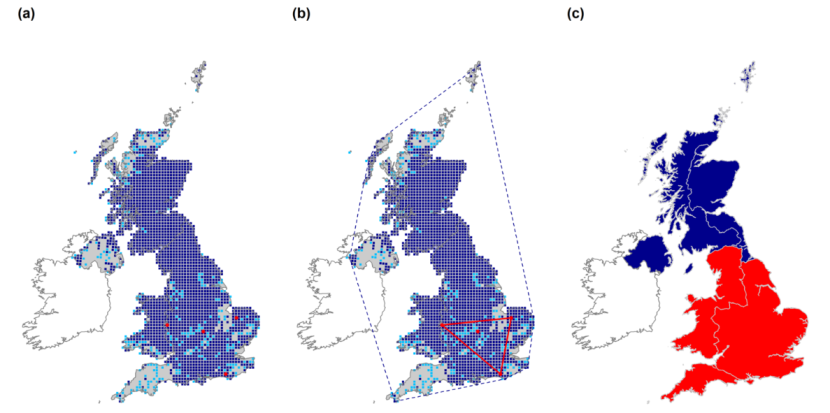
Seed collections in the Millenium Seed Bank (MSB) cover
Click for a full description
Dark blue = species distribution, red = represented in ex situ collection, light blue= pre 2000 records.
- (a) 4 of 2101 occupied 10-km squares (< 1%)
- (b) an EOO of 23,799 km² out of 527,742 km² occupied (5%);
- (c) 2 out of 5 Regions of Provenance (40%).
As there are no collections from Scotland, hexaploids are not represented in this ex situ collection.
Current conservation actions
Actions:
- Nitrogen deposition control needs to continue. Measures are beginning to show results with declines in NOx over the last decade, but approximately 40% of nitrogen-sensitive habitats in Scotland exceed critical loads, and ammonia is still rising.
- Raise awareness of polyploid spatial structure to ensure restoration projects and seed supply chains avoid inadvertent mismatch of between local and planted races.
- Complete ex situ collections to ensure representation of, at least, both cytotypes.
| Ex situ | Translocation | Habitat management | Legal protection of habitat or species | Regulation of exploitation | Control of INNS/pests/pathogens |
|---|---|---|---|---|---|
| X | - | X | - | - | - |
Population assessment/monitoring
Population
Demographic
N pops assessed/monitored in Scotland = 2/2
N pops assessed/monitored in UK = 5/5
Genetic
N pops assessed/monitored in Scotland = 2/2
N pops assessed/monitored in UK = 5/5
Further Research
Additional work recommended to assess variation in the strength of the reproductive barriers between tetraploid and hexaploid races and whether this varies with location (i.e. at varying distances from the contact zone). Formal quantification of the extent of nuclear genetic diversity would be valuable and enable thorough evaluation of the risks posed by transplantation and hybridisation.
References
Herbert, R., Samuel, S., & Patterson, G. (1999). Using Local Stock for Planting Native Trees and Shrubs. Forestry Commission Practice Note.
Stevens, C.J., Wilson, J., McAllister, H.A. (2012) Biological flora of the British Isles: Campanula rotundifolia. Journal of Ecology 100:821–839.
Stroh, P.A., Walker, K.J., Humphrey, T.A., Pescott, O.L. and Burkmar, R.J. (2023) Plant atlas 2020: mapping changes in the distribution of the British and Irish Flora. Princeton University Press.
Wilson, J., Perry, A., Shepherd, J.R., Jeffree, C.E., Walker, K. and Cavers, S. (2020) Invasion, isolation and evolution shape population genetic structure in Campanula rotundifolia. AoB Plants. 12(2)
Assessors:
- Rebecca Yahr, Royal Botanic Garden Edinburgh
- Stephen Cavers, UK Centre for Ecology & Hydrology
Reviewers:
- Julia Wilson, UKCEH Honorary Fellow
- Pete Hollingsworth, Royal Botanic Garden Edinburgh
Last updated: