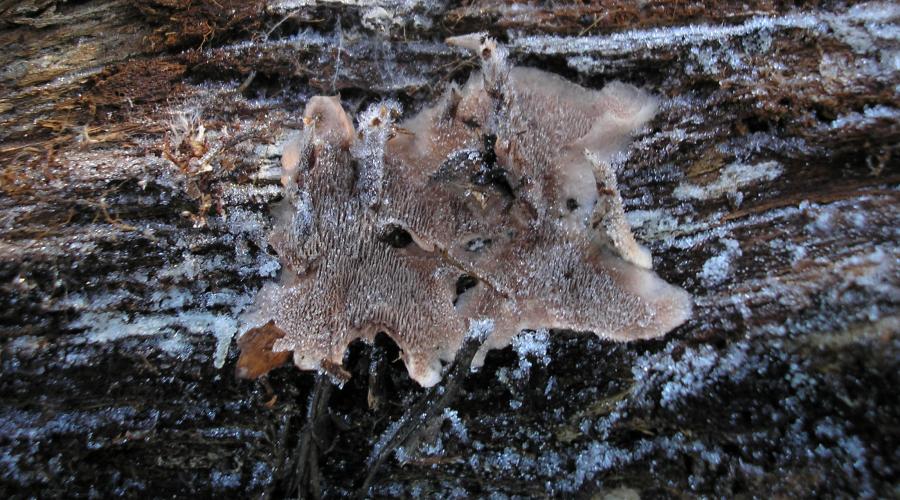
Genetic Scorecard Indicator - Graceful tooth fungus
Graceful tooth fungus (Hydnellum gracilipes )

IUCN Category:
- Great Britain: Not assessed (indicated above)
- Europe: Not assessed
- Global: Vulnerable

Genetic Health Status:
- Scottish Risk: Moderate (indicated above)
- UK Risk: Moderate
- Scottish Mitigation status: Not in place
- UK Mitigation status: Not in place
Background
This mycorrhizal species is found in ancient pine forests, often with sandy soils, and is one of an assemblage of tooth fungi found in this habitat. It can most often be seen fruiting in disturbed areas such as alongside paths or in forest stands with a history of low intensity fire (Brandrud, 2015), but the mycelium extends below the forest floor into the soil (Taylor et al., 2014).
Genetic and morphological evidence suggests that what had previously been recorded as Hydnellum scrobiculatum is in fact H. gracilipes (Ainsworth et al., 2010), and so in this document the two will be treated as H. gracilipes (meaning that historical records are also H. gracilipes). The difficulty in recording tooth fungus species should be taken into account when considering distributions and genetic suppositions based those distributions. The species has a restricted distribution and few records and was highlighted as a species of conservation concern in the now-obsolete UK BAP (as H. scrobiculatum).
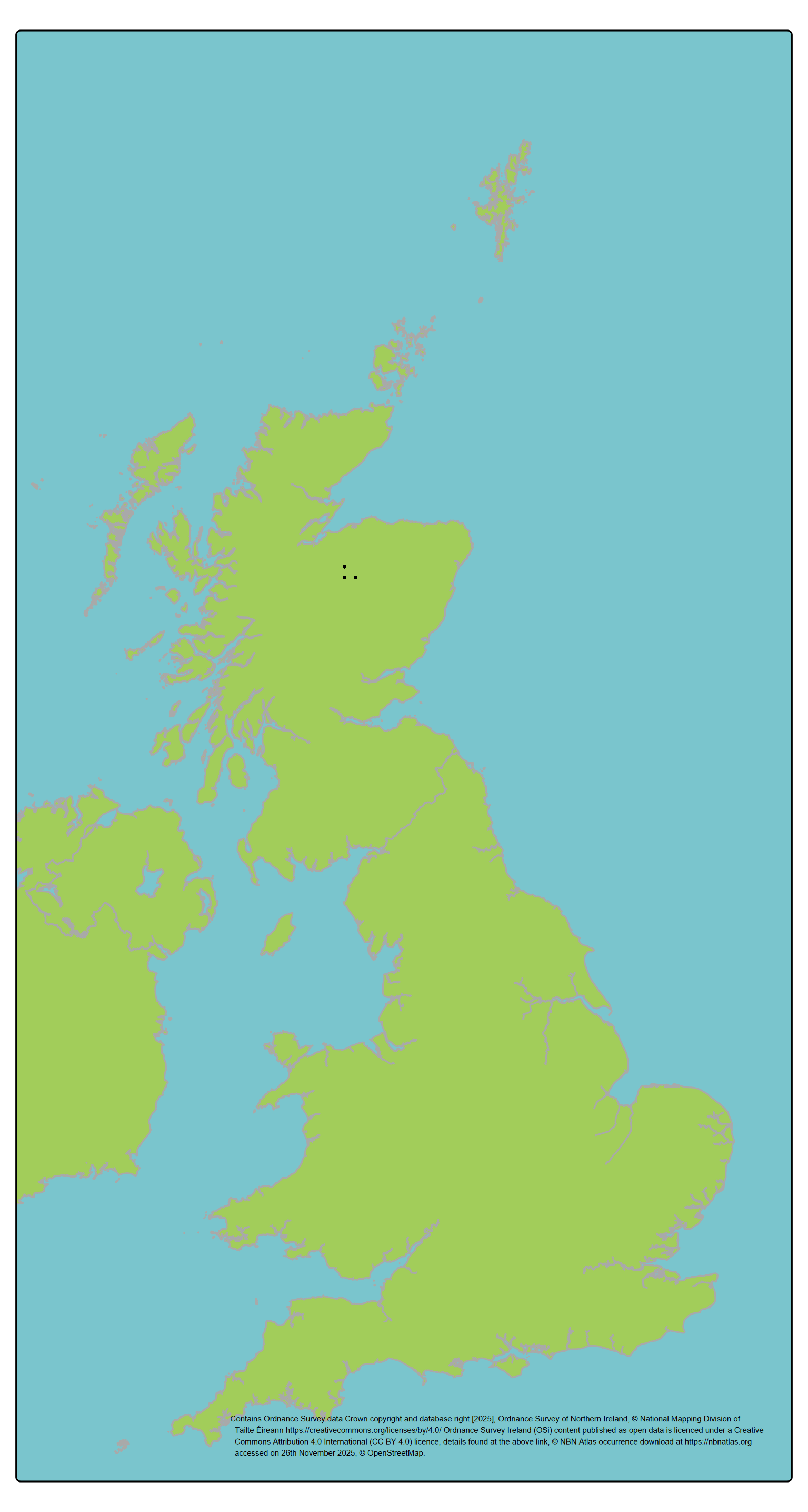
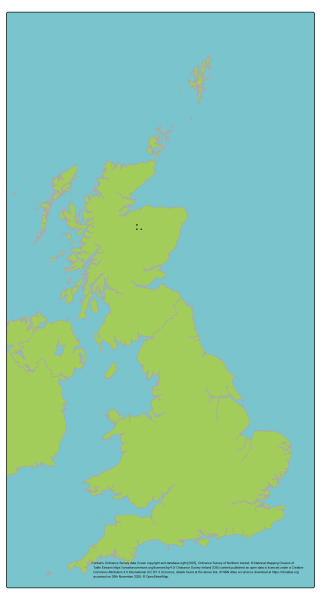
View a larger version of the distribution map for Graceful tooth fungus.
Current Threats
The Graceful Tooth, and many other tooth fungi, are threatened by loss of habitat. Ancient pine forests can be considered as irreplaceable habitats as it takes centuries for the fungi and flora to develop. Tooth fungi seem to disappear from clearcut forests, so are thought to require a continuity of habitat, or for a buffer zone of trees to be left intact to preserve tooth fungi until the next restocking. While low intensity fires can increase fruiting in the short term (Brandrud, 2015), forest fires are a threat to ancient woodlands. This species has an IUCN Red List categorisation of Vulnerable A2c+3c+4c due to the rate of loss of ancient pine forests (Brandrud, 2015), partically in the European continent.
Contribution of Scottish/UK population to total species diversity
The population in Scotland is concentrated around the Cairngorm region, in which a SSSI is designated for its pinewood fungi. Scotland contains most of the Great Britain and UK population, but a small proportion of the European population. There are just over 500 records in Scotland in the GBIF portal under the name H. scrobiculatum. Targeted surveys and record collation for tooth fungi (Newton et al 2002) gathered information on where this species is found and did not find significant declines. However, recording relies on fruit body presence, which fluctuates greatly between years and is not a good indicator of population size for this family of fungi.
Genetic risks
Diversity loss: population declines
Though there has been increased recording effort on this species over the last 25 years leading to more sites being found, it is likely that habitat has decreased overall due to clear-cutting of forests. As spores travel long distances, this species is unlikely to suffer from inbreeding. However, if declines continue and distances between sites increase, risks may increase from inbreeding, genetic drift and stochastic effects.
Global Biodiversity Framework Indicators
Population definitions:
Populations defined by ecological or biogeographic proxies. The majority of records are clustered around the Cairngorm region. This area has a higher rate of mycological recording than much of Scotland and is a stronghold for ancient pine forest. There is a further small population in Highland. It is likely that these 2 sites will have more geneflow within the populations than between the populations.
Ne500: The proportion of populations that have an effective population size of more than 500.
- Proportion of populations with Ne > 500 in Scotland = Not assessed, insufficient data.
- Proportion of populations with Ne > 500 in UK = Not assessed, insufficient data.
PM: Proportion of populations that existed in 2000 that still exist in 2025.
- Proportion of populations maintained in Scotland = 2/2
- Proportion of populations maintained in UK = 2/2
Diversity loss: functional variation
Functional variation
There is no evidence of functional variation in the UK.
Divergent lineages
Unknown
Hybridisation/Introgression
No research available.
Low turnover - constraints on adaptive opportunities
The Graceful Tooth is not a frequent fruiter and may be in higher numbers underground than recorded through fruitbody searches. It is also a species of an ancient habitat and likely has a low turnover compared to other fungi.
Cumulative Risk Summary
Overall Genetic Health Status
Scotland
- Risk: Moderate
- Mitigation: Partially Effective
Great Britain/UK
- Risk: Moderate
- Mitigation: Partially Effective
Overall Genetic Health status explanation
High uncertainty over current population size, but limited known distribution and reliance on specialized conditions of ancient pinewood with downed logs and low-intensity fites to maintain substrates for fruiting. The habitat for this species is declining slowly and it is likely that populations will be lost; however, current population size is large enough to remain genetically robust for quite some time due to the likely high dispersal ability of propagules.
In situ genetic threat level
In situ genetic threat level
- In situ Risk for Scotland: Moderate
- In situ Risk for UK: Unknown due to cryptic status
Confidence in in situ threat level
- Confidence score for Scotland: Low (No research on genetic structure)
- Confidence score for UK: Unknown due to cryptic status
Ex situ representation
None known.
Current conservation actions
There is a SSSI designated in part for its importance to tooth fungi, including the Graceful Tooth, to ensure the continuation of favourable management for tooth fungi in the site.
| Ex situ | Translocation | Habitat management | Legal protection of habitat or species | Regulation of exploitation | Control of INNS/pests/pathogens |
|---|---|---|---|---|---|
| - | - | X | - | - | - |
Population assessment/monitoring
Population
Demographic
N pops assessed/monitored in Scotland = Unknown due to cryptic taxa
N pops assessed/monitored in UK = Unknown due to cryptic taxa
Genetic
N pops assessed/monitored in Scotland = Unknown due to cryptic taxa
N pops assessed/monitored in UK = Unknown due to cryptic taxa
References
Ainsworth, A.M., Parfitt, D., Rogers, H.J., and Boddy, L. 2010. Cryptic taxa within European species of Hydnellum and Phellodon revealed by combined molecular and morphological analysis, Fungal Ecology, 3 (2), pp 65-80
Brandrud, T.-E. 2015. Hydnellum gracilipes. The IUCN Red List of Threatened Species 2015: e.T76170958A76170972.
A.C. Newton, E. Holden, L.M. Davy, S.D. Ward, L.V. Fleming, R. Watling. 2002. Status and distribution of stipitate hydnoid fungi in Scottish coniferous forests.Biological Conservation,107 (2), pp181-192
Taylor, A.F.S., Holden, E.M., Kilkenny, N., Potts, J.M. & Genney, D.R. 2014. Development of a surveillance scheme for priority fungi in Scotland. Scottish Natural Heritage, Commissioned Report No. 762.
Assessor: Kat O'Brien
Reviewer: Rebecca Yahr