Genetic Scorecard Indicator - Golden eagle
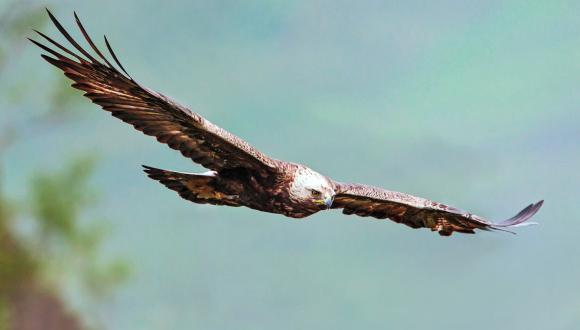
Golden eagle (Aquila chrysaetos)

IUCN Category:
- Great Britain: Green listed (indicated above)
- Europe: Least concern
- Global: Least concern

Genetic Health Status:
- Scottish Risk: Negligible (indicated above)
- UK Risk: Negligible
- Scottish Mitigation status: Effective
- UK Mitigation status: Not required
Background
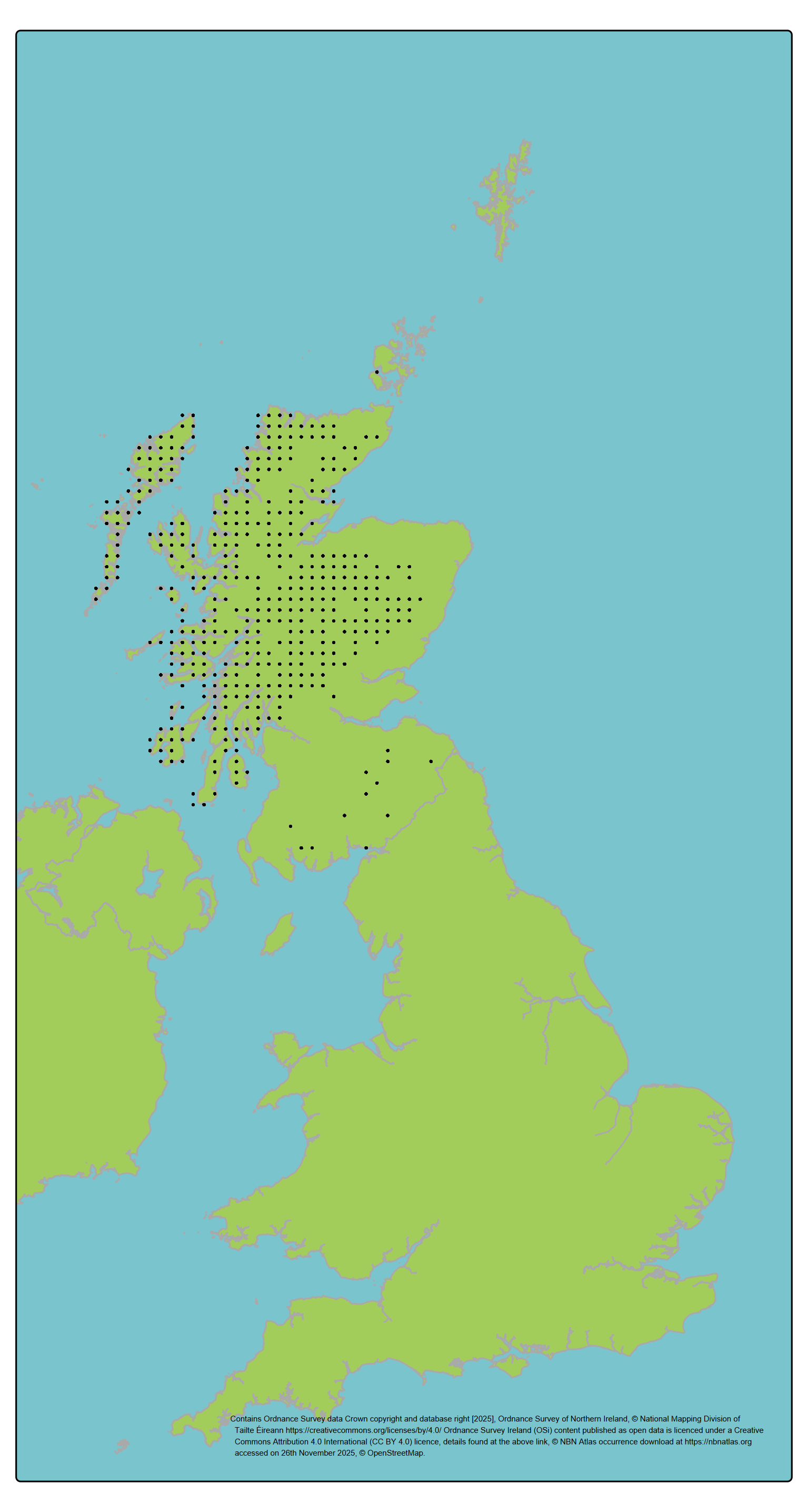
Iconic raptor that has suffered historic reductions in range and population size across the UK. Population currently limited to Scotland but considered stable / recovering (Watson, 2010, Hayhow et al., 2017). A recent (2019-25) translocation project into South Scotland has reinforced and likely stabilised the local population, with potential for expansion to N. England. Mate-pair breeding, range-wide dispersal.
Previous genetic (Ogden et al., 2015) and genomic (Sato et al., 2020; Sato et al., 2023) studies describe a single management unit in Scotland with significantly reduced genome-wide diversity and some genetic differentiation relative to continental populations.
View a larger version of the distribution map for the Golden Eagle.
Current Threats
Ongoing persecution particularly in East Scotland threatens maintenance / growth in the region. Reproduction rates in other areas considered below expectation, with causes unknown but a shortage of live prey is a key factor, and subject of current research.
Contribution of Scottish/UK population to total species diversity
Scotland is the only UK region with golden eagles, however, the contribution to global species diversity is not considered particularly high. Part of a circumglobal species distribution, there is no phylogenetic uniqueness, but strong contemporary population structure may support some local adaptation.
Genetic risks
Diversity loss: population declines
The Scottish golden eagle population is not heavily structured (Ogden et al., 2015) therefore loss of genetic diversity through individual population declines is not a specific threat. However, low population numbers elevate sensitivity to diversity loss through random genetic drift, especially outside the Scottish Highlands and Islands core range.
Global Biodiversity Framework Indicators
Population definitions:
The population is defined based on genetic clusters. The species is continually distributed and efficiently dispersed over wide geographic distances. Treat as a single population / Management unit. This is based on a range wide DNA analysis of the species.
Ne500: The proportion of populations that have an effective population size of more than 500.
- Proportion of populations with Ne > 500 in Scotland = 0/1
- Proportion of populations with Ne > 500 in UK = 0/1
PM: Proportion of populations that existed in 2000 that still exist in 2025.
- Proportion of populations maintained in Scotland = 1/1
- Proportion of populations maintained in UK = 1/1
Diversity loss: functional variation
Functional variation
The population is unlikely to have strong local adaptive diversity within Scotland, minimising risk of loss to functional variation at a national scale. Functional differentiation of Scottish birds within the species is unknown but possible given genomic differentiation and is the subject of ongoing research.
Divergent lineages
One DNA lineage observed in Scotland not seen elsewhere to date; however, Scotland shares many other lineages with populations across Eurasia (Nebel et al., 2015). Risk of loss considered low.
Hybridisation/Introgression
No risk of hybridisation/introgression.
Low turnover - constraints on adaptive opportunities
Very low population numbers / recruitment in certain regions (e.g. southern Scotland) may limit range of adaptive responses.
Cumulative Risk Summary
Overall Genetic Health Status
Scotland
- Risk: Negligible
- Mitigation: Effective
Great Britain/UK
- Risk: Negligible
- Mitigation: Effective
Overall Genetic Health status explanation
The species only occurs in Scotland but is widely distributed within a single population (one management unit).
Genetic diversity and Ne are low relative to other golden eagle populations, but the trajectory is stable and level of genetic distinctiveness within species range considered low. Increasing breadth and depth of genetic studies starting to provide detailed knowledge and confidence in estimates.
In situ genetic threat level
In situ genetic threat level
- In situ Risk for Scotland: Negligible
- In situ Risk for UK : Negligible
Low genome-wide diversity recorded across Scotland relative to continental populations and Ne<500, but population size slowly increasing and high dispersal throughout species range
Confidence in in situ threat level
- Confidence score for Scotland: High
- Confidence score for UK: High
Population subject to recent comprehensive genetic analysis and ongoing conservation studies.
Ex situ representation
There are no ex-situ populations.
Current conservation actions
South Scotland translocation project has successfully reinforced population across southern counties (n~50).
| Ex situ | Translocation | Habitat management | Legal protection of habitat or species | Regulation of exploitation | Control of INNS/pests/pathogens |
|---|---|---|---|---|---|
| - | X | X | X | - | - |
Population assessment/monitoring
Population
Demographic
- N pops assessed/monitored in Scotland =1/1
- N pops assessed/monitored in UK = 1/1
Genetic
- N pops assessed/monitored in Scotland =1/1
- N pops assessed/monitored in UK = 1/1
References
Hayhow, D.B., Benn, S., Stevenson, A., Stirling-Aird, P.K., Eaton, M.A., (2017) Status of Golden Eagle Aquila chrysaetos in Britain in 2015. Bird Study, 64(3), 281–294
Ogden, R., Heap E., McEwing R., Tingay R., Whitfield, D.P., (2015) Population structure and dispersal patterns in Scottish Golden Eagles Aquila chrysaetos revealed by molecular genetic analysis of territorial birds. Ibis DOI: 10.1111/ibi.12282
Nebel, C., Gamauf, A., Haring, E., Segelbacher, G., Villers, A. and Zachos, F.E., 2015. Mitochondrial DNA analysis reveals Holarctic homogeneity and a distinct Mediterranean lineage in the Golden eagle (Aquila chrysaetos). Biological Journal of the Linnean Society, 116(2), pp.328-340.
Sato, Y., Humble, E., Ogden, R., (2023) Genomic data reveal strong differentiation and reduced genetic diversity in island golden eagle populations. Biological Journal of the Linnean Society, 143(1) 10.1093/biolinnean/blad172
Sato Y., Ogden R., Kishida T., Nakajima N., Maeda T., Inoue-Murayama M., (2020) Population history of the golden eagle inferred from whole-genome sequencing of three of its subspecies. Biological Journal of the Linnean Society 130(4) 826-838
Watson, J., 2010. The golden eagle. Bloomsbury Publishing.
Assessor: Rob Ogden, University of Edinburgh.
Reviewer: Linda Neaves, Murdoch University.