Genetic Scorecard Indicator - Flotow's Rock Dimple
Flotow's Rock Dimple (Gyalecta flotowii)

IUCN Category:
- Great Britain: Near Threatened (indicated above)
- Europe: Not Assessed
- Global: Not Assessed

Genetic Health Status:
- Scottish Risk: Serious (indicated above)
- UK Risk: Serious
- Scottish Mitigation status: Not effective
- UK Mitigation status: Not effective
Background
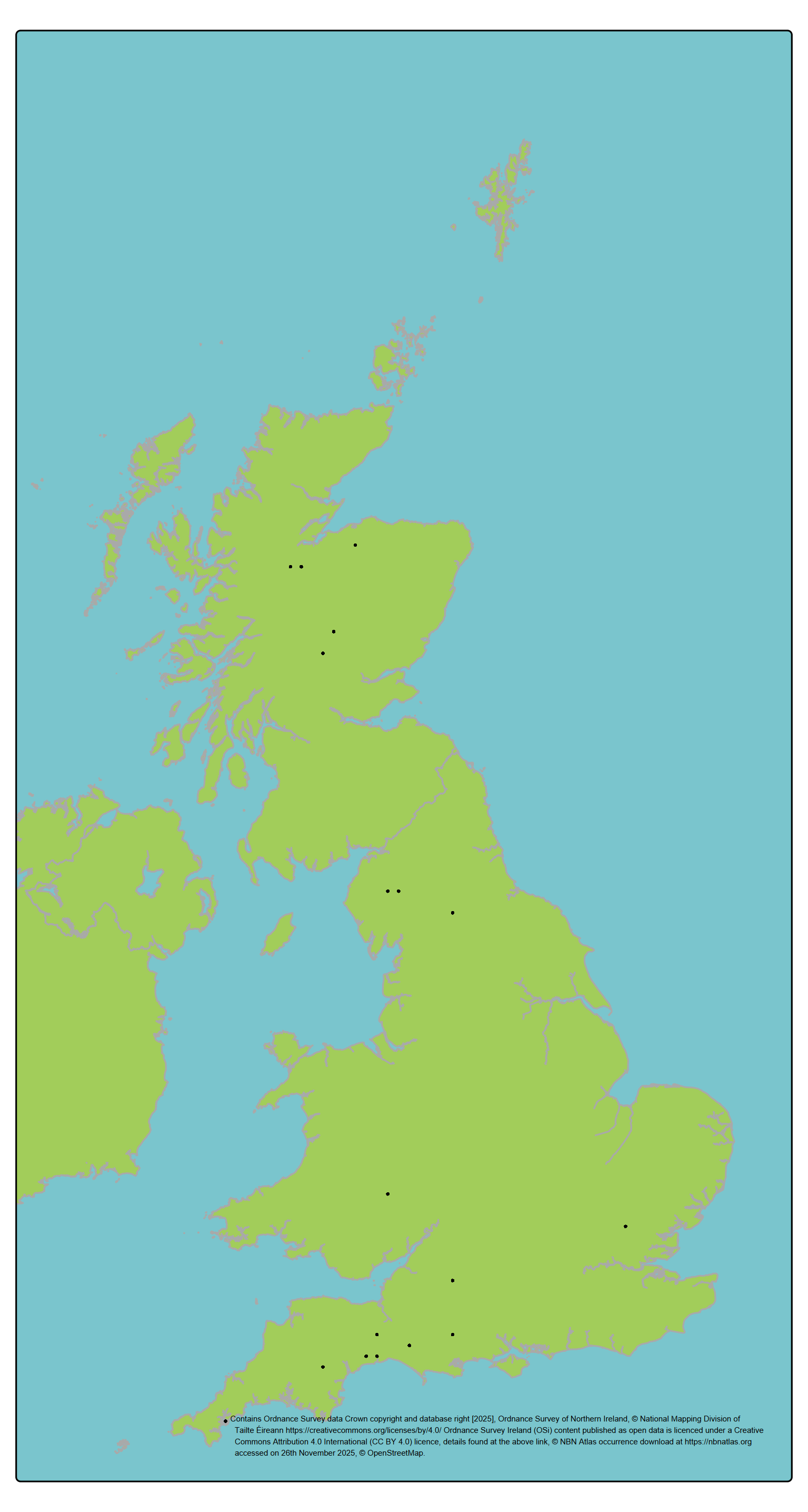
Restricted to old broadleaved trees with base-rich bark (Ulmus, Fraxinus, Acer) in pasture or glade woodlands. This species is rare and declining due to loss of its historic primary habitat, veteran Ulmus trees. Now mainly on Fraxinus and Acer. In some parts of its distribution, it is noted to occur only within rain tracks or wound tracks on bark, restricting its distribution within potentially inhabited trees. Reproduction by sexual spores.
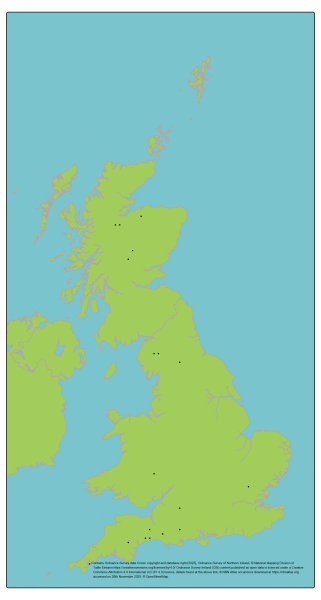
View a larger version of the distribution map for Flotow's Rock Dimple.
Current Threats
Major threats include losses of its primary habitat within the UK, veteran Ulmus trees. Fraxinus, a less-frequently inhabited tree, is under threat from the fungal pathogen ash dieback, and many older trees are dying and expected to be lost as well.
Contribution of Scottish/UK population to total species diversity
This is a widespread but infrequently encountered species. There is no evidence for unique variation with the UK, although the oceanic-hyperoceanic climate of much of the UK is likely to provide differing selective pressure and may support locally adapted populations.
Genetic risks
Diversity loss: population declines
Population declines have been severe in the UK, with modelled declines of over 30% to nearly 70% since 1980 (UK CEH) and increasing population fragmentation with losses across entire regions. Although recording is not at all complete, the magnitude of this modelled decline is supported by the loss of veteran elm trees in the south and the ongoing and increasing losses of ash trees.
Global Biodiversity Framework Indicators
Population definitions:
Populations are defined by ecological and biogeographic proxies. The four GB Regions of Provenance (Herbert et al., 1999) were selected here to represent the major population groupings / management units (treating Northern Ireland as an additional region) as they broadly reflect the environmental variation across which the species is distributed and are likely to capture major patterns of genetic structure.
Ne500: The proportion of populations that have an effective population size of more than 500.
- Proportion of populations with Ne > 500 in Scotland = 0/2
- Proportion of populations with Ne > 500 in UK = 0/5
PM: Proportion of populations that existed in 2000 that still exist in 2025.
- Proportion of populations maintained in Scotland = 1/2
- Proportion of populations maintained in UK = 3/5
Diversity loss: functional variation
Functional variation
Concomitant with significant losses of habitat and known sites, it is expected that functional variation will also be lost, but there is no direct evidence of this.
Divergent lineages
Along with significant losses of habitat and known sites, it is expected that divergent lineages may also be lost, particularly in the south of the UK, where most elm trees have been lost, but there is no direct evidence of this.
Hybridisation/Introgression
There is no evidence of hybridisation or introgression in this species and no studies of these potential effects within the genus.
Low turnover - constraints on adaptive opportunities
Populations are very small due to the lack of suitable habitats (trees), and microhabitats (rain or wound tracks) may be further limiting. Therefore, propagule pressure is likely to be very low, probably limiting dispersal and establishment in this species. The species has small spores compared with congeners, which may also limit its ability to establish.
Cumulative Risk Summary
Overall Genetic Health Status
Scotland
- Risk: Serious
- Mitigation: Not effective
Great Britain/UK
- Risk: Serious
- Mitigation: Not effective
Overall Genetic Health status explanation
The species is at severe genetic risk due to small, declining and fragmented populations.
In situ genetic threat level
In situ genetic threat level
- In situ Risk for Scotland: Serious
- In situ Risk for UK: Serious
The species is apparently rare across its distribution, with small populations, marked declines and significant fragmentation.
Confidence in in situ threat level
- Confidence score for Scotland: High
- Confidence score for UK: High
Although this is a small and easily overlooked species, there is a high level of confidence in the threat assessment because of consistency in risk factors across its range: the species appears to be rare throughout its range, and population declines are well-supported by the losses of elm and ash trees throughout, with high levels of fragmentation due to historic losses.
Ex situ representation
None.
Current conservation actions
Some survey work is ongoing, and efforts to increase pathogen-resistant ash and elm trees are underway; however, these are unlikely to produce the old tree habitats required by these species at the same rate as older trees are being lost.
| Ex situ | Translocation | Habitat management | Legal protection of habitat or species | Regulation of exploitation | Control of INNS/pests/pathogens |
|---|---|---|---|---|---|
| - | - | X | - | - | - |
Population assessment/monitoring
Population
Demographic
N pops assessed/monitored in Scotland = 1/3
N pops assessed/monitored in UK = 3/5
Genetic
N pops assessed/monitored in Scotland = 0/2
N pops assessed/monitored in UK = 0/5
References
UK CEH, 2024. Modeled data for UK Lichen Red Listing.
Image © Jaques Haine
Assessor: Rebecca Yahr, RBGE
Reviewer: Kat O'Brien, NatureScot