Genetic Scorecard Indicator - Elderberry
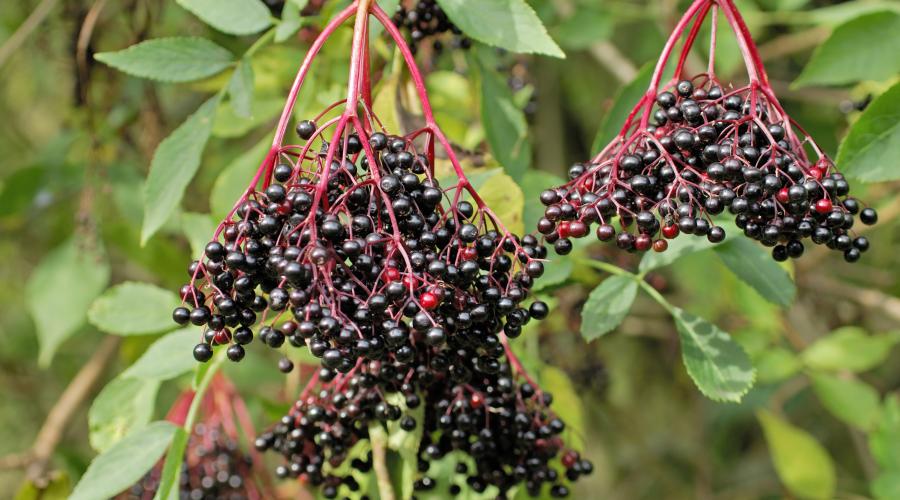
Elderberry (Sambucus nigra )

IUCN Category:
- Great Britain: Least concern (indicated above)
- Europe: Least concern
- Global: Least concern

Genetic Health Status:
- Scottish Risk: Negligible (indicated above)
- UK Risk: Negligible
- Scottish Mitigation status: Not required
- UK Mitigation status: Not required
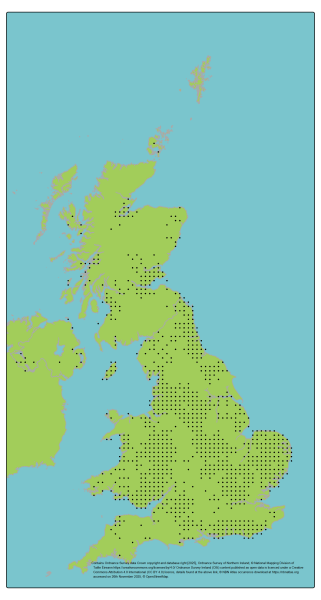
Background
Perennial, hermaphrodite, deciduous shrub, common and widely distributed in eutrophic woodlands, hedges and disturbed sites in the UK and continental Europe. Pollination by generalist beetles, flies and bees. Fertilisation mostly from the same individual, though both outcrossing and fruit set without pollination have been observed. Seeds are bird dispersed (Atkinson & Atkinson, 2002).
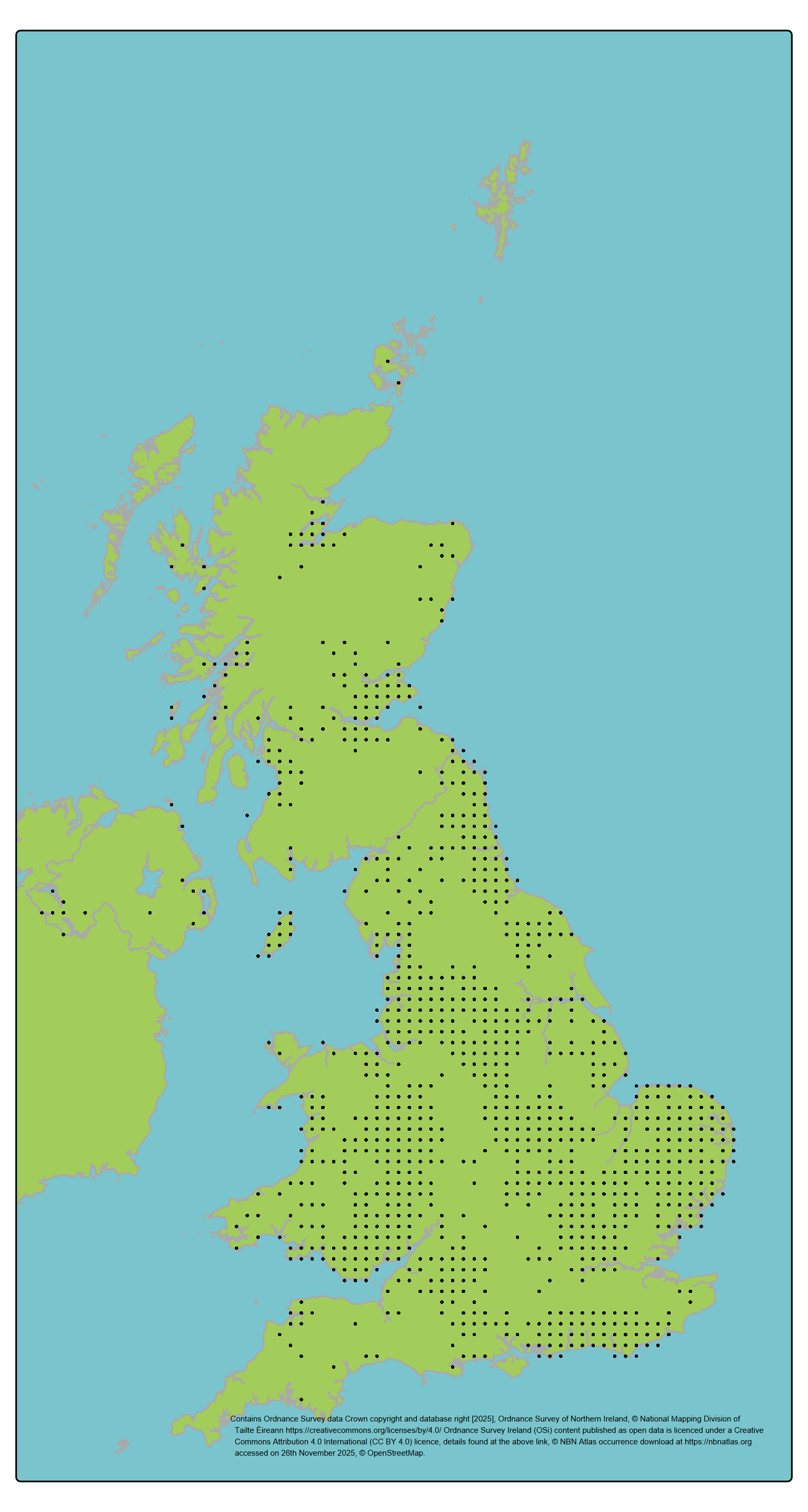
View a larger version of the distribution map for the Elderberry.
Current Threats
This species probably benefits from periodic human disturbance and an agricultural landscape. Some sensitivity to acidification of soils for seed germination and risks to vegetative parts from late frosts and drought (Atkinson & Atkinson, 2002). Fragmentation in parts of range (Anon, 2023) but species remains widespread and abundant.
Contribution of Scottish/UK population to total species diversity
The species is common elsewhere in its range and there is no expectation of divergent endemic genetic lineages in Scotland, although the populations may be adapted to the local environment.
Genetic risks
Diversity loss: population declines
No evidence for genetic diversity loss and individual plant longevity ameliorates short-term risks.
Global Biodiversity Framework Indicators
Population definitions:
Populations are defined based on management units. This species is widely and continuously distributed across UK in large numbers (Stroh et al., 2023; NBN, 2025). The four Great British Regions of Provenance (Herbert et al., 1999) were selected here to represent the major population groupings / management units (treating Northern Ireland as an additional region) as they broadly reflect the environmental variation across which the species is distributed and are likely to capture major patterns of genetic structure.
Ne500: The proportion of populations that have an effective population size of more than 500.
- Proportion of populations with Ne > 500 in Scotland = 2/2
- Proportion of populations with Ne > 500 in UK = 5/5
PM: Proportion of populations that existed in 2000 that still exist in 2025.
- Proportion of populations maintained in Scotland = 2/2
- Proportion of populations maintained in UK = 5/5
Diversity loss: functional variation
Functional variation
Populations are large and widespread and without evidence for significant decline (Braithwaite et al., 2006; Stroh et al., 2023). No immediate risk of loss to functional variation.
Divergent lineages
Limited risk as no evidence for phylogenetically divergent lineages present in Scotland.
Hybridisation/Introgression
Limited risk. A hybrid with S. anadensis has been reported in northern Scotland (Amphlett, 2024) and Anon (2023) also flags potential hybridisation with alien and ornamental forms.
Low turnover - constraints on adaptive opportunities
No constraints apparent.
Cumulative Risk Summary
Overall Genetic Health Status
Scotland
- Risk: Negligible
- Mitigation: Not required
Great Britain/UK
- Risk: Negligible
- Mitigation: Not required
Overall Genetic Health status explanation
With large populations, wide distribution and populations generally promoted by current landscape structure, no risks to genetic variation require attention.
In situ genetic threat level
In situ genetic threat level
- In situ Risk for Scotland: Negligible
- In situ Risk for UK: Negligible
Large, widespread populations and no major threats.
Confidence in in situ threat level
- Confidence score for Scotland: Medium
- Confidence score for UK: Medium
Assessment based on good demographic data supported by direct data on most aspects of species’ biology.
Ex situ representation
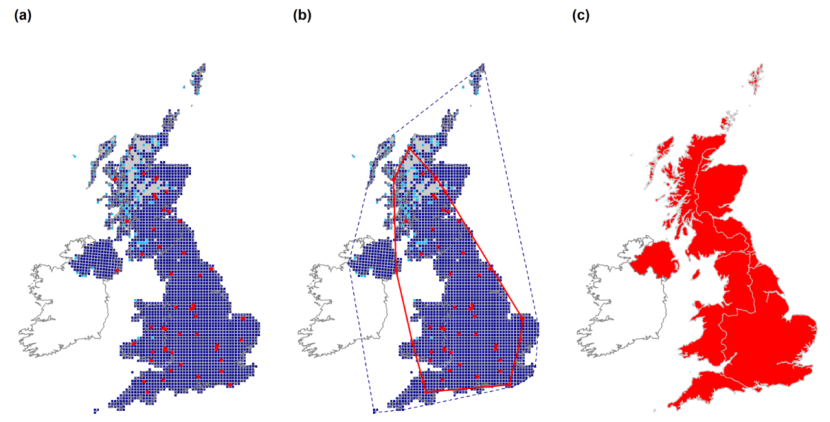
Seed collections in the Millenium Seed Bank (MSB) cover
Click for a full description
Dark blue = species distribution, red = represented in ex situ collection, light blue= pre 2000 records.
- (a) 49 of 2677 occupied 10-km squares (2%)
- (b) an EOO of 233,408 km² out of 556,157 km² occupied (42%)
- (c) 5 out of 5 Regions of Provenance (100%)
Current conservation actions
Species largely protected by wider habitat management efforts
| Ex situ | Translocation | Habitat management | Legal protection of habitat or species | Regulation of exploitation | Control of INNS/pests/pathogens |
|---|---|---|---|---|---|
| X | - | - | - | - | - |
Population assessment/monitoring
Population
Demographic
N pops assessed/monitored in Scotland = 2/2
N pops assessed/monitored in UK = 5/5
Genetic
N pops assessed/monitored in Scotland = 0/2
N pops assessed/monitored in UK = 0/5
Further Research
Genetic surveys utilising the Darwin Tree of Life reference genome (Christenhusz et al., 2024) and subsequent resequencing across populations would provide more directly quantified insights into patterns of genetic diversity and any patterns of hybridisation.
References
Anon 2023. Tree Seed Species Strategies. Report.
Atkinson, M.D. & Atkinson, E. 2002. Sambucus nigra L. Journal of Ecology, 90, 895-923.
Amphlett, A. (2024). Sambucus canadensis × S. nigra (Sambucaceae): a hybrid Elder in northern Scotland. British and Irish Botany, 6, 98-115.
Braithwaite, M.E., Ellis, R.W. & Preston, C.D. 2006. Change in the British Flora 1987-2004. Botanical Society of the British Isles, London.
Christenhusz, M. J. M., Leitch I. J., Royal Botanic Gardens Kew Genome Acquisition Lab et al. 2024. The genome sequence of black elder, Sambucus nigra Linnaeus, 1753 (Adoxaceae) [version 1; peer review: 2 approved]. Wellcome Open Res 2024, 9:609
Herbert, R., Samuel, S., & Patterson, G. (1999). Using Local Stock for Planting Native Trees and Shrubs. Forestry Commission Practice Note.
Stroh, P.A., Walker, K.J., Humphrey, T.A., Pescott, O.L. and Burkmar, R.J., 2023. Plant atlas 2020: mapping changes in the distribution of the British and Irish Flora. Princeton University Press.
Assessors:
- Rebecca Yahr, Royal Botanic Garden Edinburgh
- Alicia Mastretta-Yanes, Royal Botanic Garden Kew
Reviewers:
- Iain Macdonald, NatureScot
- Pete Hollingsworth, Royal Botanic Garden Edinburgh
Last updated: