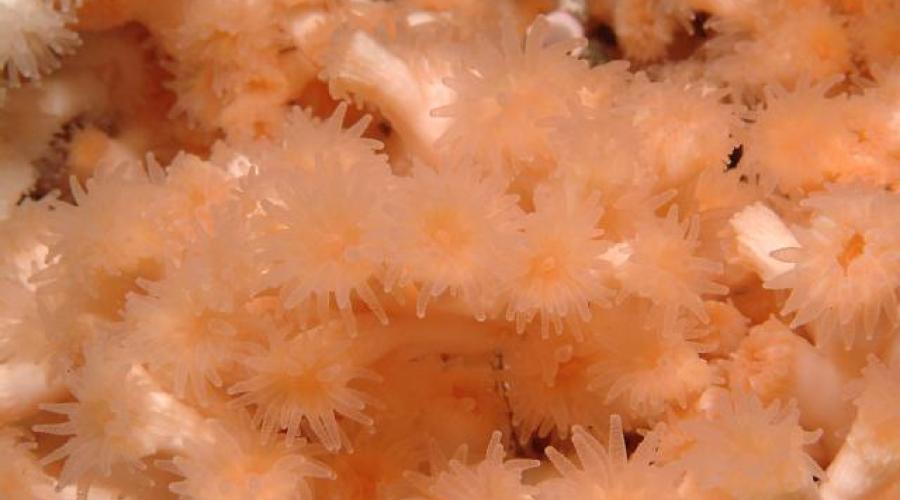
Genetic Scorecard Indicator - Cold Water Coral
Cold Water Coral (Desmophyllum pertusum (formerly Lophehila pertusa))

IUCN Category:
- Great Britain: Not Assessed (indicated above)
- Europe: Not Assessed
- Global: Vulnerable

Genetic Health Status:
- Scottish Risk: Serious (indicated above)
- UK Risk: Serious
- Scottish Mitigation status: Unknown if effective
- UK Mitigation status: Unknown if effective
Background
Desmophyllum pertusum is distributed throughout the North Atlantic, mainly on the continental slopes. Cold-water coral reefs have been recorded at Rockall, Hatton and George Bligh Banks, and Anton Dohrn, Rosemary Bank and Hebrides Terrace Seamounts, as well as the Wyville-Thomson Ridge and Darwin Mounds. A single example, Mingulay Reef, exists the in nearshore waters of the Sea of Hebrides.
D. pertusum is slow growing, with reefs developing over thousands of years; e.g. the coral from Mingulay reefs has been dated at 7700 years old (Douarin et al., 2013). D. pertusum is gonochoristic, with a seasonal broadcast of gametes and a high fecundity, providing an opportunity for long distance larval dispersal (Waller, 2005; Waller et al., 2023). They also generate new colonies asexually through budding and fragmentation (Cairns, 1979; Rogers, 1999). Growth rates of cold-water corals are variable with estimates of between 4 - 25 millimetres per year (Roberts, 2002; Gass & Roberts, 2006).
Molecular genetic studies in the Northeast Atlantic showed that D. pertusum is not a panmictic population but composed of genetically distinct offshore and fjordic subpopulations (Le Goff-Vitry et al., 2004; Le Goff-Vitry & Rogers, 2005; Jollivet et al., 2024). Where gene flow is occurring, the recruitment of sexually produced larvae is likely to be strongly local (Le Goff-Vitry et al., 2004). Additionally, D. pertusum demonsrates high phenotypic plasticity, with variation in polyp budding and corallite morphology being a responses to hydrographic factors (e.g. dissolved oxygen, temperature and flow speed) (Sanna, 2024).
Cold Water Coral reefs provide critical three-dimensional habitat for many ecologically and economically significant species (Henry et al., 2010; Kurman et al., 2017). The coral reefs provide an important blue carbon store (Burrows et al., 2014). D. pertusum reefs are an OSPAR threatened and / or declining habitat (OSPAR, 2008 & 2009) and are recognised as biogenic reefs under the Convention on the Conservation of European Wildlife and Natural Habitats (Evans & Roekaerts, 2019).
Current Threats
Cold-water corals are highly sensitive to demersal fishing activities (Davies et al., 2009; Dahl, 2013; Durán Muñoz 2011, 2012; Ragnarsson et al., 2017). Deep sea mining and oil and gas extraction have also been identified as potential threats (Ragnarsson et al., 2017; Liu et al., 2024). Climate change is a significant threat with ocean warming expected to lead to the significant loss of habitat (Hennige et al., 2020; Morato et al., 2020) and ocean acidification expected to impact coral health (Roberts & Cairns, 2014; Krueger et al., 2023).
Contribution of Scottish/UK population to total species diversity
Almost all UK records for D. pertusum occur in Scottish waters. These populations are considered to be relatively well connected (Roberts, 2002; Fox et al., 2016; Sanna, 2024).
Genetic risks
Diversity loss: population declines
Cold Water Corals are slow growing and develop over thousands of years (Dahl, 2013). Consequently, they are slow to recover from damage. OSPAR (2022) consider the extent of Cold Water Coral reefs to be declining, primarily as a result of fishing impacts, and hence there is a risk of the loss of genetic diversity.
Global Biodiversity Framework Indicators
Population definitions:
The population typology of D. pertusum reflects the combination of asexual and sexual reproduction, and their environmental requirements. Provisionally, three genetic groups have been identified in the NE Atlantic: a Mediterranean lineage, a Lusitanian lineage, which includes samples from the Azores, the Bay of Biscay, and some individuals of the Celtic Sea and Iceland, and a boreal lineage consisting of individuals from Iceland, the Celtic Sea and the North Sea (Sweden and Norway) (Jollivet et al., 2024). Due to asexual proliferation and the longevity of the clones, even a low-level and sporadic recruitment of sexually produced larvae from outside a given subpopulation might be sufficient to maintain genetic cohesion across the open slope (Dahl et al., 2012). In contrast, the Darwin Mounds coral population is clonal with a complete absence of reproductive corals (Le Goff-Vitry et al., 2004; Waller & Tyler 2005).
Ne500: The proportion of populations that have an effective population size of more than 500.
- Proportion of populations with Ne > 500 in Scotland = Unknown
- Proportion of populations with Ne > 500 in UK = Unknown
The effective population size of Cold Water Corals in UK cannot be meaningfully assessed.
PM: Proportion of populations that existed in 2000 that still exist in 2025.
- Proportion of populations maintained in Scotland = 2/2
- Proportion of populations maintained in UK = 2/2
Scotland: Almost all UK records for D. pertusum reefs occur in Scottish waters, particularly along the shelf edge but with one inshore location, with two distinct populations identified (Jollivet et al., 2024).
GB/UK: Outwith Scotland, there is a single record of a Cold Water Coral reef in the southwest. D. pertusum reefs are generally considered to be in a poor condition in UK waters (OSPAR, 2022; Scottish Government, 2024).
Diversity loss: functional variation
Functional variation
D. pertusum have high rates of clonal reproduction, with some individual clones being several thousands of years old (Dahl, 2013). Populations are typically founded by a relatively low number of genetic individuals (Dahl et al., 2012). Sexual reproduction provides some connectivity across the NE Atlantic, which is sporadic, asymmetric and mainly driven by large-scale oceanographic currents in a north-south direction (Le Goff-Vitry & Rogers, 2002, 2005; Dahl et al., 2012; Dahl, 2013).
Divergent lineages
Three linages have been provisionally identified in European waters (Jollivet et al., 2024). Although Cold Water Corals spawn annually and the larvae provide a mechanism for dispersal, this is not generally considered sufficient to counteract the reproductive isolation of some populations. Where gene flow does occur, the recruitment of sexually produced larvae can be strongly local (Le Goff-Vitry et al., 2004). Together this suggests that the species could be vulnerable to the loss of divergent lineages.
Hybridisation/Introgression
No evidence of hybridisation or introgression has been recorded.
Low turnover - constraints on adaptive opportunities
Asexual reproduction dominates. Connectivity between reefs is thought to be driven by circulation patterns (Fox et al., 2016; Guy et al., 2025), with the presence of anthropogenic structures (i.e. offshore wind turbines and oil platforms), potentially increasing connectivity by providing stepping stone populations (Henry et al., 2018; Moyorga-Adame et al., 2022). D. pertusum may contain sufficient genetic variability to adapt to future ocean acidification in some regions (Kurman et al., 2017; Georgian et al., 2016).
Cumulative Risk Summary
Overall Genetic Health Status
Scotland
- Risk: Serious
- Mitigation: Unknown if effective
GB/UK
- Risk: Serious
- Mitigation: Unknown if effective
There are threats from fishing and climate change which threaten genetic diversity, but relatively little baseline /monitoring data available at a national level. Corals are very slow to recover once damaged.
Overall Genetic Health status explanation
Cold Water Corals comprise genetically distinct offshore and fjordic subpopulations. Anthropogenic impacts including demersal fishing present ongoing genetic risks, with climate change potentially leading to the loss of >85% of our reef habitat.
In situ genetic threat level
In situ genetic threat level
- In situ Risk for Scotland: Serious
- In situ Risk for UK: Serious
Genetically distinct offshore and fjordic subpopulations, anthropogenic impacts including demersal fishing present ongoing genetic risks, climate change may result in the loss of >85% of our reef habitat.
Confidence in in situ threat level
- Confidence score for Scotland: High
- Confidence score for UK: High
Assessment based on combination of Scottish and non-UK, genetic data, known biology and population differentiation.
Ex situ representation
None, although some specimens may be kept in research facilities.
Current conservation actions
Cold-water coral reefs are a priority marine feature (PMF) in Scotland’s seas, which means that National Marine Plan General Policy GEN 9b applies. This ensures that development and use of the marine environment does not have a significant effect on their national status.
There are 8 marine protected areas designated for D. pertusum. These are:
- East Mingulay Special Area of Conservation (SAC)
- Anton Dohrn Seamount SAC
- Darwin Mounds SAC
- East Rockall Bank SAC
- Hatton Bank SAC
- North West Rockall Bank SAC
- The Canyons Marine Conservation Zone (MCZ)
- West of Scotland Nature Conservation MPA (NCMPA)
Fisheries measures have been implemented in these MPAs in order to protect the Cold Water Coral.
The Scottish Biodiversity Strategy to 2045, the Scottish Biodiversity Duty and UK Marine Strategy Good Environmental Status provide further drivers to ensure biological diversity is restored, and ecosystems are safeguarded. Removing anthropogenic pressures can lead to recovery of ecosystem function in the short term and structural reef in the longer term (decades) (Buhl-Mortensen, 2017; Beazley et al., 2021). Therefore, ensuring that all pressures are removed from marine protected areas established for the conservation of D. pertusum will be crucial for promoting resilience and allow the species the space to adapt to climate change over the coming decades (OSPAR, 2022).
Efforts to aid restoration of Cold Water Corals are also being considered. These include translocation and the provision of artificial structures to improve settlement on degraded reefs (e.g. Montseny et al., 2021; Strong et al., 2023).
| Ex situ | Translocation | Habitat management | Legal protection of habitat or species | Regulation of exploitation | Control of INNS/pests/pathogens |
|---|---|---|---|---|---|
| - | X | X | X | - | - |
Population assessment/monitoring
Population
Demographic
N pops assessed/monitored in Scotland = 0/2
N pops assessed/monitored in UK = 0/2
Scotland: Routine monitoring of protected sites with Cold Water Corals is undertaken at irregular intervals depending on the prioritisation and risks identified by Marine Directorate, NatureScot and JNCC.
UK: Monitoring of The Canyons MPA is ad hoc and undertaken by JNCC.
Genetic
N pops assessed/monitored in Scotland = 0/2
N pops assessed/monitored in UK = 0/2
Scotland: Specific monitoring of population genetics data on the number of populations genetically monitored is limited and likely to be ad hoc.
UK: Genetic surveys of UK populations are ad hoc and rare.
Further Research
- Improved understanding of baseline genetics of Cold Water Coral populations in Scotland/UK.
- Improved understanding of the condition of Cold Water Coral reefs to determine the effectiveness of conservation measures that have been introduced.
References
Beazley L., Kenchington, E, Korabik M, Fenton D, King M. 2021. Other effective area-based conservation measures promote recovery in a cold-water coral reef. Global Ecology and Conservation 26 e01485
Buhl-Mortensen, P. 2017. Coral reefs in the Southern Barents Sea: habitat description and the effects of bottom fishing, Marine Biology Research, 13(10), 1027–1040
Burrows M.T., Kamenos N.A., Hughes D.J., Stahl H., Howe J.A. & Tett P. 2014. Assessment of carbon budgets and potential blue carbon stores in Scotland’s coastal and marine environment. Scottish Natural Heritage Commissioned Report No. 761.
Cairns, S.D. 1979. The deep-water Scleractinia of the Caribbean Sea and adjacent waters. Studies on the Fauna of Curaçao and other Caribbean Islands, 57(1): 1-34.
Dahl M.P. et al., 2012 Fine-scale spatial genetic structure and clonal distribution of the cold-water coral Lophelia pertusa. Coral Reefs, 31, 1135–1148.
Davies, A.J., Green, S.L., Long, D. & Roberts, J.M. 2009. Developing the necessary data layers to inform the development of a site boundary for the East Mingulay dSAC - Phase II. Scottish Natural Heritage Commissioned Report No. 306.
Douarin, M., Elliot, M., Noble, S.R., Sinclair, D., Henry, L-A., Long, D., Moreton, S.G. & Roberts, J.M. 2013. Growth of north-east Atlantic cold-water coral reefs and mounds during the Holocene: a high resolution U series and 14C chronology. Earth & Planetary Science Letters, 375: 176-187.
Durán Muñoz, P., Murillo, F.J., Sayago-Gil, M., Serrano, A., Laporta, M., Otero, I. and Gómez, C. 2011. Effects of deep-sea bottom longlining on the Hatton Bank fish communities and benthic ecosystem, north-east Atlantic. Journal of the Marine Biological Association of the United Kingdom, 91(4), 939-952.
Durán Muñoz, P., Sayago-Gil, M., Patrocinio, T., González-Porto, M., Murillo, F.J., Sacau, M.,González, E., Fernández, G., and Gago, A. 2012. Distribution patterns of deep-sea fish and benthic invertebrates from trawlable grounds of the Hatton Bank, north-east Atlantic: effects of deep-sea bottom trawling. Journal of the Marine Biological Association of the United Kingdom 92(07): 1509-1524.
Evans, D. & Roekaerts, M. 2019. Interpretation manual of the habitats listed in Resolution No. 4 (1996) listing endangered natural habitats requiring specific conservation measures. T-PVS/PA (2019) 18
Fosså, J., Mortensen, P. & Furevik, D. 2002. The deep-water coral Lophelia pertusa in Norwegian waters: distribution and fishery impacts. Hydrobiologia 471: 1-12.
Fox A.D., Henry L-A., Corne D.W., Roberts J.M. 2016. Sensitivity of marine protected area network connectivity to atmospheric variability. Royal Society Open Science, 3(11): 160494.
Gass, S.E. & Roberts, J.M. 2006. The occurrence of the cold-water coral Lophelia pertusa (Scleractinia) on oil and gas platforms in the North Sea: colony growth, recruitment and environmental controls on distribution. Marine Pollution Bulletin, 52(5): 549-559.
Georgian et al. 2016. Biogeographic variability in the physiological response of the cold‐water coral Lophelia pertusa to ocean acidification. Marine Ecology 37: 1345-1359.
Guy, G. et al 2025. Stable connections in the deep sea: Temporally consistent larval pathways for the deep-sea coral, Lophelia pertusa (=Desmophyllum pertusum) in the Northwest Atlantic Ocean. Deep–Sea Research, 218, 104462
Henry et al., 2010. Beta diversity of cold-water coral reef communities off western Scotland. Coral Reefs, 29:427–436
Hennige, S.J. Wicks, L.C. Kamenos, N.A. Perna, G. Findlay, H.S. & Roberts J.M. 2015. Hidden impacts of ocean acidification to live and dead coral framework. Proceedings of the Royal Society B, 282(1813): 20150990
Hennige, S.J. Wolfram, U. Wickes, L.C. Murray, F. Roberts, J.M. Kamenos, N.A. Schofield, S.Groetsch, A. Spiesz, E.M. Aubin-Tam, M. & Etnoyer, P.J. 2020. Crumbling Reefs and Cold-Water Coral Habitat Loss in a Future Ocean: Evidence of “Coralporosis” as an Indicator of Habitat Integrity. Frontiers in Marine Science, 7(668): 1-16.
Holt, T.J., Rees, E.I., Hawkins, S.J. & Seed, R. 1998. Biogenic reefs (volume IX). An overview of dynamic and sensitivity characteristics for conservation management of marine SACs. Scottish Association of Marine Science (UK Marine SACs Project).
Jackson, E. L., Davies, A. J., Howell, K. L., Kershaw, P. J. and Hall-Spencer, J. M. (2014). Futureproofing marine protected area networks for Cold Water Coral reefs. ICES Journal of Marine Science, 71(9): 2621–2629.
Jollivet, D., Portanier, E., Tran Lu Y, A., Matabos, M., Pradillon, F., Arnaud-Haond, S. (2024). Preferential pathways of dispersal and role of the AMOC in connectivity. IAtlantic Deliverable 1.5
Krueger et al., 2023. Wanted Dead or Alive: Skeletal Structure Alteration of Cold-Water Coral Desmophyllum pertusum (Lophelia pertusa) from Anthropogenic Stressors. Oceans, 4(1), 68-79
Kurman et al. 2017. Intra-specific variation reveals potential for adaptation to ocean acidification in a cold-water coral from the Gulf of Mexico. Front. Mar. Sci., 04
Le Goff-Vitry, M. C., Pybus, O. G., & Rogers, A. D. (2004). Genetic structure of the deep-sea coral. Molecular Ecology, 13, 537–549
Le Goff, M.C. and Rogers, A.D. (2002). Characterization of 10 microsatellite loci for the deep-sea coral Lophelia pertusa (Linnaeus 1758). Molecular Ecology Notes, 2, 164–166.
Le Goff-Vitry, M-C. and Rogers, A.D (2005) Molecular ecology of Lophelia pertusa in the NE Atlantic. Freiwald, A. and Roberts, J.M. (eds.) In Cold-water corals and ecosystems. Springer. pp. 653-662.
Liu et al. (2024) CORDAP R and D roadmap for conservation and restoration of cold-water corals. CORDAP
Mayorga-Adame CG, Polton JA, Fox AD, Henry LA (2022) Spatiotemporal scales of larval dispersal and connectivity among oil and gas structures in the North Sea. Mar Ecol Prog Ser 685:49-67
Montseny, M., Linares, C., Carreiro-Silva, M., Henry, L.-A., Billett, D., Cordes E.E., Smith, C.J., Papadopoulou, N., Bilan, M., Girard, F., Burdett, H.L., Larsson, A., Strömberg, S., Viladrich, N., Barry, J.P., Baena, P., Godinho, A., Grinyó, J., Santínn A., Morato, T., Sweetman, A.K., Gili, J.-M., Gori, A. (2021). Active Ecological Restoration of Cold-Water Corals: Techniques, Challenges, Costs and Future Directions. Frontiers in Marine Science, 8
Morato, T. et al. 2020. Climate-induced changes in the suitable habitat of cold-water corals and commercially important deep-sea fishes in the North Atlantic. Global Change Biology 26: 2181-2202
Morrissey, D. & Allcock, A.L. 2024. Desmophyllum pertusum. The IUCN Red List of Threatened Species 2024: e.T195215A166021306
OSPAR. 2008. Case Reports for the OSPAR List of Threatened and/or Declining Species & Habitats. OSPAR Commission, 2008. Publication number: 358. ISBN 978-1-905859-97-9
OSPAR. 2009. Background document for Lophelia pertusa reefs. ISBN 978-1-906840-63-1
OSPAR, 2022. Status Assessment 2022 - Lophelia pertusa reefs
Ragnarsson, S.Á. et al. (2017). The Impact of Anthropogenic Activity on Cold-Water Corals. In: Rossi, S., Bramanti, L., Gori, A., Orejas , C. (eds) Marine Animal Forests. Springer, Cham.
Roberts, J.M. 2002. The occurrence of the coral Lophelia pertusa and other conspicuous epifauna around an oil platform in the North Sea. Journal for the Society for Underwater Technology, 25(2): 83-91.
Roberts, J. M., and Cairns, S. D., 2014. Cold-water corals in a changing ocean. Current Opinion in Environmental Sustainability, 7, 118-126.
Rogers, A.D. 1999. The biology of Lophelia pertusa (Linnaeus, 1758) and other deep-water reef-forming corals and impacts from human activities. International Review of Hydrobiology, 84(4): 315-406.
Ross, R.E., Nimmo-Smith, W.A.M. and Howell, K.L. 2017. Towards ‘ecological coherence’: Assessing larval dispersal within a network of existing Marine Protected Areas. Deep Sea Research Part I: Oceanographic Research Papers, 126: 128–138.
Scottish Government 2024. Fisheries Management Measures within Scottish Offshore Marine Protected Areas (MPAs). Site Proposal Document
Strong, J.A., Piechaud, N., De Clippele, L.H., Bett, B.J., Horton, T., Corbera, G. and Huvenne, V.A.I. (2023), Recovery and restoration potential of cold-water corals: experience from a deep-sea marine protected area. Restoration Ecology, 31, e13970
Waller R.G., Tyler P.A. 2005. The reproductive biology of two deep-water, reef-building scleractinians from the NE Atlantic Ocean. Coral Reefs, 24: 514–522.
Waller, R.G., Goode, S., Tracey, D., Johnstone, J., Mercier, A., 2023. A review of current knowledge on reproductive and larval processes of deep-sea corals. Mar. Biol. 170, 58
For Kobo:
Assessor:
- Emma-Louise Smith (University of Edinburgh)
- Eunice Pinn (NatureScot)
Reviewer: Alex Thomson (Seawilding)