Genetic Scorecard Indicator - British bluebell
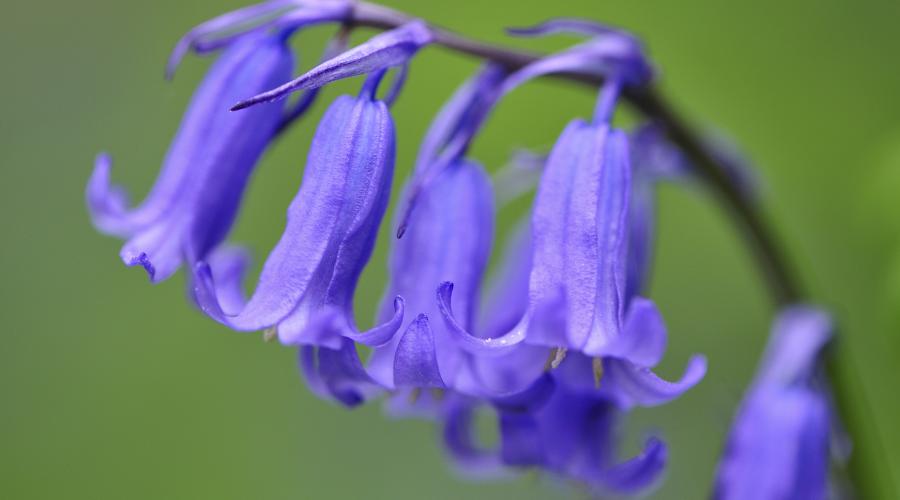
British bluebell (Hyacinthoides non-scripta)

IUCN Category:
- Great Britain: Least concern (indicated above)
- Europe: Not Evaluated
- Global: Not Evaluated

Genetic Health Status:
- Scottish Risk: Negligible (indicated above)
- UK Risk: Negligible
- Scottish Mitigation status: Mitigation effective
- UK Mitigation status: Mitigation effective
Background
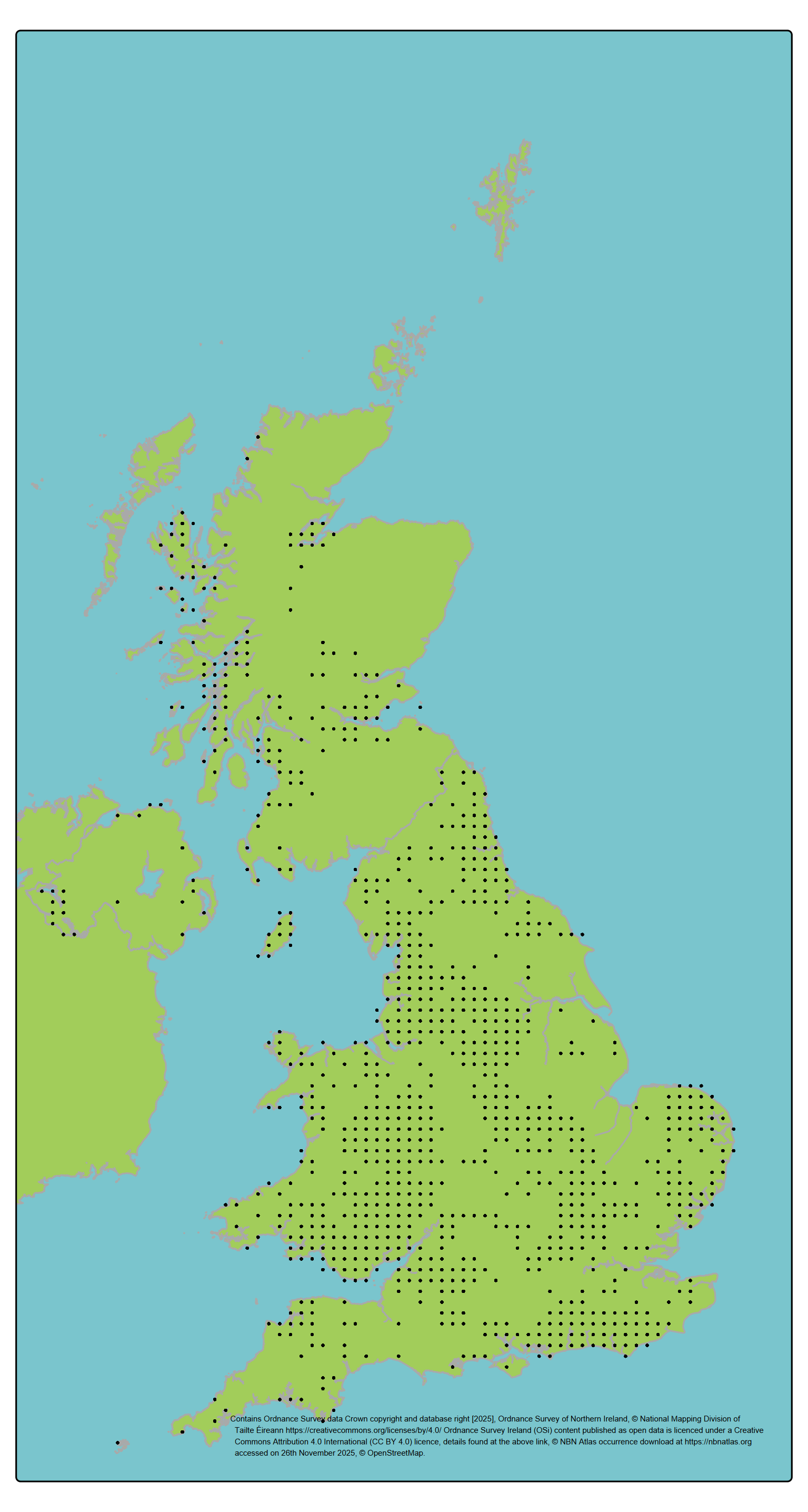
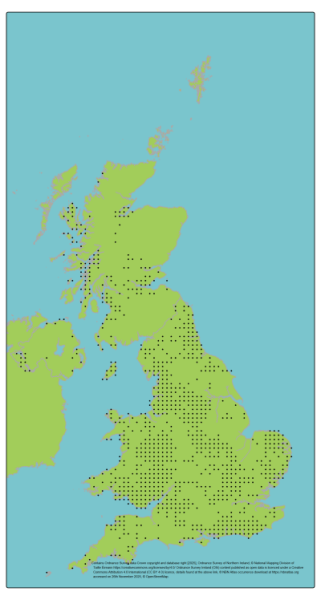
The British bluebell is a diploid herbaceous predominantly outcrossing perennial, able to reproduce sexually via seed and asexually via bulbs. It is widespread and abundant in the UK, with strongholds in woodlands and more open habitats towards the west-coast (Kohn et al., 2009; Stroh et al., 2023).
View a larger version of the distribution map for the British Bluebell.
Current Threats
Introduced non-natives or “Spanish bluebells” (likely originally to have been horticultural introductions of Hyacinthoides hispanica from the Iberian peninsula and later of commercial varieties of uncertain provenance, often sold as H. hispanica but now widely ascribed to the hybrid, H. x massartiana, between H. non-scripta and H. hispanica) have been considered to be a major threat to the British bluebell either via competitive displacement or extinction by hybridisation (summarised in Kohn et al., 2019). Non-natives occur frequently throughout the range of H. non-scripta, particularly near urban areas, roadsides, and other sites of human disturbance.
Contribution of Scottish/UK population to total species diversity
The British Isles are the global stronghold for the British bluebell, and the species is abundant in Scotland, with many populations far from urban centres and hence likely to have more limited co-occurrence (and thus hybridisation potential) with non-natives (Kohn, 2009). The Scottish/UK population is thus globally important from a demographic perspective and may contain unique locally adapted variants.
Genetic risks
Diversity loss: population declines
No clear evidence for demographic declines. The species is widespread and abundant across the UK. There is the possibility of loss via competition with the non-native bluebell in the UK, but the current evidence of high bulb densities suggests physical encroachment is likely to have limited effects.
Global Biodiversity Framework Indicators
Population definitions:
Populations are defined based on management units. This species is widely and continuously distributed across UK in large numbers (Stroh et al., 2023; NBN, 2025). The four Great British Regions of Provenance (Herbert et al., 1999) were selected here to represent the major population groupings / management units (treating Northern Ireland as an additional region) as they broadly reflect the environmental variation across which the species is distributed and are likely to capture major patterns of genetic structure.
Ne500: The proportion of populations that have an effective population size of more than 500.
- Proportion of populations with Ne > 500 in Scotland = 2/2
- Proportion of populations with Ne > 500 in UK = 5/5
PM: Proportion of populations that existed in 2000 that still exist in 2025.
- Proportion of populations maintained in Scotland = 2/2
- Proportion of populations maintained in UK = 5/5
Diversity loss: functional variation
Functional variation
No evidence for loss of adaptive variants. The species remains common and abundant across the UK.
Divergent lineages
As the British Isles are the global stronghold of the species, any decline in the UK runs the risk of loss of unique diversity. However, at present, there is no evidence for catastrophic loss across its range in the UK.
Hybridisation/Introgression
Hybridisation has been considered a major concern. There is very high co-occurrence with non-native bluebell, and the concern is particularly acute for important large natural populations in ancient woodlands close to urban areas. However, recent genetic data shows that the native bluebell has a fertility advantage compared to non-natives, and considerably greater numbers of individuals (Kohn et al., 2009, 2019; Ruhsam et al., 2023). Thus, although persistent, naturalised non-natives are widespread and continued crossing at low levels can be expected, it is unlikely to lead to systematic and widespread genetic diversity loss in the H. non-scripta.
Low turnover - constraints on adaptive opportunities
No evidence of limitation to recruitment. Populations appear to reproduce via a mixture of sexual and asexual reproduction (Blackman & Rutter, 1954; Wilson, 1959).
Cumulative Risk Summary
Overall Genetic Health Status
Scotland
- Risk: Negligible
- Mitigation: Mitigation effective
Great Britain/UK
- Risk: Negligible
- Mitigation: Mitigation effective
Overall Genetic Health status explanation
There is a clear threat from non-native bluebells; however, the sheer numbers of the native bluebell, the longevity of individual plants via bulb production, and its greater fertility mean that in the immediate future there is limited threat to the overall genetic diversity of the British bluebell. Growing awareness of the problems from non-native bluebells should help and reduce horticultural sales and plantings near native woodland populations.
In situ genetic threat level
In situ genetic threat level
- In situ Risk for Scotland: Moderate
- In situ Risk for UK: Moderate
High co-occurrence with non-native bluebells with hybridisation and competition a clear threat at individual sites; however, the reduced fertility of non-natives, perennation and reproduction by bulbs, and the numerical supremacy of the native bluebell substantially limits any threat of overall catastrophic losses.
Confidence in in situ threat level
- Confidence score for Scotland: High
- Confidence score for UK: High
Assessment based on extensive genetic data and quantitative demographic surveys
Ex situ representation
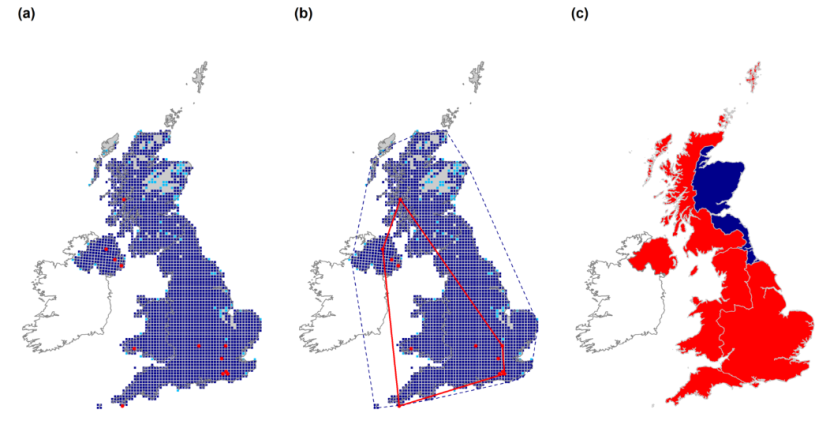
Seed collections in the Millenium Seed Bank (MSB) cover.
Click for a full description
Dark blue = species distribution, red = represented in ex situ collection, light blue= pre 2000 records.
- (a) 12 of 2606 occupied 10-km squares (<1%)
- (b) an EOO of 170,781 km² out of 449,809 km² occupied (38%)
- (c) 4 out of 5 Regions of Provenance (80%)
Current conservation actions
Promotion of pollinator-friendly management provides an opportunity for lowland populations of bluebell to increase.
| Ex situ | Translocation | Habitat management | Legal protection of habitat or species | Regulation of exploitation | Control of INNS/pests/pathogens |
|---|---|---|---|---|---|
| X | - | X | X | - | X |
Population assessment/monitoring
Population
Demographic
N pops assessed/monitored in Scotland = 2/2
N pops assessed/monitored in UK = 5/5
Genetic
N pops assessed/monitored in Scotland = 2/2
N pops assessed/monitored in UK = 5/5
Further Research
Continued genetic surveys using whole genome sequencing methods to assess the extent of any cryptic introgression into populations of H. non-scripta, from introduced Spanish bluebells.
References
Blackman, G.E. & Rutter, A.J. 1954. Endymion nonscriptus (L.) Garcke. Journal of Ecology, 42(2), 629-638.
Herbert, R., Samuel, S., & Patterson, G. (1999). Using Local Stock for Planting Native Trees and Shrubs. Forestry Commission Practice Note.
Kohn, D.D., Hulme, P.E., Hollingsworth, P.M. & Butler, A. 2009. Are native bluebells (Hyacinthoides non-scripta) at risk from alien congenerics? Evidence from distributions and co-occurrence in Scotland. Biological Conservation, 142(1), 61-74.
Kohn, D.D., Ruhsam, M., Hulme, P.E., Barrett, S.C.H. & Hollingsworth, P.M. 2019. Paternity analysis reveals constraints on hybridization potential between native and introduced bluebells (Hyacinthoides). Conservation Genetics, 20(3), 571-584.
Ruhsam, M., Kohn, D., Marquardt, J., Leitch, A. R., Schneider, H., Vogel, J. C., Barrett, S. C. H., Hulme, P. E. & Hollingsworth, P. M. (2023). Is hybridisation with non-native congeneric species a threat to the UK native bluebell Hyacinthoides non-scripta? PLANTS, PEOPLE, PLANET, 5(6), 963-975
Stroh, P.A., Walker, K.J., Humphrey, T.A., Pescott, O.L. and Burkmar, R.J., 2023. Plant atlas 2020: mapping changes in the distribution of the British and Irish Flora. Princeton University Press.
Wilson, J.Y., 1959. Vegetative reproduction in the bluebell, Endymion nonscriptus (L.) Garcke. The New Phytologist, 58(2), 155-163.
Assessor: Pete Hollingsworth, Royal Botanic Garden Edinburgh
Reviewer: Deborah Kohn, Royal Botanic Garden Edinburgh
Last updated: