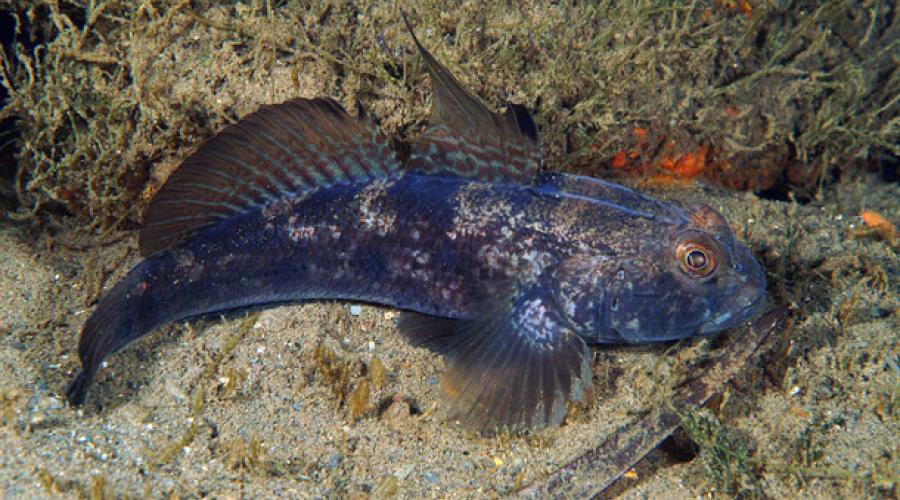
Genetic Scorecard Indicator - Black Goby
Black Goby (Gobius niger )

IUCN Category:
- Great Britain: Least concern (indicated above)
- Europe: Least concern
- Global: Least concern

Genetic Health Status:
- Scottish Risk: Negligible (indicated above)
- UK Risk: Negligible
- Scottish Mitigation status: Not required
- UK Mitigation status: Not required
Background
The black goby, a species of ray-finned fish, has a large distribution from the Norwegian coast to Mauritania including the Mediterranean, Black and Baltic Seas (Brittain et al., 2024; Fishbase). In the United Kingdom, the species is more common on the western and southern coasts but rare in the east and inhabits soft-bottomed (sandy or muddy), shallow waters. Black goby are under recorded and probably more widely distributed (MarLIN). The mating system is polygynous with alternative male mating tactics where smaller males adopt a "sneaker" tactic, releasing sperm when the larger males are spawning (Mazzoldi & Rasotto, 2002).
Previous genetic studies include the development of a microsatellite panel for population genetic analyses (Ruggeri et al., 2012), phylogeography (Lamkhalkhal et al., 2023) and a genome study that describes the first genome for the species (Brittain et al., 2024). However, no genetic studies have been undertaken in UK populations.
Current Threats
Black gobies are sensitive to changes in the environment which make them vulnerable to habitat degradation. Other threats include pollution and the introduction of invasive fish such as round gobies (Neogobius melanostomus) which compete and predate on black gobies.
Contribution of Scottish/UK population to total species diversity
Information is currently lacking regarding whether populations in the UK and Scotland are differentiated from other populations. It is likely that populations from the UK/Scotland are not differentiated from other populations. The population in the UK/Scotland does not represent an internationally important population and the species is not endemic to the UK or Scotland.
Genetic risks
Diversity loss: population declines
The current large population of black goby in the UK and Scotland suggests there is no threat of diversity loss due to population declines. Although the species is under-recorded, it can be assumed that the population is large (> 5,000 individuals).
Global Biodiversity Framework Indicators
Population definitions:
The populations are defined based on geographic boundaries. No data are available but the species has moderate dispersal abilities. Therefore, the UK was treated as one continuous population (see map).
Ne500: The proportion of populations that have an effective population size of more than 500.
- Proportion of populations with Ne > 500 in Scotland = 1/1
- Proportion of populations with Ne > 500 in UK = 1/1
PM: Proportion of populations that existed in 2000 that still exist in 2025.
- Proportion of populations maintained in Scotland = 1/1
- Proportion of populations maintained in UK = 1/1
Diversity loss: functional variation
Functional variation
No evidence of risks to loss of functional variation.
Divergent lineages
No evidence of divergent lineages or loss.
Hybridisation/Introgression
No evidence of hybridisation/introgression.
Low turnover - constraints on adaptive opportunities
No evidence of constraints on adaptive opportunities. The species is common and widespread in various coastal habitats around the UK. Due to difficulties in identifying the species (mistaken for other goby species) and cryptic colouration, it is likely under reported (MarLIN).
Cumulative Risk Summary
Overall Genetic Health Status
Scotland
- Risk: Low
- Mitigation: Not required
Great Britain/UK
- Risk: Low
- Mitigation: Not required
Overall Genetic Health status explanation
No data available but due to large population size, the species in Scotland and the UK should be genetically healthy.
In situ genetic threat level
In situ genetic threat level
- In situ Risk for Scotland: Negligible
- In situ Risk for UK: Negligible
No data available but due to the current large population there are likely no genetic risks.
Confidence in in situ threat level
- Confidence score for Scotland: Medium
- Confidence score for UK: Medium
No data available but given the current large population a medium confidence in the in situ threat level can be assumed.
Ex situ representation
There are no ex-situ populations.
Current conservation actions
No conservation actions.
| Ex situ | Translocation | Habitat management | Legal protection of habitat or species | Regulation of exploitation | Control of INNS/pests/pathogens |
|---|---|---|---|---|---|
| - | - | - | - | - | - |
Population assessment/monitoring
Population
Demographic
- N pops assessed/monitored in Scotland = 0/1
- N pops assessed/monitored in UK = 0/1
Genetic
- N pops assessed/monitored in Scotland = 0/1
- N pops assessed/monitored in UK = 0/1
Useful links
References
Brittain, R., Adkins, P., Harley, J. et al., 2024. The genome sequence of the Black Goby, Gobius niger Linnaeus, 1758 [version 1]. Wellcome Open Research, 9, 153,
Lamkhalkhal, A., Selfati, M., Rahmouni, I. et al., 2023. The black goby Gobius niger Linnaeus, 1758 in the Marchica lagoon (Alboran Sea, Morocco): spatial-temporal distribution and its environmental drivers, and the site-related footprint. BioRxiv preprint
Mazzoldi, C. & Rasotto, M.B. 2002. Alternative male mating tactics in Gobius niger. Journal of Fish Biology, 61, 157-172.
Ruggeri, P., Spendiani, A., Giovannotti, M., Cerioni, P.N, Caputo, V. 2012. Isolation of novel microsatellite loci in the black goby (Gobius niger) and cross-amplification in other gobiid species (Perciformes, Gobiidae). Journal of Fish Biology, 81, 2044-2052.
Assessor: Isa-Rita Russo, University of Cardiff.
Reviewer: Linda Neaves, Murdoch University.