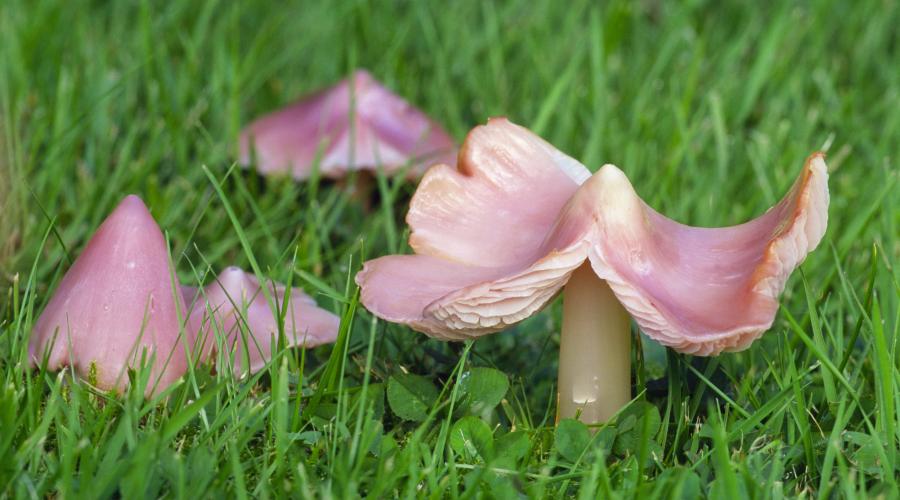
Genetic Scorecard Indicator - Ballerina Waxcap
Ballerina Waxcap (Porpolomopsis calyptriformis )

IUCN Category:
- Great Britain: Not Assessed (indicated above)
- Europe: Not Assessed
- Global: Vulnerable

Genetic Health Status:
- Scottish Risk: Negligible (indicated above)
- UK Risk: Negligible
- Scottish Mitigation status: Effective
- UK Mitigation status: Effetive
Background
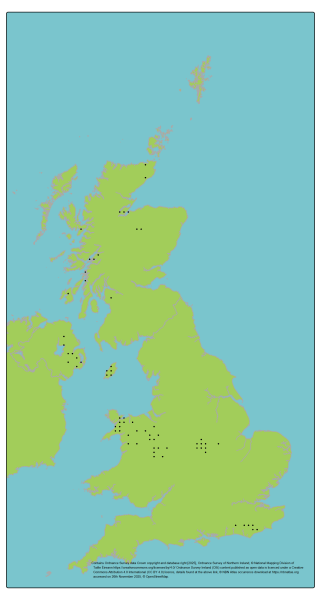
In the UK the Ballerina Waxcap is found in ancient grasslands. Its pale pink colour and tutu-like shape make it easy to identify, and it is widespread across the UK. With its ease of identification and selectiveness for old grasslands, this was considered an indicator of high diversity for grassland fungi in the SSSI guidelines (Bosanquet et al 2018). This species was on the original 1994 UK BAP list, However, with increased recording effort, it was found to be commoner than originally thought and was removed from the BRIG 2007 review (which is now also obsolete). Nevertheless, this species is iconic of older grasslands and easily recorded by citizen scientists.
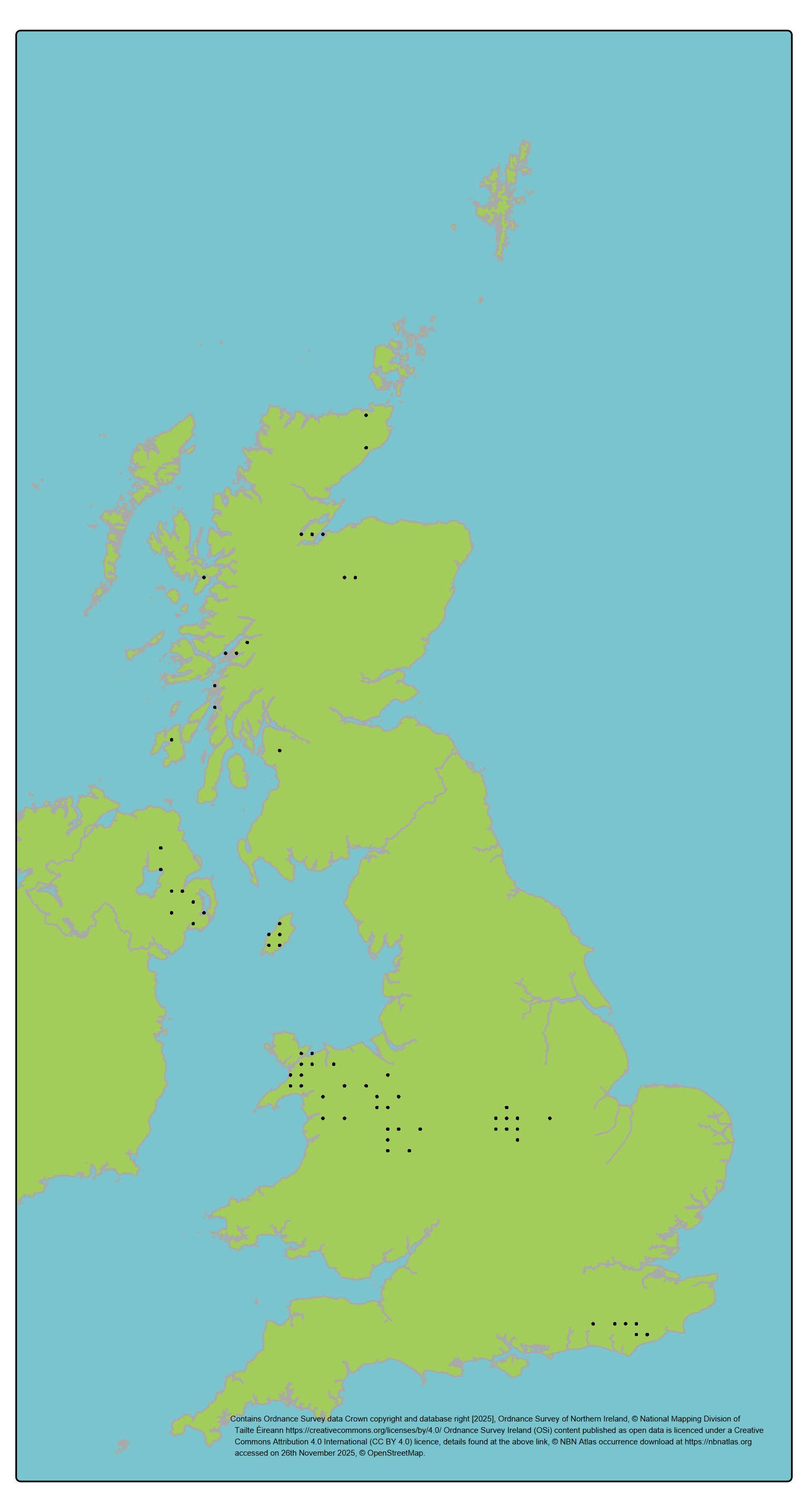
View a larger version of the distribution map for the Ballerina Waxcap.
Current Threats
The main threat is the rapid loss of ancient unimproved grassland due to development and land use change. Many sites are being lost due to the reduction of traditional grazing causing the ‘scrubbing up’ of grasslands, or the active planting of trees. This species is sensitive to fertilisers and pesticides. The loss of appropriate grassland and declining quality of habitats across Europe and the UK, as well as the long establishment time of the Ballerina Waxcap means it is currently losing sites faster than it is gaining them, leading to an IUCN Red List categorisation of Vulnerable (A2c+3c+4c) (Gonçalves, 2019).
Contribution of Scottish/UK population to total species diversity
Scotland (and the UK as a whole) has a significant proportion of the European population. There have been no studies into the genetic composition of Ballerina Waxcap within Europe. Although there are records from North America, there are notable morphological differences between them and the European population, suggesting they are different species.
The IUCN global Red List assessment (Gonçalves, 2019) treats Ballerina Waxcap as a Europe-only species.
Genetic risks
Diversity loss: population declines
The habitat of unimproved grassland has been heavily declining across Europe. It is therefore extremely likely that Ballerina Waxcap is also being lost. It is estimated that Ballerina Waxcap has had a decline of 30-50% across Europe in the last 50 years (Gonçalves, 2019). Because this species has a large fruiting population and spores are assumed to travel long distances, this species is less likely to suffer from inbreeding. However, if declines continue and distances between sites increase fragmentation, inbreeding and genetic drift may threaten populations.
Global Biodiversity Framework Indicators
Population definitions:
There is likely to be ongoing gene flow among sites due to the potential for spores to travel long distances.
Populations are defined based on management units. There is a wide distribution of Ballerina Waxcap across the UK, and there is likely to be ongoing gene flow among sites due to the potential for spores to travel long distances. The four GB Regions of Provenance (Herbert et al., 1999) were selected here to represent the major population groupings / management units (treating Northern Ireland as an additional region) as they broadly reflect the environmental variation across which the species is distributed and are likely to capture major patterns of genetic structure.
Ne500: The proportion of populations that have an effective population size of more than 500.
- Proportion of populations with Ne > 500 in Scotland = Not meaningfully calculable.
- Proportion of populations with Ne > 500 in UK = Not meaningfully calculable.
PM: Proportion of populations that existed in 2000 that still exist in 2025.
- Proportion of populations maintained in Scotland = 2/2
- Proportion of populations maintained in UK = 5/5
Diversity loss: functional variation
Functional variation
There is no sign of functional variation within Scotland or the UK.
Divergent lineages
Considered negligible risk as the travel of spores is unlikely to create meaningful population structure.
Hybridisation/Introgression
No research available.
Low turnover - constraints on adaptive opportunities
It takes many years for this species to establish and fruit, and it can only produce fruit bodies if the grass sward is at the right height. However, once established it can produce high numbers of spores.
Cumulative Risk Summary
Overall Genetic Health Status
Scotland
- Risk: Negligible
- Mitigation: Effective
Great Britain/UK
- Risk: Negligible
- Mitigation: Effective
Overall Genetic Health status explanation
There is likely to be ongoing gene flow among sites in Scotland due to the potential for spores to travel long distances. Though the distance between sites in the Highlands is quite far, it is also likely that there are sites that have not been discovered that act as genetic bridges.
In situ genetic threat level
In situ genetic threat level
- In situ Risk for Scotland: Negligible
- In situ Risk for UK: Negligible
Reasonably common fruiter but highly dispersible.
Confidence in in situ threat level
- Confidence score for Scotland: Medium
- Confidence score for UK: Medium
No research on genetic structure but large number of records.
Ex situ representation
Attempts to establish the species ex situ have been unsuccessful, and grassland fungi are thought to translocate poorly, though more trials would be beneficial.
Current conservation actions
Work is underway to understand the distribution of unimproved grasslands in Scotland. Once this has been completed this information can be used to inform development and forest creation planning.
| Ex situ | Translocation | Habitat management | Legal protection of habitat or species | Regulation of exploitation | Control of INNS/pests/pathogens |
|---|---|---|---|---|---|
| - | - | X | - | - | - |
Population assessment/monitoring
Population
Demographic
N pops assessed/monitored in Scotland = Not Assessed
N pops assessed/monitored in UK = Not Assessed
Genetic
N pops assessed/monitored in Scotland = Not Assessed
N pops assessed/monitored in UK = Not Assessed
References
Bosanquet, S.D.S., Ainsworth, A.M., Cooch, S.P., Genney, D.R, & Wilkins, T.C. 2018. Guidelines for the Selection of Biological SSSIs. Part 2: Detailed Guidelines for Habitats and Species Groups. Chapter 14 Nonlichenised Fungi. Joint Nature Conservation Committee, Peterborough.
BRIG. 2007. Report on the Species and Habitat Review (Report by the Biodiversity Reporting and Information Group (BRIG) to the UK Standing Committee). JNCC, Peterborough.
Gonçalves, S.C. 2019. Porpolomopsis calyptriformis. The IUCN Red List of Threatened Species 2019: e.T125434807A151188119.
Herbert, R., Samuel, S., & Patterson, G. (1999). Using Local Stock for Planting Native Trees and Shrubs. Forestry Commission Practice Note.
Assessor: Kat O’Brien
Reviewer: Rebecca Yahr