Genetic Scorecard Indicator - Atlantic Puffin
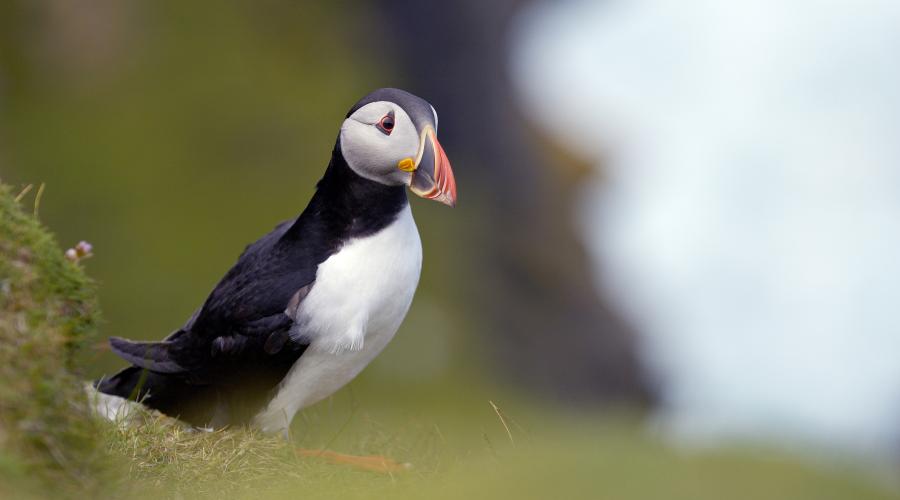
Atlantic Puffin (Fratercula arctica )

IUCN Category:
- Great Britain: Red List species under the Birds of Conservation Concern (indicated above)
- Europe: Endangered
- Global: Vulnerable

Genetic Health Status:
- Scottish Risk: Moderate (indicated above)
- UK Risk: Moderate
- Scottish Mitigation status: Partially effective
- UK Mitigation status: Partially effective
Background
The Atlantic puffin is migratory species found in rocky coastal areas and offshore islands throughout the North Atlantic Ocean (Nettleship et al 2014). It is well recognised for its large multicoloured bill displayed during the breeding season. The UK has most of the breeding populations of F. a. grabae, the smallest of the three forms of Atlantic puffin (which is the only form found in the UK). Puffins spend most of the year at sea, feeding on pelagic fishes and sandeel, plus occasionally juvenile demersal fishes, planktonic crustaceans and polychaete worms (Martin 1989, Harris et al., 2015). Puffins exhibit fidelity to their breeding colonies, although occasional natal dispersal has been noted at some colonies (Haris and Wanless, 2011).
Genetic studies have demonstrated genetic differentiation in the three forms/subspecies (Kersten et al., 2021). The only UK population assessed (Isle of May) exhibited a level of diversity similar to other island populations of puffin.
Puffins are known to exhibit fidelity to breeding sites, but there is evidence that suggest some natal dispersal. There is no genetic data to guide population subdivision, with only one site having been assessed. However, this distribution wide study suggests colonies elsewhere still fall into one of three genetic ESUs (corresponding to subspecies), one of which contains the UK populations (Kersten et al, 2021).
Current Threats
Prey shortages appear to be the greatest threat to Atlantic puffin (Durant et al. ,2006, Fayet et al 2021, Miles et al 2015). Puffins are highly susceptible to climate change, notably increase sea surface temperatures and the associated shifts in prey distribution, abundance and quality (Durant et al., 2003). This can cause mismatches between plankton blooms, prey abundance peaks and puffin breeding season, which can lead to breeding failures, poor chick growth, shorter nesting time and low fledging rate (Durant et al., 2006). Commercial harvesting of prey species can also lead to insufficient food supplies (Breton and Diamond, 2014).
Extreme weather events and storms can cause mass mortality events (Suárez-Santana et al., 2025), and the species is also vulnerable to oil spills and other forms of marine pollution. As with many seabirds, predation of chicks and eggs by invasive predators can present a substantial threat (Mitchell et al., 2004). Atlantic puffin have shown few impacts of highly pathogenic avian influenza (H5N1) (Macgregor et al., 2024). They may also be susceptible to collision with offshore marine wind turbines, although this may be low (Bradbury et al., 2014; Martin and Banks, 2023) and with associated underwater structures (Martin and Wanless, 2015).
Contribution of Scottish/UK population to total species diversity
The Scottish and UK populations represent the majority of breeding populations of the subspecies F. a. grabae (smallest form) and hence represent unique phenotypic and likely genetic diversity. This is ~ 8% of the global nominate species population, and 9% of the European breeding population (Burnell et al., 2023). Scotland contains approximately one fifth of the UK puffins.
Genetic risks
Diversity loss: population declines
The overall population and most key colonies are large. However, declines have been noted in many breeding populations, which does present a risk (Burnell et al., 2023). Overall, occupancy in 10km squares has dropped 26.8% in the breeding seasons (between 1968-72 and 2008-2011), and 53.4% in winter range (between 1981-84 and 2007-2011)(British Trust for Ornithology). There is no direct genetic evidence, but since puffin typically return to specific breeding colonies there is a chance that the loss of any core colony may represent the loss of unique diversity.
Global Biodiversity Framework Indicators
Population definitions:
Species is continually distributed and efficiently dispersed over wider geographically distances, treat as a single population.
Ne500: The proportion of populations that have an effective population size of more than 500.
- Proportion of populations with Ne > 500 in Scotland = 1/1 (point estimate: 696102 breeding individuals)
- Proportion of populations with Ne > 500 in UK = 1/1 (point estimate: 906902 breeding individuals)
PM: Proportion of populations that existed in 2000 that still exist in 2025.
- Proportion of populations maintained in Scotland = 1/1
- Proportion of populations maintained in UK = 1/1
Diversity loss: functional variation
Functional variation
Low risk within UK. Atlantic puffins in the UK represent the majority of populations of the smallest form of puffin, F. a. grabae.
Divergent lineages
The UK populations appear to represent a distinct genetic unit, corresponding to F. a. grabae, relative to the global population. Puffin are known to return to specific breeding sites, which may mean further subdivisions occur within the UK, but no data is available.
Hybridisation/Introgression
No evidence of hybridisation in F. a. grabae. Hybridisation between other subspecies of puffin is known to occur where they coexist (Kersten et al., 2023). There are no reported cases of hybridisation with other species.
Low turnover - constraints on adaptive opportunities
Atlantic puffins first breed after 5 years, and produce 1 offspring per year. This may limit their ability to adapt to changing conditions, such mismatches in food supply and breeding time due to climate change.
Cumulative Risk Summary
Overall Genetic Health Status
Scotland
- Risk: Moderate;
- Mitigation: Partially effective; Underway
Great Britain/UK
- Risk: Moderate;
- Mitigation: Partially effective; Underway
Overall Genetic Health status explanation
Overall, the population size of Atlantic puffin is large. However, populations are declining, likely due to reduced prey at key times which may rapidly increase in risk over time due to climate change. A lack of genetic data in the UK prevents and understanding of genetic loss and identification of genetic structure due to puffin returning to the same breeding sites. Low rates of turnover may hamper their ability to adapt to changing conditions.
In situ genetic threat level
In situ genetic threat level
In situ Risk
- In situ Risk for Scotland: Moderate
- In situ Risk for UK: Moderate
Large population size, but declines in population size and occupancy mean. Relatively low rate of turnover may limit their ability to adapt to changing conditions.
Confidence in in situ threat level
- Confidence score for Scotland: Medium
- Confidence score for UK: Medium
High quality regular long-term population monitoring but limited knowledge of precise threats leading to observed declines and the lack of direct genetic data.
Ex situ representation
There are no ex-situ populations
Current conservation actions
Regular monitoring, and protections habitat (many breeding locations are SPA or SSSI). Specific locations include control eradication of invasive predators. Since the species is associated with coastal areas and islands it is encompassed the Scottish Biodiversity Strategy (SBS) to 2045, specifically the 2045 goal to “Scotland’s internationally important species will have increased in numbers and have healthy resilient populations.” and “health, condition, and resilience of pelagic, coastal, shelf, and deep sea marine habitats will have been restored”. Ongoing management of fishing activities to reduce impacts, including timing of fishing and management of marine waste. Sandeel fishing has been banned in UK and Scottish waters since 2021 (with International Arbitration Panel ruling against challenges by the EU in 2025), although harvesting of other prey species continues. Conservation will also be supported by additional actions associated with the development of the Scottish seabird conservation action plan.
| Ex situ | Translocation | Habitat management | Legal protection of habitat or species | Regulation of exploitation | Control of INNS/pests/pathogens |
|---|---|---|---|---|---|
| - | - | - | X | - | X |
Population assessment/monitoring
Population
Demographic
- N population assessed/monitored in Scotland = 1/1 (comprising of ~129 colonies in 21 counties)
- N population assessed/monitored in UK = 1/1 (comprising of ~164 colonies in 34 counties)
Regular and detailed monitoring undertaken as part of Seabird surveys in 2000 (1998-2002) and 2020 (2015-2021), which include counts of occupied nests (Burnell et al. 2023).
Genetic
- N population assessed/monitored in Scotland = 0/1
- N population assessed/monitored in UK = 0/1
References
Bradbury, G.; Trinder, M.; Furness, B.; Banks, A.N.; Caldow, R.W.G.; Hume, D. 2014. Mapping seabird sensitivity to offshore wind farms. PLoS ONE 9(9): e106366.
Breton, A.R., and Diamond, A.W. 2014. Annual survival of adult Atlantic Puffins Fratercula arctica is positively correlated with Herring Clupea harengus availability. Ibis 156(1): 35-47.
Burnell, D. et al. (2023) Seabirds Count: A Census of Breeding Seabirds in Britain and Ireland (2015–2021). Barcelona, Spain: Lynx Nature Books.
Durant, J.; Anker-Nilssen, T.; Stenseth, N. C. 2003. Trophic interactions under climate fluctuations: the Atlantic puffin as an example. Proceedings of the Royal Society of London Series B 270: 1461-1466.
Durant, J.M., Anker-Nilssen,T. and Stenseth, N.C. 2006. Ocean climate prior to breeding affects the duration of the nestling period in the Atlantic puffin. Biology Letters 2: 628-631.
Fayet AL, Clucas GV, Anker-Nilssen T, Syposz M, Hansen ES. 2021. Local prey shortages drive foraging costs and breeding success in a declining seabird, the Atlantic puffin. J Anim Ecol; 90: 1152–1164.
Harris, M. P.; Leopold, M. F.; Jensen, J.-K.; Meesters, E. H.; Wanless, S. 2015. The winter diet of the Atlantic Puffin Fratercula arctica around the Faroe Islands. Ibis 157: 468-479.
Kersten, O., Star, B., Leigh, D.M. et al. 2021. Complex population structure of the Atlantic puffin revealed by whole genome analyses. Commun Biol 4, 922.
Kersten et al. 2023. Hybridization of Atlantic puffins in the Arctic coincides with 20th-century climate change. Sci. Adv.9,eadh1407.
Martin, A.R. 1989. The diet of Atlantic puffin Fratercula arctica and northern gannet Sula bassana chicks at a Shetland colony during a period of changing prey availability. Bird Study 36(3): 170-180.
Martin, G. R., & Banks, A. N. (2023). Marine birds: Vision-based wind turbine collision mitigation. Global Ecology and Conservation, 42, e02386.
Martin, G.R., Wanless, S. 2015. The visual fields of Common Guilemots Uria aalge and Atlantic Puffins Fratercula arctica: foraging, vigilance and collision vulnerability. Ibis 157: 798-807.
Miles WTS, Mavor R, Riddiford NJ, Harvey PV, Riddington R, et al. 2015. Decline in an Atlantic Puffin Population: Evaluation of Magnitude and Mechanisms. PLOS ONE 10(7): e0131527.
Mitchell, P. I.; Newton, S. F.; Ratcliffe, N.; Dunn, T.E. 2004. Seabird populations of Britain and Ireland. Christopher Helm, London.
Nettleship, D.N., Kirwan, G.M., Christie, D.A. and de Juana, E. 2014. Atlantic Puffin (Fratercula arctica). In: del Hoyo, J., Elliott, A., Sargatal, J., Christie, D.A. and de Juana, E. (eds), Handbook of the Birds of the World Alive, Lynx Edicions, Barcelona.
Suárez-Santana, C.M.; Marrero-Ponce, L.; Quesada-Canales, Ó.; Colom-Rivero, A.; Pino-Vera, R.; Cabrera-Pérez, M.A.; Miquel, J.; Melián-Melián, A.; Foronda, P.; Rivero-Herrera, C.; et al. 2025. Unusual Mass Mortality of Atlantic Puffins (Fratercula arctica) in the Canary Islands Associated with Adverse Weather Events. Animals 15, 1281.
Assessor: Linda Neaves, Murdoch University
Reviewer: David O’Brien, NatureScot