Further advice on fishing activity relevant to Special Protection Areas (SPAS) in the MPA network
Please note - The advice below was produced (January 2024) to assist the development of proposed management measures for fishing activity for Marine Protected Areas (MPAs) and Priority Marine Features (PMFs) (11 most sensitive to bottom contact gear) outside MPAs. Further considerations were made by Marine Directorate and the final proposed management measures being consulted upon in 2026 are available via Scottish Government’s website.
January 2024
Background
NatureScot is in the process of publishing Conservation and Management Advice (CMA) on SiteLink, for marine and colony SPAs that form part of the MPA network. The CMAs provide site-specific advice for stakeholders on the conservation objectives of the protected areas and identify a range of pressures and activities that may affect the protected features of the site. This report outlines NatureScot’s generic advice on fishing activities used to inform the CMA and presents potential options for further site-specific refinement based on interpretation of dive-depth and prey-supporting habitat analysis of the protected features.
This report provides detail of the relevant data used, methods and analysis by NatureScot. Section 2 provides an overview of the fisheries advice provided in the CMAs, sections 3 and 4 provide a summary of the additional advice provided in relation to entanglement risk for diving birds and the interaction of fishing activities with prey species/supporting habitats.
Advice on fishing activity
Table 1 below is a summary of NatureScot’s generic advice for relevant fishing activities for which it is possible (i.e. there is a sufficient evidence base) to provide further advice to support the development of management measures for the protected features in marine and colony SPAs in the Scottish MPA network. The advice in the table is not site-specific and does not take account of seasonal or species-specific information, all of which may change the advice at a site level. For this reason, it is important to also refer to the relevant CMA and the associated site-specific document NatureScot has produced.
We also advise the following:
- We are not providing any further advice on hand gathering, tractor dredging and bait collection. The advice provided in the CMAs remains relevant.
- There is insufficient evidence on the interactions between demersal mobile gear and prey species / supporting habitats of gulls (except kittiwake) to support the development of site-specific measures.
- Site-specific measures for long-lining are not currently considered appropriate due to the scale of the fishery, and the wide-spread interaction with seabirds. However, there is evidence of seabird bycatch in long-line (not jigging) fisheries which we recommend require wider seas measures.
Static gear, netting, refers to those gear types where the catching operation does not require an active movement of the gear. This can include those nets which are set or anchored to the seabed (bottom set nets) and may include gill, trammel and tangle nets, or types of trap net (e.g. fyke nets). Also included in the definition are drift nets, which are gill or trammel nets suspended in the water and can occur at the surface or throughout the water column. Depending on how the nets are set and where in the water column, they may target demersal or pelagic species. Nets set in targeting these species, may therefore be referred to as demersal static nets or pelagic static nets.
| Activities considered capable of affecting the protected features | Advice to support management (summarised from Conservation & Management Advice documents) | Additional NatureScot advice provided |
|---|---|---|
| Fishing – static gear (drift nets and bottom set nets including fyke nets) | a) Non-breeding season b) Breeding season | Dive depth analysis (section 3 of this paper & associated site-specific mapping) Dive depth analysis (section 3 of this paper & associated site-specific mapping) |
| Fishing - demersal mobile/active gear (inc. mechanical trawls, dredges and benthic trawls) | a) Key fish supporting habitat Whilst we have limited understanding about the extent of interactions between benthic fisheries and prey-supporting habitat within the site, we recommend that a principal objective of the management of the relevant fisheries should be to ensure that the fishing activity does not cause such disturbance to the benthic habitats that it adversely affects the abundance and availability of prey.
b) Habitats supporting prey for seaduck species – molluscs The potential to provide advice on management measures for most sedimentary habitats supporting molluscan prey is limited by the evidence base concerning the relationships between relevant benthic fisheries and their potential to affect the availability of molluscan prey to the benthic feeding seaducks. However, it is possible to make management recommendations with respect to blue mussel beds. In this case, there is a sufficient understanding of the value of mussels as feeding habitat to seaducks, together with corresponding knowledge of the potential for impacts on mussel beds from fishing related disturbance (whether this arises from direct exploitation of mussels, or other benthic fisheries using gears that may result in impacts on mussel beds through abrasion). Therefore, management to remove or avoid pressures to blue mussel bed habitat associated with demersal mobile/active gear is recommended. For other habitats that are used by seaduck for molluscan prey, we recommend that a principal objective of the management of the relevant fisheries should be to ensure that the fishing activity does not cause such damage to the benthic habitats that it adversely affects the availability of prey to bottom-feeding seaducks. | Discussion paper on sandeel and herring sensitivities in relation to MPA fisheries management measure advice
See section 4 of this paper. |
| Fishing – hydraulic dredge | a) Key fish supporting habitat Remove or avoid pressures (removal of prey species and disturbance of prey-supporting habitat) associated with hydraulic fishing that has the potential to damage seabed habitat (in particular, sandeel habitat) is recommended. b) Molluscs & supporting habitat | Discussion paper on sandeel and herring sensitivities in relation to MPA fisheries management measure advice
See section 4 of this paper. |
Dive Depth Mapping and Analysis: Interactions with demersal static netting
Our CMAs identified entanglement as a key pressure associated with some fishing gear. To look at potential interaction with static netting, where foraging marine birds could be exposed to these gear types operating within the SPAs, analysis of the relevant dive depths of protected features was undertaken. Table 2 provides maximum dive depths for species that dive below the surface to feed in the water column and/or to feed on the seabed. Mean depths are also provided as a broad indicator of where feeding activity takes place.
The dive depths presented in Table 2 are based on a synthesis of published research undertaken by Robbins et al. (in prep.). The underlying research varies in sample sizes and is limited to small studies undertaken at individual colonies. As such caution is required when applying these dive depths across all sites as there is likely to be site-specific variation in the depths at which birds are foraging and therefore in the level of entanglement risk.
Surface feeders may be exposed to gear that operates at or near the sea surface throughout the SPA however, the risk of feature-fisheries interaction is considered to be low. Therefore, only species that dive below 0.5 metres have been included in the mapping analysis.
For each SPA the generic mean and maximum dive depths recorded for each species that dives below the surface (Table 2) were mapped. The site-specific documents provide maps which show areas within the SPAs where there is potential for exposure of protected features to relevant demersal fishing gear (demersal static nets) only (with the exception of potential exposure during deployment and retrieval).
Mapping is most relevant to those birds which dive to the seabed to feed (see Table 2) as their dive depths can be used to determine limits to exposure. The value of mapping dive depths is however less useful for pursuit diving seabirds (Auks, shearwaters and gannet chase prey below the surface using their wings for propulsion. Cormorants and divers can use their feet to drive them forward underwater while in pursuit of prey. These diving seabirds are therefore often called “pursuit divers.”), which dive below the surface to feed and could be exposed to pelagic or midwater gear types throughout the water column of the SPA, down to the maximum dive depth specified for each species. For example, dive depth mapping for guillemot shows the areas of seabed where interactions could occur with demersal static nets, but exposure to other gear types, e.g. longlines, or midwater drift nets could occur within the water column to a depth of 177 m throughout the SPA (based on data from Robbins et al., in prep). As such whilst we recognise that those static nets which are not fishing demersally (demersal static nets) are a key pressure for marine birds, we cannot provide spatial advice for these gear types. However, our advice remains remove or avoid for these pressures within the relevant sites.
In the site-specific documents, maps are presented using the dive depths of the protected feature(s) which have the greatest maximum dive depth. The greatest mean dive depth is provided as an additional indicator of feeding activity. By mapping areas for the species with the greatest maximum dive depth in any marine SPA this will ensure the areas identified are equal to or shallower than the maximum dive depths of all protected features. It also accounts for variation between individuals within and between species (maps for all features are provided in annexes to the site-specific documents).
For marine SPAs we recommend the removal or avoidance of pressures associated with demersal static nets over the majority of the area encompassed by the greatest maximum diving depth for the protected species of the SPA. Any seasonal elements are outlined in the site-specific advice.
For marine extensions to colony SPAs our understanding of risk associated with static nets entanglement is less clear. The marine extensions were designated to provide protection to the marine areas immediately surrounding the colonies that are used by seabirds for maintenance and socialisation behaviours (preening, bathing, rafting etc.). They were not designated specifically to protect foraging areas, but all species are likely to feed within the relevant 1 km, 2 km or 4 km extension areas.
There is evidence from studies on seabird mean foraging ranges that would suggest core foraging areas for most seabirds extends beyond the respective 1 km, 2 km or 4 km marine extension boundaries (Woodward et al., 2019). However, in the work to underpin the SPA marine extensions, McSorley et al. (2003) investigated bird density and behaviour between the colony and up to 5 km from the coast. Although much of the report is focused on the time spent on maintenance behaviours, the surveys also estimated the total number and frequency of feeding birds within 5 km of the colony. The formal analysis of distance bands (1 km, 2 km and 4 km) incorporates only birds engaging in maintenance behaviours, however within the 5 km study areas, feeding was regularly recorded in the behaviour of most species. Based on this data we expect seabird protected features to be feeding within the SPA marine extensions.
For SPA marine extensions we recommend the removal or avoidance of pressures associated with demersal static nets over the majority of the area encompassed by the greatest maximum diving depth for the protected species of the SPA. Any seasonal elements are outlined in the site-specific advice. The general methods used for defining the site-specific seasonal definitions are detailed in Annex 1. Site-specific analysis has been undertaken for all sites except Fetlar SPA, as there are no diving seabird protected features. This is presented in the site-specific documents.
| Protected feature | 'Preferred’ / mean dive depth (m) | Max. dive depth (m) |
|---|---|---|
| Great northern diver | ND | 55 |
| Red-throated diver | 10 | 21 |
| Black throated diver | ND | ND |
| Slavonian grebe | 10 | ND |
| Eider | 10 | 60 |
| Long-tailed duck | 20 | 37 |
| Scaup | ND | 10 |
| Common goldeneye | ND | 6 |
| Common scoter | 20 | 63 |
| Velvet scoter | 20 | 35 |
| Red-breasted merganser | 10 | ND |
| Goosander | ND | ND |
| Arctic tern | ND | 0.5 |
| Common tern | ND | 0.5 |
| Sandwich tern | ND | 0.5 |
| Little tern | ND | 0.5 |
| Roseate tern | ND | 0.5 |
| Northern Fulmar | N/A | N/A |
| European storm petrel | N/A | N/A |
| Leach's storm petrel | N/A | N/A |
| Manx shearwater | 32.7 | ND |
| Northern gannet | 8 | 34 |
| Great skua | N/A | N/A |
| Arctic skua | N/A | N/A |
| Great black-backed gull | N/A | N/A |
| Lesser black-backed gull | N/A | N/A |
| Herring gull | N/A | N/A |
| Black-headed gull | N/A | N/A |
| Common gull | N/A | N/A |
| Little gull | N/A | N/A |
| Black-legged kittiwake | N/A | N/A |
| Common guillemot | 27.2 | 177 |
| Razorbill | 9.6 | 140 |
| Atlantic puffin | 10.8 | 68 |
| European shag | 16 | 64.5 |
| Great cormorant | 7.7 | 33 |
Assessment of Prey- Supporting Habitats: Interaction with Blue Mussel Beds
Our advice in the CMAs and summarised above (Table 1) highlights potential impacts from mobile/active demersal fishing gear, including hydraulic dredges, on prey-supporting benthic habitats. Impacts may be through prey removal and damage or disturbance, potentially affecting habitat extent and viability to support prey. The CMAs for sites which are protected for diving seaducks include advice in relation to habitats supporting molluscs, which form a key part of their diet.
Whilst our understanding is currently limited on the extent of interactions between fishing activities and prey supporting habitats due to the variability of prey (e.g., molluscs, crustaceans, fish etc), some habitats are more sensitive to the pressures exerted by mobile/active fishing gear than others. In particular, blue mussel beds, have been identified as being highly sensitive to surface abrasion that can be caused by demersal mobile gear. Blue mussels (Mytilus edulis), living attached to the surface of the seabed are vulnerable to abrasion, which can either directly affect mussels by crushing them, or indirectly affect them by weakening or breaking their byssus threads making them vulnerable to displacement (Denny, 1987). Mainwaring et al., (2014) undertook a literature review considering the sensitivity of blue mussels to human pressures and identified that mussels have a low resistance and medium resilience to abrasion.
Table 3 below highlights those marine SPAs in which seaducks are protected and molluscan prey habitat has been identified. Interrogation of the data held within GeMS (Geodatabase of Marine features adjacent to Scotland) to identify mussel beds (littoral and sublittoral) has been undertaken and findings summarised in Table 3, and where appropriate additional spatial information has been included within the site-specific advice. Whilst additional records may exist for individual mussel records, these may not be part of the high-density aggregations which are considered a bed, as a result only data classified as mussel beds has been used to inform this advice.
The prey of seaducks includes other benthic invertebrate species within the SPAs. The level of evidence on the extent of these habitats and their exposure to mobile fishing gear is limited and there is insufficient evidence to provide further advice to support the development of management measures at the current time.
| Site | Relevant protected features | Summary of advice |
|---|---|---|
| Coll and Tiree SPA | Eider | No records of subtidal Mytilus edulis beds. |
| Moray Firth SPA | Eider, long-tailed duck, scaup, goldeneye, common scoter and velvet scoter. | Records of subtidal Mytilus edulis beds within the Moray Firth SPA, included in site-specific advice. Details included within Moray Firth SPA site specific advice document. |
| Outer Firth of Forth and St Andrews Bay Complex SPA | Eider, long-tailed duck, goldeneye, common scoter and velvet scoter. | Mytilus edulis beds identified in littoral zone across site. Subtidal records within the Tay estuary, details included within Outer Firth of Forth and St Andrews Bay Complex SPA site-specific advice document. |
| Solway Firth SPA | Scaup, goldeneye and common scoter | Records of intertidal/subtidal Mytilus edulis beds at Southerness point. Details included within Solway Firth SPA site-specific advice document. |
| Sound of Gigha SPA | Eider | Records of subtidal Mytilus edulis beds. Details included within Sound of Gigha SPA site-specific document. |
| North Orkney SPA | Velvet scoter | No records of subtidal Mytilus edulis beds. |
| Scapa Flow SPA | Eider, long-tailed duck | No records of subtidal Mytilus edulis beds. |
| West Coast of the Outer Hebrides SPA | Eider, long-tailed duck | No records of subtidal Mytilus edulis beds. |
| Ythan Estuary, Sands of Forvie and Meikle Loch SPA | Eider | No records of subtidal Mytilus edulis beds. |
Annex 1: Methods for developing site specific seasonality definitions
In order to provide seasonal advice for each of the site-specific documents the following method was used to define the breeding season and non-breeding season where the individual species season either overlapped or resulted in a gap in the seasonal advice.
- The breeding period has been defined by amalgamating the breeding season for all relevant features (including those present year-round but not designated as a breeding feature). (Note that the breeding season encompasses breeding site attendance (as defined in Seasonal Periods for Birds in the Scottish Marine Environment guidance note.))
- The non-breeding period has been defined by amalgamating the non-breeding season for all relevant features (including those present year-round but not designated as a non-breeding feature).
Where there is overlap between the amalgamated seasons, the feature with the greatest dive depth should be preferred for the period of overlap.
Table 4 provides the breeding and non-breeding seasons for each of the diving species (derived from the seasonal definitions advice and simplified). The species are ordered by dive depth so the deepest diving are further down the list.
Although we advise the use of the amalgamated seasons, there may be parts of each of these broad seasons where the deepest diving bird is not present for a short period of the consolidated season. Therefore, an alternative option could be to consider the diving depth of the species with the deepest dive depth present during that month.
Table 4 - Species seasonality and dive depths
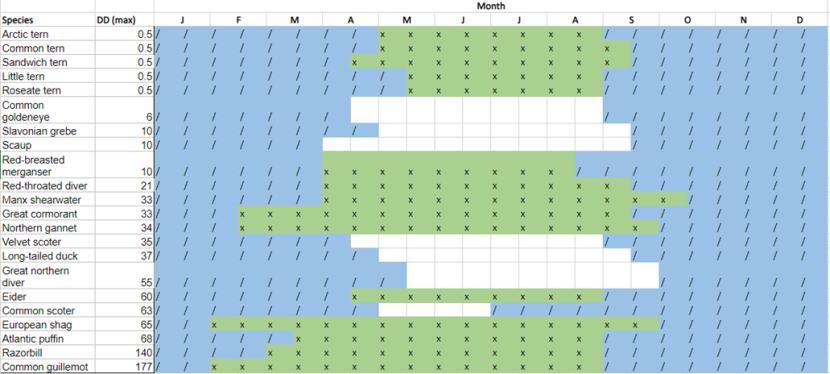
Species seasonality and dive depths. Blue denotes the non-breeding season, and green denotes the breeding season. Some species are not present in Scotland in the summer months and therefore a breeding season is not defined here.
References
Denny MW (1987) Lift as a mechanism of patch initiation in mussel beds. J Exp Mar Biol Ecol 113:231–245.
Mainwaring, K., Tillin, H. & Tyler-Walters, H. 2014. Assessing the sensitivity of blue mussel beds to pressures associated with human activities. Peterborough, Joint Nature Conservation Committee, JNCC Report No. 506.
McSorley C.A., Dean B.J., Webb A. & Reid, J.B. 2003. Seabird use of waters adjacent to colonies: Implications for seaward extensions to existing breeding seabird colony Special Protection Areas. JNCC Report No. 329, JNCC, Peterborough.
NatureScot discussion paper on sandeel and herring sensitivities in relation to MPA fisheries management measure – Feb 2023.
Robbins AMC, Thaxter, C, Cook ASCP, Furness RW, Daunt, F, Masden EA, In prep. Marine bird diving behaviour to inform underwater collision risk with tidal stream turbines; a synthesis and data gaps.
Woodward, I., Thaxter, C.B., Owen, E., Cook, A.S.C.P. 2019. Desk-based revision of seabird foraging ranges used for HRA screening. BTO Research Report 724.