Priority Marine Feature - Cold-water coral reefs
Improving the protection given to Priority Marine Features

An overview of cold-water coral reef records
Description
Characteristics
The cold-water coral Desmophyllum pertusum (also known as Lophelia pertusa) forms patches of bushy growths composed of a network of branches that grow into thickets and eventually reefs, under favourable conditions (Perry & Tyler-Walters, 2016). Reefs can be up to several km long and more than 20 m high. D. pertusum reefs often occur in association with other hard corals (e.g. Madrepora oculata and Solenosmilia variabilis). Mobile species present can include redfish (Sebastes spp.), ling (Molva molva) and tusk (Brosme brosme). Reefs may also support early life stages of deepwater elasmobranchs (Henry et al., 2013) as well as extremely rich assemblages of invertebrates - particularly starfish, sea urchins, anemones, squat lobsters and sponges.
Definition
The morphology and size of cold-water coral reefs are highly variable. They may be circular, halo-shaped, domed or elongate, forming distinct patches or arranged in lines. To qualify as a reef, individual coral thickets should be greater than 1-2 m across and collectively cover an area of at least 5 m x 5 m. The biogenic structures form a substantial, raised habitat, which is very different from the surrounding seabed. The coral provides a complex 3-dimensional structure and a variety of microhabitats that provide shelter and a surface of attachment for other species (Perry & Tyler-Walters, 2016).
Environmental preferences
Cold-water corals typically occur within a depth range of 200-400 m on the continental slope although may occur at extremes between 40 m and >3000 m. Larval settlement requires hard substrates, which may comprise coral rubble from an old colony, glacial deposits or bedrock. Cold-water corals have also been found on man-made structures (including in the North Sea; Roberts, 2002). Generally found in water temperatures of between 4 and 8°C and moderate current velocities (0.5 knots). They are often associated with the slopes of seafloor elevations including seamounts, carbonate mounds and iceberg plough-mark areas.
Distribution
Scottish distribution
In nearshore waters, cold-water coral reefs are currently only known in the Sea of Hebrides, ~13 km east of Mingulay below the 110 m contour line. In offshore waters, reefs are present on: Rockall, Hatton and George Bligh banks; Anton Dohrn; Rosemary Bank and Hebrides Terrace seamounts; Wyville-Thomson Ridge; and at the Darwin Mounds.
Estimated known Scottish extent
The Mingulay cold-water coral reefs comprise characteristic mounds at a relative height of approximately 90 m from the surrounding seabed and cover an area of about 5.4 square kilometres (Davies et al., 2009). The habitat is much more extensive in offshore waters around Scotland.
Wider distribution
Cold-water corals have a fairly cosmopolitan distribution throughout the world’s oceans, with a geographic range from 55°S to 70°N where water temperatures typically remain between 4 - 8°C. In the NE Atlantic and off Britain the majority of cold-water reef records occur beyond the shelf break, mainly on the continental slopes of west Scotland and Ireland.
Status
Desmophyllum pertusumreefs are an OSPAR threatened and / or declining habitat (OSPAR, 2008 & 2009) and are recognised as biogenic reefs which can be part of the broadscale habitats protected in Special Areas of Conservation (SACs) under Annex 1 of the EU Habitats Directive (European Commission, 2013). The Directive is transposed into domestic legislation through The Conservation (Natural Habitats, &c.) Regulations 1994 (as amended in Scotland) (Habitats Regulations).
Demersal fishing activities are known to have impacted the Mingulay cold-water coral reefs. Visual surveys have recorded lost / snagged fishing nets and cabling on the corals and high-resolution acoustic mapping revealed trawl marks around the reefs (Davies et al., 2009). Ocean acidification could cause ecosystem-scale habitat loss for the majority of cold-water coral reefs (Hennige et al., 2020).
Drivers for improving protection
Cold-water coral reefs are included on the PMF list which means that National Marine Plan General Policy 9(b) (avoiding significant impact on national status) applies. Cold-water coral reefs are an OSPAR threatened and deciling habitat in need of protection. The Scottish Biodiversity Strategy to 2045, the Scottish Biodiversity Duty and UK Marine Strategy Good Environmental Status provide further drivers to ensure biological diversity is restored, and ecosystems are safeguarded.
Sensitivity (including recovery)
[Key sources:FeAST, Fisheries Management Guidance]
Cold-water coral reefs are highly sensitive to abrasion and physical disturbance as well as localised effects of smothering and marine pollution.
Towed bottom-contacting fishing gear can cause direct mortality to the living cold-water coral polyps as well as breaking up and removing the coral framework, thus limiting future recruitment.
The predicted impacts of climate change also threaten cold-water coral reef populations through ocean warming, ocean acidification (Roberts & Cairns, 2014), and potential disruption of larval transport. It has been estimated that by 2060, over 85% of known cold-water coral reefs in UK waters could be exposed to waters that are corrosive to them (Jackson et al., 2014), weakening the skeletons of the live coral and their associated dead coral framework (Hennige et al., 2015). Increased porosity in structurally critical sections of coral framework will lead to crumbling of load-bearing material, and a potential collapse and loss of complexity of the larger habitat. The habitat could shift from a habitat with high 3-dimensional complexity provided by both live and dead coral framework, to a habitat restricted primarily to live coral colonies with lower 3-dimensional complexity (Hennige et al., 2020).
Growth rates of cold-water corals are variable with estimates of between 4-25 millimetres per year (Roberts, 2002; Gass & Roberts, 2006). Coral material dated at 7700 years old has been recovered from the Mingulay reefs (Douarin et al., 2013).
Connectivity
Between cold-water coral reefs
D. pertusum is gonochoristic (separate sexes) and can reproduce both sexually and asexually. D. pertusum is thought to spawn annually (Waller, 2005), with spawning in the NE Atlantic occurring around February (Waller & Tyler, 2005). Pelagic larval survival rate is estimated to be 60% over a 3-month period, with some able to survive for over 1 year (Stromberg and Larsson, 2017). Although reefs are generally found >200 m, larvae are active and are able to migrate to shallower waters for the first 4-5 weeks which allows them to move into faster moving surface waters (Stromberg and Larsson, 2017). Active larvae behaviour and a long pelagic larval duration means that cold-water coral reefs may be relativity well connected (Fox et al., 2016; Ross et al., 2017), with larvae able to travel 100 km (Moyorga-Adame et al., 2022) to 800 km (Ross et al., 2017) from larval sources. Connectivity between reefs is thought to be driven by circulation patterns (Fox et al., 2016), with the presence of anthropogenic structures (i.e. offshore wind turbines), potentially increasing connectivity by providing stepping stone populations of D. pertusum (Henry et al., 2018; Moyorga-Adame et al., 2022).
Asexual clonal reproduction of cold-water coral polyps occurs by budding (Cairns, 1979, 1994; Roberts, 2009; Brooke & Jarnegren, 2013). Fragmentation of the coral skeleton is part of the process of reef growth and development (Wilson, 1979a; Rogers, 1999). Coral fragments fall or break off, and under suitable conditions either continue to grow or are colonized by coral larvae.
Work by Fox et al., (2016) and Roberts (2002) suggests that cold-water coral reefs formed by D. pertusum are relatively well connected in Scottish waters. In particular reefs at Hatton Bank appear to be well connected to Rockall Bank sites (known as the western group). The Rosemary Bank Seamount, Darwin Mounds, Wyville Thomson Ridge and reefs at Faroe-Shetland also appear to be well connected to each other (known as the northern group). Hatton Bank is considered important as a larval source and the Rosemary Bank Seamount is considered important at linking northern and western groups.
Roberts (2002) suggested that colonies on infrastructure in North Sea oil fields originated as larvae from the offshore banks of the Atlantic margin and are now believed to be self-recruiting to the platforms.
With other PMFs
The coral reef framework and adjacent hard substrates may be colonised by sponges, providing a connection to the northern sea fan and sponge communities PMF. Extensive sponge communities were recorded around the Mingulay cold-water coral reef complex during survey work undertaken in 2003 (Roberts et al., 2004) and subsequent Marine Directorate sampling in 2010 (Moore & Roberts, 2011). Sponges play a key role in carbonate recycling (Beuck et al., 2007) and help to bind coral structures; enhancing survival and mediating regeneration of physically damaged reefs (Wulff, 2001). Though Wulff (2001) worked on tropical corals, the functional role played by sponges is considered relevant to temperate reefs (Bell, 2008). Submersible observations on cold-water coral reefs on the Rockall Bank in the 1970s concluded that coral patch development may be stimulated by clionid sponge attacks weakening and breaking-up living colonies, generating additional hard substrates for subsequent settlement and lateral patch expansion (Wilson, 1979a). Modification of the coral structures in this way increases habitat complexity and helps enhance biodiversity (Lancaster et al., 2014).
In offshore waters, reef forming hard corals are found within the coral gardens PMF and often occur on seamounts. Cold-water corals also contribute to the development of carbonate mounds (OSPAR, 2009) and may be associated with the deep-sea sponge aggregations PMF.
Ecosystem services
Cold-water coral reefs play an important role in habitat creation. The habitat provided by cold water coral reefs support a number of other species and contributes to the protection of biodiversity.
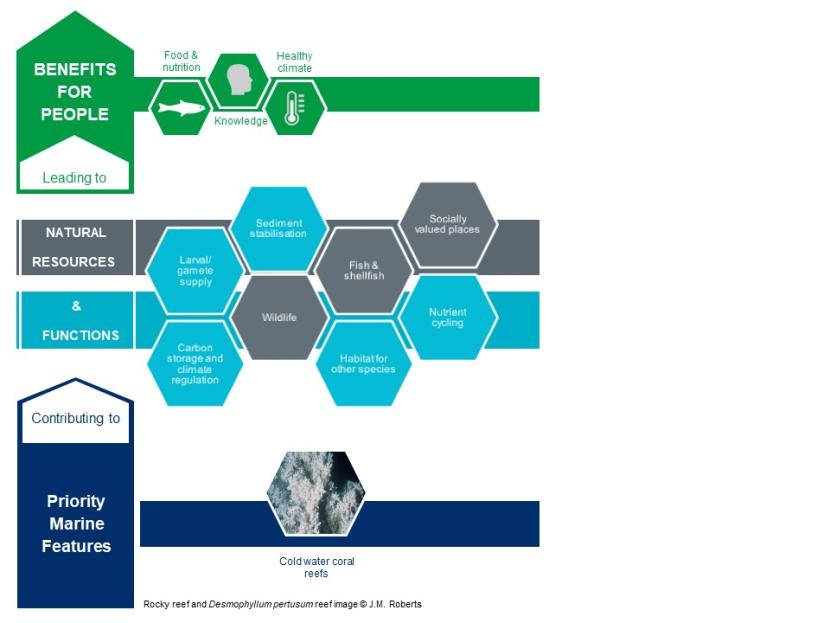
The contribution cold-water coral reefs make to natural resources and functions and the benefits for people that these lead to.
Click for a full description
- Priority Marine Feature: Cold-water coral reefs contributing to
- Natural resources (NR) and functions (F)
- Laval/gamete supply (supporting connectivity (F)
- Sediment stabilisation (F)
- Carbon storage and climate regulation (F)
- Wildlife (NR)
- Socially valued places/seascapes (NR)
- Habitat for other species (supporting biodiversity) (F)
- Fish & shellfish stocks (NR)
- Nutrient cycling (F)
- Which leads to benefits for people
- Food and nutrition
- Knowledge
- Healthy climate
Existing Marine Protected Areas
All extant, inshore records of cold-water coral reefs occur within the East Mingulay MPA.
Existing and proposed fishing measures providing PMF protection
Cold-water coral reefs are protected by the following existing fishing measures:
- The Inshore Fishing (Scotland) Order 2015 (East Mingulay).
Approach to assessing improvements in management needed to protect cold-water coral reefs from impacts related to towed bottom-contacting fishing gear
The assessment presented in this document relates to fishing using towed bottom-contacting gear only. It is consistent with the approach taken for assessing proposed developments.
All recent, extant records in Scottish nearshore waters are already afforded protection against damage from towed bottom-contacting and static gear fisheries within the East Mingulay MPA. Any new records of this habitat would also warrant protection.
Any towed bottom-contacting fishing activity that leads to the loss of entire reefs or damage to cold-water coral reefs, such that function or provision of ecosystem services cannot be maintained should be considered to have a significant impact on national status and as a result not meet General Policy 9(b) in the National Marine Plan. Existing licensing and consenting processes will continue to consider the potential for significant impacts on cold-water coral reefs.
Key locations for the protection of cold-water coral reefs outside designated sites and existing towed bottom-contacting fisheries restrictions
There are currently no other known, verified records of cold-water coral reefs outside the existing MPA network in Scottish territorial waters.
Data confidence
All extant records of cold-water coral reefs in territorial waters are situated within the East Mingulay MPA. Cold-water coral was first recorded off Mingulay in 1968. The data underpinning the MPA are recent (2003-2010) and robust (Davies et al., 2009). Records from the 2003 MINCH Project (Roberts et al., 2004) are not currently held within the GeMS database. Historical records exist in four other locations in Scottish territorial waters - to the west of Skye; between Rum and Eigg; at the Southern Trench; and, off Rockall and were derived from the OSPAR Desmophyllum pertusum reefs T&D dataset. These records are old and have poor associated positional information (Long et al., 1999) and so have not been considered.
Knowledge gaps and other recommended work
We recommend continuing efforts to explore opportunities for collaborative monitoring, survey and research to improve our understanding of this habitat, for example:
- It is possible that cold-water coral reefs exist elsewhere in Scottish inshore waters. Three knowledge gap areas have been identified: north-west of Skye ; south of Rum; and east of Barra. Any opportunistic sampling to explore these areas could be guided by initial predictive habitat modelling (akin to that presented in Ross & Howell, 2012).
- Prior to the discovery of opportunistic cold-water coral development on oil platforms in the late 1990s (Bell & Smith, 1999), the only published record of Desmophyllum pertusum from the Scottish North Sea was from a dead specimen recovered by a trawl in the outer Moray Firth in 1965 (Wilson, 1979b). There have been no subsequent reports of cold-water corals from this area. This record is encompassed within the boundary of the Southern Trench MPA proposal.
Key locations for the protection of cold-water coral reefs

Key locations for the protection of cold-water coral reefs are all located within MPAs with management measures and existing towed bottom-contacting fisheries restrictions.
Click for a full description
The Map shows key locations for cold-water coral reefs, which are near East Mingulay.
References
Bell, J.J. 2008. The functional role of marine sponges. Estuarine, Coastal and Shelf Science, 79(3): 341-353.
Bell, N. & Smith, J. 1999. Coral growing on North Sea oil rigs. Nature, 402: 601.
Beuck, L., Vertina, A., Stepina, E., Karolczak, M. & Pfannkuche, O. 2007. Skeletal response of Lophelia pertusa(Scleractinia) to bioeroding sponge infestation visualized with micro-computed tomography. Facies, 53: 157-176.
Brooke, S. & Järnegren, J. 2013. Reproductive periodicity of the scleractinian coral Lophelia pertusa from the Trondheim Fjord, Norway. Marine Biology, 160(1): 139-153.
Cairns, S.D. 1979. The deep-water Scleractinia of the Caribbean Sea and adjacent waters. Studies on the Fauna of Curaçao and other Caribbean Islands, 57(180): 1-341.
Cairns, S.D. 1994. Scleractinia of the temperate North Pacific. Smithsonian Contributions to Zoology, 557: 1-150.
Davies, A.J., Green, S.L., Long, D. & Roberts, J.M. 2009. Developing the necessary data layers to inform the development of a site boundary for the East Mingulay dSAC - Phase II. Scottish Natural Heritage Commissioned Report No. 306.
Douarin, M., Elliot, M., Noble, S.R., Sinclair, D., Henry, L-A., Long, D., Moreton, S.G. & Roberts, J.M. 2013. Growth of north-east Atlantic cold-water coral reefs and mounds during the Holocene: a high resolution U series and 14C chronology. Earth & Planetary Science Letters, 375: 176-187.
European Commission. 2013. Interpretation manual of European Union habitats. EUR 28, 144 pages.
Fox A.D., Henry L-A., Corne D.W. & Roberts J.M. 2016. Sensitivity of marine protected area network connectivity to atmospheric variability. Royal Society Open Science, 3(11): 160494.
Gass, S.E. & Roberts, J.M. 2006. The occurrence of the cold-water coral Lophelia pertusa (Scleractinia) on oil and gas platforms in the North Sea: colony growth, recruitment and environmental controls on distribution. Marine Pollution Bulletin, 52(5): 549-559.
Hennige, S.J., Wicks, L.C., Kamenos, N.A., Perna, G., Findlay, H.S. & Roberts J.M. 2015. Hidden impacts of ocean acidification to live and dead coral framework. Proceedings of the Royal Society B, 282(1813): 20150990.
Hennige, S.J., Wolfram, U., Wickes, L.C., Murray, F. Roberts, J.M., Kamenos, N.A., Schofield, S., Groetsch, A., Spiesz, E.M., Aubin-Tam, M-E. & Etnoyer, P.J. 2020. Crumbling Reefs and Cold-Water Coral Habitat Loss in a Future Ocean: Evidence of “Coralporosis” as an Indicator of Habitat Integrity. Frontiers in Marine Science, 7(668): 1-16.
Henry, L-A., Mayorga-Adame, C.G., Fox, A.D., Polton, J.A., Ferris, J.S., McLellan, F., McCabe, C., Kutti, C. & Roberts, J.M. 2018. Ocean sprawl facilitates dispersal and connectivity of protected species. Nature Scientific Reports, 8: 11346.
Henry, L-A., Navas, J.M., Hennige, S.J., Wicks, L.C., Vad, J. & Roberts, J.M. 2013. Cold-water coral reef habitats benefit recreationally valuable sharks. Biological Conservation, 161: 67-70.
Holt, T.J., Rees, E.I., Hawkins, S.J. & Seed, R. 1998. Biogenic reefs (volume IX). An overview of dynamic and sensitivity characteristics for conservation management of marine SACs. Scottish Association of Marine Science (UK Marine SACs Project), 169 pages.
Huvenne, V.A.I., Bett, B.J., Masson, D.G., Le Bas, T.P. & Wheeler, A.J. Effectiveness of a deep-sea cold-water coral Marine Protected Area, following eight years of fisheries closure. Biological Conservation, 200: 60-69.
Jackson, E. L., Davies, A. J., Howell, K. L., Kershaw, P. J. & Hall-Spencer, J. M. 2014. Futureproofing marine protected area networks for cold water coral reefs. ICES Journal of Marine Science, 71(9): 2621-2629.
Lancaster, J. (Ed.), McCallum, S., Lowe A.C., Taylor, E., Chapman A. & Pomfret, J. 2014. Development of detailed ecological guidance to support the application of the Scottish MPA selection guidelines in Scotland’s seas. Scottish Natural Heritage Commissioned Report No. 491.
Long, D., Roberts, J.M. & Gillespie, E.J. 1999. Occurrences of Lophelia pertusa on the Atlantic Margin. British Geological Survey Technical Report, WB/99/24.
Moore, C.G. & Roberts, J.M. 2011. An assessment of the conservation importance of species and habitats identified during a series of recent research cruises around Scotland. Scottish Natural Heritage Commissioned Report No. 446.
NatureScot. 2024. Geodatabase of Marine features adjacent to Scotland (GeMS). GeMS V10 (i26).
OSPAR. 2008. Case Reports for the OSPAR List of Threatened and/or Declining Species & Habitats. OSPAR Commission, 2008. Publication number: 358. ISBN 978-1-905859-97-9.
OSPAR. 2009. Background document for Lophelia pertusa reefs. Biodiversity Series. OSPAR Commission. Publication number: 423. ISBN 978-1-906840-63-1.
Perry, F. & Tyler-Walters, H. 2016. Lophelia reefs. In: Tyler-Walters, H. & Hiscock, K, eds. Marine Life Information Network: Biology and Sensitivity Key Information Reviews, [on-line]. Plymouth: Marine Biological Association of the United Kingdom.
Roberts, J.M. 2002. The occurrence of the coral Lophelia pertusa and other conspicuous epifauna around an oil platform in the North Sea. Journal for the Society for Underwater Technology, 25(2): 83-91.
Roberts, J.M., Brown, C.J., Long, D., Wilson, C.K., Bates, C.R., Mitchell, A.J. & Service, M. 2004. Mapping INshore Coral Habitats: The Minch Project. Final Report. Scottish Association for Marine Science, 115 pages.
Roberts, J.M. & Cairns, S.D. 2014. Cold-water corals in a changing ocean. Current Opinion in Environmental Sustainability, 7: 118-126.
Roberts, J.M., Wheeler, A., Freiwald, A. & Cairns, S. 2009. Cold-water corals: the biology and geology of deep-sea coral habitats. Cambridge: Cambridge University Press, 352 pages.
Rogers, A.D. 1999. The biology of Lophelia pertusa (Linnaeus, 1758) and other deep-water reef-forming corals and impacts from human activities. International Review of Hydrobiology, 84(4): 315-406.
Ross, R. E. & Howell, K. 2012. Use of predictive habitat modelling to assess the distribution and extent of the current protection of 'listed' deep-sea habitats. Diversity and Distributions, 19(4): 433-445.
Ross, R.E., Nimmo-Smith, A.M., & Howell, K.L. 2017. Towards ‘ecological coherence’: Assessing larval dispersal within a network of existing Marine Protected Areas. Deep-Sea Research Part I: Oceanographic Research Papers, 126: 128-138.
Waller, R.G. 2005. Deep-water Scleractinia (Cnidaria: Anthozoa): current knowledge of reproductive processes. In Freiwald, A. & Roberts, J.M, eds. Cold-Water Corals and Ecosystems. Erlangen Earth Conference Series. Berlin, Heidelberg: Springer: 691-700.
Waller, R.G. & Tyler, P.A. 2005. The reproductive biology of two deep-water, reef-building scleractinians from the NE Atlantic Ocean. Coral Reefs, 24: 514-522.
Wilson, J.B. 1979a. 'Patch' development of the deep-water coral Lophelia pertusa (L.) on Rockall Bank. Journal of the Marine Biological Association of the United Kingdom, 59(1): 165-177.
Wilson, J.B. 1979b. The distribution of the coral Lophelia pertusa (L.) [L. prolifera (Pallas)] in the north-east Atlantic. Journal of the Marine Biological Association of the United Kingdom, 59(1): 149-164.
Wulff, J. 2001. Assessing and monitoring coral reef sponges: Why and how? Bulletin of Marine Science, 69(2): 831-846.