Secrets in the Sand: Findhorn Dunes Rewilded
A sand dune can look lifeless but is actually one of the most important places for biodiversity in Scotland. We head to the Moray coast to explore the Findhorn Hinterland, where a small, determined local charity is restoring dunes, grassland and woodland while keeping the whole community involved. Along the way we hear why Nature 30 recognition matters for safeguarding the site, and why conservation success can start right on your doorstep.
We’re joined by Jonathan Caddy from the Findhorn Hinterland Trust, who shares the long story of this landscape, from childhood memories to today’s hands-on habitat management across a 50-hectare mosaic. He explains what it takes to run a community conservation organisation, how volunteering keeps momentum, and why environmental education with local schools is central to long-term nature recovery.
Then Alan Watson Featherstone, founder of Trees for Life, brings us into the tiny world that most of us miss: lichens, fungi and invertebrates that hold ecosystems together. Ecologist Sean Reed walks us through sand dune restoration in practical detail, including the challenge of scrub encroachment, the need for early successional habitats, and the careful work of creating new bare sand that rare species can use for decades.
Information
Transcript
Kirstin: 00:05
Hi and welcome to Make Space for Nature from NatureScot. I'm Kirstin Guthrie, and in this episode Fiona Leith and I are on the Morayshire coast exploring the remarkable nature restoration happening in Findhorn, driven by a small but mighty local charity called Findhorn Hinterland Trust. For decades the Trust has been at the heart of community life here, connecting people to nature through volunteering and conservation work, and they've recently been recognised as a Nature 30 site, a mark of the outstanding contribution they're making to Scottish biodiversity. Today we're meeting Jonathan Caddy and Sean Wade from the project, as well as Alan Watson Featherstone, founder of Trees for Life. I want to start by asking Jonathan about the kinds of work going on here.
Fiona: 00:46
Hello Jonathan, and welcome to the podcast and thanks for joining us today. Jonathan, your parents were co-founders of this community at the Park Eco Village back in the 1960s, so you have a very personal connection to this place and its long history of caring for wild land. You've also recently stepped aside as chair of the Hinterland Trust uh after years of dedication to the project. Can you give us a sense of the nature conservation work that's taken place here over the years?
Jonathan: 01:18
Yeah, it's great to be here and yes, to have the opportunity to talk about this place because yes, I have a long connection. Came here in 1962, as you've said, there, but uh it was very different, very different. We're in a woodland just now, and the trees were about oh about 40 centimetres high there, and now look at them there, and they're almost 70 years old. Uh they don't look like that, but anyway, um it's been fantastic to be a witness to the change that's happened here. And there was a big sign I was telling you about uh at the entrance to the site here, and it said uh private property keep out. And I was six years old when we first came here, and this was the place to be. And this is how I got to know this land. Uh I intimately I knew where all the birds' eggs and nests were and all that sort of thing. And it gave me an interest in ecology, and that's what I went and studied, and it's been great to be able to come back for the last 20 years and get involved in actually doing some of the conservation work here. It has changed over time.
Jonathan: 02:34
We actually manage about 50 hectares of land, and we're just about to become the owners of that fifty hectares, and it is a mosaic of different habitats. Uh the most well the most um rare is the Dune Heath habitat, but there's also gorse scrub, there's the woodland that you see here, which is uh uh it was a monocultural of pine, we've been uh converting that to a a more diverse uh uh broadleafed uh trees and so on there. And we uh there's also species rich grassland.
Jonathan: 03:16
So in terms of what's been happening for the last uh twenty years, um yes we we actually had a a huge disaster here, a huge gorge fire, and uh there was um a public meeting down in the village, and I thought well uh a few people would come, but actually it was full, absolutely full. That was about 2005. And uh from that this uh it was clear that local people wanted to get involved in management of the land, and out of that came the precursor of our charity, Findhorn Hinterland Trust, which was called Findhorn Hinterland Group.
Fiona: 04:02
So a lot of personal connection to this place, but it's really interesting to hear about the the wider community and and and how they reacted to something happening uh to the land around them. And could you tell us a little bit about the community of people involved in the trust today, the uh the individuals and and the type of work they're undertaking?
Jonathan: 04:23
Yes, I mean the the trust is uh certainly grown, and we have a group of about 20 uh people that's trustees, and we're divided into different teams. The land management team, uh we also have uh the uh um education and community team, we have a green burial team because we actually have the first community green burial on in this woodland here, and uh other teams that are involved there. But in terms of people, we have uh uh 220 members um in the local area here, some in the local town of Forest and and and uh village of Finhordn, but also in the Park Eco Village uh here. There are lots of people that are involved. We've been involved right from the start, 20 years. Uh every month we've been uh we we'll have work parties out on the land and doing something, something positive for nature over that time. And we've done it quite a lot in terms of public consultation. Uh when we first became a charity in 2015, 2016, we had public consultation there and just got to hear from uh people as to how they would like this land to be managed. And out of that come our purposes, which is conservation of the land, that's number one, also involved in in uh uh environmental education, sort of uh helping people understand what is here, uh building local community, and the fourth thing is providing uh recreational facilities. So we've been involved, very much involved with the the local community here, particularly this last uh couple of years when we have doing uh a public relations um exercise, telling about the dune restoration that we dune restoration project that we were about to do. Um because it's hard uh to change people's concept of what nature restoration is. You know, uh everyone loves trees, there everyone loves red squirrels, and we have them here, but actually what's important in our uh landscape here is that we've got a tiny remnant of the second largest dune system in Europe, and there there are some very rare species, not just of of of lichens, but invertebrates in terms of fungi and so on, and that's what we've been involved in that conservation work and trying to trying to educate folk about this.
Fiona: 07:13
It was wonderful to have a walk around with you there just now and come from the the lichen through the through the dunes and into the woodland here, and you're saying that we're sitting outside a a hut built from original woodland that you remember as a child, is that right?
Jonathan: 07:29
Absolutely. I mean and and what that's a a great feeling uh to be able to create something from the the trees that I've watched grow up and you know to be able to use uh the the uh the trunks as as columns and to be able to uh have a portable bandsaw to make uh all the flooring and and and the various other bits and pieces, the cladding and and what this is our conservation hub they built in 2022, and uh it was a real community effort during COVID, uh brought people together, and it is certainly something worth celebrating. It's where we have our tools to manage the land, our retractor there, and uh all the the various tools that we have there. We've got a part-time uh land steward that does that, but a lot of volunteering happens here too.
Fiona: 08:22
Great. And the sun's shining on it today for us.
Jonathan: 08:25
So we're yeah, that's right, and we're out of the wind. So it uh it's always good.
Fiona: 08:30
Now last year uh you were actually recognised, or or the Findhorn Hinterland Trust was recognised as a nature thirty site, and these are areas of Scotland that count towards conserving 30% of land and fresh water by 2030, and they were recognised because of the way nature is managed here, like you've alluded to, and the fact that it delivers long-term results for for local wildlife, but the community as well. Can you tell us a little bit about what that recognition means to the people here?
Jonathan: 09:05
Well, I'll just start with myself. It's huge. This is this is great. I mean, unexpected to have the Cabinet Secretary for Climate Change and Energy here, actually, where we're sitting right now, uh announcing this uh this initiative, which is part of something that is connected to a worldwide crisis, the biodiversity crisis. And it what matters is what happens locally on uh on on the doorstep uh here. And you know, that's what what to get that message across to people that what matters is what happens in every person's backyard. Every backyard is special, and if we can do that, then you know nature uh really has um a chance to uh not just establish itself but you know that connection of people and nature is so so im important. So it has had a a great effect, and in terms of uh what we Findhorn Hinterland Trust do, we have a partnership with the local secondary school and we bring pupils out here. We're expecting about 160 uh um S2 to S3 transition pupils out here doing practical things on the land, learning about you know how little three seedlings uh uh you know, if they're left there, they will actually take away the June heath, that is our rarest habitat, and all the species that will be there. And that we also have for the last four or five years had the biology students come out and do the practical uh here. And it's really hopefully we're teaching the next generation too, about uh what it takes to really look after and conserve uh land and appreciate the the natural world that is around, which we are very much part of.
Fiona: 11:08
That's really encouraging uh about how young people can be offered that connection with nature and how important we know that is.
Fiona: 11:15
If if people listening had never been here, um how would you describe it and and what might they find here in terms of habitat and and and species that they might not find anywhere else?
Jonathan: 11:28
Right, I mean uh when we walked around I was talking about uh the fact that uh dune systems are some of the rarest habitats uh here in Britain in in Europe, and uh they are biodiversity hotspots. And we as I said, we've got a tiny remnant here of uh of the second largest uh dune system in Europe. And so in that we we have species that are found just maybe here or a couple of of places in Scotland and in the UK, uh species of of fungi, species of uh invertebrates and and and uh uh also lichens uh there. The thing is that people will notice that the habitats it it's a strange landscape in some ways, certainly the dunes out there, but there's a lot of gorse too, and there's a lot of trees coming back. They will they will notice those. They might not notice you really need a hand lens uh to uh be able to see what what is there, and I think uh I mean I'll introduce you to Alan Watson Featherstone, who has uh done a lot in terms of bringing specialists here to actually see uh what what we've got on our doorstep here.
Kirstin: 12:50
So hello Alan. Would you like to introduce yourself and just tell us about the kind of the work that you do here, please?
Alan: 12:56
Yes, thank you. Uh so my name's Alan Watson Featherstone. I've been living here in the Findhorn community since 1978, and I'm probably best known for my work with Trees for Life, a conservation charity which I founded in 1986 that works to restore the Caledonian forests in Glen Affric that owns 10,000 acres in Glen Morriston and has been involved last week in the reintroduction of beavers to Glen Affric. So when I was there, I commissioned a lot of studies and surveys for biodiversity, particularly at the charity's Dundragon Estate, and I've kind of brought that with me here to the hinterland where I'm a trustee now. So my particular interest is in finding out all the species that live here. So people often see me out with a hand lens and my camera gear, photographing aphids or slime moulds or things like that. So some of the scarce species, special species I've found here, uh including the sandy earth tongue fungus, which is on known from only one other site in Scotland and one site in the south of England, the red-banded sand wasp, these are some of the species associated with the sand dune habitat, and I'm always finding new things. Uh they're not big, spectacular, dramatic creatures, they're tiny little things, but they're an essential part of a web of life, and they're the food for you know small mammals, birds and so forth. So if we don't have those and if we don't know about them, um then we can't make sure we've got a healthy ecosystem here.
Kirstin: 14:27
That is so exciting though, um, and also reinforces all the you know all the work that goes on here and and it shows that these species are actually coming to these habitats and yes, indeed.
Alan: 14:36
And you know, we've got a 70-year-old plantation here which we're naturalising, so we're creating small coops where we're felling some of the trees, particularly some of the non-native trees, and then planting native broadleaves because the soil is improved enough that they can grow there. And as soon as you plant things like that or encourage regeneration, then the associated species arrive, the flying insects that lay their larvae in uh the leaves or catkins of birch or hazel, and they in turn are food for birds and so forth. So the whole web of life begins to re-weave itself when we create the right conditions.
Kirstin: 15:13
So thank you, Fiona, Jonathan and Alan. Um, you know, there's such important work going on here, and it's great to hear that um, you know, there's so many different species, there's lots of kids coming out here, lots of volunteers doing such important work as well. Um and
Kirstin: 15:26
Sean, you know, you're you're a local ecologist who came here um in back in 2004, um, and you know, we really enjoy looking at some of your photography on the the Hinterland website, and it's clear that are there's so many incredible species to be found here. Can you just tell us a wee bit about your involvement in the ecology work, particularly the dune restoration and what difference that's making for nature in the area?
Sean: 15:48
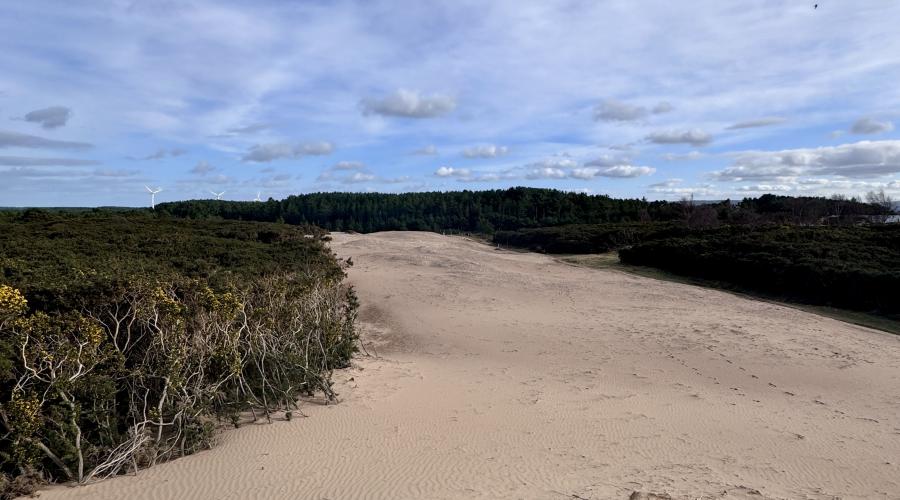
Yes, um, yeah, so I became interested in the in the in the ecology of the dunes in around 2008, when there was a survey undertaken for lichens of the whole dunes, and that showed that the dunes were nationally important for lichens. And looking at how some of the best lichen areas were being threatened and actually disappearing under gorse, I became concerned about uh scrub encroachment at that point. Um a lot of the hinterland uh work at that time, the hinterland group it was called, was um woodland focused. And as Alan was saying, this woodland's been completely transformed over the last 20 years or so. So my role has been to produce three local biodiversity action plans since 2013 and increasing in level of detail in each one as more information on the biodiversity of the dunes has been uncovered, and as there's been more national guidance on uh sand dune management. And the 2013 one that was really to raise the profile of sand dune habitats and the threat of scrub encroachment. And then in 2020, the second managed um biodiversity action plan that outlined a programme of dune restoration to get a healthier balance of sand habitats and scrub and woodland. And then COVID came along in 2020. That really slowed things down. Um but in 2023 um we all came back together and decided yes, we're going to do some dune restoration, and that involved creating a new area of bare sand to reset um the ecosystem in in areas which was completely dominated by gorse where all the habitats uh the earlier successional habitats had all been lost in the last 20 years or so. Um yeah, so we uh knew that this we could be potentially controversial with the local community. Cutting things down is almost always controversial scrub clearance, and so we knew that we needed to focus on that and to clearly explain why we wanted to do that. So we put a PR strategy together a whole year in advance of of doing the work. Um the work itself involves mulching gorse with a heavy-duty forestry mulcher and then scraping up the mulch, um, scraping up the gorse litter and all the roots down to about 30 centimetres deep, um piling that up and then burying it in in deep pits, and then capping uh the top of the pits off with about a meter of sand. So the result is new pristine sand um which should last several decades, maybe fifty years, and during that time it will slowly develop the early successional stage habitats, which are so important for species which are found in just a few other places in the UK and are essentially threatened with extinction if if sand dune habitats disappear. So the third um biodiversity action plan I'm just finishing at the moment, and that's got much more detail on the ecological and geomorphological context and and more refinement on on the um on the uh dune restoration work. There's been a lot of new information on uh guidance and best practice on on this subject published in the last few years. And during this biodiversity action plan, which have been developing over a period of about a year, that's included reaching out to partner organisations like Butterfly Conservation and the RSPB, Forestry and Land Scotland, uh, who have also got dune restoration uh projects going on on the Moray Firth. This is quite a new area of work for everybody, and so it's important that we all share information and and um and our experiences, and also reaching out to NatureScot, who've got uh coastal advisors, and so we've had input also from from NatureScot. And I can also say over the last 10 years or so, speaking to Alan there, you you've just heard, we've we found um uh we've got a lot more information now than we've ever had on the biodiversity here.
Sean: 20:10
Um some of the photography, the photography you mentioned, that is actually by Alan. The best photographs are by Alan. Alan is essentially a professional photographer. Um, but some of the most notable species, I heard Alan mention a few, but maybe uh hopefully not repeating too much. The Ling Owlet moth, that is only found in two places in Scotland, and Findhorn dunes are the most important site. As Jonathan mentioned, 400 species of moths here, and more than 20 of those are Scottish biodiversity list species. And quite a few of those are associated with the the the acid grassland that we have, which is not very extensive, but is is a very rare habitat in itself. Um I think over 90% of grasslands, natural grasslands have been in lost in the last last 70 or 80 years, and I think it's 97%. And um yeah, dry lowland grassland is also a Scottish biodiversity list habitat. Then we've got the red bass red-banded sand wasp, which Alan mentioned, interesting species. Um maybe I'll maybe talk about that more later. The pied-winged robberfly, uh super predator, um, and only found on three places that we know about in Scotland. And then several super rare flies, leafhoppers and plant hoppers. And this is just a flavour. There's there's a lot of very, very rare biodiversity here. Um lichens have been mentioned, but there's one species of Lichenicolous fungus. This is a fungus which grows on a lichen, Dacampia peltigericola, I think is uh as close as I'll get to it. Uh and that that grows on the rare mat felt lichen, which is uh a very rare lichen, um and is also Scottish Biodiversity listed. And then I'll I'll mention the the sandy earth tongue. That's just a flavour of some of the things that that we have here. Jonathan mentioned sand dunes are one of the rarest habitats in Europe and the world. And the loss of sand dunes follows pretty much the same pattern everywhere. And that's the some sort of human activity, be that industrial or agricultural or forest-related, leading to direct habitat loss, but also indirect loss through sand stabilisation and the resulting unnatural vegetation growth that happens as a result of that. So normally a sand dune is a self-perpetuating ecosystem that would left to its own devices exist like that for thousands and thousands of years. And that that was the case here for some six thousand years self-sustaining ecosystem until about the last 100 years. And during that time, around 95% of this ecosystem has been lost. And that's mainly been due to uh forestry, uh plantation forestry establishment, which was actually uh started partly to to stabilise the sand dunes. And then once um that vegetation uh uh becomes established we get a negative feedback loop where uh scrubs and trees uh spread and then they create more shelter, which allows more scrub and trees to spread, which creates more shelter. And of course, these things are casting their seeds uh all over the place. And Findhorn dunes as a whole is 140 hectares. Uh the dunes close uh closer to the sea are in relatively good condition. There's lots of open sandy habitats there. Um yeah, the sandy habitats and these early ex early successional uh stages are important for the rarest and most threatened species. So that's the lichens and the fungi, but around 70 to 75 percent of the rarest uh invertebrates need these uh sandy habitats to complete their life cycles, and they burrow into the sand, and that's where they have their nests and and their lava grow. And out on the on the on the dunes near the sea, trees is the main threat there. The trees are spreading very quickly. The hinterland, the Findorn hinterland area is closer to the settlement area though, further away from the sea. Uh, and there it's even more sheltered. Um, there's less sand supply coming from the beach, um, and it's mostly covered by gorse, but with some very valuable surviving areas of sand and shingle within there.
Kirstin: 24:53
That's great, Sean. And you know, it's clearly a unique place here at Findhorn and an important one for for UK biodiversity. So, you know, what's your what's your favourite thing about it? What's your what why do you love working here so much?
Sean: 25:05
Well, I I don't know anything anywhere else like uh Findhorn dunes. Um I was really struck when I first came here. It's it's it it is uh quite a unique landscape. To me, it has um a feeling of it's got this wild barren feeling, which I I actually like in the in the in the dune shingle areas. Um it's got a feeling of kind of a no-man's land to it, um, which is difficult to describe, but that that's the feeling I get. And then there's the the mix of habitats here, including including the gorse and and the sheltered dells that you get within the gorse and and the woodland. Um you can walk out of the woodland in it immediately in a completely different landscape. So yeah, I think that mix is is very important, plus one of the most beautiful beaches in Scotland.
Kirstin: 25:58
Yeah, absolutely. It is very, very special. And you know, I'm gonna ask both Jonathan and and Sean this kind of final question, and I'm sure it's a really hard one for you for you both to answer.
Kirstin: 26:08
I’ll start with you, Jonathan. First, what's your your personal favourite species found here, and what do you hope the future holds for this site?
Jonathan: 26:16
Okay, that's a is a difficult question, isn't it? And I'm I'm gonna I'm gonna pick a lichen, and it's uh the matt felt lichen that's been mentioned before, and uh Peltigera malacea, uh it's an endangered uh species. Yes, it's i i in the wet it it's green and quite lush and so on, but what I like is that it gets you down on your hands and knees with a hand lens, and you actually see this wonderful mini landscape. It's like being in a coral reef, just uh there's so many uh different forms and colours and so on. It's like it's like going down the rabbit hole, you know, with Alice in Wonderland into a new world, and actually we we we've got a play later on on in the year, Alice in Hinterland, that uh by a theatre company here that's going to highlight some of the rare species here and bring it alive to to a local audience. So yeah, I mean uh it it is uh yeah, it's pretty amazing what what is on our doorstep. Actually, it's on everyone's doorstep. It's it it's it's actually about opening eyes but also opening minds uh to uh to to see what's in front of us because we take so much for granted.
Kirstin: 27:38
Absolutely. I mean that's that's spot on it's what we talk about in the Make Space for Nature campaign, is is literally everybody there is nature on your doorstep, you're part of nature, you know, you just need to open your front door and away you go. Um and you know, the second part of the question was, you know, what do you hope the future holds for this site?
Jonathan: 27:55
Yeah, I mean I've been involved for 20 years uh in this site here, and recently we've had to restructure the organisation because I do too much, and is to make the organisation sustainable and resilient because it's not about just the individual. I think that good organisations with good structures can take good ideas into the future, and I think that we've got a really good idea here. We've got certainly a fantastic uh uh landscape uh with all the different habitats and species, and hope that hopefully that more and more people will start to understand just uh what we've got on our doorstep.
Kirstin: 28:37
Yeah, absolutely. You've got a fantastic team around you as well. It's it's amazing to see all this hard work. And and over to you, Sean. What's what's your favorite species and and what do you hope the future holds for the site?
Sean: 28:48
Yeah, I'm gonna go for the red-banded sandwasp. Yeah, and that that's I think partly because one landed on my dad about 20 years ago, and I thought, wow, that is an impressive beast. And I wondered if it was a sand uh a red-banded sand wasp, but that's only been confirmed relatively recently. Uh interesting species, it it um creates burrows, catches caterpillars, lays an egg on them, and that's what feeds its larvae, and actually will go and to other nests and steal caterpillars, take the eggs off and lay their own eggs. So it's like the sort of thing you will see on a on a nature documentary. So yeah, an impressive beastie. Um yeah, in terms of the future, I I think yeah, Nature 30 recognition has been uh a real milestone um puts the um site on the map. And I think the main priority going forward is to continue the dune restoration work, uh small areas gradually, keeping um the public on board and yeah, just slowly carrying on in that in that way.
Kirstin: 29:58
Brilliant. Listen, it's been absolutely fantastic to meet to meet you and Alan, who's who's now headed off. But um, yep, thank you so much for joining us and uh we wish you all the best for this site because it's an absolutely beautiful place to be. So thank you.
Jonathan: 30:11
Thank you.
Kirstin: 30:13
Thanks for listening. For more ways to connect with and help protect Scotland's natural world. Go to nature.scot.
Last updated: