The Red List of Ecosystems Indicator
What is the Red List of Ecosystems Indicator?
The Red List of Ecosystems Indicator measures the average risk of ecosystem collapse across natural and semi-natural ecosystems in Scotland and the UK.
Why do we produce this statistic?
Healthy, functional and resilient ecosystems are crucial for supporting species and for providing the ecosystem services that society relies upon. The global Sustainable Development Goals (SDGs) which aim to end poverty, tackle inequalities and combat climate change identify a heathy environment (biosphere) as underpinning all other goals including achieving the social and economic ambitions of the SDGs. Scotland was one of the first countries to adopt the SDGs in 2015 and so understanding the functioning and threats facing our ecosystems is vital to achieving this goal.
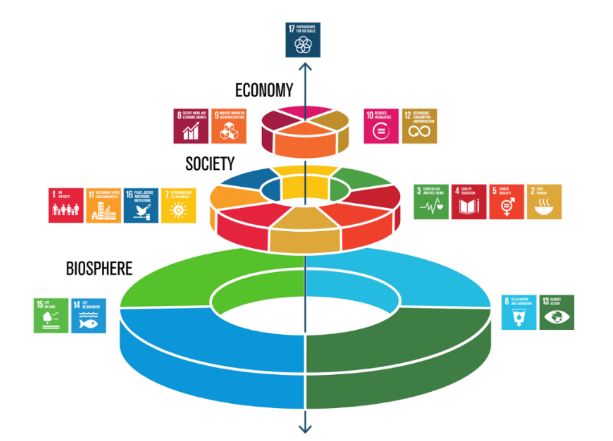
Figure 1. Sustainable Development Goals
Click for a full description
The Sustainable Development Goals (SDG) Wedding Cake developed by the Stockholm Resilience Centre. The illustration shows how economies and societies are interconnected processes embedded within the biosphere. The base circle represents the biosphere which includes SDG goals 15 (life on land), 14 (life below water), 6 (clean water and sanitation) and 13 (climate action). A higher tier, resting on the biosphere, represents society, including SDG goals 1 (no poverty), 11 (sustainable cities and communities), 16 (peace, justice and strong institutions), 7 (affordable and clean energy), 3 (good health and wellbeing), 4 (quality education), 5 (gender equality) and 2 (zero hunger). The next tier, resting on society and the biosphere, is economy, including SDG goals 8 (decent work and economic growth), 9 (industry and infrastructure), 10 (reduced inequalities) and 12 (responsible consumption and production). The final tier of the SDG wedding cake is SDG goal 17 (partnership for the goals) which rests on economy, society and the biosphere layers.
An illustration of the Sustainable Development Goals, illustrating how economies and societies should be seen as embedded within the biosphere. This vision is a move away from the current sectoral approach where social, economic, and ecological development are seen as separate processes. Created by the United Nations.
This indicator presents the level of threat facing ecosystems in Scotland and the UK and enables comparison of different ecosystems. At a practical level, the creation of RLE assessments could influence prioritisation for conservation funding and where to take conservation management action on the ground.
How do we produce this statistic?
Last published: 2025
Updated: Every 5 years
This indicator was produced through a collaboration between specialists at NatureScot and JNCC. This indicator is produced at the UK level, meaning that, at this stage, we do not have specific data for Scotland alone. However, the indicators will be refreshed in December 2026 to show Scotland-level assessments. Assessments are made for ecosystems classified at Global Ecosystem Typology level 3 (also known as Ecosystem Functional Groups) using IUCN criteria. Each ecosystem assessment draws on published data and research to evaluate the current status and likely trends over the next 50 years.
The current iteration of the indicator, produced in 2025, assessed almost half of the natural and semi-natural ecosystem types from in the UK, and this will be completed over the next 3 years. The initial ecosystems assessed have been prioritised on the basis of pragmatism, primarily on the availability of specialist staff available to undertake assessments and a desire to cover a range of different ecosystem types.
Once complete, this indicator will be updated every 5 years, at which point it will include change in the average risk of ecosystem collapse across natural and semi-natural ecosystems. We will also produce assessments for artificial ‘anthropogenic’ ecosystems in Scotland, as these ecosystems can be important for biodiversity and are often where people encounter nature on a daily basis.
Key Findings:
For detailed outcomes of this indicator, please see JNCC’s UK Biodiversity Indicator: Red List of Ecosystems.
The overall indicator value in 2025, based on the subset of ecosystem types currently assessed, is 0.54. A score of 0 indicates that all ecosystems included have collapsed. A score of 1 indicates that all ecosystems included are classified as being of least concern.
Of the 20 ecosystems assessed, 85% of ecosystems were classified as threatened (see Figure 1), compared to the Red List of Species assessment which found 16.1% of species are threatened in the UK and 11% in Scotland (shown in State of Nature 2023).
| Threat category | Total ecosystems within category |
|---|---|
| Ecosystems assessed as Critically Endangered | 2 |
| Ecosystems assessed as Endangered | 7 |
| Ecosystems assessed as Vulnerable | 8 |
| Ecosystems assessed as Near Threatened | 1 |
| Ecosystems assessed as Least Concern | 2 |
| Ecosystems not assessed | 28 |
The importance of Scotland’s ecosystems:
Ecosystem value
Nature is valuable in itself and for the role it plays in our culture in addition to the tangible benefits it provides us. While difficult to determine, working out an economic value for nature can help to highlight the importance of nature, and nature-based solutions, to our society and economy and ensure it is included decision-making. Industries reliant on ecosystems, excluding non-renewable resource sectors such as oil and gas, supported £40.1 billion of the total economic output in 2024. This is 14.4% of Scotland’s total output, around 261,600 jobs, directly and indirectly (Cabinet Secretary for Rural Affairs, Land Reform and Islands, 2024).
Industries that are most dependent of natural capital include, agriculture (88% reliant), forestry and wood products (59%), water and sewage (40%), spirits / wine and beer / malt sectors (30%), and electricity (30%). The value of more specific services provided by ecosystems in Scotland may be difficult to determine, however, insect pollination has been valued at an estimated £43 million per year and Scotland’s beaches and salt marshes protect £13 billion of coastal buildings and infrastructure, compared to £5bn protected by engineered sea walls.
Ecosystem Services
Scotland’s ecosystems deliver benefits to people through 4 groupings of ecosystem services:
- Provisioning services: physical things we can take from the environment such as food, water and timber;
- Regulating services: ensuring we have an environment fit to live in through services like natural flood protection and air filtration;
- Cultural services: the benefits we get from the environment that are perceived by us, such as aesthetic beauty and recreation;
Scotland’s natural capital, the stock of natural assets which deliver ecosystem services, has been maintaining state since 2016, as shown by the Natural Capital Asset Index (NCAI).
Protect and Restore
Protecting, restoring and managing natural habitats is vital for ensuring biodiversity thrives. Ecosystem-based management strategies is a more holistic approach to conservation which uses nature-based solutions principles to balance ecological, social and economic needs of areas to better conserve and restore ecosystems. This approach emphasizes restoring ecosystems and enhancing ecosystem services to safeguard society and biodiversity from the negative impacts of climate change, land degradation, biodiversity loss, pollution, and waste.
Ecosystem (or habitat)-based conservation protects entire ecosystems and all species within them, as well as genetic diversity with species, offering a broad, efficient approach, while species-based conservation focuses on saving specific, often endangered, animals or plants. Focusing on the ecosystem as a whole is generally considered to be more effective for biodiversity, while species specific actions are still important, especially when addressing immediate extinction threats, for example, the work done by Species on the Edge.
Net Zero
Functional and healthy ecosystems are crucial to Scotland’s plan to achieving net zero by 2045.
Decarbonisation of industries is vitally important, as are restoring and protecting ecosystems that act as carbon sinks, including, peatlands, seagrass, woodlands and wetlands. Reducing Scotland’s carbon footprint through nature restoration features in Scotland’s Environment Strategy, including strategies to:
- Restore 10,000 hectares of peatland (like natural bogs that store carbon) through Peatland ACTION.
- Create 10,000 hectares of new woodlands.
- Fund for over 200 projects to help nature recover through our £65 million Nature Restoration Fund.
- Support marine restoration and enhancement.
Climate Change Adaptation
Scotland’s National Adaptation Plan (2024-2029) sets out how Scottish Government and partners will prepare for and respond to the impacts of climate change. Climate change impacts can cascade across landscapes, affecting lives and livelihoods at scale. Healthy, resilient and biodiverse ecosystems help us to adapt to the changing climate. If ecosystems are able to remain functional as the climate changes, they are therefore able to continue to deliver ecosystem services, many of which will negate the impacts of climate change, for example, mitigating the effects of flooding, heatwaves and sea level rise.
Health and wellbeing
Nature and the outdoors can contribute to people’s health by contributing to effective recovery, providing space for physical activity, building communities and encouraging young people to go outdoors. ‘Green Health’ a key target for Scottish Government as part of Scotland’s Environment Strategy, Mental Health and Wellbeing Strategy and Physical Activity and Sport Framework.
Main pressures acting on Scotland’s Ecosystems:
We are currently developing a new metric, the Ecosystem Threat Matrix, which is designed to gather information on the actions which are threatening and putting pressure on Scotland’s ecosystems. Ecosystems specialists can use the Ecosystem Threat Matric to score various threats identified by the IUCN Threats Classification Scheme (Version 3.3), quantifying the causes of decline.
Understanding which actions pose the biggest threats to ecosystems will allow policy makers, land managers and decision makers to factor the source of ecosystem pressures into funding and management priorities. This will help to reduce or prevent avoidable threats or adapt ecosystems to unavoidable threats, overall, improving ecosystem health.
Actions to support Scotland’s ecosystems:
The Scottish Biodiversity Strategy (SBS) sets out Scotland’s clear ambition to be Nature Positive by 2030 and to have restored and regenerate biodiversity across the country by 2045. The SBS identifies that biodiversity conservation calls for an ecosystem approach, recognising that nature is a system of many functioning parts that work in balance with each other. The Scottish Biodiversity Strategy is delivered using a whole of government and whole of society approach, with partners and stakeholders working to solve the biodiversity crisis including actions taken by government and public bodies, and Scotland's NGOs, land managers, farmers and fisheries and communities.
For more information on the work contributing to protecting and restoring Scotland’s Ecosystems see: Scotland's Biodiversity Strategy web page.
How is this indicator used?
This indicator ‘A1 Red List of Ecosystems’ is a headline indicator that has been published as part of the UK’s response to the Convention on Biological Diversity’s Kunming-Montreal Global Biodiversity Framework (GBF). This indicator links to GBF Goal A ‘Protect and Restore' and Target 1 ‘Plan and Manage all Areas to Reduce Biodiversity Loss’.'
The Red List of Ecosystems is also an important indicator for measuring the delivery of the Scottish Biodiversity Strategy Outcomes. This indicator will be used to measure two outcomes:
- Outcome 1: Ecosystems will be diverse, healthy, resilient and deliver a wide range of ecosystem services.
- Outcome 22: The health, condition, and resilience of pelagic, coastal, shelf, and deep-sea marine habitats will have been restored, supporting wider ecosystem function, providing increased benefits to society, and contributing to climate resilience and adaptation through nature-based solutions.
This indicator also contributes to our understanding of the threats facing the provision of ecosystem services provided by Scotland’s ecosystems. The Natural Capital Asset Index (NCAI) assesses the ecosystem services provided as “maintaining state”. The RLE can supplement the NCAI by providing additional data on the risk of ecosystem collapse, to support an understanding of the potential changes to the flow of ecosystem services.