NatureScot Research Report 1358 - Greenland barnacle geese Branta leucopsis: Results of the international census, February 2023
Published: 2024
Authors: Carl Mitchell & Alan Leitch
Cite as: Mitchell, C. & Leitch, A. 2024. Greenland barnacle geese Branta leucopsis: Results of the international census, February 2023. NatureScot Research Report 1358.
Keywords
Greenland barnacle goose; Islay; Scotland; census
Summary
- A ground and aerial survey of Greenland barnacle geese in Scotland in February 2023 found 48,332 birds, a decline of 16.9% compared to counts made in March 2020.
- Including counts from Ireland, the total population count was 62,159 geese, which represents a 15.3% decline from the previous census in March 2020 when 73,391 geese were counted.
- Due to poor weather conditions (strong winds and rain), the aerial survey in Scotland was undertaken on 26-27 February 2023. Ground counts were mostly undertaken between 18 and 26 February 2023. In Ireland, the count was largely conducted on 23-24 February. Coverage was thought to be good in both countries.
Acknowledgements
Aerial counts were greatly assisted by pilot Jasmine Waring (Ravenair). Morven Laurie, Johanne Ferguson and numerous NatureScot staff, RSPB staff and volunteer counters undertook ground counts on Islay and mainland North Uist. John Bowler, Pat Batty, Ben Jones, Bruce Taylor, Bob McMillan, Donald Mitchell, Niall Tierney, North Ronaldsay Bird Observatory, Chris Bell, Sandra Otter, Rod Thorne, Vicky Anderson, Pauline Wilson, Dave Wakefield, Stan Groundwater, Frank Gaertner, Paul Holinrake, Malcolm Gamble, Tom Wells, Stuart Edwards and Ross Goodwin provided counts and valuable advice about the status of winter flocks in Scotland. Grateful thanks to all and apologies to anyone inadvertently omitted. NatureScot funded the survey in Scotland.
Methods
The method employed for the international census has been previously described in full (Walsh & Merne, 1988). Aerial surveys are conducted using a twin-propeller aircraft flying at approximately 150–200 m above ground or sea. Counts are undertaken as the geese are flushed by the approaching aircraft. One observer makes a visual estimate of flock size, while the second attempts to photograph the geese. The photographs are examined later and, if of good quality, are used to derive the count for the census total. The visual count is used where the quality of the photograph is poor or where there were difficulties photographing the entire flock. Where practicable, and given flying and weather conditions at the time, all islands where Greenland barnacle geese have previously been recorded are surveyed, as are, where practicable, adjacent mainland coast where suitable vegetation is present.
Where possible, the aerial survey is co-ordinated with ground counts to minimise the risk of movements of geese between sites. However, counts outwith, but close to, this period are accepted if counters could not undertake counts on the scheduled dates.
Photo verification of the flocks encountered during the aerial survey provide greater accuracy than visual estimates made at the time. The accuracy of visual counts has, however, been shown to be acceptable when numbers have been compared to those derived from photographic verification of individual flocks (Delany & Ogilvie 1994, Cranswick et al., 2000).
Weather conditions, length of daylight hours and type of aircraft (in the past) have meant that aerial surveys were more easily carried out in late March or early April (Boyd 1968). This survey was conducted in February, following concern by NatureScot that birds were already moving within the winter range by mid-March.
Timing of counts and coverage
Ground counts in Scotland were mostly undertaken between 18 and 26 February 2023 (Table 1). Due to poor weather conditions (strong winds and rain), the aerial survey in Scotland was undertaken on 26-27 February 2023, seven days after the main counting weekend and followed the following schedule: 26 February - Dundee to islands off Islay, west coast Argyll, Mull, Gunna, Small Isles, islands from Barra Head to Barra, Sound of Barra, North Uist/Sound of Harris to Stornoway: 27 February – Stornoway, Shiants, Skye, west Sutherland, north Sutherland, Orkney, Dundee. Poor weather for flying also delayed the aerial survey in Ireland which was carried out over two days; 23-24 February 2023. Further details of the Irish survey are given in Kelly et al., (2023).
Population size and distribution
During the 2023 census, 214 islands and mainland sites in Scotland were checked and 44 were found to hold Greenland barnacle geese (range 1 – 24,656 birds; Table 1, Figure 1). The total in Scotland was 48,332 geese.
| Area | Date | Site | Grid reference | Number of geese | Survey method 1 |
|---|---|---|---|---|---|
| Islay | - | - | - | - | - |
| 1 | 21/22 Feb | Islay | NR3362 | 24,656 | Ground |
| Kintyre | - | - | - | - | - |
| 2 | 22 Feb | Machrihanish | NR6824 | 3 | Ground |
| Sound of Jura | - | - | - | - | - |
| 3 | 19 Feb | Danna | NR6675 | 709 | Ground |
| 4 | 18 Feb | Luing | NM7405 | 256 | Ground |
| Inner Hebrides | - | - | - | - | - |
| 5 | 20 Feb | Colonsay/Oronsay | NM3588 | 2,015 2 | Ground |
| 6 | 26 Feb | Inchkenneth | NM4335 | 216 | Aerial |
| 7 | 26 Feb | Treshnish Isles (Burgh Beg) | NM3044 | 47 | Aerial |
| 8 | 26 Feb | Muck/Eilean nan Each | NM4279 | 265 | Aerial |
| 9 | 22/23 Feb | Tiree | NL9844 | 5,223 | Ground |
| 10 | 20 Feb | Coll | NM1554 | 1,110 | Ground |
| Outer Hebrides | - | - | - | - | - |
| 11 | 1 Feb | Borve Point | - | 250 3 | - |
| 12 | 26 Feb | Fiaray, Sound of Barra | NF7010 | 267 | Aerial |
| 13 | 26 Feb | Monach Isles | NF6163 | 810 4 | Aerial |
| 14 | 26 Feb | Baleshare, North Uist | NF7762 | 1,100 | Ground |
| 15 | 26 Feb | Claddach Kyles | NF7766 | 100 | Ground |
| 16 | 26 Feb | Bayhead/Paible | NF7466 | 2,100 | Ground |
| 17 | 26 Feb | Balranald | NF7070 | 300 | Ground |
| 18 | 26 Feb | Scolpaig | NF7475 | 150 | Ground |
| 19 | 26 Feb | Vallay, North Uist | NF7776 | 1,647 | Aerial |
| 20 | 26 Feb | Clachan Sands | NF7774 | 120 | Ground |
| 21 | 26 Feb | Sollas | NF8175 | 1,230 | Ground |
| 22 | 26 Feb | Berneray | NF9182 | 1,260 | Ground |
| 23 | 26 Feb | Boreray, Sound of Harris | NF8581 | 730 | Aerial |
| Minch | - | - | - | - | - |
| 24 | 27 Feb | En an Tighe, Shiants | NG4297 | 175 | Aerial |
| Skye | - | - | - | - | - |
| 25 | 27 Feb | Isay | NG2157 | 186 | Aerial |
| 26 | 27 Feb | South Ascrib (Ascribs) | NG3063 | 63 | Aerial |
| 27 | 27 Feb | Eilean Creagach (Ascribs) | NG2965 | 58 | Aerial |
| 28 | 27 Feb | Eilean Trodday | NG4479 | 61 | Aerial |
| Wester Ross | - | - | - | - | - |
| 29 | 27 Feb | Gruinard/Mungasdale | NG9494 | 110 | Aerial |
| 30 | 26 Feb | Achiltibuie | NC0208 | 154 | Ground |
| 31 | 27 Feb | Soyea | NC0421 | 38 | Aerial |
| 32 | 27 Feb | Eilean Chrone | NC0633 | 38 | Aerial |
| 33 | 27 Feb | Meall Mor | NC1238 | 8 | Aerial |
| Sutherland | - | - | - | - | - |
| 34 | 27 Feb | Eilean Hoan/Durness | NC4467 | 528 | Aerial |
| 35 | 27 Feb | Eilean nan Ron/Kyle of Tongue | NC6365 | 142 | Aerial |
| Orkney | - | - | - | - | - |
| 36 | 22 Feb | South Walls | ND3289 | 1,419 | Ground |
| 37 | 18 Feb | Loch of Skaill | HY2318 | 8 | Ground |
| 38 | 18 Feb | Kirkness, Loch of Harray | HY2915 | 24 | Ground |
| 39 | 18 Feb | South Ronaldsay | ND4684 | 557 | Ground |
| 40 | 22 Feb | The Loons | HY2524 | 8 | Ground |
| 41 | 18 Feb | Papa Westray | HY4952 | 105 | Ground |
| 42 | 18 Feb | Westray | HY4646 | 5 | Ground |
| 43 | 18 Feb | Stronsay | HY6724 | 80 | Ground |
| 44 | 18 Feb | Shapinsay | HY5018 | 1 | Ground |
| Scotland total | - | - | - | 48,332 | - |
1 Ground denotes ground count and Aerial denotes aerial photographic verification.
2 Traditionally reported on jointly; individual island counts were 1,669 birds on Oronsay and 346 on Colonsay.
3 regular wintering flock reported by B. Taylor, but not located during aerial survey.
4 Traditionally reported on jointly; individual island counts were 210 birds on Shillay, 257 on Cearn Iar and 343 on Ceann Ear.

Figure 1. Sites in Scotland holding Greenland barnacle geese in February 2023 (see Table 1 for key to site numbers)
Click for a full description
Map of Scotland showing numbered sites (key to site numbers given in Table 1) marked by dots where Greenland barnacle geese were counted in the February 2023 census. The size of the dots corresponds to the size of the count in 5 bands of 1-100, 101-500, 501-1,000, 1,001-5,223 and 24,656. The last band only includes one data point for Islay.
In Ireland, 113 sites were checked, and 29 held geese (range 1 - 4,802; Table 2) with a total count of 13,827 geese.
| Date | County | Site | Number of geese | Survey method |
|---|---|---|---|---|
| 24 Feb | Wexford | North Slobs | 7 | Ground |
| 25 Feb | Clare | Mutton Island and Mattle Island | 230 | Ground |
| 23 Feb | Galway | Birmore Island | 300 | Aerial |
| 23 Feb | Galway | Masson Island | 11 | Aerial |
| 23 Feb | Galway | Croaghnakeela Island | 340 | Aerial |
| 23 Feb | Galway | Illaunnacroagh Mor | 10 | Aerial |
| 23 Feb | Galway | Slyne Head | 10 | Aerial |
| 23 Feb | Galway | Inishshark | 525 | Aerial |
| 23 Feb | Galway | Davillaun Island | 300 | Aerial |
| 23 Feb | Mayo | Caher Island | 35 | Aerial |
| 23 Feb | Mayo | Roonagh Lough | 110 | Aerial |
| 23 Feb | Mayo | Moynish Island | 8 | Aerial |
| 23 Feb | Mayo | Corraun | 80 | Aerial |
| 23 Feb | Mayo | Inishgalloon | 130 | Aerial |
| 23 Feb | Mayo | Duvillaun More | 40 | Aerial |
| 23 Feb | Mayo | Inishkea Islands (North & South) | 2,450 | Aerial |
| 23 Feb | Mayo | Falmore, Mullet Peninsula | 1 | Ground |
| 23 Feb | Mayo | Tiraun, Mullet Peninsula | 595 | Ground |
| 23 Feb | Mayo | Clogher, Mullet Peninsula | 35 | Ground |
| 23 Feb | Mayo | Cross, Mullet Peninsula | 440 | Ground |
| 23 Feb | Mayo | Termoncarragh, Mullet Peninsula | 415 | Ground |
| 24 Feb | Sligo | Ballygilgan, Lissadell, Ballintemple, surrounds | 4,802 | Ground |
| 24 Feb | Donegal | Shalwy | 275 | Aerial |
| 24 Feb | Donegal | Rathlin O'Birne Island | 85 | Aerial |
| 24 Feb | Donegal | Gola Island | 240 | Aerial |
| 24 Feb | Donegal | New Lake, Dunfanaghy | 845 | Ground |
| 24 Feb | Donegal | Trawbreaga Bay | 1,070 | Ground |
| 24 Feb | Donegal | Malin Head | 178 | Ground |
| 28 Feb | Donegal | Dooey | 260 | Ground |
| Total Count | - | - | 13,827 | - |
The total population count was 62,159 Greenland barnacle geese, which represents a 15.3% decline from the previous census in March 2020 when 73,391 geese were counted. The number of Greenland barnacle geese in Scotland was 16.9% lower than that recorded in March 2020 (Table 3).
| Site | March 2018 | March 2020 | February 2023 | Change 2020-2023 (%) |
|---|---|---|---|---|
| Islay | 34,750 | 33,202 | 24,656 | -25.7 |
| Scotland excluding Islay | 21,175 | 24,933 | 23,676 | -5.0 |
| Scotland | 55,925 | 58,135 | 48,332 | -16.9 |
| Ireland | 16,237 | 15,256 | 13,827 | -9.4 |
| Population | 72,162 | 73,391 | 62,159 | -15.3 |
Compared to 2020, five out of the seven key areas surveyed in Scotland held fewer birds in 2023 (Figure 2). The largest decline was on Oronsay/Colonsay (site 5, down 29.7%), followed by Islay (site 1, down 25.7%). Two key sites showed an increase: North Uist (consolidated) (sites 14-23) where numbers increased by 4.8%, and North Sutherland: Durness and Kyle of Tongue (sites 34 and 35) where numbers increased by 16.3%.
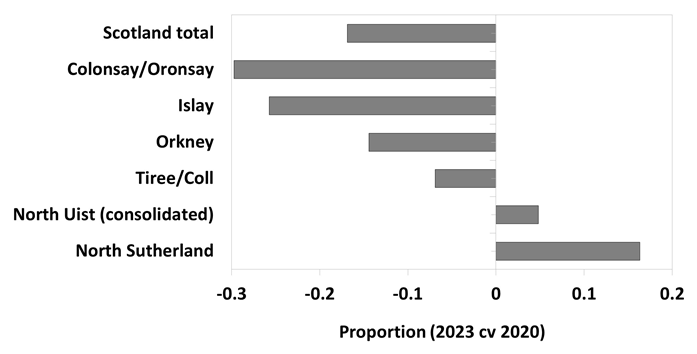
Figure 2. Counts of Greenland barnacle geese at key sites/areas in Scotland in February 2023, expressed as a proportion of counts made in March 2020.
Click for a full description
Graph showing the 2023 counts as a proportion of the 2020 counts by main areas (total, Colonsay/Oronsay, Islay, Orkney, Tiree/Coll, North Uist (consolidated), and North Sutherland). All sites except North Uist (consolidated) and North Sutherland showed a decline, with Oronsay/Colonsay showing the largest decline of 29.7%.
Discussion
Census total and accuracy in Scotland
Weather conditions in the week 18-25 February were poor for flying, with intermittent strong winds and occasional heavy rain. The ground counts in Scotland, carried out in locally good weather, were made over a nine-day period (18-26 February). Due to the poor weather conditions, the duration of the census was longer than in previous years, although it is not thought that, at this time of year, the geese make major movements between wintering sites. Of 13 barnacle geese marked with Global Positioning System (GPS) tags active during the census period, only one moved between resorts between 18-27 February; from Malin Beg, Ireland to Islay on 25 February. The movement occurred after the Islay count and before the Ireland count, and so a movement of a flock of birds, including the GPS-tagged individual, is unlikely to have affected the census total.
Overall, 89% of the census total in Scotland comprised estimates from ground counts and 11% were counted from photographs taken during the aerial survey. Eighteen flocks were counted from photographs during the aerial survey (Table 1). All the counts made during the aerial survey were taken from photographs (e.g. Figure 3) and no visual estimates (where no photograph was available) were necessary. This increases the accuracy of the individual site counts and indicates that the accuracy of the overall census total is likely to be high.
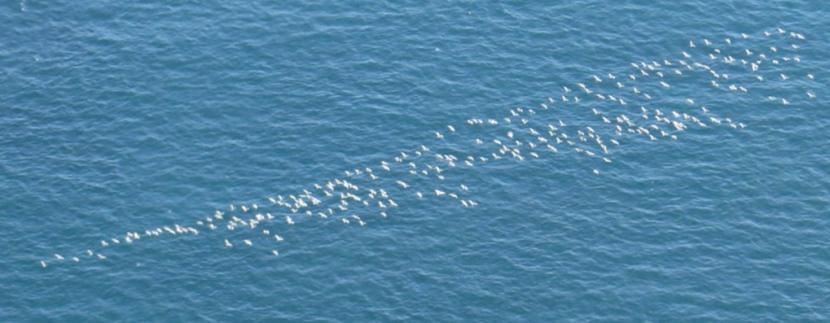
Figure 3. Photograph taken during the February 2023 aerial survey showing a flock of 265 Greenland barnacle geese at Muck (A.J. Leitch).
Coverage was thought to be good in Scotland with almost all known haunts of Greenland barnacle geese checked during the census (but see below). Prior to the census, Royal Society for the Protection of Birds (RSPB) reserve wardens, Highland Rangers and NatureScot staff reported no new sites that were thought to hold barnacle geese. However, Greenland barnacle geese were not found during the aerial survey at one site known to hold geese, and counts obtained outwith the core census period were used for the international population estimate. The count of 250 barnacle geese at Borve Point, Barra, merited inclusion in the final population estimate, since it normally holds geese throughout the winter period (B.Taylor in litt.).
Nature Scot staff reported that “.a few other flocks regularly use areas into Benbecula and South Uist, but hold just a few hundred birds in total and weren’t counted..." (J. Ferguson, in litt.). On Islay, whole island counts were undertaken on two days (22 and 23 February); the totals were 24,383 and 24,929 respectively, a 2.2% difference (546 birds) and the mean of the two counts is used i.e. + 273 birds). Given these caveats, whilst attempts were made to make an accurate assessment of the population total in Scotland, the total could be larger by at least approximately 500 birds (approx. + 1%).
No Greenland barnacle geese were reported in Iceland at the time of the census (A. Sigfusson pers. comm) and, in an analysis of spring arrival dates in Iceland, Gunnarsson & Tómasson (2011) noted first arrivals around 15 April. Thus, it seems likely that the census took place before any geese had left Scotland and migrated to Iceland.
References
Boyd, H. 1968. Barnacle geese in the west of Scotland, 1957-67. Wildfowl, 19, 96–107.
Cranswick, P.A., Mitchell, C., Merne, O.J., Kershaw, M., Delany, S.N., MacKay, M. & Lilley, R. 2000. Status and distribution of the Greenland population of barnacle goose in Britain and Ireland, 1993 to 1999. The Wildfowl & Wetlands Trust, Slimbridge.
Delany, S. & Ogilvie, M.A. 1994. Greenland barnacle geese in Scotland, March 1994. The Wildfowl & Wetlands Trust, Slimbridge.
Gunnarsson, T.G. & Tómasson, G. 2011. Flexibility in spring arrival of migratory birds at northern latitudes under rapid temperature changes. Bird Study, 58, 1–12
Kelly, S., Cummins, S., Walsh, A. and Tierney, D. 2023. Summary report: Results from the February 2023 Barnacle Goose Branta leucopsis population census in Ireland. National Parks and Wildlife Service, Dublin, Ireland.
Walsh, A. & Merne, O.J. 1988. Barnacle geese Branta leucopsis in Ireland, spring 1988. Irish Birds, 3, 539–550.