Horse mussel beds
Improving the protection given to Priority Marine Features
Feature – Horse mussel beds - subtidal only
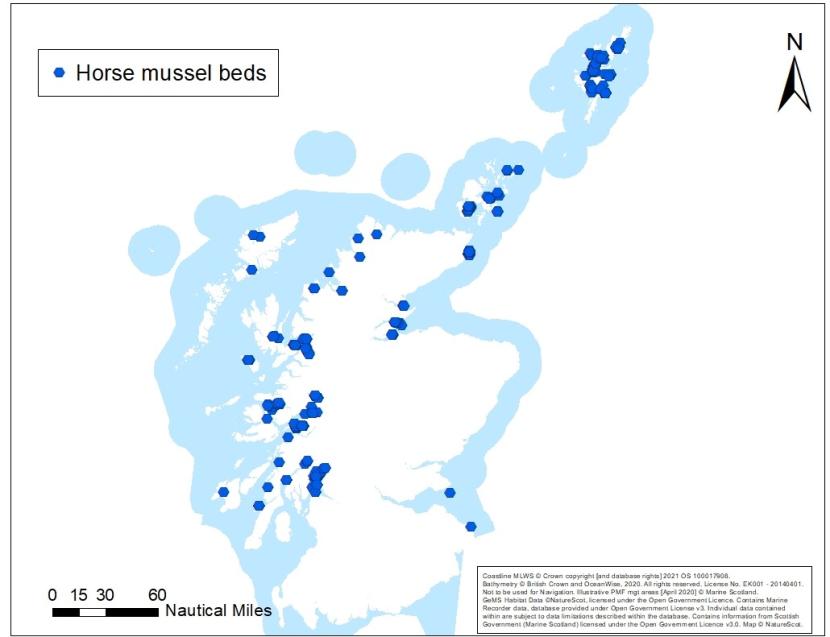
An overview of horse mussel bed records
Description
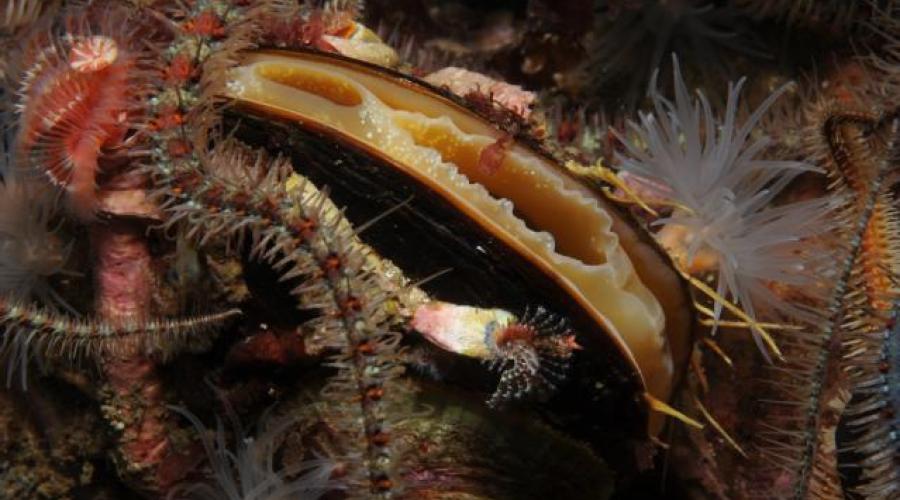
Characteristics - Horse mussels (Modiolus modiolus) may occur as isolated individuals or aggregated into beds in the form of scattered clumps, thin layers or dense raised hummocks or mounds, with densities reaching up to 400 individuals per m2 (Lindenbaum et al., 2008). Individuals can grow to lengths >150 mm and live for >45 years (Anwar et al., 1990). The mussels attach to the substratum and to each other using tough threads (known as byssus) to create a distinctive biogenic habitat (or reef) that stabilises seabed sediments and can extend over several hectares. Silt, organic waste and shell material accumulate within the structure and further increase the bed height. In this way, horse mussel beds significantly modify sedimentary habitats and provide substrate, refuge and ecological niches for a wide variety of organisms. The beds increase local biodiversity and may provide settling grounds for commercially important bivalves, such as queen scallops. Fish make use of both the higher production of benthic prey and the added structural complexity (OSPAR, 2009).
Definition - Beds are formed from clumps of horse mussels and shells covering more than 30% of the seabed over an area of at least 5 m x 5 m. Live adult horse mussels must be present. The horse mussels may be semi-infaunal (partially embedded within the seabed sediments - with densities of greater than 5 live individuals per m2) or form epifaunal mounds (standing clear of the substrate with more than 10 live individuals per clump) (Morris, 2015). Horse mussel beds support distinct communities with high species richness (or diversity) compared to surrounding sediments (Holt et al., 1998; Fariñas-Franco et al., 2014).
OSPAR (2009) note that beds may also be recognised at lower levels of coverage where frequent smaller clumps of mussels influence ecosystem functioning. Horse mussel beds vary considerably in their appearance and structure depending on environmental conditions, particularly exposure and tidal flow (Fariñas-Franco et al., 2014). Beds occurring in sheltered sea lochs are very different to those found on exposed coasts (Morris, 2015).
Environmental preferences - Horse mussel beds develop in areas of weak to strong water movement (<1 to >3 knots or <0.5 to >1.5 m/sec.), in depths of 5-220 m (although most known beds are 20-50 m) on a variety of mixed substrates from cobbles through to muddy gravels (Gormley et al., 2013). Predominantly found in fully saline conditions, horse mussel beds have also been recorded in the outer reaches of estuaries (e.g. Firth of Forth and Solway Firth; Mair et al., 2000).
Distribution
Scottish distribution - Recorded from sea lochs, embayments, tidal channels and at the open coast; in Shetland, Orkney, off Caithness and down the west coast, with scattered records from the Outer Hebrides and Moray Firth. The most northerly record is in Bluemull Sound (Shetland) and the most southerly record is off the Berwickshire coast to the east, with historic records of beds in the Solway Firth to the west (Cutts & Hemmingway, 1996; Allen et al., 1999).
Estimated known Scottish extent - Horse mussel beds vary in terms of the extent, density, elevation above the seabed and mussel size distribution. The largest known bed in Scotland, estimated at over 410 ha in size, is off Noss Head near Wick (Moore & Roberts, 2011; Hirst et al., 2013). This very tidally-swept, open coast bed supports a high abundance of live bound, low-lying mussels providing almost 100% cover in places with cryptic/encrusting associated epifauna (Morris, 2015). Other dense, continuous large beds occur off Copinsay in Orkney (~40 ha) and in the Dornoch Firth (at least 25 ha). Smaller beds occur in the Annat Narrows in Loch Linnhe (4 ha and 6 ha), Loch Leven (<1 ha), Oban Bay (<1 ha) and off Port Appin (~2 ha) (Moore et al., 2012).
Wider distribution - Horse mussel beds have been recorded from the Ards Peninsula and Strangford Lough in Northern Ireland, off both ends of the Isle of Man and off north-west Anglesey. The most southerly known bed is located off the Llŷn Peninsula in Wales, although scattered horse mussels have been recorded as far south as the Bay of Biscay. Beds also occur in Norway, Iceland and Newfoundland (east coast of Canada).
Status
Horse mussel beds are an OSPAR threatened and / or declining habitat (OSPAR, 2009) and are recognised as biogenic reefs which can be part of the broadscale habitats protected in Special Areas of Conservation (SACs) under Annex 1 of the EU Habitats Directive (European Commission, 2013). The Directive is transposed into domestic legislation through The Conservation (Natural Habitats, &c.) Regulations 1994 (as amended in Scotland) (Habitats Regulations).
The extent and quality of horse mussel bed habitat has declined since the 1950s. The loss of formerly extensive beds in Strangford Lough (N. Ireland) is attributed to scallop dredging and trawling activity (Strain et al., 2012). Declines in the diversity of associated species and density of horse mussels triggered a ban on mobile fishing gear imposed in 2003. Some signs of recovery of these beds were evident in 2018 (Joe Breen, pers comm) after total protection was introduced in 2011. The reduction in horse mussel abundance and habitat extent in Strangford Lough has been associated with a loss of ecosystem function (Strong et al., 2016).
In Scottish waters, declines in horse mussel bed cover have been recorded in Loch Alsh and Loch Fyne (Moore et al., 2013).
Horse mussels were reported as common in the Firth of Forth in the 1800s with subsequent documented declines linked to the exploitation of the former oyster fishery. Dredge survey work undertaken in 1895 (Fulton, 1896) to assess the state of the then dwindling native oyster population recorded just 317 living oysters in the 233 dredges (~550 m long tows). In contrast, nearly 35,000 live queen scallops and 8,113 horse mussels were taken during the survey (Thurstan et al., 2013).
Drivers for improving protection
Horse mussel beds are included on the PMF list which means that National Marine Plan General Policy 9(b) (avoiding significant impact on national status) applies. Horse mussel beds are an OSPAR threatened and deciling habitat in need of protection. The Scottish Biodiversity Strategy to 2045, the Scottish Biodiversity Duty and UK Marine Strategy Good Environmental Status provide further drivers to ensure biological diversity is restored, and ecosystems are safeguarded.
Sensitivity (including recovery)
[Key sources: FeAST, Fisheries Management Guidance]
Horse mussel beds are sensitive to physical disturbance, surface and sub-surface abrasion, siltation changes and removal of non-target and target species. Horse mussels are not able to migrate vertically when smothered and in a study after 16 days burial, over 50% mortality occurred (Hutchison et al., 2016).
Towed bottom-contacting fishing gears have the potential to cause damage to individual mussels, to the structural integrity of mussel clumps and to epifauna, as documented in Strangford Lough (Magorrian & Service, 1998; Roberts et al., 2004), North Wales (Cook et al., 2013) and the Isle of Man (Jones, 1951; Cook et al., 2013).
Horse mussels may be vulnerable to future climate impacts associated with increased sea temperature, including marine heat waves, ocean acidification and decreased salinity. The area of suitable habitat in the UK for horse mussel beds is predicted to decrease over the next century (Gormley et al., 2013).
Habitat recovery following impact is dependent on removal of the pressure, the continued presence of suitable substrates and a source of adult mussels to act as colonists or a source of larval recruits. Horse mussels are slow growing, have variable dispersal success, low fertilisation and settlement success rates as well as high juvenile mortality. No studies have observed full recovery of horse mussel beds, following either passive recolonisation after disturbance or active restoration. However, signs of recovery have been seen in Strangford Lough 15 years after measures were put in place to remove pressures (Joe Breen, pers comm). Overall, several elements of the biology and ecology of horse mussels significantly reduce the recovery potential of this species (Mazik et al., 2015).
Flame shells may out-compete horse mussels. Flame shell bed development in Loch Alsh between 1999 (Mair et al., 2000) and 2012 coincided with a marked decline in horse mussel density (Moore et al., 2013). A similar natural succession between the two habitat-forming species may have occurred in the Strome Narrows in Loch Carron since 1985 (Moore et al., 2018).
Connectivity
Between horse mussel beds - Horse mussel larvae are thought to have a pelagic larval duration of over 50 days resulting in a high dispersal potential.Larval migration is thought to be predominantly clockwise around the Scottish coastline (Millar et al., 2019). A distinction can be made between horse mussel beds in the south-west and north-west, with connectivity within each region. The Small Isles MPA appears to act as a link between the two regions, as it receives larvae from horse mussel populations in the southwest and exports larvae to the north-west (Millar et al., 2019). Orkney horse mussel beds receive larvae from west coast of Scotland populations. Model simulations show that within the Orkney populations, the beds self-recruit and are weakly connected to each other. Horse mussel beds in Shetland are mainly isolated from other Scottish populations with beds self-recruiting and well connected to other Shetland beds. The horse mussel bed in the Berwickshire and North Northumberland Coast SAC has low self-recruitment and this area receives no larvae from other known Scottish horse mussel beds (Millar et al., 2019). There may be horse mussel beds in the Firth of Forth supplying larvae to areas in south-east Scotland, but this requires further investigation. Additional management could help provide connectivity between beds, including those within the MPA network.
With other PMFs - Horse mussel beds can be found interspersed with the flame shell beds PMF, for example in Loch Alsh, Loch Creran and Loch Carron (Moore et al., 2018). In Loch Alsh, Moore et al. (2013) suggest that an observed decline in horse mussels may be related to flame shell population growth. Horse mussel beds are also found in the same location as the maerl beds PMF in Hascosay Sound (Hirst et al., 2013), the fan mussel aggregations PMF in the Sound of Canna (see Moore & Roberts, 2011) and the subtidal blue mussel beds PMF in the Dornoch Firth (The Highland Council, 2017). All the associations listed are within MPAs.
Ecosystem services
Horse mussel beds have a role in sediment stabilisation. The habitat provided by horse mussels support a number of other species and contribute to the protection of biodiversity. Horse mussels also have an important role in nutrient cycling as well as filtering sea water and removing potentially toxic algae.
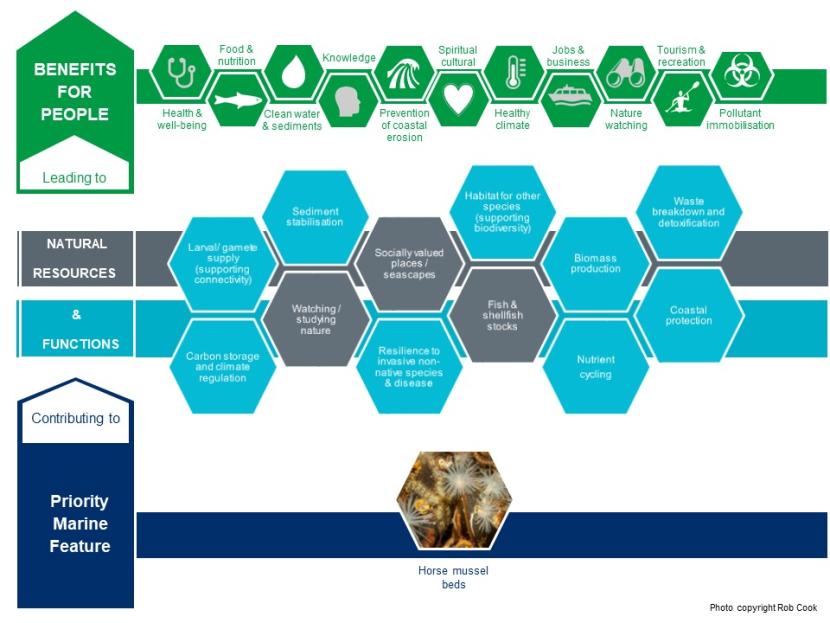
The contribution horse mussel beds make to natural resources and functions and the benefits for people that these lead to.
Click for a full description
- Priority Marine Feature: Horse mussel beds contributing to
- Natural resources (NR) and functions (F)
- Laval/gamete supply (supporting connectivity (F)
- Carbon storage & climate mitigation
- Waste breakdown and detoxification
- Sediment stabilisation (F)
- Socially valued places/seascapes (NR)
- Nutrient cycling (F)
- Watching/studying nature (NR)
- Resilience to invasive non-native species & disease (F)
- Habitat for other species (supporting biodiversity) (F)
- Fish and shellfish stocks (NR
- Biomass production (F)
- Coastal protection (F)
- Which leads to benefits for people
- Health & wellbeing
- Spiritual/cultural
- Clean water & sediments
- Pollutant immobilisation
- Knowledge
- Food and nutrition
- Prevention of coastal erosion
- Healthy climate
- Jobs and business
- Nature watching
- Tourism and recreation
Existing Marine Protected Areas
Horse mussel beds are a protected feature of 12 MPAs: Loch Laxford; Lochs Duich, Long and Alsh; Sunart; Upper Loch Fyne and Loch Goil; Loch Creran; Berwickshire and North Northumberland Coast; Sanday; Noss Head; Sullom Voe; Dornoch Firth and Morrich More; Small Isles; and Fetlar to Haroldswick.
Existing and proposed fisheries measures providing PMF protection
Horse mussel beds are protected by the following existing fishing measures:
- The Inshore Fishing (Scotland) Order 2015 (Loch Laxford; Lochs Duich, Long and Alsh (through the combined Southern Inner Sound measures CA150); Sunart; Upper Loch Fyne and Loch Goil; Loch Creran; Sanday; and Noss Head).
- The Wester Ross Marine Conservation Order 2016.
- The Loch Carron Marine Conservation Order 2019.
- Loch Roag (CA67) and The Gare Loch (CA53).
- The Inshore Fishing (Scotland) Order 2004 Berwickshire and North Northumberland Coast SAC).
- Dornoch Firth (CA72)
New fishing measures are proposed which will protect horse mussel beds in the following MPAs:
- Sullom Voe; Dornoch Firth and Morrich More; Small Isles; and Fetlar to Haroldswick.
The Shetland Shellfish Management Organisation (SSMO) is the regulator for shellfish fisheries within Shetland’s six-mile limit. There is a requirement that measures to manage scallop dredging activity within relevant MPAs will be introduced by the SSMO to complement measures proposed by Marine Directorate and provide the necessary protection for designated habitats and species (including the PMFs covered by this review). Existing SSMO measures encompass horse mussel bed records in the Fetlar to Haroldswick MPA and some records in Sullom Voe MPA.
Proposed measures in the Dornoch Firth are expected to derogate the Tain blue mussel fishery from wider mechanical dredge prohibitions and enable future fishing subject to satisfying a Habitats Regulation Appraisal (HRA) for the SAC. Surveys (2015 and 2016; Cook et al., 2016) recorded an area of horse mussel beds (and fragile sponge communities) in the Dornoch Firth, adjacent to subtidal blue mussel beds (The Highland Council, 2017).
Approach to assessing improvements in management needed to protect horse mussel beds from impacts related to towed bottom-contacting fishing gear
The assessment presented in this document relates to fishing with towed bottom-contacting gear only. It is consistent with the approach taken for assessing proposed developments.
When considering biodiversity evidence more weight has been given to clusters of horse mussel records and records which show the extent of horse mussel beds (i.e. polygon data) where available, in preference to isolated observations. There has been particular consideration of larger beds in comparison to smaller ones (where extent is known), except where smaller or fragmented beds are the only remaining examples in a geographic area and require protection to support recovery of the PMF.
Consideration of key locations for horse mussel beds has focused on dense continuous beds outside protected areas and encompassing all forms of bed (e.g. scattered clumps, thin layers or dense raised hummocks) as well as ensuring the areas/locations are distributed to cover the full range of environmental conditions in which horse mussel beds occur (type of wider environment e.g. sea loch vs. coastal, depth, geographic range, substrate, etc.), and the connectivity of beds. The majority of records occur in coastal areas such as sea lochs and embayments, which are thought to be a source of recuits for other areas (Mackenzie et al., 2018), although beds also occur away from the coast, in more exposed areas.
A greater biological diversity of associated faunal and floral communities and greater bed extents are factors which increase the conservation importance of a bed. Information on these characteristics does not exist for all records in Scottish waters precluding their detailed application in this assessment. Such information should be sought and used in development licensing and consenting processes.
Any towed bottom-contactin fishing activity that leads to the loss of entire beds or damage to beds, such that function or provision of ecosystem services cannot be maintained, should be considered to have a significant impact on national status and as a result not meet General Policy 9(b) in the National Marine Plan. Existing licensing and consenting processes will continue to consider the potential for significant impacts on horse mussel beds.
Key locations for the protection of horse mussel beds outside designated sites and existing towed bottom-contacting fisheries restrictions
Summary
We recommend that the development of spatial fisheries measures to protect horse mussel beds from pressures associated with towed bottom-contacting gears should cover records of the feature within the following key locations (outside of MPAs that protect this feature and areas with existing fisheries measures). These are shown in Map 2: Gigha; Islay; Loch Craignish; north-west Scotland; Orkney; Shetland; Lochs Linnhe, Leven and Eil; Gourock; Loch Long (upper); Dornoch Firth; Skye; and Harris and Lewis.
The recommendations for subtidal horse mussel beds need to be considered alongside the recommendations for the other 10 PMFs considered as part of the development of PMF management areas. These recommendations are based on biodiversity evidence taking into consideration the information above and will inform fisheries management led by Marine Directorate.
If fisheries management measures were established to protect records in all these key locations it would achieve substantial protection for horse mussel beds, complementing the protection already in place for some MPAs and proposed for other MPAs (see map 2).
Details of locations
North-east Gigha and Loch Indaal (Islay) may be important for connectivity with Irish Sea populations of horse mussels and include records from as recent as 2019. The patches of horse mussel bed habitat in north-east Gigha cover a fairly large area. A horse mussel bed record is amongst seagrass bed records in Loch Craignish.
Island populations may act as stepping stone beds to maintain population connectivity; such beds should also be a priority for management. Given the predicted climate change trend for suitable horse mussel habitat to be restricted to more northerly locations (Gormley et al., 2013), protection of horse mussel beds in north-west Scotland, including records in Loch Eriboll and Eddrachillis Bay, as well as in Orkney and Shetland would add resilience to existing measures. In Orkney a relatively large, dense bed has been recorded off Copinsay but its extent to the north has not been defined and could be connected to other records further north (e.g. Stronsay). Beds are also present further west in the Bring Deeps in Scapa Flow and in a mosiac with maerl and flame shell beds in Gutter Sound.
Around Shetland there are numerous records of horse mussel beds, although some of these are scattered clumps of live mussels at relatively low density. Outside MPAs, some of the records are afforded partial protection (with prohibitions in place for scallop dredging only) within SSMO statutory closed areas (e.g. Busta Voe and Quey Firth). Multiple other records currently have no fisheries measures in place including south-west Whalsay, Ollaberry, and Linga Sound.
There is a dense, continuous bed off Port Appin in Loch Linnhe, with recent records of horse mussel beds in the upper part of the loch and from Loch Eil and Loch Leven often alongside flame shell beds. In the Firth of Clyde Seasearch divers recorded a 200 m long horse mussel bed off Gourock (near Greenock) in 2016 and again in 2017 and there are multiple records in Loch Long (upper).
Fisheries management in the Dornoch Firth
The horse mussel bed records within the Dornoch Firth are considered as managed because proposed measures for the MPA would prohibit bottom-contacting fishing gear. However, a derogation is proposed for the Tain blue mussel dredge fishery to continue on its current basis providing that it satisfies a HRA. Formalising spatial restrictions to protect the recently mapped horse mussel bed and associated fragile sponge communities in the outer part of the estuary should also be considered. Some knowledge gaps remain where the bed extends into an MOD area within the Dornoch Firth. The responsible approach taken by Highland Council and Tain Community Council in resting the blue mussel fishery until 2005 levels of stocks are reached again; stipulating the need for a future stock assessment survey that can inform HRA; and, in identifying the horse mussel bed as a sensitive area to be avoided if the fishery re-starts (The Highland Council, 2017) is recognised and welcomed.
To the east of Skye Loch Sligachan and Loch Ainort and Caolas, Scalpay have records of horse mussel beds along with recent records of flame shell beds. In Harris and Lewis unprotected horse mussel beds are present in East Loch Tarbert and consideration of measures here would provide protection to the only known record of this feature on the east coast of the Western Isles.
Data confidence
We have recent records from 2019. Surveys vary in scope from Seasearch (carried out by volunteer divers), studies undertaken to support development proposals, dedicated PMF validation surveys (e.g. 2012 SNH/MSS Shetland benthic camera survey) and academic research (e.g. Heriot-Watt University surveys). Records come from both diving and remote video surveys. Multibeam data were used to assess the extent of the Noss Head bed.
Horse mussel bed records in Shetland were cross-checked against the results of survey work undertaken by the University of the Highlands and Islands (UHI) Shetland (Shelmerdine et al., 2014 and Shelmerdine & Mouat, 2020). A process to incorporate relevant, confirmed PMF data, collated as part of the Shetland Islands Regional Marine Plan (SIRMP) is in development. These records will be mobilised via future updates to Marine Directorate’s National Marine Plan interactive (NMPi) online tool.
Knowledge gaps and other recommended work
We recommend continuing efforts to explore opportunities for collaborative monitoring, survey and research to improve our understanding of this habitat, for example:
- Historic records off Islay and east Skye could be investigated to determine their continued presence and status.
- New survey work is required to confirm the current status of horse mussel beds in the Firth of Forth with historic records off Cramond and more recent confirmation of records off Inchkeith (Thurstan et al., 2013) and the Isle of May (just outside the Isle of May MPA) (ERT Scotland Ltd., 2003).
- A considerable area of suitable habitat for horse mussel beds is predicted in Orkney and Shetland (outside the areas suggested above) as well as in sea lochs on the west coast and the Outer Hebrides (Gormley et al., 2013). However, historic survey effort is low in these areas, particularly along the north-west coast. Opportunistic sampling could determine the presence of horse mussel beds.
Key locations for the protection of horse mussel beds outside of MPAs with management measures and existing towed bottom-contacting fisheries restrictions

Key locations for the protection of horse mussel beds outside of MPAs with management measures and existing towed bottom-contacting fisheries restrictions.
Click for a full description
For further details about the locations marked in this map see above, section Key locations for the protection of horse mussel beds outside designated sites and existing towed bottom-contacting fisheries restrictions
References
Allen, J., Cutts, N., Elliott, M., Hemingway, K. & Read, S. 1999. Solway Firth - Marine SAC mapping subtidal sediments and scars. Scottish Natural Heritage Report No. ZO93-F-99.
Anwar, N.A., Richardson, C.A. & Seed, R. 1990. Age determination, growth rate, and population structure of the horse mussel Modiolus modiolus. Journal of the Marine Biological Association of the United Kingdom, 70(2): 441-457.
Burrows, M.T., Kamenos, N.A., Hughes, D.J., Stahl, H., Howe, J.A. & Tett, P. 2014. Assessment of carbon budgets and potential blue carbon stores in Scotland’s coastal and marine environment. Scottish Natural Heritage Commissioned Report No. 761.
Cook, R., Fariñas-Franco, J.M., Gell, F.R., Holt, R.H.F., Holt, T., Lindenbaum, C., Porter, J.S., Seed, R., Skates, L.R., Stringell, T.B. & Sanderson, W.G. 2013. The substantial first impact of bottom fishing on rare biodiversity hotspots: a dilemma for evidence-based conservation. PLoS One, 8(8): e69904.
Cutts, N. & Hemmingway, K. 1996. The Solway Firth: broad scale habitat mapping. Scottish Natural Heritage Research, Survey and Monitoring Report No. 46.
ERT Scotland Ltd. 2003. The Forth Spatial Study: Broad Scale Biotope Mapping of the Isle of May Candidate Special Area of Conservation, September 2002. Unpublished report to Scottish Natural Heritage.
European Commission. 2013. Interpretation manual of European Union habitats. EUR 28, 144 pages.
Fariñas-Franco, J.M., Allcock, A.L. & Roberts, D. 2018. Protection alone may not promote natural recovery of biogenic habitats of high biodiversity damaged by mobile fishing gears. Marine Environmental Research, 135: 18-28.
Fariñas-Franco, J.M., Pearce, B., Porter, J., Harries, D., Mair, J.M., Woolmer, A.S. & Sanderson, W.G. 2014. Marine Strategy Framework Directive indicators for biogenic reefs formed by Modiolus modiolus, Mytilus edulis and Sabellaria spinulosa Part 1: Defining and validating the indicators. Peterborough: Joint Nature Conservation Committee. JNCC Report No. 523, 92 pages.
Gormley, K.S., Porter, J.S., Bell, M.C., Hull, A.D. & Sanderson, W.G. 2013. Predictive habitat modelling as a tool to assess the change in distribution and extent of an OSPAR priority habitat under an increased ocean temperature scenario: consequences for marine protected area networks and management. PloS One, 8(7): e68263.
Hirst, N.E., Kamphausen, L.M., Cook, R.L., Porter, J.S. & Sanderson, W.G. 2013. Distribution and status of proposed protected features in the Fetlar to Haroldswick MPA proposal. Scottish Natural Heritage Commissioned Report No. 599.
Holt, T.J., Rees, E.I.S. & Seed, R. 1998. Biogenic Reefs (Volume IX). An overview of dynamic and sensitivity characteristics for conservation management of marine SACs. Scottish Association for Marine Science (UK Marine SACs Project), 170 pages.
Hutchison, Z.L., Hendrick, V.J., Burrows, M.T., Wilson, B. & Last, K.S. 2016. Buried alive: the behavioural response of the mussels, Modiolus modiolus and Mytilus edulis to sudden burial by sediment. PloS One, 11(3): e0151471.
Jones, N.S. 1951. The bottom fauna off the south of the Isle of Man. Journal of Animal Ecology, 20(1): 132-144.
Kent, F.E., Mair, J.M., Newton, J., Lindenbaum, C., Porter, J.S. & Sanderson, W.G. 2017. Commercially important species associated with horse mussel (Modiolus modiolus) biogenic reefs: A priority habitat for nature conservation and fisheries benefits. Marine Pollution Bulletin, 118(1): 71-78.
Lindenbaum, C., Bennell, J.D., Rees, E.I.S., McClean, D., Cook, W., Wheeler, A.J. & Sanderson, W.G. 2008. Small-scale variation within a Modiolus modiolus (Mollusca: Bivalvia) reef in the Irish Sea: I. Seabed mapping and reef morphology. Journal of the Marine Biological Association of the UK, 88(1): 133-141.
Mackenzie, C.L., Kent, F.E.A., Baxter, J.M. & Porter, J.S. 2018. Genetic analysis of horse mussel bed populations in Scotland. Scottish Natural Heritage Commissioned Report No. 1000.
Magorrian, B.H. & Service, M. 1998. Analysis of underwater visual data to identify the impact of physical disturbance on horse mussel (Modiolus modiolus) beds. Marine Pollution Bulletin, 36(5) 354-359.
Mair, J.M., Moore, C.G., Kingston, P.F. & Harries, D.B. 2000. A review of the status, ecology and conservation of horse mussel Modiolus modiolus beds in Scotland. Scottish Natural Heritage Commissioned Report No. F99PA08.
Mazik, K., Strong, J., Little, S., Bhatia, N., Mander, L., Barnard, S. & Elliott, M. 2015. A review of the recovery potential and influencing factors of relevance to the management of habitats and species within Marine Protected Areas around Scotland. Scottish Natural Heritage Commissioned Report No. 771.
Millar, H., Murray, R.O’H., Gallego, A., Gormley, K. & Kent, F. 2019. Connectivity of selected Priority Marine Features within and outwith the Scottish MPA network. Scottish Natural Heritage Research Report No. 1048.
Moore, C.G., Harries, D.B., Cook, R.L., Hirst, N.E., Saunders, G.R., Kent, F.E.A., Trigg, C. & Lyndon, A.R. 2013. The distribution and condition of selected MPA search features within Lochs Alsh, Duich, Creran and Fyne. Scottish Natural Heritage Commissioned Report No. 566.
Moore, C.G., Harries, D.B., James, B., Cook, R.L., Saunders, G.R, Tulbure, K.W., Harbour, R.P. & Kamphausen, L. 2018. The distribution and condition of flame shell beds and other Priority Marine Features in Loch Carron Marine Protected Area and adjacent waters. Scottish Natural Heritage Research Report No. 1038.
Moore, C.G., Harries, D.B. & Trigg, C. 2012. The distribution of selected MPA search features within Lochs Linnhe, Etive, Leven and Eil: a broadscale validation survey (Part B). Scottish Natural Heritage Commissioned Report No. 502.
Moore, C.G. & Roberts, J.M. 2011. An assessment of the conservation importance of species and habitats identified during a series of recent research cruises around Scotland. Scottish Natural Heritage Commissioned Report No. 446.
Morris, E. 2015. Defining Annex I biogenic Modiolus modiolus reef habitat under the Habitats Directive. Peterborough: Joint Nature Conservation Committee. JNCC Report No. 531, 37 pages.
NatureScot. 2024. Geodatabase of Marine features adjacent to Scotland (GeMS). GeMS V10 (i26).
OSPAR. 2009. Background Document for Modiolus modiolus beds. Biodiversity Series. OSPAR Commission. Publication number: 425. ISBN 978-1-906840-65-5.
Roberts, D., Davies, C., Mitchell, A., Moore, H., Picton, B., Portig, A., Preston, J., Service, M., Smyth, D. Strong, D. & Vize, S. 2004. Strangford Lough ecological change investigation (SLECI). Report to the Environment and Heritage Service by the Queens University, Belfast.
Shelmerdine, R.L. & Mouat, B. 2020. Distribution of maerl and horse mussels (Modiolus modiolus) around Shetland: findings from a direct PMF survey. NAFC Marine Centre UHI.
Shelmerdine, R.L., Stone, D., Leslie, B. & Robinson, M. 2014. Implications of defining fisheries closed areas based on predicted habitats in Shetland: A proactive and precautionary approach. Marine Policy 43: 184-199.
Strong, J.A., Service, M. & Moore, H. 2016. Estimating the historical distribution, abundance and ecological contribution of Modiolus modiolus in Strangford Lough, Northern Ireland. Biology and Environment: Proceedings of the Royal Irish Academy, 116B(1): 1-16.
The Highland Council. 2017. Tain Common Good - Mussel Fishery. Report by the Director of Development and Infrastructure, Agenda item 6, Report no. RC/004/17.
Thurstan, R.H., Hawkins, J.P., Raby, L. & Roberts, C.M. 2013. Oyster (Ostrea edulis) extirpation and ecosystem transformation in the Firth of Forth, Scotland. Journal for Nature Conservation, 21(5): 253-261.