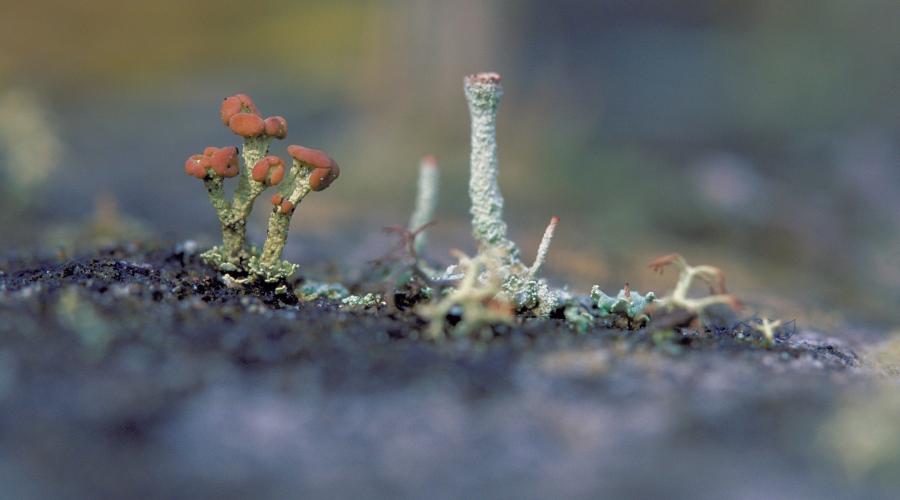
Genetic Scorecard Indicator - Wooden Soldiers Lichen
Wooden Soldiers Lichen (Cladonia botrytes)

IUCN Category:
- Great Britain: Critically Endangered (indicated above)
- Europe: Not Assessed
- Global: Not Assessed

Genetic Health Status:
- Scottish Risk: Serious (indicated above)
- UK Risk: Serious
- Scottish Mitigation status: Not in place
- UK Mitigation status: Not in place
Background
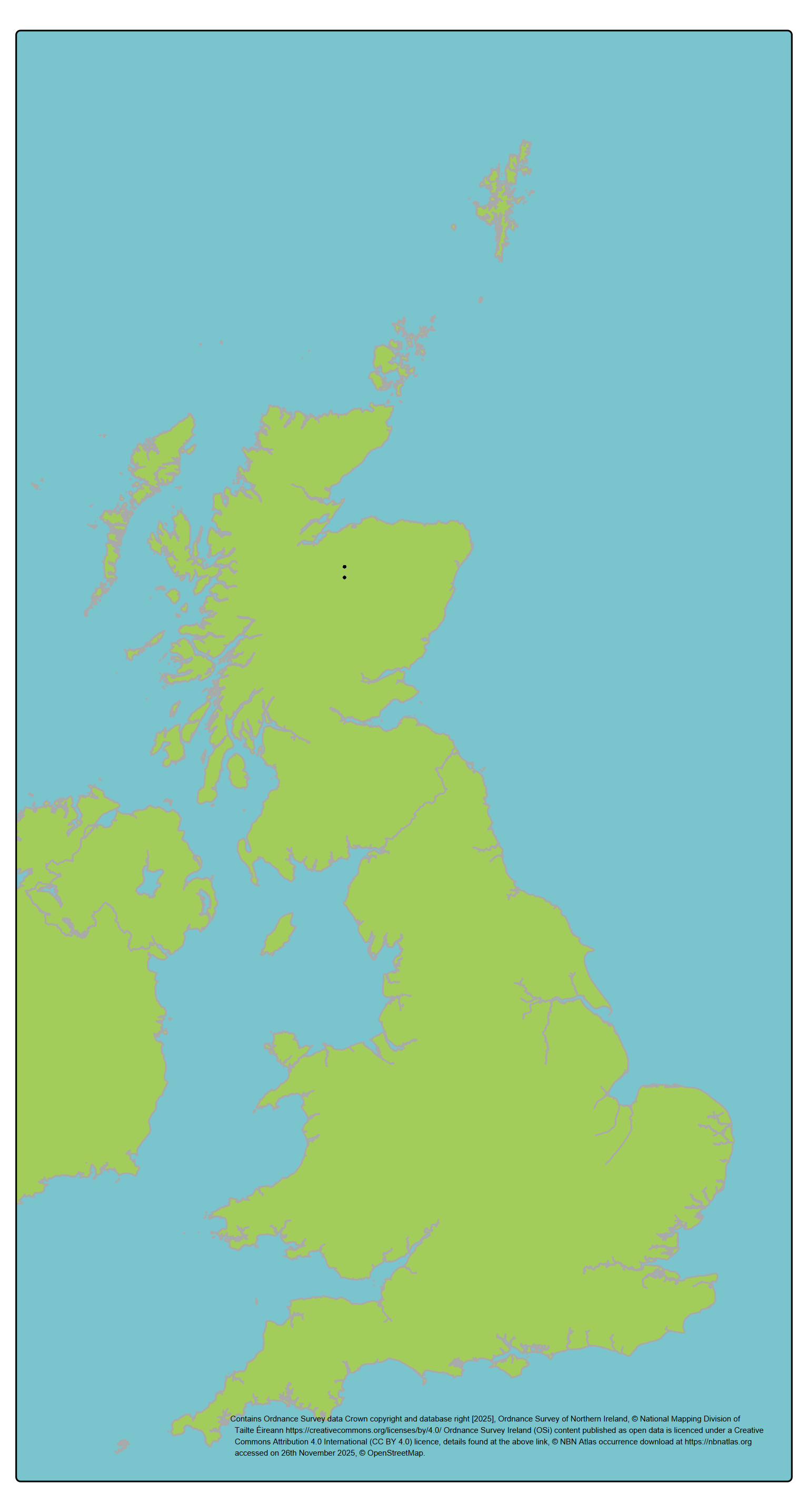
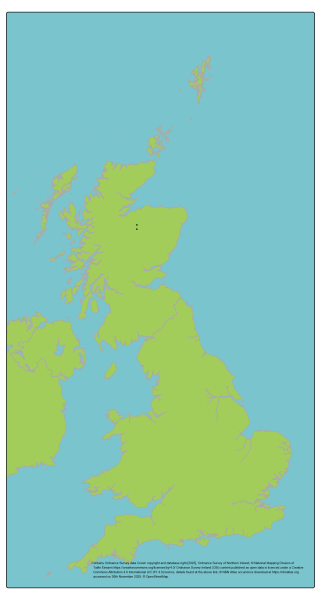
A short-lived lichen that occurs within the UK primarily on relatively recently cut surfaces of Pinus stumps, more rarely on Picea stumps or dead Calluna stems. Its distribution in the UK is restricted to the Cairngorm region of northern Scotland, where it is rather rare and very local and characterised by an unstable meta-population relaying on patchy ephemeral habitat. Most records are from recently cut (4–10 years) stumps of conifers, and populations are vulnerable due to decay of the substrata (Yahr et al., 2013). More than 90% of individual mats of the lichen persist not more than three years. Felling in native pinewoods has ceased in recent decades, and rapidly replanted commercial plantations are a lower quality habitat. Currently the largest sites are in commercial plantations felled to restore to native woodland by natural regeneration. Current data gives an AOO of 52km2 occurring in three distinct locations with probably separate meta-populations in Strath Spey, Deeside and the East Perthshire and Angus Glens, the latter with few records. The populations are subject to extreme fluctuations in locations and numbers of functional individuals. Ephemeral populations in clear fells can reach up to 50 stumps. It is highly unlikely that there are more than 2500 occupied stumps at any one time.
View a larger version of the distribution map for Wooden Soldiers Lichen.
Current Threats
Habitats in the UK are primarily in clear-felled plantations, and especially on Pinus stumps. Management now rarely includes clear felling of Pinus, so primary habitat within the UK is less often available.
Contribution of Scottish/UK population to total species diversity
Within the UK, this species is only known from a small number of Scottish sites. However, globally, Cladonia botrytes can be an abundant species in other boreal forests, growing abundantly also on downed logs and other fallen conifer wood in addition to soil.
Genetic risks
Diversity loss: population declines
Populations are ephemeral, subject to dramatic fluctuations as habitats are formed, become suitable and decline.
Global Biodiversity Framework Indicators
Population definitions:
Populations are defined by ecological and biogeographic proxies. Evidence from studies in Sweden suggest some differentiation of habitat use across geographic areas. Populations are defined at large biogeographic scales, with all Scottish sites considered part of the same metapopulation, comprised of few to many ephemeral sites or localities.
Ne500: The proportion of populations that have an effective population size of more than 500.
- Proportion of populations with Ne > 500 in Scotland = 0/1
- Proportion of populations with Ne > 500 in UK = 0/1
PM: Proportion of populations that existed in 2000 that still exist in 2025.
- Proportion of populations maintained in Scotland = 1/1
- Proportion of populations maintained in UK = 1/1
Diversity loss: functional variation
Functional variation
The ecology of the species varies with distribution, with Swedish populations frequently occurring on humus on soil or over boulders in addition to dead and downed lignin of trees, and with proportion of substrates varying by region (Bogomazova, 2013).
Divergent lineages
Loss within the UK seems most likely given its apparent rarity and habitat specialisation.
Hybridisation/Introgression
No evidence of hybridisation/introgression.
Low turnover - constraints on adaptive opportunities
The demography of the species in the UK suggests rapid turnover within populations and short-lived individuals, but it is not known if these are recruited from mycelium within wood or from dispersal and establishment of spores. It is not known if UK/Scottish populations are recruited via long distance dispersal from larger European/North American populations or are isolated.
Cumulative Risk Summary
Overall Genetic Health Status
Scotland
- Risk: Serious
- Mitigation: Not in place
Great Britain/UK
- Risk: Serious
- Mitigation: Not in place
Overall Genetic Health status explanation
Biology and the precautionary principle are opposing drivers of summary status for this species. Tested boreal lichens have gene flow and large population sizes without genetic structure at the continental scale (Geml, 2011), whereas the untested possibility that this species has unique significant functional or genetic diversity within the UK could suggest an extreme risk of negative genetic effects.
In situ genetic threat level
In situ genetic threat level
- In situ Risk for Scotland: Serious
- In situ Risk for UK: Serious
Applying the precautionary principle that UK/Scottish populations are genetically independent from other larger populations in other countries, the species in the UK/Scotland should be assessed as severely threatened by small population size.
Confidence in in situ threat level
- Confidence score for Scotland: Low
- Confidence score for UK: Low
Two scenarios appear likely:
- Scottish/UK populations are at their climatic range edge and behave as specialists with small local subpopulation size though are part of a larger boreal population, connected by gene flow and spore dispersal at the continental scale (Geml 2011);
- Scottish/UK populations are genetically isolated and experience severe fluctuations and are at risk from small population size.
Ex situ representation
None.
Current conservation actions
None. Occasional monitoring programmes have been in effect but are not now continuing.
| Ex situ | Translocation | Habitat management | Legal protection of habitat or species | Regulation of exploitation | Control of INNS/pests/pathogens |
|---|---|---|---|---|---|
| - | - | - | - | - | - |
Population assessment/monitoring
Population
Demographic
N pops assessed/monitored in Scotland = 1/1
N pops assessed/monitored in UK = 1/1
Genetic
N pops assessed/monitored in Scotland = 0/1
N pops assessed/monitored in UK = 0/1
References
Bogomazova, K., 2013. Ecology of the lichen Cladonia botrytes in Sweden.
Geml, J., 2011. Coalescent analyses reveal contrasting patterns of intercontinental gene flow in arctic-alpine and boreal-temperate fungi. Biogeography of Microscopic Organisms: is everything small everywhere, pp.175-190.
Yahr, R., Coppins, B.J. and Coppins, A.M., 2013. Transient populations in the British conservation priority lichen, Cladonia botrytes. The Lichenologist, 45(2), pp.265-276.
Assessor: Rebecca Yahr, RBGE
Reviewer: Kat O'Brien, NatureScot