Genetic Scorecard Indicator - Sea Trout; Brown Trout; Ferox Trout
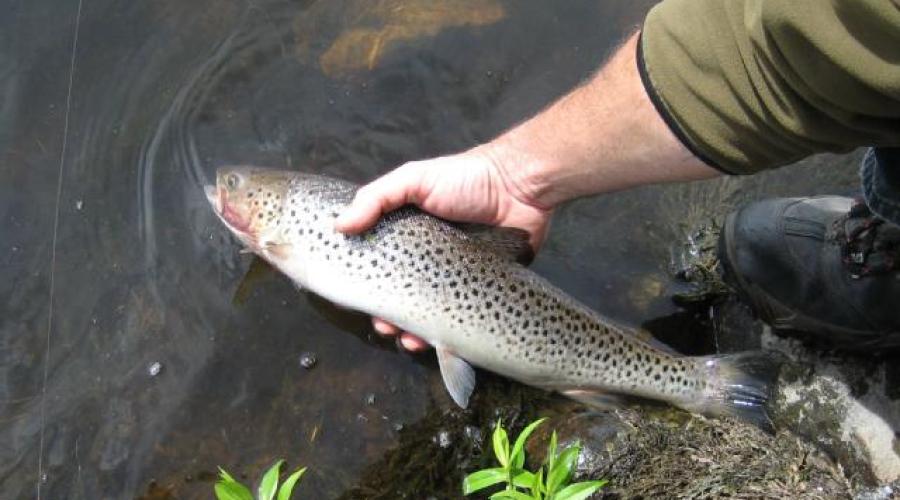
Sea Trout; Brown Trout; Ferox Trout (Salmo trutta)

IUCN Category:
- Great Britain: Least concern (indicated above)
- Europe: Least concern
- Global: Least concern

Genetic Health Status:
- Scottish Risk: Moderate (indicated above)
- UK Risk: Moderate
- Scottish Mitigation status: Partly effective
- UK Mitigation status: Partly effective
Background
Salmo trutta is a polytypic and widespread salmonid fish species that occurs in many types of freshwater habitat across Europe, north Africa and western Asia (Klemetsen et al., 2003). In common with other salmonids, it is polygamous with external spawning; age at maturity varies from two to several years, generations are overlapping and individuals are iteroparus.
Native to Europe, it has been widely introduced across the globe and is a popular target of recreational and some commercial fisheries. In the UK, S. trutta populations with access to the ocean exhibit a mix of anadromous ('Sea Trout') and resident ('Brown Trout') life-history strategies.
The anadromous life history generates some gene flow between populations in different catchments; however, this is spatially limited resulting in genetic differentiation at the catchment level (Bekkevold et al., 2024). There is additionally an unknown large number of non-anadromous stream- and lake dwelling populations in the UK, each of which can be considered genetically isolated and may have very small effective population sizes (e.g. Palm et al., 2003).
Within larger lakes, S. trutta can occur as multiple, genetically distinct ecotypes, including a large piscivorous form ('Ferox Trout') (Verspoor et al., 2019; Ferguson & Prodöhl, 2022); the total extent of ecotypic differentiation within and across U.K. lakes is unknown. Hatchery-reared S. trutta have been extensively stocked into native wild populations.
S. trutta occur in most freshwater habitats across the UK. Native resident trout in lakes, ponds and small streams often have little/no gene flow among them and can each be considered as genetically separate populations. Further, several larger lakes support multiple genetically distinct ecotypes. S. trutta in larger rivers with an anadromous stock component have more inter-river gene flow, however this varies between rivers, and many can also be considered distinct populations. By this definition, there are likely >500 genetically differentiated native wild S. trutta populations across the UK.
Current Threats
- Loss of spawning/juvenile rearing habitat due to declines in water quality (pollution, siltation, acidification), imposition of migration barriers and other river/stream channel engineering impacts.
- Climate change impacts, including increased freshwater/ocean temperatures, more frequent droughts and spates, changes in prey populations (Jackson et al., 2018).
- Disease/parasites, in particular increased sea lice burdens of anadromous trout migrating past Atlantic salmon aquaculture pens (Thorstad & Finstad, 2018).
- Targeted fishing, by-catch mortality, and fishing of prey species.
- Invasive predatory or competitive species in freshwater environments, including pike, perch, signal crayfish and pink salmon.
- Increased local predation.
- Hybridization with non-native stocked S. trutta; potential negative impacts of supplementary stocking with local fish.
Contribution of Scottish/UK population to total species diversity
Scotland and UK support genetically distinct populations of anadromous S. trutta, genetically distinct populations of lacustrine S. trutta including unique ecotypes, and many smaller populations of resident S. trutta.
Genetic risks
Diversity loss: population declines
Anadromous populations: Catch statistics indicate an ongoing decline in UK Sea Trout populations over the past several decades (Adams et al., 2022), with some localized stock collapses.
Stream-resident populations: Generally not monitored.
Lacustrine populations: Multiple upland lake-dwelling populations were lost in the 20th century due to acidification (Prodohl et al., 2019) but most have been re-stocked. Invasive species, in particular pike and perch, are believed to threaten several lacustrine populations.
Global Biodiversity Framework Indicators
Population definitions:
Populations are defined geographically by freshwater network.
Ne500: The proportion of populations that have an effective population size of more than 500.
Ne assessment was performed for anadromous S. trutta (Sea Trout) only, with individual management units defined as separate populations. Ne estimates are presented as a range owing to variation in underlying data.
- Lower bound: assumes 30% exploitation rate, Ne:Nc = 0.11
- Upper bound: assumes 2.5% exploitation rate, Ne:Nc = 0.53
- Proportion of populations with Ne > 500 in Scotland (anadromous form only, range) = 3/97 - 76/97
- Proportion of populations with Ne > 500 in UK (anadromous form only, range) = 3/176 – 131/176
PM: Proportion of populations that existed in 2000 that still exist in 2025.
- Proportion of populations maintained in Scotland (all forms, estimate) = >0.9 out of >500
- Proportion of populations maintained in UK (all forms, estimate) = >0.9 out of >500
Diversity loss: functional variation
Functional variation
Ecotypes within lakes are poorly characterized and monitored: threats include invasive species and lake engineering. Certain ecotypes (e.g. Ferox) may have relatively small population sizes and long generation times, increasing vulnerability.
Populations spawning in different areas are likely have locally adaptive genetic variation (Bekkevold et al., 2020).
Divergent lineages
As above: potential loss of divergent ecotypes and genetically differentiated populations breeding in different locations.
Hybridisation/Introgression
S. trutta has been extensively stocked throughout the UK and introduced fish may represent a hybridization risk to wild populations (e.g. Bekkevold et al., 2024). Recent policies permitting stocking of only local or infertile triploid Brown Trout have reduced this risk.
Low turnover - constraints on adaptive opportunities
No known issues, but little relevant data.
Cumulative Risk Summary
Overall Genetic Health Status
Scotland
- Risk: Moderate
- Mitigation: Partly effective
Great Britain/UK
- Risk: Moderate
- Mitigation: Partly effective
Overall Genetic Health status explanation
Multiple potential threats to local populations, and thus Scottish/Great Britain/UK genetic diversity, but relatively little baseline / monitoring data available at a national level.
In situ genetic threat level
In situ genetic threat level
- In situ Risk for Scotland: Moderate
- In situ Risk for UK: Moderate
Widespread species but multiple threats create possibility of repeated local declines/local genetic diversity loss.
Confidence in in situ threat level
- Confidence score for Scotland: Medium
- Confidence score for UK: Medium
Some populations (e.g. Sea Trout) are relatively well monitored but others (e.g. lake ecotypes) are not.
Ex situ representation
Several domesticated strains; some hatchery rearing and stocking of local populations.
Current conservation actions
S. trutta is a UK Biodiversity Action Plan priority fish species, and Sea Trout are a Scottish Priority Marine Feature. There is ongoing work to improve monitoring and assessment of anadromous populations at the juvenile and returning adult stages (ICES, 2024), and harvests of anadromous or resident trout are regulated at the local and national level with a move towards catch-and-release only for some stocks. Recent changes in Scotland/UK stocking policy allow only local fish or infertile triploids to be stocked into wild S. trutta populations. There are efforts towards freshwater habitat restoration, either directly targeted for S. trutta, or targeted towards S. salar but with associated benefits for S. trutta.
| Ex situ | Translocation | Habitat management | Legal protection of habitat or species | Regulation of exploitation | Control of INNS/pests/pathogens |
|---|---|---|---|---|---|
| - | X | X | X | X | - |
Population assessment/monitoring
Population
Demographic
Annual catch monitoring for anadromous form Sea Trout); little or no monitoring for resident S. trutta.
N pops assessed/monitored in Scotland (anadromous form only) = 96/69
N pops assessed/monitored in UK (anadromous form only) = 176/176
Genetic
N pops assessed/monitored in Scotland = <50 out of >500
N pops assessed/monitored in UK = <50 out of >500
Further Research
A better understanding of genetic and demographic threats is required, particularly for lacustrine ecotypes.
References
Adams, CE, Honkanen HM, Bryson E. et al. (2022) A comparison of trends in population size and life history features of Atlantic salmon (Salmo salar) and anadromous and non-anadromous Brown Trout (Salmo trutta) in a single catchment over 116 years. Hydrobiologia 849, 945–965.
Andersson A, Karlsson S, Ryman N, Laikre L (2022). Mapping and monitoring genetic diversity of an alpine freshwater top predator by applying newly proposed indicators. Molecular Ecology, 31, 6422–6439.
Bekkevold D, Höjesjö J, Nielsen EE, et al. (2020) Northern European Salmo trutta (L.) populations are genetically divergent across geographical regions and environmental gradients. Evol Appl. 2020; 13: 400–416.
Bekkevold D, Knutsen DH, Hemmer-Hansen J, Sodeland M, Höjesjö J, Bleeker K, Aarestrup K, Skov C, Nielsen EE (2024) Genetic monitoring uncovers long-distance marine feeding coupled with strong spatial segregation in Sea Trout (Salmo trutta L.) consistent at annual and decadal time scales, ICES Journal of Marine Science, Volume 8: 1655–1668.
Bekkevold, D., Besnier, F., Frank-Gopolos, T., Nielsen, E. E., & Glover, K. A. (2024). Introgression affects Salmo trutta juvenile life-history traits generations after stocking with non-native strains. Evolutionary Applications, 17, e13725.
Charlier J, Palmé A, Laikre L, Andersson J, Ryman N (2011), Census (NC) and genetically effective (Ne) population size in a lake-resident population of Brown Trout Salmo trutta. Journal of Fish Biology, 79: 2074-2082.
Environment Agency (2008) Science Report: Evaluating options for Sea Trout and Brown Trout biological reference points.
Ferguson A, Prodöhl PA (2022). Identifying and conserving sympatric diversity in trout of the genus Salmo, with particular reference to Lough Melvin, Ireland. Ecology of Freshwater Fish, 31, 177–207.
Hansen MM, Ruzzante DE, Nielsen EE, Bekkevold, D, Mensberg K-LD (2002) Long-term effective population sizes, temporal stability of genetic composition and potential for local adaptation in anadromous Brown Trout (Salmo trutta) populations. Molecular Ecology, 11: 2523-2535.
ICES (2023) Working Group to Develop and Test Assessment Methods for Sea Trout Populations (anadromous Salmo trutta) (Outputs from 2020-2023 Meetings) (WGTRUTTA). ICES Scientific Reports. 6:88. 29 pp.
Jensen LF, Hansen MM, Carlsson J. et al. (2005) Spatial and temporal genetic differentiation and effective population size of Brown Trout (Salmo trutta, L.) in small Danish rivers. Conserv Genet 6, 615–621.
Klemetsen A, Amundsen P-A, Dempson JB, Jonsson B, Jonsson N, O'Connell MF, Mortensen E (2003), Atlantic salmon Salmo salar L., Brown Trout Salmo trutta L. and Arctic charr Salvelinus alpinus (L.): a review of aspects of their life histories. Ecol. Freshw. Fish, 12: 1-59.
Nunn AD, Ainsworth RF, Walton S, Bean CW, Hatton-Ellis TW, Brown A. et al. (2023). Extinction risks and threats facing the freshwater fishes of Britain. Aquatic Conservation: Marine and Freshwater Ecosystems, 33, 1460–1476.
Palm, S, Laikre L, Jorde PE et al. (2003) Effective population size and temporal genetic change in stream resident Brown Trout (Salmo trutta, L.). Conservation Genetics 4, 249–264.
Serbezov D, Jorde PE, Bernatchez L, Olsen EM, Vøllestad LA. (2012) Life history and demographic determinants of effective/census size ratios as exemplified by Brown Trout (Salmo trutta). Evol Appl.5:607-18.
Thorstad EB & Finstad B (2018). Impacts of salmon lice emanating from salmon farms on wild Atlantic salmon and Sea Trout. NINA Report 1449: 1-22.
Verspoor E, Coulson MW, Greer RB, Knox D. (2019) Unique sympatric quartet of limnetic, benthic, profundal and piscivorous Brown Trout populations resolved by 3D sampling and focused molecular marker selection. Freshwater Biol. 64: 121–137.
Assessor: Victoria Pritchard, UHI Inverness
Reviewer: Rob Ogden, University of Edinburgh
Last updated: