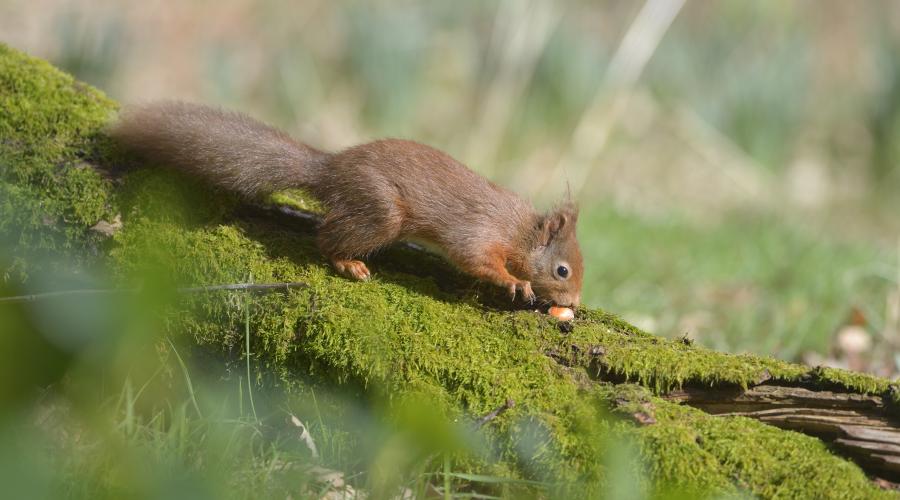
Genetic Scorecard Indicator - Red Squirrel
Red Squirrel (Sciurus vulgaris )

IUCN Category:
- Great Britain: Endangered (indicated above)
- Europe: Least Concern
- Global: Least Concern

Genetic Health Status:
- Scottish Risk: Moderate (indicated above)
- UK Risk: Moderate
- Scottish Mitigation status: Partially effective
- UK Mitigation status: Partially effective
Background
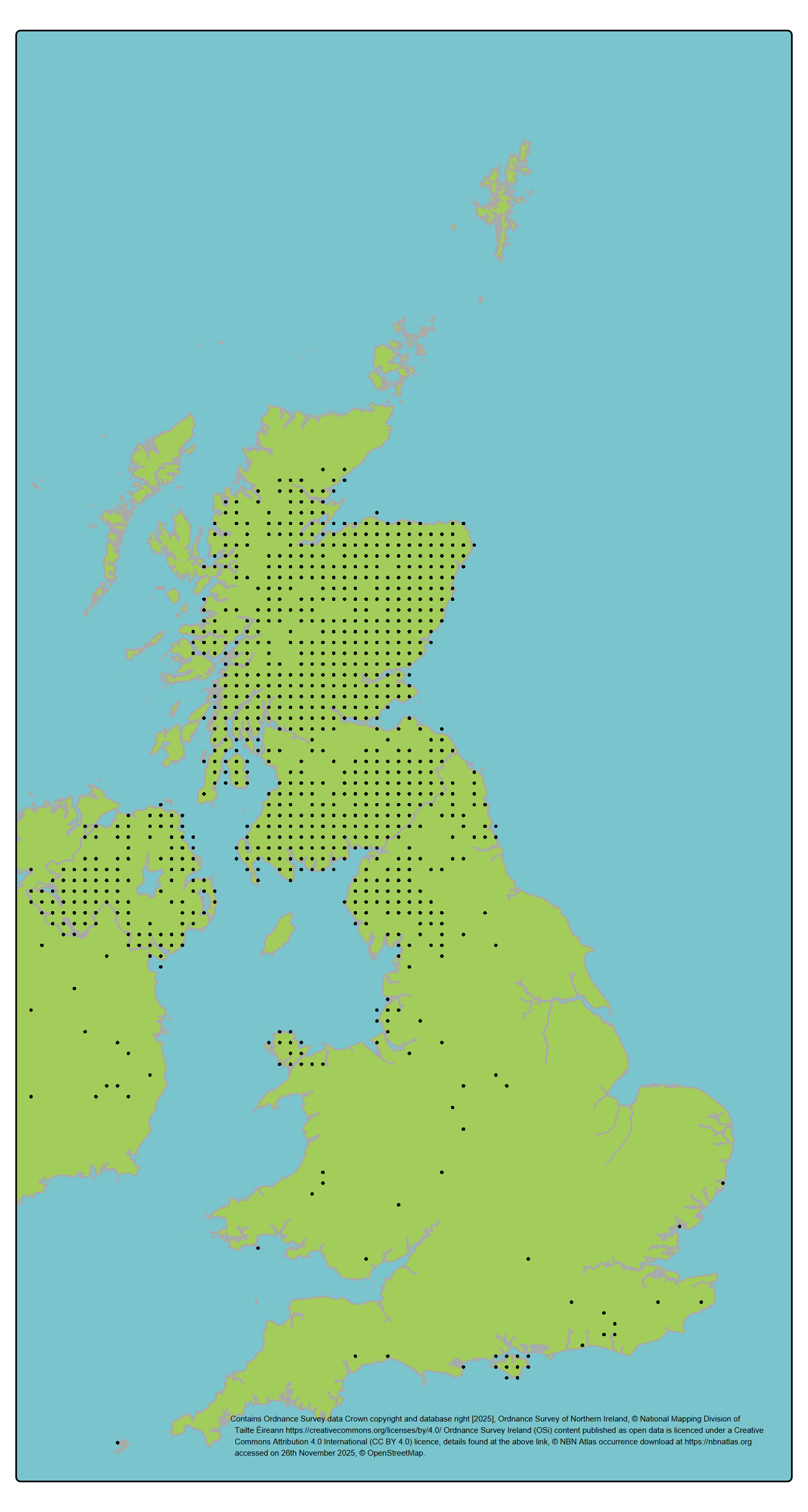
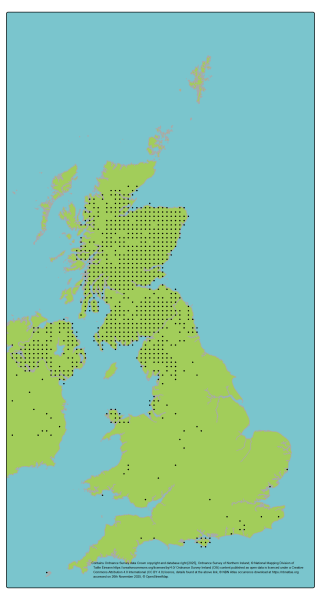
Iconic mammal species found in woodland habitats with a wide Eurasian distribution. Considered a flagship species for many nature reserves in the UK. Distributed throughout Northern Ireland (NI) where the population is continuous with Republic of Ireland (RoI) and may represent the original (post-glacial/pre-translocation) population (Finnegan et al., 2008; O’Meara et al., 2018). Multiple translocations of Red Squirrels into and within the British Isles have occurred but the species is now mostly absent from mainland England and Wales. Island populations exist on the Isle of Wight, Anglesey, Jersey, Brownsea, along with sustained, fragmented populations in mid and north Wales, Lancashire (Formby) and Cumbria. Red squirrels are present throughout suitable habitat in Scotland, which supports ~85% of UK population. The Scottish distribution includes the Isle of Arran but excludes the Central Belt and far north. Mainland Scottish squirrels are divided into three main genetic populations, with evidence of some further sub-division (Marr et al., 2025). Multiple genetic studies have been undertaken, based initially on mitochondrial DNA D-loop and microsatellites (e.g. Barratt et al., 1999; Hale et al., 2001; Ogden et al., 2005; Hardouin et al., 2019) and more recently a genome-wide diversity assessment in Scotland (Marr et al., 2025).
View a larger version of the distribution map for Red Squirrel.
Current Threats
Habitat competition and displacement by invasive grey squirrel, Sciurus carolinensis (Kenward et al., 1998). Loss of reproductive fitness and risk of death due to diseases, including squirrelpox virus, adenovirus and potentially leprosy (McInnes et al., 2006; Avanzi et al., 2016). Extremely low genome-wide genetic diversity may be affecting individual and population-level fitness (Marr et al., 2025).
Contribution of Scottish/UK population to total species diversity
No unique lineages are currently recognised in the Great British populations (Barratt et al., 1999), despite a historical description of a UK subspecies. The Northern Irish distribution is contiguous with Republic of Ireland population, which includes unique mitochondrial DNA lineages. Contribution to total diversity across the Eurasian species range is not high but may harbour unique genotypes and adaptations due to its edge of range distribution.
Genetic risks
Diversity loss: population declines
High habitat fragmentation and a history of serial founder events in some areas risks localised inbreeding. The four mainland Scottish populations are large (> 5,000) mitigating genetic diversity losses but standing diversity is very low (Marr et al., 2025).
Global Biodiversity Framework Indicators
Population definitions:
Population definitions are based on geographic boundaries and management units. Red Squirrel has a composite mix of clearly distinct populations (island and isolated mainland fragments) and more continuously distributed populations (Scotland). Therefore, spatially discrete populations were treated as geographically discontinuous, while Scottish mainland populations were treated as Management Units.
Ne500: The proportion of populations that have an effective population size of more than 500.
- Proportion of populations with Ne > 500 in Scotland = 4/8
- Proportion of populations with Ne > 500 in UK = 4/17
PM: Proportion of populations that existed in 2000 that still exist in 2025.
- Proportion of populations maintained in Scotland = 8/8
- Proportion of populations maintained in UK = 17/17
Diversity loss: functional variation
Functional variation
Reduced immunogenetic diversity relative to European populations has been observed (Ballingall et al., 2016) but the potential rate of loss unknown. Scottish population is edge-of-range and may contain locally adapted genetic variants.
Divergent lineages
Risk of loss is considered negligible, as evolutionary lineages were derived from continental Europe relatively recently. Phylogeographic studies show no distinct monophyletic lineages.
Hybridisation/Introgression
No risk of hybridisation/introgression with other species.
Unmanaged translocations risk undesirable introgression between divergent populations.
Low turnover - constraints on adaptive opportunities
Species reproduces annually with sufficient fecundity for rapid mammalian population growth.
Cumulative Risk Summary
Overall Genetic Health Status
Scotland
- Risk: Moderate
- Mitigation: Moderate
Great Britain/UK
- Risk: Partially effective
- Mitigation: Partially effective
Overall Genetic Health status explanation
Scottish populations are generally large and robust, but very low in genetic diversity; some isolated population fragments.
The Northern Irish population are stable, with genetic diversity similar to RoI and of relatively little concern.
England and Wales populations typically consist of small, fragmented, isolated populations, but mixed population history mitigates risk of loss of genetic variation.
The increasing breadth and depth of genetic studies are starting to provide detailed knowledge and confidence in estimates.
In situ genetic threat level
In situ genetic threat level
- In situ Risk for Scotland: Modeerate
- In situ Risk for UK: Moderate
Very low genome-wide diversity recorded across Scotland but population sizes are generally high enough to prevent drift and further decline; however recently established small west coast population fragments are expected to have very low diversity at high risk of further losses. Clear threats from competition/disease set against extensive conservation management for Red Squirrel and its habitat.
Genome-wide diversity not assessed across UK. Some small, isolated populations are considered at serious risk, while other populations are larger and/or have received reinforcement from diverse continental populations and risk is therefore considered moderate.
Confidence in in situ threat level
- Confidence score for Scotland: High
- Confidence score for UK: Medium
Comprehensive genetic analysis and ongoing conservation studies in Scottish populations. Elsewhere in the UK, many populations have low census estimates and are known to be isolated.
Ex situ representation
Some collections of Red Squirrels in UK zoos and sanctuaries, unlikely to represent current UK genetic diversity.
Current conservation actions
In Scotland conservation management of Red Squirrel populations in the Scottish borders, maintenance of a grey squirrel boundary line across the country, south of the Highlands. Forestry and Land Scotland currently consider promotion of Red Squirrel habitat within strategic planning. Some translocation programmes are underway to populate the western Highlands from central and eastern areas.
Elsewhere in the UK, conservation management in all three Welsh populations and monitoring programmes in England and Northern Ireland.
| Ex situ | Translocation | Habitat management | Legal protection of habitat or species | Regulation of exploitation | Control of INNS/pests/pathogens |
|---|---|---|---|---|---|
| X | X | X | X | - | X |
Population assessment/monitoring
Population
Demographic
N pops assessed/monitored in Scotland = 8/8 (since 2021)
N pops assessed/monitored in UK = 16/17 (since 2005)
Genetic
N pops assessed/monitored in Scotland = 7/8 (2022)
N pops assessed/monitored in UK = 11/17 (since 2012)
Further Research
Updating demographic and genetic monitoring results required, England, Wales and particularly northern Ireland, as current available data quite old.
References
Barratt EM, Gurnell J, Malarky G, Deaville R, Bruford MW (1999) Genetic structure of fragmented populations of Red Squirrel (Sciurus vulgaris) in the UK. Mol. Ecol., 8, S55–S63.
Finnegan et al. (2008) Origin of, and conservation units in, the Irish Red Squirrel (Sciurus vulgaris) population. Conservation Genetics (2008) 9:1099–1109. DOI 10.1007/s10592-007-9419-7
Hale ML, Lurz PWW, Shirley MDF, Rushton S, Fuller RM, Wolff K (2001b) Impact of landscape management on the genetic drift of Red Squirrel populations. Science, 293, 2246–2248.
Marr M, Humble H, Lurz PWW, Wilson L, Milne E, Beckmann K, Schoenebeck J, Fung U, Kitchener A, Portland K, Edwards C, Ogden R (2025) Genomic Insights Into Red Squirrels in Scotland Reveal Loss of Heterozygosity Associated With Extreme Founder Effects. Evolutionary Applications, 18(1) e70072.
Ogden R, Shuttleworth C, McEwing R, Cesarini S (2005). Genetic management of the Red Squirrel, Sciurus vulgaris: a practical approach to regional conservation. Conservation Genetics 6:511-525.
O’Meara BD et al. (2018) Mammal Research (2018) 63:173–184.
Assessor: Rob Ogden, University of Edinburgh
Reviewer: Isa-Rita Russo, University of Cardiff