Genetic Scorecard Indicator - Red grouse
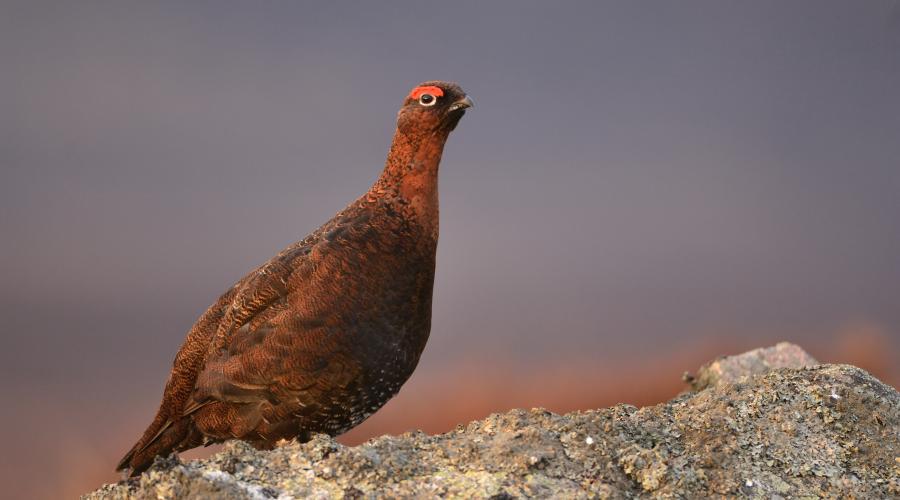
Red grouse (Lagopus scotica)

IUCN Category:
- Great Britain: Least Concern (indicated above)
- Europe: Least Concern
- Global: Least Concern

Genetic Health Status:
- Scottish Risk: Medium (indicated above)
- UK Risk: Medium
- Scottish Mitigation status: Partially Effective
- UK Mitigation status: Partially Effective
Background
Culturally and economically important upland gamebird species endemic to the British Isles, widely distributed in heather-dominated moorland areas. Previously considered a subspecies of the willow ptarmigan (Lagopus lagopus), it now has full species status (AviList Core Team, 2025). Phenotypically similar birds occur in Ireland but are considered a separate taxon (L. s. hibernica).
Birds form pairs in autumn, with males becoming increasingly territorial as winter progresses. Hens lay six to nine eggs in April and May, which are incubated for up to 25 days, with chicks able to fly within 12 to 13 days and fully grown after 30 to 35 days.
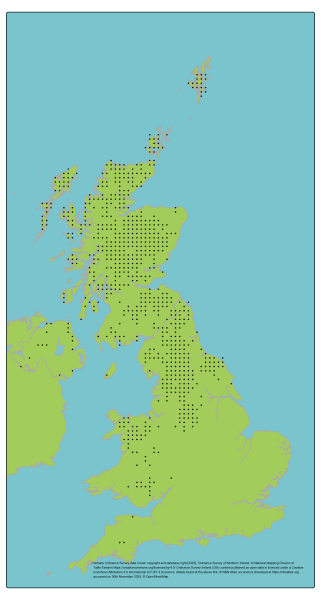
Red Grouse are found across most parts of Scotland, including Orkney, Shetland and most of the Outer Hebrides. In England it is found mainly in the north down to the Peak District and Staffordshire, and in Wales there are some fragmented and retracting populations in Snowdonia and Brecon Beacons. Populations exhibit cyclic population dynamics, linked to the effects of gastrointestinal nematodes and localised social structure. Long-term declines of this species in range and abundance have been reported (Eaton et al., 2009).
Previous genetic analysis has focussed on population or social structure across relatively small geographic scales. There is clear population genetic structure with signatures of isolation by distance driven by localised gene flow. There is no documented evidence of lower-than-expected levels of genetic diversity across populations at either functionally important or neutral markers (Piertney et al., 1998, 2000; Quintela et al., 2010; Meyer-Lucht et al., 2016), though assessment does not include the full geographic range.
View a larger version of the distribution map for the Red Grouse.
Current Threats
Long-term declines are associated with the loss or deterioration of heather moorland habitats, as a result of land use change from management of the habitat for hunting to an increase in sheep grazing and forestry plantations (Robertson et al., 2001, 2017; Ludwig et al., 2018).
Contribution of Scottish/UK population to total species diversity
Very significant – UK endemic species, with majority of distribution within Scotland.
Genetic risks
Diversity loss: population declines
The habitat reduction and gradual decline of population sizes predict habitat fragmentation could lead to reductions in genetic diversity and population loss. This may be particularly prominent in the more historically isolated populations across the species range such as Wales.
Global Biodiversity Framework Indicators
Population definitions:
The populations have been defined by geographic boundaries and associated dispersal buffer. It has been established that Red Grouse in Northern Ireland are genetically distinct from Scottish/English populations. However, no study has examined broad scale genetic structure within England and Scotland to determine any genetic discontinuities and identify demographically independent units. Given patterns of localised structure and population genetic isolation by distance, it is likely further population structure will be identified.
Ne500: The proportion of populations that have an effective population size of more than 500.
- Proportion of populations with Ne > 500 in Scotland = 1/1
- Proportion of populations with Ne > 500 in UK = 2/2
PM: Proportion of populations that existed in 2000 that still exist in 2025.
- Proportion of populations maintained in Scotland = 1/1
- Proportion of populations maintained in UK = 2/2
Diversity loss: functional variation
Functional variation
There are no genome-wide studies of adaptive genetic diversity across populations to measure functional diversity in relation to population size and/or isolation. Genetic variation at several adaptive genetic markers and patterns of epigenetic variation have been shown to be affected by parasite burden of gastrointestinal nematodes.
Divergent lineages
The fragmented nature of the species distribution across the UK predicts phylogeographic structure, with populations such as Wales or isolated island populations such as the Outer Hebrides, potentially representing isolated lineages at risk of loss, although no data are currently available to confirm this.
Hybridisation/Introgression
Anecdotal evidence of some introgressive hybridisation with rock ptarmigan (Lagopus muta) exists where distributions overlap, though the extent is unknown and likely to have more significant impact on the rock ptarmigan rather than Red Grouse gene pools.
Low turnover - constraints on adaptive opportunities
Relatively short generation time with no observed loss of reproductive fitness.
Cumulative Risk Summary
Overall Genetic Health Status
Scotland
- Risk: Medium
- Mitigation: Medium
Great Britain/UK
- Risk: Partially Effective
- Mitigation: Partially Effective
Overall Genetic Health status explanation
Large, widely distributed populations will retain genetic diversity and reduce potential for reduced fitness or population extinction. More isolated, peripheral or relict populations are likely to have reduced genetic health.
In situ genetic threat level
In situ genetic threat level
- In situ Risk for Scotland: Moderate
- In situ Risk for UK: Moderate
Large population sizes and sub-population connectivity are likely to prevent any large loss of genetic diversity in the more continuous parts of the geographic range. There is increased likelihood of genetic diversity loss in more isolated populations. There are immediate threats due to land use change and disappearance of heather moorland.
Confidence in in situ threat level
- Confidence score for Scotland: Medium
- Confidence score for UK: Medium
Available genetic data have been gathered to examine patterns of localised social structure within populations or clarify the species status relative to willow ptarmigan and Irish birds.
Ex situ representation
There are no ex-situ populations.
Current conservation actions
Estate management (heather burning, predator control) is common practice to maximise the population sizes for harvesting.
| Ex situ | Translocation | Habitat management | Legal protection of habitat or species | Regulation of exploitation | Control of INNS/pests/pathogens |
|---|---|---|---|---|---|
| - | - | X | X | - | X |
Population assessment/monitoring
Population
Demographic
N pops assessed/monitored in Scotland = 1/1
N pops assessed/monitored in UK = 2/2
Genetic
N pops assessed/monitored in Scotland = 0/1
N pops assessed/monitored in UK = 0/2
Further Research
Assessment of phylogeographic and broader population genetic structure that would identify genetic divergence of isolated populations and facilitate a comparative analysis of neutral and adaptive genetic variation among populations across the range.
References
AviList Core Team (2025) AviList: The Global Avian Checklist, v2025. doi.org/10.2173/avilist.v2025
Ludwig, S.C., Aebischer, N.J., Bubb, D., Richardson, M., Roos, S., Wilson, J.D. & Baines, D. 2018. Population responses of Red Grouse Lagopus lagopus scotica to expansion of heather Calluna vulgaris cover on a Scottish grouse moor. Avian Conservation and Ecology,
13(2), 14.
Meyer-Lucht, Y., Mulder, K.P., James, M.C., McMahon, B.J., Buckley, K., Piertney, S.B. & Höglund, J. 2016. Adaptive and neutral genetic differentiation among Scottish and endangered Irish Red Grouse (Lagopus lagopus scotica). Conservation Genetics, 17, 615-630.
Piertney, S.B., MacColl, A.D.C., Bacon, P.J. & Dallas, J.F. 1998. Local genetic structure in Red Grouse (Lagopus lagopus scoticus): evidence from microsatellite DNA markers. Molecular
Ecology, 7, 1645-1654. 77
Piertney, S.B., MacColl, A.D., Bacon, P.J., Racey, P.A., Lambin, X. & Dallas, J.F. 2000. Matrilineal genetic structure and female‐mediated gene flow in Red Grouse (Lagopus lagopus scoticus): an analysis using mitochondrial DNA. Evolution, 54(1), 279-289.
Robertson, G.S., Aebischer, N.J. & Baines, D. 2017. Using harvesting data to examine temporal and regional variation in Red Grouse abundance in the British uplands. Wildlife Biology, 2017(4), https://doi.org/10.2981/wlb.00276
Robertson, P.A., Park K.J. & Barton, A.F. 2001. Loss of heather Calluna vulgaris moorland in the Scottish uplands: the role of Red Grouse Lagopus lagopus scoticus management.
Wildlife Biology, 7, 11-16.
Wenzel, M.A. & Piertney, S.B. 2014. Fine-scale population epigenetic structure in relation to gastrointestinal parasite load in Red Grouse (Lagopus lagopus scotica). Molecular Ecology, 23, 4256-4273.
Wenzel, M.A., James, M.C., Douglas, A. & Piertney, S.B. 2015a. Genome-wide association and genome partitioning reveal novel genomic regions underlying variation in gastrointestinal
nematode burden in a wild bird. Molecular Ecology, 24, 4175-92.
Wenzel, M.A. & Piertney, S.B. 2015b. Digging for gold nuggets: uncovering novel candidate genes for variation in gastrointestinal nematode burden in a wild bird species. Journal of Evolutionary Biology, 28, 807-825.
Wenzel, M.A., Webster, L.M.I., Paterson, S. & Piertney, S.B. 2015c. Identification and characterisation of polymorphic candidate genes for response to parasitic nematode (Trichostrongylus tenuis) infection in Red Grouse (Lagopus lagopus scotica). Conservation
Genetics Resources, 7, 23-28.
Assessor:
- Stuart Piertney, University of Aberdeen
- Martin Stervander, National Museums Scotland; Silvia Perez-Espona
Reviewer:
- Linda Neaves, Murdoch University
- Rob Ogden, University of Edinburgh