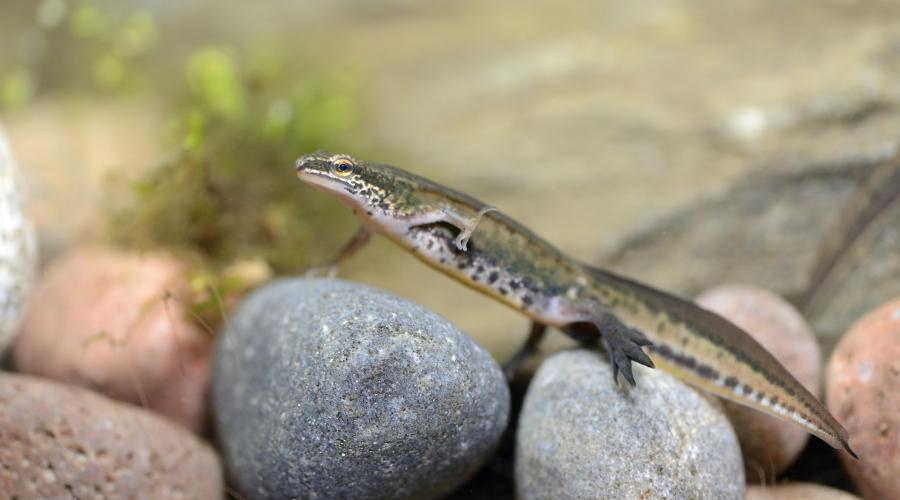
Genetic Scorecard Indicator - Palmate Newt
Palmate Newt (Lissotriton helveticus)

IUCN Category:
- Great Britain: Least concern (indicated above)
- Europe: Least concern
- Global: Least concern

Genetic Health Status:
- Scottish Risk: Negligible (indicated above)
- UK Risk: Negligible
- Scottish Mitigation status: Not required
- UK Mitigation status: Not required
Background
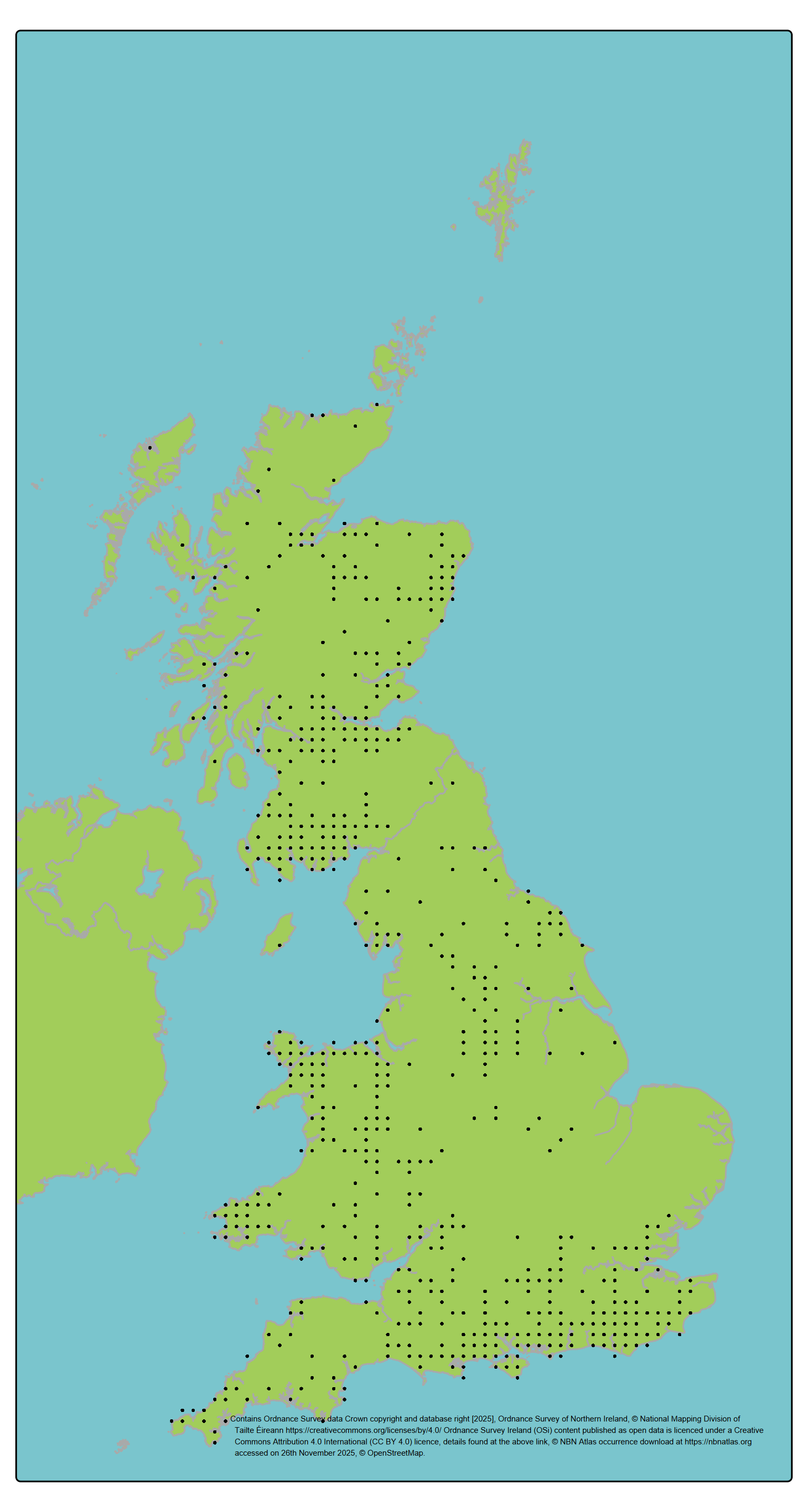
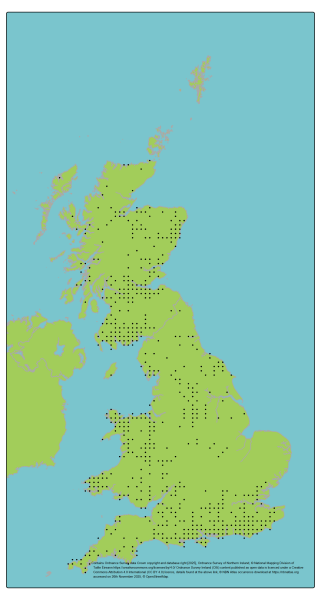
The smallest British newt, naturally occurring throughout the country, the palmate newt has adapted to a wide variety of environments and water conditions (O’Brien, 2016). Absent from Northern Ireland, the palmate newt can be found from the north of Scotland through to the South coast of England (Beebee & Griffiths, 2000). It often occurs in pools of water with more extreme pH levels (both acidic and alkaline), and poorer water quality than the other newt species within Britain (O’Brien, 2016). This species is widely present throughout Western Europe (Belgium, Czechia, France, Germany, Luxembourg, Netherlands, Portugal, Spain, Switzerland), however, within the UK its genetics, populations, and behaviour have been poorly studied compared with the other two native newt species within the country (Turner et al., 2022). Genetic data exist for some populations outside of UK, but not within UK (e.g. Elfering et al., 2024).
View a larger version of the distribution map for the Palmate Newt.
Current Threats
Threats include agricultural intensification, transportation corridors, development and ecosystem modifications, pollution, climate change (including droughts) (Salvador et al., 2024), alien species such as crayfish and diseases such as Batrachochytrium salamandrivorans (Bsal) and Batrachochytrium dendrobatidis (Bd) found currently in captive bred species of amphibians as of 2021 (Defra, 2021).
Contribution of Scottish/UK population to total species diversity
There is little known genetic variation for palmate newts outside of its putative glacial refugium in Iberia (Elfering et al., 2024). However, as previously mentioned, no genetic data are available for UK populations. Given the large size of the British, and particularly the Scottish populations, coupled with their location at the range edge, the existence of locally adaptive variation cannot be ruled out without further study.
Genetic risks
Diversity loss: population declines
The palmate newt has a large continuous distribution throughout much of Great Britain. Each population is estimated to be large with high standing diversity. The species habitat preferences, and its tolerance of breeding sites which would be unsuitable for other amphibians, have likely cushioned it from some of the losses sustained by those species. However, with the lack of genetic data, there is no way to know for sure if there are high fragmentations or declines within existing populations (Turner et al., 2022).
Global Biodiversity Framework Indicators
Population definitions:
Populations are defined based on biogeographic evidence. There is a wide and near continuous distribution of palmate newts in Great Britain. To allow for local adaptation, populations this has been assessed based on the four zones that form the basis of UK provenance zones.
Ne500: The proportion of populations that have an effective population size of more than 500.
- Proportion of populations with Ne > 500 in Scotland = 2/2
- Proportion of populations with Ne > 500 in UK = 4/4
PM: Proportion of populations that existed in 2000 that still exist in 2025.
- Proportion of populations maintained in Scotland = 2/2
- Proportion of populations maintained in UK = 4/4
Diversity loss: functional variation
Functional variation
Currently, with the lack of genetic data, it is impossible to be certain whether there has been loss of functional diversity in this species. However, given its wide range and phenotypic plasticity, loss of functional diversity seems unlikely.
Divergent lineages
There is no genetic evidence that could inform knowledge of divergent lineages in Great Britain. While Elfering et al. (2024) found little variation outside of Iberia, given the range edge nature of the British population, the presence of divergent lineages cannot be ruled out.
Hybridisation/Introgression
Hybridization of the species with the smooth newt (LIssotriton vulgaris) has been documented in Britain and elsewhere in Europe (Beebee and Griffiths, 2000; Miralles et al., 2023). However, these are rare and there is no evidence of maladaptive introgression.
Low turnover - constraints on adaptive opportunities
Palmate newts can produce over 200 eggs in a season and are quick to colonise newly created ponds (O’Brien et al., 2021) leading to little risk of low turnover.
Cumulative Risk Summary
Overall Genetic Health Status
Summary of genetic conservation status, encompassing risk and efficacy of current mitigating actions e.g.
Scotland
- Risk: Negligible
- Mitigation: Not required
Great Britain/UK
- Risk: Negligible
- Mitigation: Not required
Overall Genetic Health status explanation
Overall, the palmate newt has a negligible risk of loss of genetic diversity within all portions of its range in the UK.
In situ genetic threat level
In situ genetic threat level
- In situ Risk for Scotland: Negligible
- In situ Risk for UK: Negligible
With the current, limited knowledge there appears to be a low risk of loss of genetic diversity within the listed area.
Confidence in in situ threat level
- Confidence score for Scotland: Medium
- Confidence score for UK: Medium
Despite the lack of genetic studies, this is a widespread species.
Ex situ representation
There are no current collections of palmate newts in the UK outside of private collections, with no representation of current UK genetic diversity.
Current conservation actions
Palmate newts are protected under law from live sale and pet trade under the Wildlife and Countryside Act, 1981. There are no other legislation or conservation actions in place for this species currently, although it benefits from pond creation schemes and quickly colonises green infrastructure such as Sustainable Drainage Systems (SuDS) ponds (Rae et al., 2019).
| Ex situ | Translocation | Habitat management | Legal protection of habitat or species | Regulation of exploitation | Control of INNS/pests/pathogens |
|---|---|---|---|---|---|
| - | - | - | - | X | - |
Population assessment/monitoring
Population
Demographic
N pops assessed/monitored in Scotland = 2/2
N pops assessed/monitored in UK = 4/4
Genetic
N pops assessed/monitored in Scotland = 0/2
N pops assessed/monitored in UK = 0/4
References
Beebee, T. J. C., & Griffiths, R. A. (2000). Amphibians and Reptiles: A Natural History of the British Herpetofauna: Vols. 87 The New Naturalist Library. HarperCollins.
Defra (2021) Batrachochytrium salamandrivorans: how to spot and report the disease
Elfering, R., Mannix, S., Allain, S., Ambu, J., Crochet, P.A., van Doorn, L., Dufresnes, C., Jehle, R., Julian, A., Baird, F.K. and O’Brien, D., 2024. Extreme genetic depletion upon postglacial colonization hampers determining the provenance of introduced palmate newt populations. Amphibia-reptilia, 45(3), pp.349-356.
Miralles, A., Secondi, J., Pabijan, M., Babik, W., Lemaire, C., & Crochet, P.-A. (2023). Inconsistent estimates of hybridization frequency in newts revealed by single nucleotide polymorphisms and microsatellites. Conservation Genetics, 25(1), 215–225.
O’Brien, D. (2016). Palmate newt. In The Amphibians and Reptiles of Scotland (pp. 72–89). Glasgow Natural History Society.
O'Brien, D., Hall, J.E., Miró, A., O'Brien, K. and Jehle, R., 2021. A co‐development approach to conservation leads to informed habitat design and rapid establishment of amphibian communities. Ecological Solutions and Evidence, 2(1), p.e12038.
Rae, M., Miró, A., Hall, J., O'Brien, K. and O'Brien, D., 2019. Evaluating the validity of a simple citizen science index for assessing the ecological status of urban drainage ponds. Ecological Indicators, 98, pp.1-8.
Salvador, A., Martel, A., Schmidt, B.R., Miaud, C., Recuero Gil, E., Pasmans, F., Martinez Solano, I., Bosch, J., Arntzen, J., García París, M., Denoel, M., Lizana, M., Tejedo, M., Sá-Sousa, P., Geniez, P., Jehle, R., Beebee, T. & Wilkinson, J. 2024. Lissotriton helveticus. The IUCN Red List of Threatened Species 2024: e.T59475A228185144. . Accessed on 24 June 2025.
Turner, R. K., Griffiths, R. A., Wilkinson, J. W., Julian, A. M., Toms, M. P., & Isaac, N. J. B. (2022). Diversity, fragmentation, and connectivity across the UK amphibian and reptile data management landscape. Biodiversity and Conservation, 32(1), 37–64.
(include citation for the Wildlife and Countryside Act 1981).
Websites
Assessor: Abigail Sikes, Napier University
Reviewer: Jeanette Hall, NatureScot
Last updated: