Genetic Scorecard Indicator - Northern Gannet
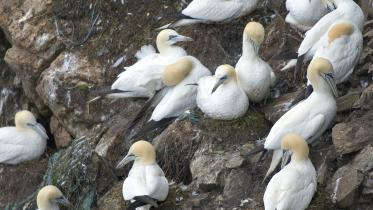
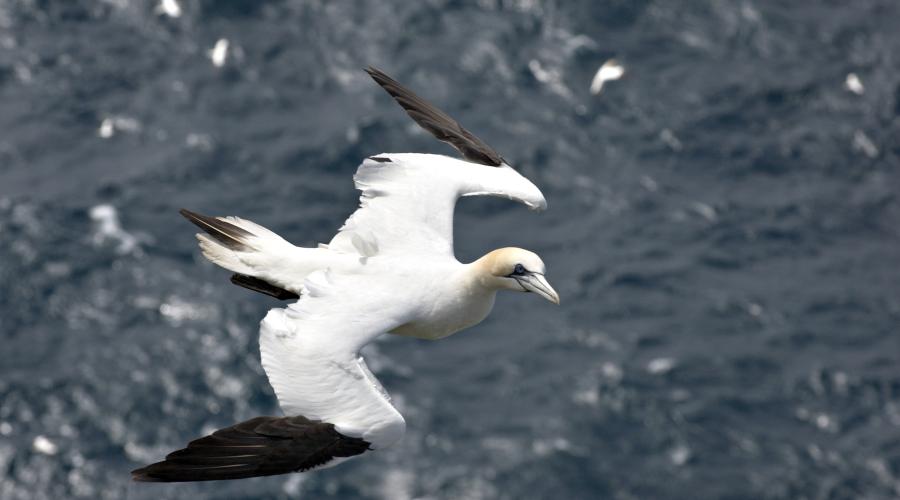
Northern Gannet (Morus bassanus)

IUCN Category:
- Great Britain: Amber listed (indicated above)
- Europe: Least concern
- Global: Least concern

Genetic Health Status:
- Scottish Risk: Negligible (indicated above)
- UK Risk: Negligible
- Scottish Mitigation status: Effective
- UK Mitigation status: Effective
Background
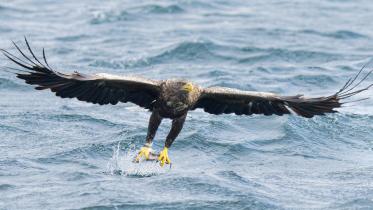
The northern gannet is native to the coasts of the North Atlantic Ocean. They are among the largest seabirds and feed on a wide range of pelagic fish and squid, which they catch by plunge diving from heights of 30m (Harris et al., 2024). Northern gannet nest in densely populated colonies, located in northern France, the United Kingdom, Ireland, Iceland, Norway and Canada (del Hoyo et al. 1992) and generally their numbers appear to be increasing (BirdLife International, 2018; Harris et al., 2024).
Broadscale genetic studies suggested colonies exhibited some genetic differentiation, such as between Scotland and Europe, but also indicated occasional movement between colonies. There was little evidence for phylogeographic structure (Clark, 2017; Friesen et al., 2021). Only one UK site has been assessed in these studies (Clark, 2017; Friesen et al., 2021).
Current Threats
Due to their feeding biology northern gannets have been identified as highly vulnerable to bycatch in both surface and pelagic gears (Bradbury et al 2017), and entanglements in discarded fishing nets and plastic waste (Rodríguez et al., 2013). Ingestion or entanglement in waste may also occur at breeding colonies (O’Hanlon et al 2017; Massetti et al., 2021). Studies in Canada have indicated increasing seas surface temperatures, due to climate change, can reduce productivity potentially causing declines (D’Entremont et al., 2022). Similar problems may arise in the future for UK colonies. Feeding in the water column can also make them susceptible to increased turbidity reducing their foraging ability (Cook and Burton, 2010). They may be susceptible to collision with offshore marine wind turbines (Bradbury et al 2014; Martin and Banks, 2023) and marine developments (Furness et al, 2013; ICES, 2015), although they may avoid offshore wind farms especially during breeding season, reducing the number of available foraging areas (Harris et al, 2024; Peschko et al. 2021). Gannets are highly vulnerable to diseases, notably highly pathogenic avian influenza (H5N1) (Lane et al., 2024), although recovery can be relatively rapid (Harris et al., 2024; Macgregor et al 2024). There is a small annual harvest of gannets on Sula Sgeir off northwest Scotland.
Contribution of Scottish/UK population to total species diversity
Scottish/UK gannet populations contribute approximately 40% of the reported number of European pairs (~ 683,000 pairs). Gannets show strong site fidelity to their breeding sites suggesting some degree of differentiation is likely. Some genetic differentiation has been noted between Scotland and Europe, but this data also indicated occasional movement between colonies, with little evidence for phylogeographic structure (Clark, 2017; Friesen et al., 2021).
Genetic risks
Diversity loss: population declines
Gannet numbers are generally increasing meaning there is no risk of loss. No direct genetic data available.
Global Biodiversity Framework Indicators
Population definitions:
Species is patchily but widely distributed, and sites are possibly connected by high levels of gene flow. Treat as a single population.
Ne500: The proprtion of populations that have an effective population size of more than 500.
- Proportion of populations with Ne > 500 in Scotland = 1/1
(point estimate: 254,773 breeding individuals)
- Proportion of populations with Ne > 500 in UK = 1/1
(point estimate: 304,176 breeding individuals)
PM: Proportion of populations that existed in 2000 that still exist in 2025.
- Proportion of populations maintained in Scotland = 1/1
- Proportion of populations maintained in UK = 1/1
Diversity loss: functional variation
Functional variation
No known clear phenotypic variants or ecotypes.
Divergent lineages
There is no genetic data to guide population subdivision (Clark, 2017; Friesen et al., 2021). Gannets are known to exhibit fidelity to breeding sites, which may lead to colonies containing unique diversity, but there is evidence that suggest some natal dispersal could limit the genetic distinctiveness of individual colonies. This was supported in the distribution wide genetic studies which suggested that while the sampled Scottish population exhibited some genetic differentiation to Europe, there is an indication of occasional movement, and little evidence for phylogeographic structure (Clark, 2017; Friesen et al., 2021).
Hybridisation/Introgression
There are no reported cases of hybridisation with other species.
Low turnover - constraints on adaptive opportunities
Northern gannets produce only one egg per season and begin breeding at the age of 5 (typically surviving for 17 years). This rate of reproduction may limit their ability to evolve in response to changing conditions.
Cumulative Risk Summary
Overall Genetic Health Status
Scotland
- Risk: Negligible
- Mitigation: Not required
Great Britain/UK
- Risk: Negligible
- Mitigation: Not required
Overall Genetic Health status explanation
Northern gannet populations are large and appear to be increasing and hence the risk of diversity loss is low, and they benefit from the protection of seabird colonies and general measures to protect seabirds. Despite this, low rates of turnover may limit their ability to adapt to changing conditions, particularly associated with prey availability in response to climate change.
In situ genetic threat level
In situ genetic threat level
- In situ Risk for Scotland: Negligible
- In situ Risk for UK: Negligible
Large population size and populations appear to be increasing. However, the relatively low rate of turnover may limit their ability to adapt to changing conditions.
Confidence in in situ threat level
- Confidence score for Scotland: Medium
- Confidence score for UK: Medium
Demographic data are standardised and relatively regular, but there is no genetic data available for the UK.
Ex situ representation
There are no ex-situ populations.
Current conservation actions
Northern gannet colonies are largely protected as Special Protection Areas (SPAs). Since the species is associated with coastal areas and islands it is encompassed the Scottish Biodiversity Strategy (SBS) to 2045, specifically the 2045 goal to “Scotland’s internationally important species will have increased in numbers and have healthy resilient populations.” and “health, condition, and resilience of pelagic, coastal, shelf, and deep sea marine habitats will have been restored”. Ongoing management of fishing activities to reduce impacts, including timing of fishing and management of marine waste. Sandeel fishing has been banned throughout Scottish waters and in the English waters of the North Sea since 2021 (with International Arbitration Panel ruling against challenges by the EU in 2025), although harvesting of other prey species continues. Conservation will also be supported by additional actions associated with the development of the Scottish seabird conservation action plan and biosecurity measures under ‘Biosecurity for Scotland’s seabird islands’ project (2023 – 2026), to remove invasive predators on seabird islands.
| Ex situ | Translocation | Habitat management | Legal protection of habitat or species | Regulation of exploitation | Control of INNS/pests/pathogens |
|---|---|---|---|---|---|
| - | - | - | X | - | X |
Population assessment/monitoring
Population
Demographic
N pops assessed/monitored in Scotland = 1/1
Comprising of ~18 colonies in eight counties
N pops assessed/monitored in UK = 1/1
Comprising of ~22 colonies in 10 counties
Genetic
N pops assessed/monitored in Scotland = 0/1
N pops assessed/monitored in UK = 0/1
Further research
Genetic data from UK populations would be useful to assess the extent to which individual colonies represent unique genetic diversity.
References
BirdLife International. 2018. Morus bassanus. The IUCN Red List of Threatened Species 2018: e.T22696657A132587285
Bradbury, G., Trinder, M., Furness, B., Banks, A.N., Caldow, R.W. and Hume, D., 2014. Mapping seabird sensitivity to offshore wind farms. PloS one, 9(9), p.e106366.
Bradbury, G., Shackshaft, M., Scott-Hayward, L., Rexstad, E., Miller, D. & Edwards, D. 2017. Risk assessment of seabird bycatch in UK waters. Report to Defra. Defra Project: MB0126
Clark, N. J. 2017. A “jaunt” across the pond: investigating patterns of genetic differentiation and trans-Atlantic migration in a temperate seabird (Morus bassanus). Queen’s University (Canada).
Cook, A.S.C.P. & Burton, N.H.K. 2010. A review of the potential impacts of marine aggregate extraction on seabirds. Marine Environment Protection Fund Project 09/P130. British Trust for Ornithology. Thetford, Norfolk, UK.
del Hoyo, J.; Elliot, A.; Sargatal, J. 1992. Handbook of the Birds of the World, Vol. 1: Ostrich to Ducks. Lynx Edicions, Barcelona, Spain.
D’Entremont, K. J. N., Guzzwell, L. M., Wilhelm, S. I., Friesen, V. L., Davoren, G. K., Walsh, C. J., & Montevecchi, W. A. 2022. Northern Gannets (Morus bassanus) breeding at their southern limit struggle with prey shortages as a result of warming waters. ICES Journal of Marine Science, 79(1), 50–60.
Friesen, V. L., Brunt, R., Morris-Pocock, J. A., Sauve, D., Baker, A. J., Birt, T. P., Davidson, W. S., Elliott, K. H., & Montevecchi, W. A. 2021. A test of mechanisms of population differentiation in gannets (Morus spp.) using comparative phylogeography and morphometrics. Marine Ornithology, 49(2), 275–291
Furness, R.W., Wade, H.M. & Masden, E.A. 2013. Assessing vulnerability of marine bird populations to offshore wind farms. Journal of Environmental Management,119: 56-66
Harris, S.J., Baker, H., Balmer, D.E., Bolton, M., Burton, N.H.K., Caulfield, E., Clarke, J.A.E., Dunn, T.E., Evans, T.J., Hereward, H.R.F., Humphreys, E.M., Money, S. and O'Hanlon, N.J. 2024. Seabird Population Trends and Causes of Change: 1986–2023, the annual report of the Seabird Monitoring Programme. BTO Research Report 771. British Trust for Ornithology, Thetford.
ICES 2015. Report of the Joint OSPAR/HELCOM/ICES Working Group on Seabirds (JWGBIRD). ICES CM2015/ACOM: 28.
Lane, J. V., Jeglinski, J. W. E., Avery-Gomm, S., Ballstaedt, E., Banyard, A. C., Barychka, T., Brown, I. H., Brugger, B., Burt, T. V., Careen, N., Castenschiold, J. H. F., Christensen-Dalsgaard, S., Clifford, S., Collins, S. M., Cunningham, E., Danielsen, J., Daunt, F., D’entremont, K. J. N., Doiron, P., … Votier, S. C. (2024). High pathogenicity avian influenza (H5N1) in Northern Gannets (Morus bassanus): Global spread, clinical signs and demographic consequences. Ibis, 166(2), 633–650.
Macgregor, C. J., Gillings, S., Balmer, D. E., Boersch-Supan, P. H., Harris, S. J., Hereward, H. F. R., … Atkinson, P. W. 2024. Impacts of highly pathogenic avian influenza on seabird populations in the North Sea are detectable in sea-watchers’ migration counts. Bird Study, 71(4), 311–325.
Martin, G. R., & Banks, A. N. (2023). Marine birds: Vision-based wind turbine collision mitigation. Global Ecology and Conservation, 42, e02386.
Massetti, L., Rangel-Buitrago, N., Pietrelli, L., & Merlino, S. 2021. Litter impacts on marine birds: The Mediterranean Northern gannet as case study. Marine Pollution Bulletin, 171, 112779
O'Hanlon, N., James, N., Masden, E. & Bond, A. 2017. Seabirds and marine plastic debris in the northeastern Atlantic: A synthesis and recommendations for monitoring and research. Environmental Pollution. 231. 10.1016/j.envpol.2017.08.101.
Peschko, V., Mendel, B., Mercker, M., Dierschke, J. & Garthe, S. 2021. Northern gannets (Morus bassanus) are strongly affected by operating offshore wind farms during the breeding season. Journal of Environmental Management 279 : 111509.
Rodríguez, B., Bécares, J., Rodríguez, A., & Arcos, J. M. 2013. Incidence of entanglements with marine debris by northern gannets (Morus bassanus) in the non-breeding grounds. Marine Pollution Bulletin, 75(1–2), 259–263
Assessor: Linda Neaves, Murdoch University
Reviewer: Eunice Pinn, NatureScot