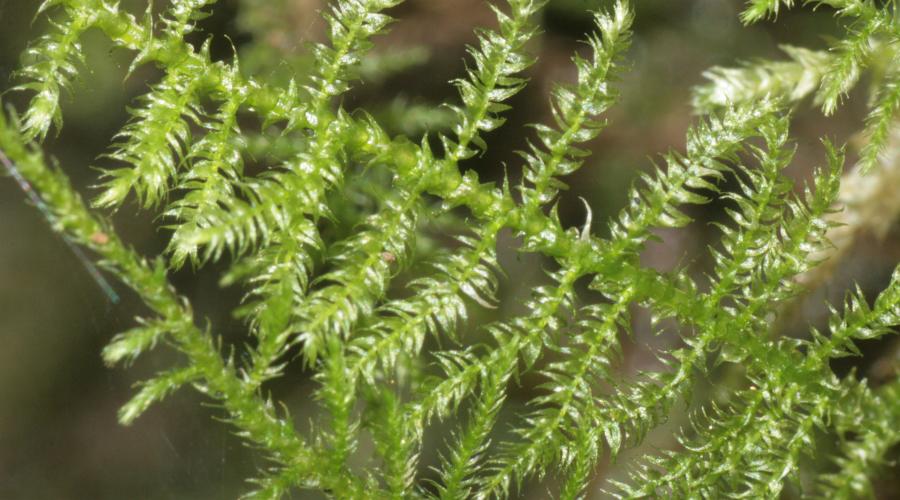
Genetic Scorecard Indicator - Lesser Curled Hook-Moss
Lesser Curled Hook-Moss (Palustriella decipiens)

IUCN Category:
- Great Britain: Near Threatened (indicated above)
- Europe: Least Concern
- Global: Not assessed

Genetic Health Status:
- Scottish Risk: Serious (indicated above)
- UK Risk: Serious
- Scottish Mitigation status: Not in place
- UK Mitigation status: Not in place
Background
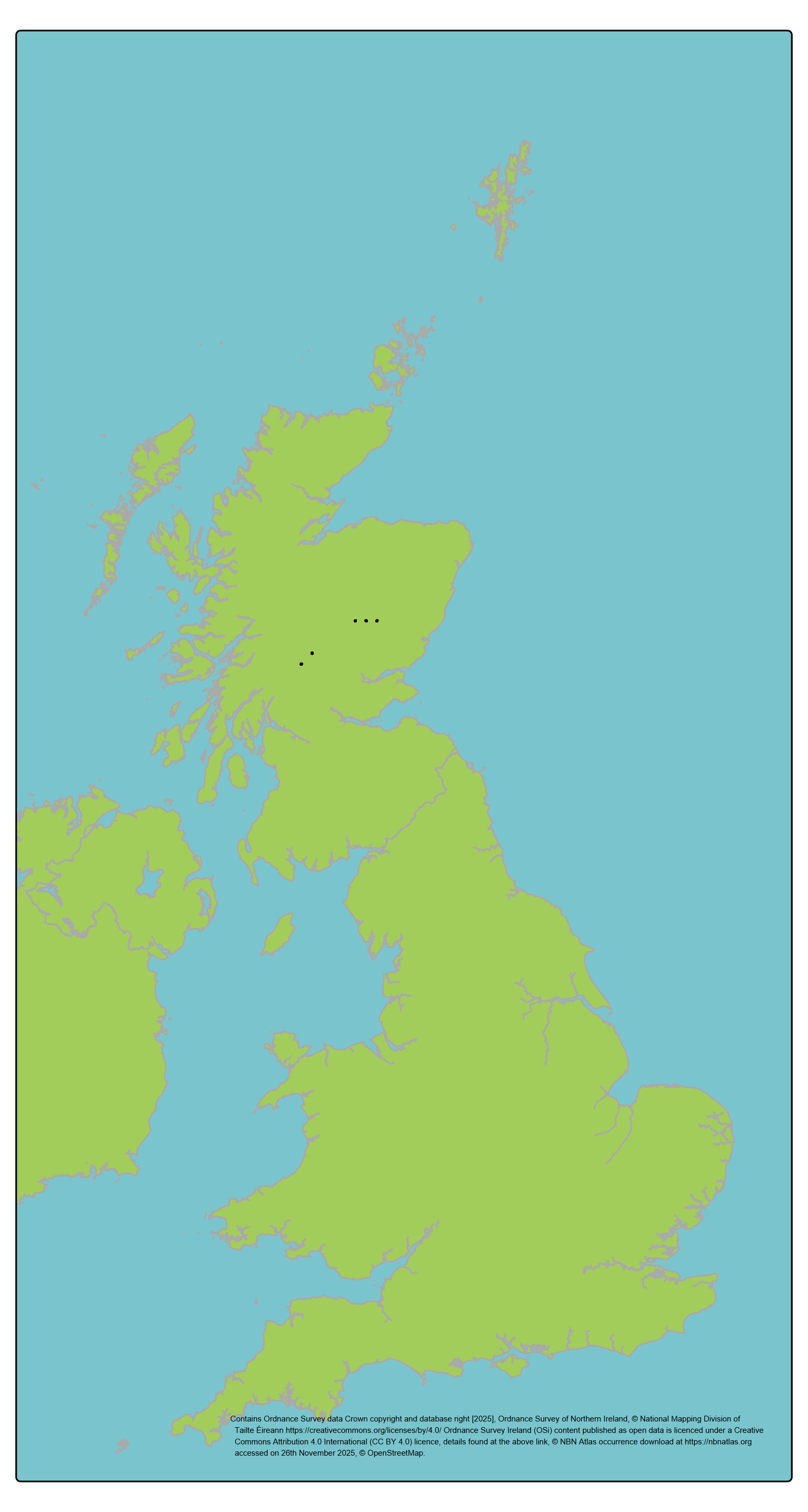
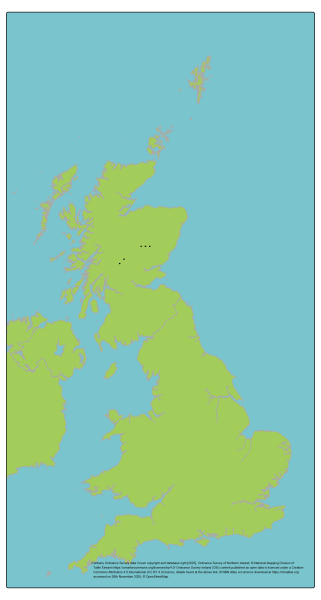
Palustriella decipiens is a widely distributed boreo-arctic species ranging from Fenno-scandinavia to the mountains of southern Spain and from Iceland to the Urals and Caucasus, with isolated records from Asia and North America (Blockeel et al., 2014). In the UK, it is confined to the Scottish Highlands, where it is found in calcareous springs, flushes and mires (Atherton et al., 2010). Here it forms patches with other bryophytes and vascular plants. The species is dioicous, but spore capsules are uncommon (Blockeel et al., 2014).
View a larger version of the distribution map for the Lesser Curled Hook-Moss.
Current Threats
Given the species' altitudinal range (650-1000m in the UK), it can be presumed to be at risk from climate change causing loss of suitability of lower altitude sites. Along with many other bryophytes, its need for wet habitats will also make it vulnerable to forecast increased drought frequency and intensity, including fire risk (Kirkpatrick Baird et al., 2023). P. decipiens is classed as Near Threatened for Great Britain due to the small number of individuals (Callaghan, 2023) and Least Concern at a European level (Hodgetts et al., 2023)
Contribution of Scottish/UK population to total species diversity
This is a widely distributed species and there is no direct evidence of the UK supporting differentiated populations. However, given the range-edge nature of the Scottish populations and the distance of separation from the nearest European populations (Norway), this cannot be discounted.
Genetic risks
Diversity loss: population declines
The species has not been recorded from several of its historical sites since the 1980s, but this may be the result of the difficulty of identifying the species (Blockeel et al., 2014), rather than actual decline (Callaghan, 2023).
Global Biodiversity Framework Indicators
Population definitions:
The populations are defined by geographic boundaries. The species is confined to mountains above 650m in the Scottish Highlands. There are four populations that are isolated from each other by unsuitable habitat.
Ne500: The proportion of populations that have an effective population size of more than 500.
- Proportion of populations with Ne > 500 in Scotland = 0/4
- Proportion of populations with Ne > 500 in UK = 0/4
PM: Proportion of populations that existed in 2000 that still exist in 2025.
- Proportion of populations maintained in Scotland = 4/4
- Proportion of populations maintained in UK = 4/4
Diversity loss: functional variation
Functional variation
There is no evidence of variation functional diversity in this species.
Divergent lineages
There is no evidence of divergent lineages in this species. In Scotland it occupies a narrower niche than elsewhere in its range (e.g. Scandinavia and the Alps; Hedenäs & Kooijman, 2004)
Hybridisation/Introgression
There is no evidence of hybridisation in this species, though it does co-occur with closely related species particularly P. commutata (Blockeel et al., 2014).
Low turnover - constraints on adaptive opportunities
The species rarely produces spore capsules in the UK (Blockeel et al., 2014).
Cumulative Risk Summary
Overall Genetic Health Status
Scotland
- Risk: Serious
- Mitigation: Serious
Great Britain/UK
- Risk: Not in place
- Mitigation: Not in place
Overall Genetic Health status explanation
This species is confined to eight locations, is inferred to have a UK population below 2000 individual equivalents (Callaghan, 2023), and appears to sexually reproduce infrequently. The species is also likely to be severely affected by climate change.
In situ genetic threat level
In situ genetic threat level
- In situ Risk for Scotland: Serious
- In situ Risk for UK: Serious
The species UK range is highly fragmented, with each population being small and a total UK population likely below 2000 individual equivalents (Callaghan, 2023). However, bryophyte propagules can travel many 1000s of km either in air currents or through zoochory, so there may be some exchange between populations. The species' niche makes it particularly vulnerable to climate change.
Confidence in in situ threat level
- Confidence score for Scotland: Medium
- Confidence score for UK: Medium
P. decipiens is not a heavily studied species and is difficult to identify in the field, so this assessment is largely based on inferences from its general biology.
Ex situ representation
There are no living collections of this species from its Scottish range.
Current conservation actions
The majority of P. decipiens sites are in protected areas, which aremanaged for general biodiversity conservation. There are no species-specific conservation actions.
| Ex situ | Translocation | Habitat management | Legal protection of habitat or species | Regulation of exploitation | Control of INNS/pests/pathogens |
|---|---|---|---|---|---|
| - | - | X | - | - | - |
Population assessment/monitoring
Population
Demographic
N pops assessed/monitored in Scotland = 0/4
N pops assessed/monitored in UK = 0/4
Genetic
N pops assessed/monitored in Scotland = 0/4
N pops assessed/monitored in UK = 0/4
Further Research
Further survey for this hard to identify species would be beneficial in order to better understand its requirements.
References
Atherton, I., Bosanquet, S. and Lawley, M. eds., 2010. Mosses and liverworts of Britain and Ireland: a field guide (p. 848). Plymouth: British Bryological Society.
Blockeel, T.L., Bosanquet, S.D., Hill, M.O. and Preston, C.D., 2014. Atlas of British & Irish Bryophytes. Pisces publications.
Callaghan, D. 2023. A new IUCN Red List of the bryophytes of Britain, 2023. Journal of Bryology, 44(4), pp.271-389.
Hedenäs, L. and Kooijman, A., 2004. Habitat differentiation within Palustriella. Lindbergia, pp.40-50.
Hodgetts, N., Cálix, M., Englefield, E., Fettes, N., Criado, M.G., Patin, L., Nieto, A., Bergamini, A.,
Kirkpatrick Baird, F., Spray, D., Hall, J. and Stubbs Partridge, J., 2023. Projected increases in extreme drought frequency and duration by 2040 affect specialist habitats and species in Scotland. Ecological Solutions and Evidence, 4(3), p.e12256.
Assessor: David O’Brien, NatureScot
Reviewer: Rebecca Yahr